by Aaron » Tue 16 Dec 2008, 09:18:18
Hey Monte... good to see you my friend.
$this->bbcode_second_pass_quote('', 'O')il Price: Dead Cat Bounce
You may have heard this little nugget of wisdom referring to market behaviour as prices fall.
"Even a dead cat will bounce if it falls far enough".
It works the same way in reverse. Take a peek at oil's roller-coaster ride over the past decade. {url=http://en.wikipedia.org/wiki/Image:US_oil_price_in_dollars_from_1999_to_2008-10-17.svg]Wiki[/url]
Expect price volatility like never before seen... if Peak Oil is a credible concept.
It's just Adam Smith's cold, dead hand enforcing supply & demand economic behaviour. The recent meteoric fall in oil's price should be at least as disturbing as it's assent... it heralds the violent correction to come.
These swings will devastate hydrocarbon alternative industries globally. With no firm economic base to ensure profitability, these fledgling oil alternative businesses will struggle for financing, and ultimately be delayed by years... perhaps decades. Imagine the downstream impact this interruption will have on our collective future.
"Drill baby drill" should contribute nicely to wild oscillations in price. Can you say "demand destruction"? I knew you could.
How about "poverty"? Yeah... thought so.
link
The problem is, of course, that not only is economics bankrupt, but it has always been nothing more than politics in disguise... economics is a form of brain damage.
Hazel Henderson
-

Aaron
- Resting in Peace
-
- Posts: 5998
- Joined: Thu 15 Apr 2004, 03:00:00
- Location: Houston
-
by killJOY » Tue 16 Dec 2008, 10:11:42
The "eye of the storm" was called back when by Charles Hugh Smith, except he called it a "head fake":
Oil: One Last Head Fake?
$this->bbcode_second_pass_quote('', '4'). What could possibly cause demand to fall significantly globally, say between 10% and 15%? The same thing which caused the 13.5% decline in the early 80s--recession. As I have suggested here for years (as have many others), the global economy is ripe for a deep, prolonged recession as the unprecedented financial excesses of the past 25 years get worked off.
...
12. As the global economy totters and falls, the lowly U.S. dollar might stage a comeback as a relative "flight to quality." This certainly seems like a tenuous thesis at the moment, but history suggests that when the U.S. sneezes, the world economy catches a cold. A rising dollar would also act to suppress the (dollar-denominated) price of oil.
What I am suggesting is a gigantic head-fake in which global recession causes oil demand and price to plummet for a brief period. This will feed a resurgent complacency about Peak Oil, setting the world up for an unprecedented shock when the global economy and demand recovers. Here is a chart illustrating the thesis:
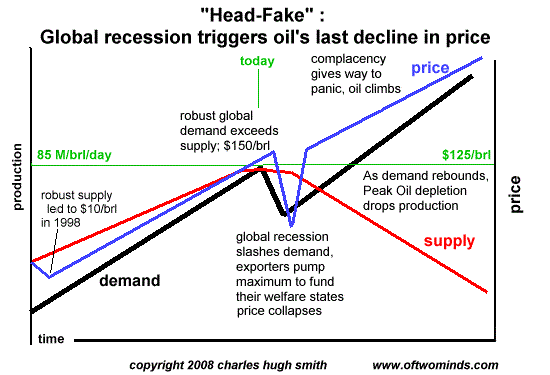
(I only disagree with his "demand" line in the chart: demand can never exceed the supply.)
Peak oil = comet Kohoutek.
-

killJOY
- Intermediate Crude

-
- Posts: 2220
- Joined: Mon 21 Feb 2005, 04:00:00
- Location: ^NNE^
-
by yesplease » Tue 16 Dec 2008, 10:52:02
$this->bbcode_second_pass_quote('', 'E')xactly what's stopping the price from climbing to $300/barrel by 2010? The standard answer is "demand destruction," i.e. people will drive less, fly less, car-pool, etc. as the the price increases past some "threshold of pain."
To most observers' surprise (me included), the rise of oil from $60/barrel to $120/barrel has barely dented demand for gasoline, jet fuel, electricity, etc.
This doesn't make sense. Oil fell drastically because of small changes in demand just like it rose drastically because of small changes in demand. I think its definitely possible we'll see another brief surge, maybe even to $200-300/bbl, but $1000/bbl would permanently kill demand unless we see another successful subversion of alternatives. OPEC alone has is supposed to cut ~4mbpd as well as idle the ~2mbpd in new production they have coming online. Not that supply/demand are tighter they can function effectively as a cartel, but that doesn't mean they'll be dumb enough to let prices skyrocket to $1000/bbl if they can help it.
$this->bbcode_second_pass_quote('Professor Membrane', ' ')Not now son, I'm making ... TOAST!
by CarlosFerreira » Tue 16 Dec 2008, 14:42:08
$this->bbcode_second_pass_quote('yesplease', '')$this->bbcode_second_pass_quote('Ferretlover', '')$this->bbcode_second_pass_quote('MonteQuest', 'T')he true costs of cheap oil and the consequences of its’ use, have historically always been externalized — our military presence in the Middle East to ensure the flow of oil; environmental damage such as global climate change; the declining health of all living things – have never been paid by consumers at the pump. They soon will be…
I agree. There aren't enough resources to pay the bills that humans have incurred.
I disagree. Pollution, health issues, traffvck, etc... Are all costs people pay now and have paid for decades if not centuries, but they don't seem to care for the most part since they've become used to them. That said, now that we're putting pen to paper these costs are becoming less acceptable to some.
Sorry, no. Some examples:
$this->bbcode_second_pass_quote('CarlosFerreira', 'W')hat are we paying for when we buy a TV? We’re paying the marginal cost - the cost of materials used, capital and labour employed, packaging, shipping, marketing, the lot. But not the impact of the product in the world around us.
The materials used in the TV come, many of them, from non-renewable sources - metals, oil-based plastics. Are we paying for the depletion? The price of non-renewables is a complicated matter, and there’s something there called “shadow price”, supposedly accounting for depletion, but does it?
Are paying for the cost of small or large conflicts that arise for the control of these materials?
Also, are we paying the social costs? Teenagers in Africa have left school and foregone a better future to work on the mines extracting copper and other metals for our TV. Teenagers in Southeastern Asia have left school and foregone a better future to work on consumer goods’ factories. Are we paying for the overall cost society faces from losing these people’s potentially superior outputs if they stayed in school longer?
Do we pay for the environmental impact that production, shipping and using the TV has - for example, the GHG gases sent to the atmosphere and the impact they have on climate change, or the cost on reduced agricultural production due to toxic material released during mining?
Are we paying for the disposal, disassembly, recycling and transportation costs of the TV once we’re done with it? Are we paying for those parts that can’t be recycled and are lost for good?
The answer to these questions is the same: no, we are not paying for them. They are a cost to society as a whole that each and everyone of us does not pay when buying a product. They are an externality.
Externalities are causes of market failure.
by MonteQuest » Tue 16 Dec 2008, 20:46:36
$this->bbcode_second_pass_quote('yesplease', '')$this->bbcode_second_pass_quote('Ferretlover', '')$this->bbcode_second_pass_quote('MonteQuest', 'T')he true costs of cheap oil and the consequences of its’ use, have historically always been externalized — our military presence in the Middle East to ensure the flow of oil; environmental damage such as global climate change; the declining health of all living things – have never been paid by consumers at the pump. They soon will be…
I agree. There aren't enough resources to pay the bills that humans have incurred.
I disagree. Pollution, health issues, traffvck, etc... Are all costs people pay now and have paid for decades if not centuries, but they don't seem to care for the most part since they've become used to them. That said, now that we're putting pen to paper these costs are becoming less acceptable to some.
With your line of thinking, if we are paying the costs of our military presence in the Middle East to ensure the flow of oil, environmental damage such as global climate change, and the declining health of all living things at the pump
right now, or anytime in the past, for that matter, if we externalized them, gas would be free.
Sorry, we
do not pay for these things at the pump...yet.
A Saudi saying, "My father rode a camel. I drive a car. My son flies a jet-plane. His son will ride a camel."
by MonteQuest » Tue 16 Dec 2008, 20:52:34
$this->bbcode_second_pass_quote('Aaron', 'H')ey Monte... good to see you my friend.
Thanks, Aaron. I'll give you a call soon and we can catch up.
Monte
A Saudi saying, "My father rode a camel. I drive a car. My son flies a jet-plane. His son will ride a camel."
-

MonteQuest
- Expert

-
- Posts: 16593
- Joined: Mon 06 Sep 2004, 03:00:00
- Location: Westboro, MO
-
by MonteQuest » Tue 16 Dec 2008, 20:55:05
$this->bbcode_second_pass_quote('JohnDenver', 'G')ood one. What kind of scooter?
A Roketa 150cc. Gets 90/mpg and will go 65 mph. $1500.00
A Saudi saying, "My father rode a camel. I drive a car. My son flies a jet-plane. His son will ride a camel."
-
MonteQuest
- Expert
-
- Posts: 16593
- Joined: Mon 06 Sep 2004, 03:00:00
- Location: Westboro, MO
-
by eastbay » Tue 16 Dec 2008, 21:02:30
$this->bbcode_second_pass_quote('MonteQuest', '')$this->bbcode_second_pass_quote('JohnDenver', 'G')ood one. What kind of scooter?
A Roketa 150cc. Gets 90/mpg and will go 65 mph. $1500.00
That's really fast for a 150cc scooter. My Derbi, which I just sold, topped out at 55. But likewise I got 90 mpg, which is essentially 'free'.
The Chinese scooters had a poor reputation a few years ago, but they keep getting better. I mean, there are tens of millions of them scootering around in China seemingly without mishap or more than the usual breakdowns.
A periodic status update would be nice.

Got Dharma?
Everything is Impermanent. Shakyamuni Buddha
by yesplease » Wed 17 Dec 2008, 01:13:06
$this->bbcode_second_pass_quote('MonteQuest', '')$this->bbcode_second_pass_quote('yesplease', '')$this->bbcode_second_pass_quote('Ferretlover', '')$this->bbcode_second_pass_quote('MonteQuest', 'T')he true costs of cheap oil and the consequences of its’ use, have historically always been externalized — our military presence in the Middle East to ensure the flow of oil; environmental damage such as global climate change; the declining health of all living things – have never been paid by consumers at the pump. They soon will be…
I agree. There aren't enough resources to pay the bills that humans have incurred.
I disagree. Pollution, health issues, traffvck, etc... Are all costs people pay now and have paid for decades if not centuries, but they don't seem to care for the most part since they've become used to them. That said, now that we're putting pen to paper these costs are becoming less acceptable to some.
With your line of thinking, if we are paying the costs of our military presence in the Middle East to ensure the flow of oil, environmental damage such as global climate change, and the declining health of all living things at the pump
right now, or anytime in the past, for that matter, if we externalized them, gas would be free.Sorry, we
do not pay for these things at the pump...yet.
$this->bbcode_second_pass_quote('Professor Membrane', ' ')Not now son, I'm making ... TOAST!
by MonteQuest » Wed 17 Dec 2008, 01:34:11
$this->bbcode_second_pass_quote('yesplease', ' ')Where did I say that we payed for those things at the pump?
I said we have never paid for those things at the pump. You disagreed.
To put it more clearly, we have
never paid for those things at the pump or anywhere else...they were
externalized costs.
A Saudi saying, "My father rode a camel. I drive a car. My son flies a jet-plane. His son will ride a camel."
-
MonteQuest
- Expert
-
- Posts: 16593
- Joined: Mon 06 Sep 2004, 03:00:00
- Location: Westboro, MO
-
by yesplease » Wed 17 Dec 2008, 01:39:58
$this->bbcode_second_pass_quote('MonteQuest', '')$this->bbcode_second_pass_quote('yesplease', ' ')Where did I say that we payed for those things at the pump?
I said we have never paid for those things at the pump. You disagreed.
Are you having trouble reading? I responded to Ferretlover's post, not your post.
$this->bbcode_second_pass_quote('Professor Membrane', ' ')Not now son, I'm making ... TOAST!
by yesplease » Wed 17 Dec 2008, 01:48:05
$this->bbcode_second_pass_quote('MonteQuest', 'T')o put it more clearly, we have never paid for those things at the pump or anywhere else...they were externalized costs.
Externalized costs, by definition, have to be paid somewhere, they just aren't paid during the specific economic transaction. While we have
never payed for the externalized costs of gasoline at the pump, according to the definition of externalized costs, we have to pay for the externalized costs of gasoline use (among other things) elsewhere. Be it more healthcare spending due to pollution, higher taxes due to our involvement in the ME, and so on.$this->bbcode_second_pass_quote('Wikipedia', 'I')n economics, an externality is an impact on any party not directly involved in an economic decision. An externality occurs when an economic activity causes external costs or external benefits to third party stakeholders who did not directly affect the economic transaction.
While it would be something if we never payed externalized costs "anywhere else", that's a contradiction of what externalized cost means.
$this->bbcode_second_pass_quote('Professor Membrane', ' ')Not now son, I'm making ... TOAST!
by MonteQuest » Wed 17 Dec 2008, 01:51:41
$this->bbcode_second_pass_quote('yesplease', ' ') I responded to Ferretlover's post, not your post.
Ok, he agreed with me and you disagreed. Guess we had a "failure to communicate".
Let's move on.
A Saudi saying, "My father rode a camel. I drive a car. My son flies a jet-plane. His son will ride a camel."
-
MonteQuest
- Expert
-
- Posts: 16593
- Joined: Mon 06 Sep 2004, 03:00:00
- Location: Westboro, MO
-
by yesplease » Wed 17 Dec 2008, 01:58:04
$this->bbcode_second_pass_quote('MonteQuest', '')$this->bbcode_second_pass_quote('yesplease', ' ') I responded to Ferretlover's post, not your post.
Ok, he agreed with me and you disagreed. Guess we had a "failure to communicate".
Let's move on.
He (I'll take your word on this

) agreed w/ you. Then he went on to saying something else. What he said after he agreed w/ you was what I was disagreeing w/. Specifically that externalized costs are like bills. We can delay bills as a whole, but we can't delay externalized costs, which we are paying for right now, and we will continue to pay for them unless we accurately account and address those externalized costs.
$this->bbcode_second_pass_quote('Professor Membrane', ' ')Not now son, I'm making ... TOAST!
by outcast » Wed 17 Dec 2008, 06:04:33
$this->bbcode_second_pass_quote('yesplease', '')$this->bbcode_second_pass_quote('', 'E')xactly what's stopping the price from climbing to $300/barrel by 2010? The standard answer is "demand destruction," i.e. people will drive less, fly less, car-pool, etc. as the the price increases past some "threshold of pain."
To most observers' surprise (me included), the rise of oil from $60/barrel to $120/barrel has barely dented demand for gasoline, jet fuel, electricity, etc.
This doesn't make sense. Oil fell drastically because of small changes in demand just like it rose drastically because of small changes in demand. I think its definitely possible we'll see another brief surge, maybe even to $200-300/bbl, but $1000/bbl would permanently kill demand unless we see another successful subversion of alternatives. OPEC alone has is supposed to cut ~4mbpd as well as idle the ~2mbpd in new production they have coming online. Not that supply/demand are tighter they can function effectively as a cartel, but that doesn't mean they'll be dumb enough to let prices skyrocket to $1000/bbl if they can help it.
Price wasn't just determined by supply and demand either. Even when demand was flattening out, prices were still going up.
by CarlosFerreira » Wed 17 Dec 2008, 07:35:37
$this->bbcode_second_pass_quote('yesplease', '')$this->bbcode_second_pass_quote('MonteQuest', 'T')o put it more clearly, we have never paid for those things at the pump or anywhere else...they were externalized costs.
Externalized costs, by definition, have to be paid somewhere, they just aren't paid during the specific economic transaction. While we have
never payed for the externalized costs of gasoline at the pump, according to the definition of externalized costs, we have to pay for the externalized costs of gasoline use (among other things) elsewhere. Be it more healthcare spending due to pollution, higher taxes due to our involvement in the ME, and so on.$this->bbcode_second_pass_quote('Wikipedia', 'I')n economics, an externality is an impact on any party not directly involved in an economic decision. An externality occurs when an economic activity causes external costs or external benefits to third party stakeholders who did not directly affect the economic transaction.
While it would be something if we never payed externalized costs "anywhere else", that's a contradiction of what externalized cost means.
The costs are paid, but not necessarily on time. The rub here is that we haven't been paying the costs
yet. There is temporal dimension to the problem.
Pollute now and, as the climate change and events happens that wouldn't otherwise, the cost of these events is a cost.
I agree with Monte on this one. We
haven't been paying. But we will. The cost is there. Messing with Nature is like asking a bad guy for a loan. There's no getting away from it: you either pay or he'll come back and break your kneecaps.