I've been reading an excellent new book by Glenn Greewald, A Tragic Legacy: How a Good Vs. Evil Mentaility Destroyed the Bush Presidency (2007).
Surprisingly, in listing all the reasons for a potential US attack on Iran, the issue of Peak Oil was briefly discussed by the book's author: Here's an excerpt from pages 191-192:
$this->bbcode_second_pass_quote('', '[')b]A Confederation of War-Seeking Factions
Why would the president, in the midst of substantial and growing cooperation with the Iranians, suddenly decree Iran in 2002 to be part of an axis of evil, and all but declare Iran an enemy on whom war must inevitably be waged? Numerous and disparate factions surrounding the president each desired, albeit for different reasons and with different motives, hostility and conflict with Iran. Those factions percieve that belligerence toward Iran, rather than a negotiated peace, would promote their respective agendas. And each was able to depict Iran in the Manichean terms that would ensure that the presidnet would see Iran as an implacable foe he was duty-bound to defeat.
....And then there is the related set of concerns: the emerging prospect that the world's demand for oil will outstrip supply, and that with Saudi oil production potentially peaking, the largest strategic reserves will be in Iran, where U.S. access can be ensued only with a pro-American government in place. Oil is a critical resource for a nation's strength, prosperity, and security. It is also finite and becoming scarce. Those who insist that such considerations are irrelevant to foreign policy decisions regarding the most oil-rich region on the planet, and the most oil-rich nations in that region, are advancing claims too frivolous to merit serious consideration. Access to and control over the Middle East's oil supply prevades, to one degree or another, virtually all power struggles within that region.
Such oil-related objectives would likely motivate most mainstream American political leaders, let alone ones such as George Bush and Dick Cheney, who share a background in the oil industry and who retain substantial ties of every type to that industry. There are multiple reasons why the United States continues to sacrifice so much of its resources, its attention, and many of its lives to continued influence and even domination of the Middle East (versus other regions of the world where we appear more or less indifferent). Those who seek to deny that ensuring our influence over the oil supply is a significant factor in why we have the Middle East our predominant national priority are either incredibly naive or indescribably dishonest.



PeakOil is You
"A Tragic Legacy" mentions Peak Oil...
First unread post • 1 post
• Page 1 of 1
"A Tragic Legacy" mentions Peak Oil...
 by Petrodollar » Tue 11 Sep 2007, 12:35:00
... A Tragic Legacy is an excellent book about the Manichean world-view of President Bush, and I am glad that the author included, at least briefly, some mention of Saudi Arabia peaking and Peak Oil and the unspoken geopolitical forces underlying the occupation of Iraq - not to mention potentially devestating military conflict with Iran. Highly recommended reading:
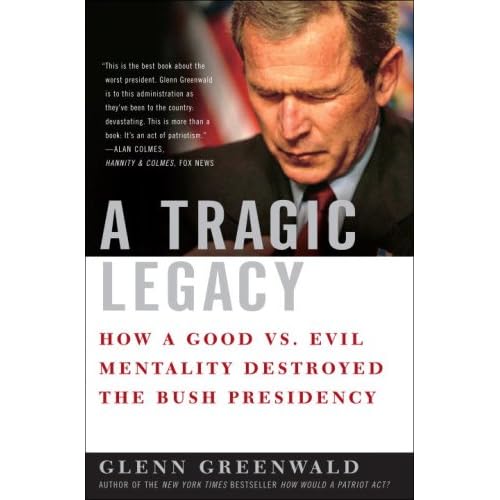
$this->bbcode_second_pass_quote('', '[')b]Book Description
What will be the legacy of President George Walker Bush? In this fascinating, timely book, Glenn Greenwald examines the Bush presidency and its long-term effect on the nation. What began on shaky, uncertain ground and was bolstered and propelled by tragedy, has ultimately faltered and failed on the back of the dichotomous worldview—good versus evil—that once served it so well. In A Tragic Legacy, Greenwald charts the rise and steep fall of the current administration, dissecting the rhetoric and revealing the faulty ideals upon which George W. Bush built his policies.
On September 12, 2001, President Bush addressed the nation and presented a very clear view of what was to come—a view that can be said to define his entire presidency: “This will be a monumental struggle of good versus evil.” Based on his own Christian faith and backed by biblical allusions, Bush’s worldview was basic and binary—and everyone was forced to choose a side. Riding high on public support, Bush sailed through the early “War on Terror,” easily defining our enemies and clearly setting an agenda for defeating them.
But once the war became murkier—its target unclear, its combatants no longer seen in black-and-white—support for Bush and his policies dropped precipitously. Glenn Greenwald brilliantly reveals the reasons behind the collapse of Bush’s power and approval, and argues that his greatest weakness is the same rhetoric that once propelled him so far forward. Facing issues that could not be turned into simple good versus evil choices—the disaster of Hurricane Katrina, his plans for Social Security “reform,” and, most ironic, the failed Dubai ports deal—Bush faltered and fell. Now, Greenwald argues, Bush is trapped by his own choices, unable to break out of the mold that once served him so well, and indifferent to the consequences.
A Tragic Legacy is the first true character study of one of the most controversial men ever to hold the office of president. Enlightening, powerful, and eye-opening, this is an in-depth look at the man whose incapability and cowboy logic have left America at risk.
-

Petrodollar - Coal

- Posts: 406
- Joined: Tue 19 Jul 2005, 03:00:00
- Location: Maryland
1 post
• Page 1 of 1
Who is online
Users browsing this forum: No registered users and 1 guest