Donate Bitcoin

Donate Paypal


PeakOil is You

PeakOil is You

Loremo [car / toy] - 157mpg

What's on your mind?
General interest discussions, not necessarily related to depletion.

Re: Loremo - 157mpg

Unread postby Sleepybag » Sun 26 Feb 2006, 18:05:37

The Citroen 2CV was launched in 1948. It had a mileage of 56 miles per gallon. It was a popular car is Europe for decades.
User avatar
Sleepybag
Peat
Peat
 
Posts: 63
Joined: Mon 17 Oct 2005, 03:00:00
Location: The Netherlands

Re: Loremo - 157mpg

Unread postby dukey » Sun 26 Feb 2006, 18:15:45

i am very dubious of those claims
im not even sure a 50cc moped does 157 miles per gallon let alone a car ! There doesn't look anything revolutionary in there to make it get such a high mpg. Maybe if they told us under what conditions it was tested it would be more believable. Like down a 157 mile hill for example :P
User avatar
dukey
Intermediate Crude
Intermediate Crude
 
Posts: 2248
Joined: Sun 20 Feb 2005, 04:00:00

Re: Loremo - 157mpg

Unread postby Daculling » Sun 26 Feb 2006, 20:00:22

$this->bbcode_second_pass_quote('Coolman', 'L')ess than 10% of the population owns a car. May I suggest a bicycle or walking if you really want to save the future for your children. You sure will be in the in crowd. Why people hang on to the stressfulness of driving is beyond me.


Like said before, I'll say it again.

I would bike to work if I didn't feel it was a significant risk to my life. Oh, and I've to told my government this and guess what. They don't care.
Daculling
Heavy Crude
Heavy Crude
 
Posts: 1228
Joined: Tue 12 Apr 2005, 03:00:00

Re: Loremo - 157mpg

Unread postby J-Rod » Sun 26 Feb 2006, 20:46:36

I brought this up with my wife, and the first thing she said is "How can that be safe?" I told her that they have built it to conform with safety standards. She says "Against a 3 ton SUV?" I guess she has a point. Even though we'd all be better off with a fleet of light safe efficient cars, the fact is we have a fleet of heavy beasts, and no one wants to be the one in a light car in a collision with a tank. :(
Reality is agreed perception. Unfortunately there is also a reality imposed by nature.
http://thisis.peakdoom.com - For all your doom needs!
User avatar
J-Rod
Lignite
Lignite
 
Posts: 375
Joined: Tue 17 May 2005, 03:00:00
Location: Northeast Ohio

Re: Loremo - 157mpg

Unread postby The_Toecutter » Sun 26 Feb 2006, 21:51:05

$this->bbcode_second_pass_quote('', 'J')-Rod, TC is the resident automotive engineering genius.


Hardly. What I write is mostly common sense. I'm merely a student.

Cut the horsepower requirement in half to travel a certain speed, and you'll need approxamately half the fuel per unit of distance travelled.

$this->bbcode_second_pass_quote('', 'I')f I were wealthy I'd write him a blank check for whatever labs, personnel, and equipment he wanted.


I don't think I'd be competent enough to handle that, at least not now. I do know individuals who are, however.

$this->bbcode_second_pass_quote('', 'T')C, practical question. Have you ever thought of doing a business startup? For example start by building retrofitted gliders, and then reinvest into complete vehicle design including original chassis/bodies.


Yes. I've considered building cars from the ground up. The only problem, there is no chance in hell I'd ever get the tens of millions of dollars to meet America's crash test standards. The auto industry in the 70s lobbied for expensive crash tests which they would jointly develop with the government, and as a result, the small auto makers were left ut of the loop. Cheaper crash tests could have sufficed just as well and performed the same purpose. And the stupid rednecks blame Nader...

$this->bbcode_second_pass_quote('', 'S')eek out investors who are in it for the long term.


As soon as you become profit driven and indebted to shareholders, they will want to maximize profits no matter what. They might request, for instance, dumping the EV and going to a more profitable ICE or hybrid system.

Further, if I were to really want to stick with making EVs, I'd have problems getting investers because they would gravitate to those businesses producing more profitable IC cars.

Thus EV makers like AC Propulsion and CommuterCars don't trade shares publically. Going that route would be a disaster to their committment of getting low-profit EVs on the road for the sake of the consumer and the environment.

Maybe post peak oil, things will change in this regard.

$this->bbcode_second_pass_quote('', 'T')hen see about merging or consolidating with other small-scale firms in the field to create a larger entity. Assume it could be done in such a manner that you would be able to stick with engineering, and the rest of the management team would be engineering-oriented. Does that interest you?


Yes.

But my biggest concern is finishing my own EV first. In the wake of peak oil, at least I'll not need gasoline for transportation. I can worry about the larger scale later when I am able to have an impact on it. As for now, those people who know what they are doing in those small businesses can stick to attempting to sell to the masses. But all it takes is a little oil industry bitching, and it's all over for them...

$this->bbcode_second_pass_quote('', 'A')ll these new cars take loads of oil to manufacture


About 9 barrels per car, from what I've read on this forum and elsewhere. To make 400 million electric cars if we were to hypothetically replace the world's fleet would take 3.6 billion barrels, or about 45 days worth of worldwide oil consumption at 80 mbpd. Since automobile fuel accounts for about 40% of oil consumption, we'd brake even in 113 days from the savings, and from then on out 32 mbpd would be cut from consumption.

Not that having that many cars is feasible, but just for the purpose of illustration, the savings over a gas car in total oil consumed would be enourmous. The amount of oil it takes to make a gas powered car is insignificant compared to what it will consume as fuel.

$this->bbcode_second_pass_quote('', 'T')C, how much does fast charging like that reduce the life of lead-acid batteries? I've done a fair amount of research on batteries for my solar power project, and I know that the life of most batteries is compromised when you start charging above the 5 hour rate or so. What kind of management do they do?


First, it depends on the battery. The battery you are likely using for your solar setup won't be able to take those currents. You'd have a melted puddle of plastic, lead, and electrolyte, assuming it wouldn't explode outright.

I am referring specifically to the Exide Orbital AGM battery when I talk about successful fast charging for lead acid batteries. I do not yet know what impact it has on cycle life, except that Rich Rudman has made multiple fast charge cycles on the Exide Orbitals in his electric Ford Fiesta, and claims to have made thousands of short cycles at slower rates. His batteries are still going strong, after over 3 years.

To find a little more about his fast charger, read here:

http://autos.groups.yahoo.com/group/ev-list-archive/message/59262

http://autos.groups.yahoo.com/group/ev-list-archive/message/59267

http://autos.groups.yahoo.com/group/ev-list-archive/message/59304

As for management, he uses shunt regulators, designed specifically for his PFC series of chargers. They compensate for both voltage and battery temperature. Most reg systems don't adjust for temperature.

His new MkIII regs can also output charging data to a labtop or palm pilot.

$this->bbcode_second_pass_quote('', 'B')TW, I thought Jetta's PD 1.9 liter turbodiesel only put out 100 hp, not 215. Or are you talking about a chipped and modified engine?

Modified. Fuel economy doesn't suffer much with added turbo boost and a performance chip.

But even if kept at 100 hp, an 1,800 pound car fitted with it would do 0-60 mph in 7 seconds, plenty fast. A 1,200 pound small car built out of composite materials with that 100 horse diesel would do 0-60 in about 5 seconds.

$this->bbcode_second_pass_quote('', 'L')ess than 10% of the population owns a car. May I suggest a bicycle or walking if you really want to save the future for your children. You sure will be in the in crowd. Why people hang on to the stressfulness of driving is beyond me.

You and I probably look at driving differently.

Post peak, when the cars are off the road no longer posing a danger to me, I'll be glad to ride a bike. In which case my electric race car would be mostly relegated to the track or a once a month pleasure drive.

I used to bike, it not only took a lot of time, but some bitch in an SUV pulled a hit and run and nearly killed me. My city doesn't allow riding on the sidewalks, combined with idiots who don't know how to drive not watching where they are going, and it's not difficult to see why I never bought another bicycle.

But I'd love to be able to bike again. Trying to avoid cars and stopping or slowing down to accomodate them was half the time spent for the commute.

One idea I have in mind is to build a bike with a full faring. A human on a bicycle has a drag coefficient of about 1.2, and would be lucky to pedal a bike to 25 mph due to wind resistance. However, full aerodynamic farings that enclose the rider have been built with .12 drag coefficients, using the principles of laminar flow. Athletes have been able to pedal those to over 70 mph, entirely under their own power. That is quite fast considering that a human in good physical shape would only generate 300-500W of peak power...

See the following link:

www.speed101.com/

In contrast, to push a car like a Ford Taurus at 70 mph would take about 25 kW of power. This Loremo could do that same speed on perhaps 8 kW.

$this->bbcode_second_pass_quote('', 'I') have not reaseached it, but I am sure that it is true. There is no such thing as a free lunch, like most Americans believe.

True, but the amount of oil it takes to make a car is insignificant compared to the amount of oil it uses for fuel and maintenance over its life. An electric eliminates both the fuel and the maintenance, while a 100+ mpg hypercar eliminates most of the fuel and most of the maintenance.

$this->bbcode_second_pass_quote('', 'I')'m with Coolman and the others who think that WE CAN'T BUY OUR WAY OUT OF PEAK OIL.

But we can reduce our oil consumption, negating peak oil's effects. Replaing the auto fleet with vastly more efficient vehicles, and REDUCING the size of the auto fleet through availability of mass transit and bike only roads, will only have a positive effect on peak oil, and at worst, would buy us more time.

$this->bbcode_second_pass_quote('', 'I')'m getting annoyed with everyone looking to a new product to protect them from the inevitable powerdown that will have to happen.

There is more than one way to powerdown. To powerdown is to use less resources.

However, you can either powerdown and increase efficiency, thereby using less resources for the same or even better living standard, or you can powerdown without increasing efficiency to compensate, resulting in a decreased living standard, or anything in between the two.

Switching to battery electric and high mileage cars basically is a powerdown of the automobile, provided they don't increase by a number sufficient to compensate for the reductions in consumption made.

$this->bbcode_second_pass_quote('', 'I')t's just like going out and madly buying duct tape and plastic sheeting during the anthrax scare a few years ago, "I'll be safe if I buy the right thing - someone ELSE will have to deal with Peak Oil, but not me!".

Localize your thinking, localize your life, don't buy what they're selling.

Technofix or not, localization is inevitable. Our current system of sprawl is unsustainable, but sprawl is something independent of the auto itself, even if they may be used together in the present day.

$this->bbcode_second_pass_quote('', 'U')nfortunately Ian I think the masses are going to attempt to hold on to what we have with the death grip of an addict. They are not going to let go easily and will go down kicking screaming and fighting. I would embrace a power down and would welcome intelligent change to get there. I just don't think we have a snowball's chance in hell of that hapening.

It's not the masses that are really to blame. They could just as well have the same standard of living on less resources provided increased efficiency.

It's that industry and government want growth, they don't want to increase efficiency. They make their money from waste, wasteful consumption of oil, wasteful wars, wasteful debt, wasteful use of cars(when if available, mass transit would be taken by many due to the cost of car ownership), and products that are intentionally designed to be short lived so that consumers wastefully purchase another to replace the one they lost.

The masses are simply caught in the middle, and they don't want to give up their living standard. Who can blame them, as they worked hard for it. They can either be presented with the more efficient option, or they will lose it all. However, to increase efficiency, means to decrease the waste that is making this economic system loads of cash, cash that mostly goes to the wealthiest investers with the largest stake in the system.

A conflict of interest thus exists. The 99% versus the 1%. Sure, the top 20% might be seperated by the bottom 80% in living standard, but the underlying principle is the same, poor and middle class, the bottom 99% are being manipulated to concentrate wealth to the top, and can be noted with the increasing percentage of wealth owned by the top 1% and the decreasing persentage owned by the rest.

Increasing efficiency will reverse this trend, by allowing people to keep their living standard needing less money to do so, but those that run the system won't be making as much profit. Unfortunately, the entire system itself is consuming the Earth's resources past capacity, and either the top 1% or the bottom 99% will have to reduce their living standards. Which will it be? Which is fair? Which future would you rather work towards?

$this->bbcode_second_pass_quote('', 'N')othing measurable will be done until there is a crisis and obviuosly that will be too late.

I agree. That is why I'm a doomer. The solutions are right in front of us, but we aren't implementing them. I'd say that's mostly due to politics and greed, as if you examine the technology, it's here, it works.

So why aren't we using it? Could it be that it's not being made available by the major stakeholders in this economic system? I know a lot of people that would love to be able to walk into a showroom and drive out in an EV or 100 mpg car, but none are being sold in America. There exist a very sizable number of people who would like to be able to get around without having to deal with the expense of owning a car, but the auto and oil industry tore down America's mass transit system in the 40s to force auto reliance. There are a lot of people who would love to buy cheaper wind electricity, but coal industry lobbying has helped hamper its availability.

$this->bbcode_second_pass_quote('', 'I')t's funny how you think that "years" ago such cars could be out on the market. Some technology these cars use has only been developed recently. Have you factored the (possibly) different materials used in such cars and if they can scale?

a) The composite materials aren't entirely new. Automotive and aircraft grade carbon fibre, would the defense industry not have a monopoly over it, could have cost $10/pound as early as the mid 1990s. (Google search "Carbon Fiber Antitrust Litigation") However, the defense industry wanted to retain their monopoly.

b) The bulk of the efficiency gains aren't from new materials, but from reduction of drag coefficient, influenced entirely b the physical shape of the vehicle. This design, the Loremo, has a .20 drag coefficient. We've been able to build .20 drag coefficient vehicles since the 1930s. The Rumpler of the 1920s achieved a .27 drag coefficient, Tatra T77a luxury sedan, a .21 drag coefficient, the Dymaxion car of the 30s, a .20 drag coefficient, the Alfa Romeo BAT full size car of the early 1950s a .21 drag coefficient, the Alfa Romeo Disco Volante sports car of the 1950s a .25 drag coefficient, the Lotus Elite sports car of the 1950s a .29 drag coefficient, the Lotus Europa sports car of the 1970s a .28 drag coefficient, the diesel Opel GT concept of the 1970s a .20 drag coefficient, and so on. Today's hybrids, like the Prius and Insight achieve a .26 and .25 respectively. More modern concepts using aerodynamic designs, like the Ford Probe V of the 1980s, achieved a .14 drag coefficient, the GM Precept, a full size car of the 90s achieved a .16 drag coefficient, and the Opel Eco Sportscar of 2003, a .20 drag coefficient. There are a LOT of gains to be made in aerodynamics. We could have done that 70 years ago! That .20 drag coefficient is where over 2/3 of the Loremo's high fuel economy comes from.
Last edited by The_Toecutter on Sun 26 Feb 2006, 22:15:04, edited 3 times in total.
The unnecessary felling of a tree, perhaps the old growth of centuries, seems to me a crime little short of murder. ~Thomas Jefferson
User avatar
The_Toecutter
Intermediate Crude
Intermediate Crude
 
Posts: 2142
Joined: Sat 18 Jun 2005, 03:00:00
Top

Re: Loremo - 157mpg

Unread postby pilferage » Sun 26 Feb 2006, 21:56:27

$this->bbcode_second_pass_quote('PolestaR', 'M')otorbikes are a lot more fuel efficient than cars and in a lot of cases can suffice for most tasks, yet I don't see millions of them on the road.


Drag is a real drag! Also, check out asia. It's a consequence of spreading ourselves out.
"Humankind cannot gain anything without first giving something in return. To obtain, something of equal value must be lost. "
User avatar
pilferage
Tar Sands
Tar Sands
 
Posts: 553
Joined: Sun 21 Nov 2004, 04:00:00
Location: ~170ft/lbs@0rpm (on my bike)
Top

Re: Loremo - 157mpg

Unread postby PolestaR » Mon 27 Feb 2006, 03:14:06

I am reluctant to believe most of the fuel gains come from reduction of drag. I would have a feeling, depending on the possible headwind and the average speed of the vehicle drag could significantly reduce fuel consumption. However, when the speed is say 50KM/h (forget the headwind for this example) does the difference between .21 and .26 drag co-efficient make that much difference in fuel consumption?

I guess one of the reasons a low drag co-efficient wasn't successful is because people don't want to have to lie down in their cars to drive them.

I think with my layman knowledge these things attribute to better fuel economy in order of importance :-

a) More efficient engine
b) Decreased mass of car
c) More aero-dynamic body
d) Reduced friction in moving parts (eg the axles)
PolestaR
Tar Sands
Tar Sands
 
Posts: 955
Joined: Tue 21 Jun 2005, 03:00:00

Re: Loremo - 157mpg

Unread postby gg3 » Mon 27 Feb 2006, 06:19:08

Re. Citroen 2CV: Also do a search for "Isetta" and a search for "Messerschmitt Kabinenroller" (translates as "cabin-scooter"); those were 2-seaters built in the 1950s and got @ 80 - 90 mpg.

Re. vs. a 3-ton SUV: Tell your proponent of 3-ton SUVs that they can be squished like bugs by large trucks. If you want the ultimate in weight as a safety factor, a loaded concrete mixer weighs in at well over 24 tons.

TC, re. business plans:

I wasn't thinking publicly-traded, but privately-held. That way you can get investors who are in for the long haul rather than those who want to take it public and cash out. If you have someone who can manage $$, that's already a major plus, as long as they're onboard with your engineering sensibilities.

You could circumvent the crash testing crap by producing a "velomobile," as you said, a bike with a full faring; except it's a 3-wheeler and can have an electric motor of up to some threshold power level. See also that Swiss vehicle of similar type (darn, the name escapes me at the moment, but it's kinda' boxy looking). Also 3-wheelers can be licensed as motorcycles in many states (e.g. California), which bypasses the crash testing.

So if you stuck to glider mods and 3-wheelers to start with, you could get a niche market going to demonstrate viability of concept.

---

I also agree that powerdown via efficiency is the ideal course, but given that the world is run by people who are essentially selfish and venal, what we're likely to get instead is screwed bigtime. Thus the need to make plans at the level of individuals and small groups.

Just think for a moment about where we would be if we had a US President with the brains & sensibilities of a Buckminster Fuller.
User avatar
gg3
Expert
Expert
 
Posts: 3271
Joined: Mon 24 May 2004, 03:00:00
Location: California, USA

Re: Loremo - 157mpg

Unread postby Daculling » Mon 27 Feb 2006, 09:21:20

$this->bbcode_second_pass_quote('gg3', '
')Re. vs. a 3-ton SUV: Tell your proponent of 3-ton SUVs that they can be squished like bugs by large trucks. If you want the ultimate in weight as a safety factor, a loaded concrete mixer weighs in at well over 24 tons.


Drivers of large trucks are trained and licenced. Drivers of SUVs are mostly distracted morons.

Off topic, using a cell phone while driving should carry the same punishment as DUI.

Cellphones while driving
Daculling
Heavy Crude
Heavy Crude
 
Posts: 1228
Joined: Tue 12 Apr 2005, 03:00:00
Top

Re: Loremo - 157mpg

Unread postby The_Toecutter » Tue 28 Feb 2006, 22:12:52

$this->bbcode_second_pass_quote('', 'I') am reluctant to believe most of the fuel gains come from reduction of drag. I would have a feeling, depending on the possible headwind and the average speed of the vehicle drag could significantly reduce fuel consumption. However, when the speed is say 50KM/h (forget the headwind for this example) does the difference between .21 and .26 drag co-efficient make that much difference in fuel consumption?


One way to get a decent estimate on the difference in fuel consumed between two cars with identical engines without going into a very deep automotive technical analysis is to calculate the horsepower needed to move the car a certain speed. This is what will mostly determine the constant speed fuel consumption. The equations used aren't 100% accurate, the drag equations don't account for outside wind speeds, and the rolling force equation is an estimate that is roughly within 3% margin of error up to about 70 mph, as rolling resistance does vary with speed in reality.

Lets say we have the Toyota Prius, with its .26 coefficient of drag and 21.9 square foot frontal area. It comes equipped with size 185/65R15 tires with about a .006 coefficient of rolling resistance. Its curb weight is about 2,900 pounds.

Now that is all the data needed to reasonably estimate horsepower needed to go a certain speed. We will compare the car with a lower drag version of itself having a .20 drag coefficient with all other parameters the same, same frontal area, same weight, same tires, at the speed you describe, 50 km/h, or about 30 mph. This is also about the speed where aerodynamic drag force balances out with rolling drag force in most cars, generally between 30 mph and 40 mph. Also, it will be assumed 15% stray losses(accessories, ect.). Assume both cars are run on flat ground.

Rolling resistance:

Fr = Cr * W = .006 * 2,900 = 17.4 lbs.

The above figure can be used for both Prii since both are assumed same weight and tires and such.

Cr = coefficient rolling resistance, no units
W = vehicle curb weight in lbs.
Fr = rolling force in lbs.

Aero Drag:

Fd = Rho * Cd * A * V^2

For .26 drag coefficient Fd = .002558 * .26 * 21.9 * 30^2 = 13.1 lbs.
For .20 drag coefficient Fd = .002558 * .20 * 21.9 * 30^2 = 10.1 lbs.

Rho = constant to adjust for normal air pressure, convert from Metric to American, and to account for the ½ normally present in the formula Fd = ½ * Rho * Cd * A * V^2
Cd = coefficient drag
A = vehicle frontal area in square feet
V = velocity in mph
Fd = aerodynamic drag force in lbs.

Total Drag = (Fd + Fr) / S

For .26 drag coefficient Total Drag = (13.1 + 17.4) / .85 = 35.9 lbs.
For .20 drag coefficient Total Drag = (10.1 + 17.4) / .85 = 32.4 lbs.

Fd = aerodynamic drag force in lbs.
Fr = rolling force in lbs.
S = 100 percent minus 15 percent stray losses and written as decimal, so expressed as .85
Total Drag = Total drag force in pounds

HP = Total Drag * V / k

For .26 drag coefficient HP = 35.9 * 30 / 375 = 2.87 horsepower
For .20 drag coefficient HP = 32.4 * 30 / 375 = 2.59 horsepower

HP = engine horsepower required to cruise at speed
V = velocity in mph
k = 375, a constant to adjust for V in mph, drag force in lbs., and HP in horsepower


You get a difference of 9.75%.

So even at 30 mph, cutting the Prius aero drag coefficient from .20 to .26 will yield ~10% difference in power needed to cruise at that speed. This would equate to about 10% better fuel economy at that speed.

If you adjust the speed to 65 mph, the difference is far more drastic. The .26 drag coefficient Prius then requires 16.10 horsepower to cruise at 65, while the .20 drag coefficient Prius requires 13.20 horsepower to cruise at 65 mph.

This is a difference of 18% in required power! Going from .26 to .20 would result in about 18% better highway mileage.

So basically, cutting the coefficient of drag from .26 to .20 on a car might give it an overall decrease in fuel consumption of about 13-15%.

Of course, you did choose a relatively aerodynamic car to start with, lowering the disparity a bit.


Most cars on the road have a drag coefficient of about .35, frontal area about 24 square feet, 3,200 pounds weight, and tires with a Cr about .010. If you go through the same formulas above, you'd find that bringing the drag coefficient to .20 from .35 while keeping everything else the same would yield a decrease in power consumption of 16% at 30 mph, and 38% at 65 mph, and thus decrease fuel consumption by roughly the same amount. ~40% more highway fuel economy, or about 30% more combined fuel economy.

This is without any LRR tires, no weight reduction of any kind, without putting a diesel powerplant under the hood, without reducing engine size o horsepower, without shrinking the car to reduce frontal area, without synthetic oils, without CVT transmissions. Just pure aerodynamics and nothing else.

Add in all those other things combined, and you'll see about ½ the benefits of all the aerodynamic improvements at highway speeds.

So how does the thought of a gas chugging V8 musclecar achieving 35 mpg fit you? Or gas-powered 160 horsepower 4-cylinder and 6-cylinder mid size cars getting 50 mpg without hybrid drives sound? Or a 180 horsepower biodiesel mid size car getting 70 mpg sound?

That Loremo has a 12.8 square foot frontal area, and .20 coefficient of drag. This is a Cd*A of 2.56. Those things multiplied for the Loremo are about 1/3 the Cd*A of a typical car. THAT is where it got most of its fuel economy. Compare a typical car, with a Cd*A of about 8.4, or a 24 foot square area and .35 drag coefficient.

$this->bbcode_second_pass_quote('', 'I') guess one of the reasons a low drag co-efficient wasn't successful is because people don't want to have to lie down in their cars to drive them.


Myth. Low drag coefficient doesn't mean low to the ground or small. It means streamlined.You could make it smaller and thus reduce frontal area, but get a Cd of about .20, and that's not necessary.

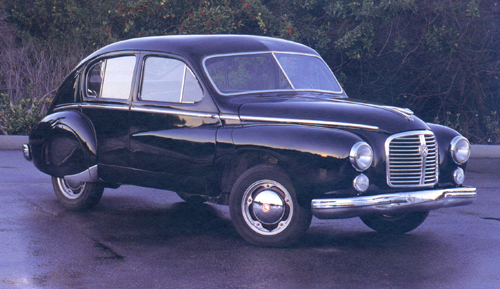
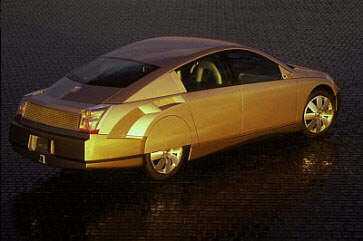
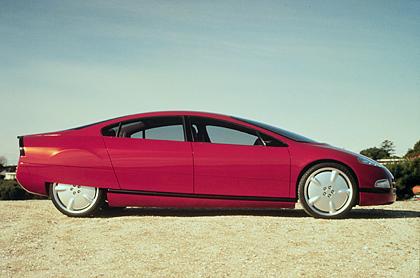
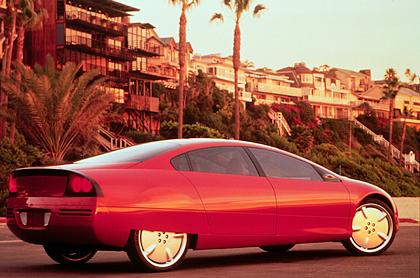
Here are pictures of some of the cars I mentioned above, all of them taller than most sedans on the road, all of them mid to full size cars capable of seating at least 4 people:

1921 Rumpler, .27 drag coefficient
Image
Image

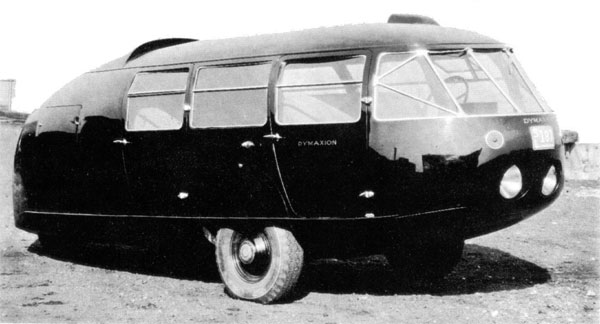
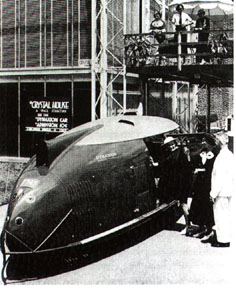
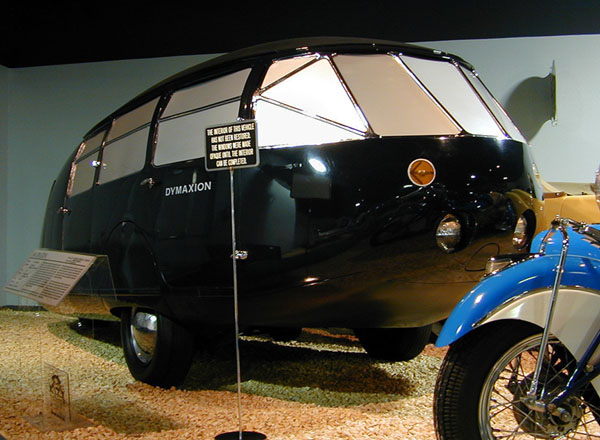
1933 Dymaxion, .25 drag coefficient
Image
Image
Image

1935 Tatra T77a, .21 drag coefficient
Image
Image
Image

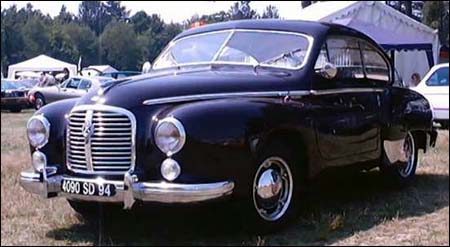
1951 Hotchkiss Gregoire, .26 drag coefficient
Image
Image
Image

1953 Alfa Romeo BAT, .21 drag coefficient
Image
Image
Image

1985 Ford Probe V, .137 drag coefficient
Image
Image
Image

2000 GM Precept, .16 drag coefficient
Image
Image
Image

1995 Dodge Intrepid ESX, .19 drag coefficient
Image
Image
Image

2005 Mercedes Bionic, .19 drag coefficient
Image
Image
Image

You know why it wasn't successful? The major automakers never offered a car with low drag coefficient in the U.S., and only recently started offeribng cars with drag coefficients in the .25-.30 region. Why? A few reasons. Buckminster Fuller, who built the Dymaxion car was told outright by auto execs that they refused to produce his car on grounds that there would be less advancements that they could sell out in the future would they produce his car immediately. Notice how cars have gotten very slowly more aerodynamic as oil got more rare? The industry wants to ration out advancements as slow as possible to maximize profits on each advancement made. Thus today, we're finally seeing .25 Cd Honda Insights that match the 1933 Dymaxion and .26 Cd Toyota Prii that match the 1921 Rumpler in drag coefficient. Further, less drag = less horsepower for a given speed needed = less engine wear = less money for the Detroit(and Europe, and Japan) pricks. Today we are just now getting cars that catch up to those that smaller industries have built over 70 years ago. This is insulting to my intelligence when I hear automakers say they are doing everything to maximize fuel economy or cut drag in their present auto fleet, when many of them before have made feasible concept cars years back with literally half the drag coefficient of their current models! Our automakers cannot even match in their commercial models the body design efficiency of cars 70 years old and only top of the line models are beginning to touch the high .20 region today, with most of today's cars being around the .35 region!

The Tatra T77a was wildly successful I might add. It was one of the fastest production cars of its day, one of the only cars of its model year able to reach over 100 mph. The British secret service in Germany particularly loved them as getaway cars that also got over 25 mpg, and these were huge 5,000 pound tanks of a car! WWII killed the company.

The Alfa Romeo BAT shows that 50s style road sharks could also be efficient. Most of the cars America made in the 50s had horrible aerodynamics, but that classic style baby boomers swoon over can be somewhat duplicated in a low drag design.

That Ford Probe V concept? The same 112 horsepower common rail diesel used in Europe's Opels if shoved into that a commercial version of thing built fully of composites and with LRR tires and CVT might be able to return 120-130 mpg, 0-60 mph in about 8-9 seconds, and top speed around 170 mph. That is what an optimized for efficiency midsize or full size car with normal performance of cars today might look like today with the very best of all components and design cherry picked. Or, you could take the 20 horsepower Loremo engine, and maybe get 200 mpg, compared to the Loremo's 157 mpg. The drag reductions would make all the difference.

$this->bbcode_second_pass_quote('', 'I') think with my layman knowledge these things attribute to better fuel economy in order of importance :-

a) More efficient engine
b) Decreased mass of car
c) More aero-dynamic body
d) Reduced friction in moving parts (eg the axles)


Take a and c and flip them around.

Most gasoline ICs have the about same efficiency, but even when you factor in efficiency at a given load for two seperate gasoline engines, there will not be much variance. Sure, a 4 cylinder will be more efficient than an 6 cylinder at say a 20-25 horsepower load indicative of highway cruising speeds, but both engines reach their peak efficiency when running near their maximum load. At highway speeds and city driving, ICs are running at their most inefficient points, and the difference between two engines, one of low peak power, the other of high peak power, running with the same horsepower demand is quite small.

You could compare the 300 horsepower 4.6L V8 2006 Ford Mustang with the 210 horsepower 4L V6 model, for instance. According to www.fueleconomy.gov, the V8 gets 17 mpg city, 25 mpg highway, 20 mpg combined, V6 gets 19 mpg city, 28 mpg highway, 22 mpg combined. Both cars weigh about the same, have the same tires, same manual transmission, and have the exact same aerodynamic drag coefficient and frontal areas. A difference of only 9% in fuel economy, while the difference in peak horsepower is 30%.

Another comparison. The 2.4L displacement 155 horsepower 4 cylinder 2006 Toyota Camry versus the 3.3L displacement 215 horsepower 6 cylinder 2006 Toyota Camry. The 4 cylinder gets 24 mpg city, 34 mpg highway, 28 mpg combined, 6 cylinder gets 21 mpg city, 29 mpg highway, 24 mpg combined. Again, the difference in fuel economy is slight, ~14%. Yet the difference in engine peak power is huge, 28%.

See a pattern? In order to see a meaningful gain in fuel economy, you'd need to cut horsepower by 2/3 to see perhaps a 20% fuel economy gain in the same car. This is like taking a 160 horsepower car and replacing it with a 60 horsepower engine. OR you could cut drag coefficient from roughly .35 to .20, and see a similar if not better gain, while retaining all performance and engine, and that's before you've decreased the car's size or cut its weight down or switched to LRR tires.

Meanwhile, refer back to aerodynamic drag and those Prius examples.

There is so much low hanging fruit that's been very obvious for over 70 years, and the auto industry won't touch it. We could have done 20 or more years ago 60 mpg cars with similar performance to what was expected, similar or even larger size, and we didn't. In the 70s fuel crisis, the auto industry didn't cut drag, they instead shrunk size. They weren't serious about increasing fuel economy, and instead kept blaming Nader.

Check out the Viking Research Cars, built by Western Washington University since the 70s. Even back then, they were building sportscars that did 0-60 mph in 5 seconds, topped 170 mph, and got over 70 mpg. This was performance to beat the Ferraris and Lamborghinis of the era, which got about 14 mpg!
Last edited by The_Toecutter on Sat 04 Mar 2006, 04:14:19, edited 1 time in total.
The unnecessary felling of a tree, perhaps the old growth of centuries, seems to me a crime little short of murder. ~Thomas Jefferson
User avatar
The_Toecutter
Intermediate Crude
Intermediate Crude
 
Posts: 2142
Joined: Sat 18 Jun 2005, 03:00:00
Top

Re: Loremo - 157mpg

Unread postby PolestaR » Tue 28 Feb 2006, 22:52:33

Thanks for taking the time to post Toecutter, it is appreciated.

However as you have shown an increase in fuel economy of 10% (for the average driving speed 30MPH) isn't that much. You don't go from 30MPG to 150MPG just by decreasing drag. You were sort of implying that this is the biggest factor concerning the fuel economy of cars and I don't think this is correct. Maybe comparing a lead square box to a hollow bullet shape might make this true, but we aren't comparing such things.

The biggest improvement does come from the engine, since this is the powerhouse of the vehicle, and at the moment we struggle to get even 40% efficiency. Since there is >55% further improvement (compared to your 10-20% drag improvement) possible I think this will and has given us the biggest breakthroughs in fuel economy, which I why I put it at #1. #2 being the weight of the car I also think is more important, since if you halve the weight of the car using same engine, then you can almost halve the fuel consumption. Which is bigger than your 10-20% drag improvement.

Don't get me wrong, I am all for making cars more efficient and there are little reasons beyond "cost" (not sure if it is more expensive to make something curvier but in theory its plausible) why cars shouldn't be more aerodynamic.
PolestaR
Tar Sands
Tar Sands
 
Posts: 955
Joined: Tue 21 Jun 2005, 03:00:00

Re: Loremo - 157mpg

Unread postby The_Toecutter » Wed 01 Mar 2006, 00:41:26

$this->bbcode_second_pass_quote('', 'H')owever as you have shown an increase in fuel economy of 10% (for the average driving speed 30MPH) isn't that much. You don't go from 30MPG to 150MPG just by decreasing drag.


But you have to consider where the Loremo started. It started as a car not much more than the size of the VW 1 liter. The frontal area was already very low, further cutting its drag significantly, as the force of drag is a function of the drag coefficient and frontal area. With a .26 Cd and larger 22 square foot frontal area to put it on par with the Prius, it would probably get around 70-75 mpg and only top out at maybe 70 mph, assuming it kept the 1,050 pound weight and 20 horsepower diesel. Likewise, a non-aerodynamic Citroen 2CV fitted with that same diesel might see perhaps 55 mpg overall, and as a gas car with 20 horsepower gas engine actually saw about 40-45 mpg overall.

It precisely went to 150 MPG because its drag was so low. Or 90 mpg for the 50 horsepower version.

If you want to compare, a VW Jetta diesel from the early 1990s, with about a 3,000 lb curb weight, 23 square foot frontal area and ~.32 Cd used a ~50 horsepower diesel, and got about 40 mpg.

The Loremo, with a 50 horsepower engine, gets 90 mpg.

$this->bbcode_second_pass_quote('', 'Y')ou were sort of implying that this is the biggest factor concerning the fuel economy of cars and I don't think this is correct. Maybe comparing a lead square box to a hollow bullet shape might make this true, but we aren't comparing such things.


.35 cd is by no means a box shape, at least not compared to the cars on the road today and which have been historically sold. That .35 is about the average of cars on the road. Many modern trucks and SUVs have drag coefficient figures around .5, vintage luxury cars around .6! The most streamlined cars currently available, like the Infiniti G35, Toyota Prius, Honda Insight have a .29, .26, and .25 respectively. Further, I did not go to the extremes of streamlined cars for my comparison in the calculations. That Ford Probe V got a .137. That is way lower than the mediocre .20 that I used!(Mediocre by the standards of what has been possible over the last 20 years). The most efficient designs built from the ground up are approaching .13, while in theory it is possible to get a passenger car on ground level down to about .11.

To get an idea of what Cd figures to expect from various cars, look here:

http://web.archive.org/web/20041118043051/http://www.teknett.com/pwp/drmayf/tbls.htm

The newest models listed are clearly within the .35-.4 range, for the 1990s models.

$this->bbcode_second_pass_quote('', 'T')he biggest improvement does come from the engine, since this is the powerhouse of the vehicle, and at the moment we struggle to get even 40% efficiency.


If you go to a diesel engine, this is correct. I was under the assumption that you stay with the same fuel type, so that an accurate comparison on the impact of drag versus horsepower/displacement reduction could be made. You can take any gas car and throw a diesel in it, and see about 30% better fuel economy by the nature of the diesel itself, but that doesn't necessarily mean changing the car from a gas to a diesel made more impact than a drag reduction because then you're comparing apples to oranges.

If you want to argue improving efficiency through a different fueled powertrain, then nothing can beat battery electric.

$this->bbcode_second_pass_quote('', 'S')ince there is >55% further improvement (compared to your 10-20% drag improvement) possible I think this will and has given us the biggest breakthroughs in fuel economy, which I why I put it at #1.


This is an extreme, however. That 20 horsepower diesel engine in the Loremo is being loaded to near 100% just to accelerate the car and about 30% just to cruise at highway speeds, and thus its efficiency will be very close to the peak of its power verus efficiency curve. When loaded to a higher percentage of the total horsepower available, an ICE will see increased efficiency, a diesel around 40% efficient near full load, and a gas IC near 25% efficient around full load. However, in practice, since in normal cars those engines are loaded to about 15% of their rated maximium power, diesel efficiency in real applications tends to be around 25-30% instead of 40%, and gas IC efficiency around 15% instead of 25%.

With the 20 hp diesel being loaded to near full on the Loremo just for normal driving, it will thus see about 40% efficiency, compared to the 50 hp version seeing about 25% due to not being loaded so high in normal use.

25/40 * 157mpg = 98 mpg, close to the 90 mpg the 50 horsepower version really gets.

So in order to get any real benefit from a 'more efficient engine' with smaller power, it has to be loaded to its maximum output or near its maximum output. Basically, this output would be exactly enough to keep it at highway speeds, otherwise the load will decrease and then the efficiency all goes to hell. In any practical car willing to meet the ability to merge into traffic, this is simply not feasible, unless the car is specifically optimized with every reduction in weight imaginable. And hence the Loremo. Its weight is sufficiently low that it can do that. Increase the weight even to even 1,200, and 0-60 might increase from 19 seconds to 25 seconds, or to 1,400 pounds, an agonizing 28 seconds...

If that engine were in a Prius like car, it would be getting less than half the fuel economy.

$this->bbcode_second_pass_quote('', '#')2 being the weight of the car I also think is more important, since if you halve the weight of the car using same engine, then you can almost halve the fuel consumption. Which is bigger than your 10-20% drag improvement.

Not exactly true.

Refer back to the equations I posted and see the horsepower needed to cruise at 30 mph and 65 mph if you were to reduce the weight of the 'typical car' example by 800 pounds through use of composite materials, bringing the midsize car down from 3,200 pounds to 2,400 pounds. The reduction in power at 2,400 lbs. needed at 30 mph might be less than 13% from when it was 3,200 pounds, but at 65 mph, it's on the order of 5%, so about 10% overall, as opposed to about 30% combined for reducing aero drag coefficient from .35 to .20 for the same example. Further, if you start to cut frontal area to also cut aero drag, say from 24 square feet to 18 square feet, and not just drag coefficient, whopping 40% overall gains can be made from that alone(~50% highway mileage increase!), but that would begin to shrink the car size a little. Two ways to decrease aero drag, frontal area and drag coefficient, one way to decrease weight, remove stuff. Basically about the biggest improvement weight reduction will have is in acceleration and amount of fuel used to accelerate, along with increased city fuel economy, but not much else.

Try the equations out for yourself to get an estimate. Figure out which sources, whether rolling drag or aero drag, are requiring the most horsepower at a given speed. Compare what horsepower a typical car will need to cruise at various speeds unmodified, with a .35 cd, 24 square foot area, 3,200 pound weight, and .010 rolling resistance coefficient, 15% various losses. See what removing 800 pounds would do to the car, then 1,600 pounds, and see what lowering the drag coefficient to .20 would do, or lowering the drag coefficient to .20 AND frontal area to 18 feet square would do. Then see the effect of LRR tires, dropping the Cr from .010 to .006. And then see the benefits gained from all combinations of these things applied. You will find that the reduction in either frontal area or drag coefficient to those specified numbers will give you the largest reduction in horsepower needed overall(take 65 mph horsepower and add to 30 mph horsepower and divide by 2 to get overall) over reducing weight by 1/4 or even as far as 1/2.

$this->bbcode_second_pass_quote('', 'D')on't get me wrong, I am all for making cars more efficient and there are little reasons beyond "cost" (not sure if it is more expensive to make something curvier but in theory its plausible) why cars shouldn't be more aerodynamic.

Not really more expensive unless you're doing one off cars. If you have machine tools for a mass production run, practically every possible shape you want costs the same.

I could go up to some hardware chain and buy the materials needed to build wheel well covers, bellypans, grille blocks, front air dams, and side skirts for about $50, and spend about 30 hours of labor making those things and placing them on the car. And I'm doing just that for my in progress EV. Cutting the drag coefficient of my Triumph GT6 from .32 to .25 will give me about a 50% boost in highway range per charge and about a 20% boost in city range. Likewise, if I were to cut 800 pounds from the car while keeping the same battery pack, and didn't do any aero mods, I'd see about 30% more city range, 15% more highway range.

Just to see how drastic of an improvement aerodynamic modifications have, I urge you to check out Phil Knox's Toyota T100 pickup. He heavily modified the body to reduce aerodynamic drag, and saw a 30% increase in highway fuel economy from 25 mpg to 32 mpg, ~20% increase overall. The coefficient of drag was lowered from .44 to .25.

http://www.evworld.com/view.cfm?section=article&storyid=870

He'd probably need a 2,000 pound weight reduction to achieve a similar boost in fuel economy.

Another example for you to check is the Tyraine, a custom bodied wood-expoxy car built from the ground up with a 602 cc 21 horsepower Citroen 2CV engine. Same exact engine and transmission as the Citroen 2CV, to give you a basis of comparison.

The Citroen 2CV has a .4 coefficient drag, 20.4 square foot frontal area, and weighs 1,120 pounds. The Tryanne wood bodied car has a .24 coefficient of drag and 18.5 square foot frontal area, weighs 900 pounds, only 220 pounds less than the Citroen. The wood car apparently gets 55 mpg city, 70 mpg highway, compared to the 21 hp 602cc Citroen 2CV's 40 mpg city, 46 mpg highway. How much of that 45% gain in fuel economy do you think came from shaving off a meagre 200 pounds?

Again the aerodynamic drag reduction shows its worth. Cd*A of the 2CV at 8.16, the Tryanne at 4.44. The 2CV on that 21 horsepower engine can only reach 65 mph, while the Tryanne using the same engine can exceed 100 mph, again due to reduced air drag.

Article on the Tyraine II:

http://news.bbc.co.uk/1/hi/wales/813811.stm

Website:

http://home.clara.net/peterfrost/tryaneii.html


The original Citroen 2CV with 9 hp got 56 mpg I read, but it only hit 40 mph. If that were put in the Tyraine II, it would probably see a 70 mph top speed and 90 mpg. Swap in a diesel, even a big 120 horsepower diesel, and it would likely see over 100 mpg and accelerate like a rocket.
The unnecessary felling of a tree, perhaps the old growth of centuries, seems to me a crime little short of murder. ~Thomas Jefferson
User avatar
The_Toecutter
Intermediate Crude
Intermediate Crude
 
Posts: 2142
Joined: Sat 18 Jun 2005, 03:00:00
Top

Re: Loremo - 157mpg

Unread postby MonteQuest » Wed 01 Mar 2006, 01:42:20

$this->bbcode_second_pass_quote('The_Toecutter', ' ')Depends on when peak oil hits. If they are made and sold just at the start of the peak, the rate at which the fleet turns over, about 7% a year, may be enough to more than offset the decline, if and only if cars like these become the norm. Keep in mind that automobile fuel is 40% of America's oil consumption. Addressing the fuel consumption issue(along with reducing auto dependence in its entirity) certainly can have a major impact, the trick is doing so before the effects of peak oil set in and render such a prospect economically infeasible.


To what end? So people don't have to give up the private auto?

The effects of peak oil arrived with a 40% increase in gas prices. The possibility has already been rendered economically unfeasible. The housing bubble is popping and the illusionary money it created is soon to disappear. And when it does, so does the the ability to fund such a consumer turnover.

60% of the people that just bought in to the dealer discounts on SUV's were upside down in the loan on the cars they traded in. Now they become triple upside down?

Doubt it.

They will soon be upside down on their home loan as well. A record high of 528,000 unsold homes at the end of January. Home prices are going to go down...way down.
A Saudi saying, "My father rode a camel. I drive a car. My son flies a jet-plane. His son will ride a camel."
User avatar
MonteQuest
Expert
Expert
 
Posts: 16593
Joined: Mon 06 Sep 2004, 03:00:00
Location: Westboro, MO
Top

Re: Loremo - 157mpg

Unread postby tsakach » Wed 01 Mar 2006, 02:27:14

A lightweight diesel vehicle with good aerodynamics is probably the best combination for good highway mileage. The Loremo website provides some data on the vehicle but does not show how they arrive at 157mpg.

The instantaneous mileage on my Honda Insight CVT jumps from 53 to 89 when tailgating a RV, showing the effect of aerodynamics on mileage. I probably get 157mpg tailgating a RV down a grade. But who wants to tailgate RVs all the time?

The Insight gets blown around quite a bit on the road during strong gusty winds. Driving the lighter Loremo concept car would be quite a thrilling experience in these conditions.

The Loremo won't get anything near 157mpg for short trips with a cold diesel engine. No way.
User avatar
tsakach
Coal
Coal
 
Posts: 407
Joined: Wed 09 Mar 2005, 04:00:00

Re: Loremo - 157mpg

Unread postby The_Toecutter » Wed 01 Mar 2006, 02:30:57

$this->bbcode_second_pass_quote('', 'T')o what end? So people don't have to give up the private auto?


It was used as illustration, to show the effect such increased efficiency would have on oil consumption. Consumption can be cut in many areas besides cars, but cars are the fat cow that needs to be butchered.

I don't find it wise to keep the entire car fleet. We need walkable societies, mass transit, and bike only roads. But like anything else, it will take time and resources to build. A more efficient auto fleet is part of the solution, under the condition we have sufficient time to implement it. In this scenario, a good portion of people will volunatarily give up using their cars for mundane tasks(including myself), since they'll have alternatives.

If there's no incentive to give the car up due to needs in our current society, things could get ugly.

Personally, I don't think we do have the time to replace our current business as usual or to dampen the disasterous effects abut to approach us, but this problem of peak oil needs to have everything we have thrown at it. Otherwise we are garunteed to lose many of the good aspects of modern day living, with many of the bad aspects still persisting due to desperation. That's not a future I or many others be satisfied with if we sat by and let it all crumble. Even if an attempt were to be made, and it would fail, at least future generations will know that there was an attempt to preserve them a future, instead of selfishly blowing it up to collapse.

$this->bbcode_second_pass_quote('', 'T')he effects of peak oil arrived with a 40% increase in gas prices.


Peak, or plateau? If we would be seeing a significant downslope, gas prices would be rising much faster. We may get there this year, who knows, or maybe 10 years from now.

$this->bbcode_second_pass_quote('', 'T')he possibility has already been rendered economically unfeasible.


Maybe. There is a lot of fat that can be cut, it's just a matter of acting on TPTB to an extent that immediately threatens them, causing them to lose out if they do not change their direction. I'll leave just what to your imagination on this one, but I'm sure you can think of 5-10 possibilities on your own. Only way it will happen: education and a rational analysis of what could work in theory, and also an understanding of where we are going as things are. Not very likely, no, but been if the odds are worse than the lottery, it's still worth going down having made the effort IMO. Aim for the best, expect the worst.

$this->bbcode_second_pass_quote('', 'T')he housing bubble is popping and the illusionary money it created is soon to disappear. And when it does, so does the the ability to fund such a consumer turnover.


For most Americans, yes. The question is when will it fully pop. If it pops this year, we are screwed. Big time. If it doesn't, we'll have pissed away another year helping to further seal our fate.
The unnecessary felling of a tree, perhaps the old growth of centuries, seems to me a crime little short of murder. ~Thomas Jefferson
User avatar
The_Toecutter
Intermediate Crude
Intermediate Crude
 
Posts: 2142
Joined: Sat 18 Jun 2005, 03:00:00
Top

Re: Loremo - 157mpg

Unread postby The_Toecutter » Wed 01 Mar 2006, 02:39:12

$this->bbcode_second_pass_quote('', 'A') lightweight diesel vehicle with good aerodynamics is probably the best combination for good highway mileage. The Loremo website provides some data on the vehicle but does not show how they arrive at 157mpg.


My assumption was that was constant highway speeds, approxamately 55-60 mph.

It seems reasonable, as a 112 horsepower Opel Eco Speedster can return 97 mpg(113 mpg Imperial) on the mixed EU driving cycle, and it has same Cd, larger frontal area, and 500 pouns more weight. Did I mention it also tops 160 mph...

$this->bbcode_second_pass_quote('', 'T')he instantaneous mileage on my Honda Insight CVT jumps from 53 to 89 when tailgating a RV, showing the effect of aerodynamics on mileage. I probably get 157mpg tailgating a RV down a grade. But who wants to tailgate RVs all the time?


The Insight, what a car. Its body efficiency is about 70 years overdue, but it gets double the mileage of a typical economy car, again illustrating the effects of aerodynamics. It's not very light compared to the Loremo, at 1,950 pounds, but its loss of about 800 pounds over other similar economy cars added an easy 5-7 mpg.

I conderered converting one of these to EV, but they are just too pricey, used ones still going for $10k! The Triumph has much lower frontal area and a lot of reductions to be made, and looks a lot better, so I can live with that.

I hope Honda does a revision of it soon. The market failed, but that was the best of its offerings.

$this->bbcode_second_pass_quote('', 'T')he Insight gets blown around quite a bit on the road during strong gusty winds. Driving the lighter Loremo concept car would be quite a thrilling experience in these conditions.


I've driven worse. My step mom's 1994 Suzuki Sidekick is extra vulnerable to crosswinds. A 40 mph gust once tipped it on two wheels at 65 mph...

$this->bbcode_second_pass_quote('', 'T')he Loremo won't get anything near 157mpg for short trips with a cold diesel engine. No way.


I'd expect around 110-120 under those conditions.

Further, the car seems reasonable along with their figures, but those don't look like real photos on the site, nor will one be sold until 2009. As I mentioned before, hoping its real and not hype. A car like that is certainly possible.
The unnecessary felling of a tree, perhaps the old growth of centuries, seems to me a crime little short of murder. ~Thomas Jefferson
User avatar
The_Toecutter
Intermediate Crude
Intermediate Crude
 
Posts: 2142
Joined: Sat 18 Jun 2005, 03:00:00
Top

Re: Loremo - 157mpg

Unread postby Mesuge » Wed 01 Mar 2006, 10:21:05

Didn't you notice that Loremo copied some of the major concepts from the Daihatsu UFEII-III vehicles I've posted here a couple of weeks ago..?

Btw. my pro EV/Glider/Veggie Loremo production version rant at their forum here. I also encourage those who don't command German lang to use some online translation thingy because there are numerous details being answered by the guys who are behind the company:

http://www.loremo.com/forum/forum_entry ... tegory=all


Update:
So in this early thread someone asked about the EV version and the Loremo guy said that they bet all on the small volume diesel engine but they are open to alternatives but sceptical in the sense that the whole environ cost is much less with tuned system of small eco engine for the whole cycle life than from some hybrid or Lithium EV, which is perhaps a partial true.

I think it depends on your commuting regime and whether your el. is produced from renewables etc..

I agree that in the end the Lithium batt is crap for mass penetration - you just can't motor the civilization even on some advanced nano Lithium miracles - there is not enough of it in the ground. But lead and graphite for next gen lead acid like FireFly is easily recyclable and plentifull..

The Loremo people seems to be a light PeakOil believers hoping for $100/barrel soon..
http://www.loremo.com/forum/forum_entry ... order=time
DOOMerotron: at all-time high [8.3] out of 10..
User avatar
Mesuge
Heavy Crude
Heavy Crude
 
Posts: 1500
Joined: Tue 01 Nov 2005, 04:00:00
Location: Euro high horse bastard on the run

Re: Loremo - 157mpg

Unread postby Mesuge » Wed 01 Mar 2006, 16:12:26

If anybody is looking into glider options for EV conversion purposes which is very hard these days try this thread on the VisforVoltage Forum.

Very interesting is among others the affordable British Fury Kit (real diy racing gear) which is very low weight and sexy, although only a roomy two seater. I'm not sure about the Cd though it could be perhaps much better, maybe people can put on their own rear fairing etc..

The pricing for the kit is a bit less than for the Loremo but that's a concept while you can place order for Fury now and it's real and it has been racing in the UK for a number of years..

It's a kit car so allow for some assembly time but it should be pretty straightforward the company site host lots of documented work..

Chassis and body kit = $8.5K - substract something for ICE parts
add tranny and EV components of your choice..

And as has demonstrated AC Propulsion two seaters can be practical too you just connect a aerodynamic trailer if necessary..

But most importantely it designs allows after some structural additions to make it EV/hauling lead batteries ready and with lightweight FireFly/TS Lithium/PWTC batteries not a problem at all..

Image
Image

FactoryFive racing would make also a good platform with some moding.
FFR is probably the best selling kit car manuf in the world today, top notch quality - these might develop a stelar EV platform if asked or interested to do so for some investor..

Image


This hardcore diy EV is a striped truck with aero fairing..
Image

http://www.visforvoltage.com/forums/ind ... 2445&st=15
DOOMerotron: at all-time high [8.3] out of 10..
User avatar
Mesuge
Heavy Crude
Heavy Crude
 
Posts: 1500
Joined: Tue 01 Nov 2005, 04:00:00
Location: Euro high horse bastard on the run

Re: Loremo - 157mpg

Unread postby Mesuge » Wed 01 Mar 2006, 20:20:13

Loremo concept mole life shots:

Image
Image

Some more here:
http://www.auto-motor-und-sport.de/news ... 103135.htm

--

Daihatsu UFE-III gen
Image
Image
Image

Well, I think those two guys have to setup a joint venture and start manufacturing these cute babies as soon as possible..

The sad part of the story is that these are basicaly the same concepts like VRI did in the 70s under Carter. Hoops we are 30years late..
Last edited by Mesuge on Wed 01 Mar 2006, 23:30:39, edited 1 time in total.
DOOMerotron: at all-time high [8.3] out of 10..
User avatar
Mesuge
Heavy Crude
Heavy Crude
 
Posts: 1500
Joined: Tue 01 Nov 2005, 04:00:00
Location: Euro high horse bastard on the run

Re: Loremo - 157mpg

Unread postby MonteQuest » Wed 01 Mar 2006, 22:29:12

$this->bbcode_second_pass_quote('The_Toecutter', 'P')ersonally, I don't think we do have the time to replace our current business as usual or to dampen the disasterous effects abut to approach us, but this problem of peak oil needs to have everything we have thrown at it. Otherwise we are garunteed to lose many of the good aspects of modern day living, with many of the bad aspects still persisting due to desperation. That's not a future I or many others be satisfied with if we sat by and let it all crumble. Even if an attempt were to be made, and it would fail, at least future generations will know that there was an attempt to preserve them a future, instead of selfishly blowing it up to collapse.


"A house built upon a foundation of sand shall not stand."

$this->bbcode_second_pass_quote('', '')$this->bbcode_second_pass_quote('', 'T')he effects of peak oil arrived with a 40% increase in gas prices.


Peak, or plateau?


Doesn't matter. But in this case, it is lack of spare capacity, refining capacity and the growth of China and India. Also, infrastructure peak as a result of anticipating peak oil.

$this->bbcode_second_pass_quote('', '')$this->bbcode_second_pass_quote('', 'T')he possibility has already been rendered economically unfeasible.


Maybe. There is a lot of fat that can be cut, it's just a matter of acting on TPTB to an extent that immediately threatens them, causing them to lose out if they do not change their direction. I'll leave just what to your imagination on this one, but I'm sure you can think of 5-10 possibilities on your own.

Cut the fat and you cut the jobs that provide the fat. Who absorbs the loss? How will it be distributed equally?

What waste doesn't provide someone a job?
A Saudi saying, "My father rode a camel. I drive a car. My son flies a jet-plane. His son will ride a camel."
User avatar
MonteQuest
Expert
Expert
 
Posts: 16593
Joined: Mon 06 Sep 2004, 03:00:00
Location: Westboro, MO
Top

PreviousNext

Return to Open Topic Discussion

Who is online

Users browsing this forum: No registered users and 2 guests

cron