There are tons of people looking at Saudi Arabia, and Ghawar in particular but Russia is the number one producer of the world, larger than SA.
And I believe the production numbers from Russia are more alarming than those of Saudi Arabia at this moment.
russian production
Of course the picture is a bit disturbed by the perils surrounding Yukos, but if I remer correctly Campbell predicted a peak in 2007 and it indeed seems like the production is 'plateauing'.
Could this be the onset of the actual peak, perhaps in one or two years time? Because if it is we don't have to wonder when the peak is going to be. If Russia peaks, the world peaks.
That is why I would like to use this tread to collect and discuss the information on the FSU.



PeakOil is You
Russian secondary peak approaches?
Russian production discussion
 by smiley » Tue 28 Feb 2006, 19:04:38
-

smiley - Intermediate Crude

- Posts: 2274
- Joined: Fri 16 Apr 2004, 03:00:00
- Location: Europe
Re: Russian production discussion
by mekrob » Tue 28 Feb 2006, 19:44:33
Reports that I've seen say that they are supposed to peak in 07, but that can probably vary and push into 08. However, Russia still claims that there is more to be found, faster than depletion rates; however, they only say that can happen for a few years past 07. So even they aren't all giddy about oil production in their own country.
From looking at that graph, it doesn't show that they've peaked or even plateaued yet. It slowly went down for a few months, but that was in the winter when worldwide demand is lower. They also did that in the previous year and they obviously didn't peak there. We'll have to wait a few more months to get better data on their production levels. If it declines or fails to increase much even at these prices, then we can definately say they've peaked.
What is the story about their oil fields compared to their nation? I mean Mexico, UK, Norway, SA, Kuwait, Iraq, etc rely on a few massive fields while the US relies mostly on hundreds of tiny fields that produce little a piece. How about for Russia? Lots of tinies? or a few giants? Samotlar is pretty depleted, isn't she?
From looking at that graph, it doesn't show that they've peaked or even plateaued yet. It slowly went down for a few months, but that was in the winter when worldwide demand is lower. They also did that in the previous year and they obviously didn't peak there. We'll have to wait a few more months to get better data on their production levels. If it declines or fails to increase much even at these prices, then we can definately say they've peaked.
What is the story about their oil fields compared to their nation? I mean Mexico, UK, Norway, SA, Kuwait, Iraq, etc rely on a few massive fields while the US relies mostly on hundreds of tiny fields that produce little a piece. How about for Russia? Lots of tinies? or a few giants? Samotlar is pretty depleted, isn't she?
- mekrob
- Expert

- Posts: 2408
- Joined: Fri 09 Dec 2005, 04:00:00
Re: Russian production discussion
by mekrob » Tue 28 Feb 2006, 19:46:20
Oh yeah, did anyone notice that once oil prices started to climb worldwide (late '90's), oil production in Russia finally broke through her 4+ year old 6.0 mpd ceiling? Interesting. Russia increases its production 50% and oil prices more than triple. Nice return on investment.
Last edited by mekrob on Tue 28 Feb 2006, 19:49:51, edited 1 time in total.
- mekrob
- Expert
- Posts: 2408
- Joined: Fri 09 Dec 2005, 04:00:00
Re: Russian production discussion
by PolestaR » Tue 28 Feb 2006, 20:13:40
Just remember that there isn't quite "unlimited" demand for oil yet, so it doesn't necessarily mean they have peaked in production, they could just be at the line between supply/demand.
If you take a look at Saudi Arabias output over a pediod of time you could use the same analysis you guys did to say it peaked too, a while ago.
I sure hope Russia has peaked though. :D
If you take a look at Saudi Arabias output over a pediod of time you could use the same analysis you guys did to say it peaked too, a while ago.
I sure hope Russia has peaked though. :D
- PolestaR
- Tar Sands

- Posts: 955
- Joined: Tue 21 Jun 2005, 03:00:00
Re: Russian production discussion
by nth » Tue 28 Feb 2006, 20:24:34
After the Yuko crisis, Russian oil exploration and field development investment went down, especially combined with the new tax system put in place.
It is very unlikely that Russia oil production will go higher. The main culprit is the new tax system. The second is that lots of oil fields are getting old and depleting. They got a nice boost by BP when they adjusted the oil equipment to pump out more oil.
Salkin fields in the Pacific are hit with delays and issues. This is one of the new oil fields that will come online, but doesn't look likely anytime soon to contribute large production numbers.
It is very unlikely that Russia oil production will go higher. The main culprit is the new tax system. The second is that lots of oil fields are getting old and depleting. They got a nice boost by BP when they adjusted the oil equipment to pump out more oil.
Salkin fields in the Pacific are hit with delays and issues. This is one of the new oil fields that will come online, but doesn't look likely anytime soon to contribute large production numbers.
-

nth - Heavy Crude

- Posts: 1978
- Joined: Thu 24 Feb 2005, 04:00:00
Re: Russian production discussion
by khebab » Tue 28 Feb 2006, 23:43:22
$this->bbcode_second_pass_quote('', 'R')ussia is the number one producer of the world, larger than SA.
Not exactly, It was the second producer (9.27 mbpd) and the second exporter (6.67 mbpd) in 2004 (EIA).
There is a nice thread on TOD about the Russian production:
Uncertainties About Russian Reserves and Future Production
I believe that Russian production reached a plateau and should start declining in a few years:
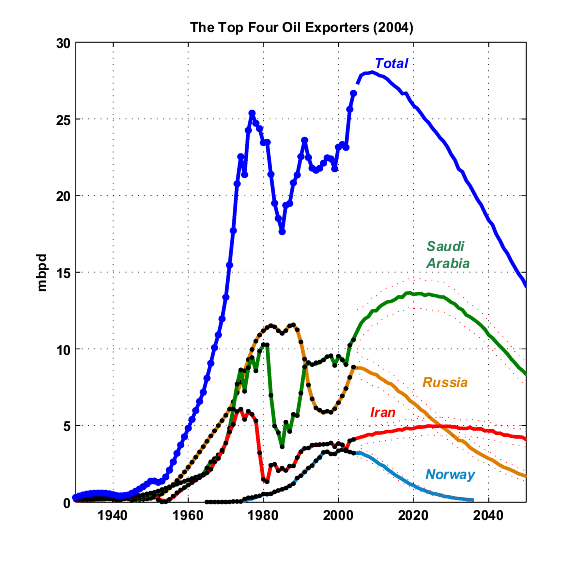
______________________________________
http://GraphOilogy.blogspot.com
http://GraphOilogy.blogspot.com
- khebab
- Tar Sands
- Posts: 899
- Joined: Mon 27 Sep 2004, 03:00:00
- Location: Canada
Re: Russian production discussion
by MOCKBA » Wed 01 Mar 2006, 01:17:36
The problem with Russia is not the lack of production capacity, but the lack of transportation. IMHO, Russia could boost its output to 10mbpd, but it would never move that much to export points. Thus anything above transportation thruput to export points bottleneck is for local consumption, or if local consumption would be flat, then the production will not break 10 mbpd.
Now, both the pipelines and production is aging. The only good thing Yukos did was upgrading production, but transportation was still in communists hands, so at the end China was paying for shipment over rail which is very limited in terms of how much oil one could move to export points. Since 2004 it is all (production and transportation) in communist hands, which means that only limited amounts of money are and will be invested in both production and transportation, which in turn means that Russia would be flat in production and exports.
Thus, IMHO, in the next 5-10 years Russia would be able to maintain 8-10 mbpd in production and 5-6 in exports with grade going sourer. It all could change if 2008 election would result in change of regime, then most likely the figures could drop or rize about 1 mbpd. Also, exports would depend on demand for sour crude. If the demand for sour crude would drop (as if there would be more sour crude due to other countries decline) Russian figures could be on the lower side of the range.
Now, both the pipelines and production is aging. The only good thing Yukos did was upgrading production, but transportation was still in communists hands, so at the end China was paying for shipment over rail which is very limited in terms of how much oil one could move to export points. Since 2004 it is all (production and transportation) in communist hands, which means that only limited amounts of money are and will be invested in both production and transportation, which in turn means that Russia would be flat in production and exports.
Thus, IMHO, in the next 5-10 years Russia would be able to maintain 8-10 mbpd in production and 5-6 in exports with grade going sourer. It all could change if 2008 election would result in change of regime, then most likely the figures could drop or rize about 1 mbpd. Also, exports would depend on demand for sour crude. If the demand for sour crude would drop (as if there would be more sour crude due to other countries decline) Russian figures could be on the lower side of the range.
-
MOCKBA - Coal

- Posts: 458
- Joined: Mon 05 Sep 2005, 03:00:00
Re: Russian production discussion
by Russian_Cowboy » Wed 01 Mar 2006, 04:54:55
Preliminaty data on February 2006 oil production in Russia will be released within the next 24 hours. It may be quite ugly and even show a year-on-year decline. This is due to the stoppage of drilling and production operations in Yugra when the temperatures there fell below -50C. The problem in Russia is not just the lack of transportation, but the lack of infrastructure. It is quite expensive to build and maintain infrastructure in places with extremely severe climate. So, nobody eants to build it.
Also, the promised polar oil may never be found in reality. The only major oilfield that Russia has in the Arctic Ocean is Prirazlomnoye with about 1.5 Gba of oil. Russian oil companies have been looking for coastal shelf oil, but failed to come up with any major finds in the last 10 years except for the 500 Mba field in the Caspian sea found a month ago by Lukoil. Also, the average cost of producing oil in Russia is climbing fast. It was only $6.7/ba in 2001, $10/ba in 2003, and $15/ba in 2005. In the near future, Kremlin may be kissing goodbye to the fabulous oil royalties it is enjoying now.
Also, the promised polar oil may never be found in reality. The only major oilfield that Russia has in the Arctic Ocean is Prirazlomnoye with about 1.5 Gba of oil. Russian oil companies have been looking for coastal shelf oil, but failed to come up with any major finds in the last 10 years except for the 500 Mba field in the Caspian sea found a month ago by Lukoil. Also, the average cost of producing oil in Russia is climbing fast. It was only $6.7/ba in 2001, $10/ba in 2003, and $15/ba in 2005. In the near future, Kremlin may be kissing goodbye to the fabulous oil royalties it is enjoying now.
-

Russian_Cowboy - Lignite
- Posts: 259
- Joined: Wed 16 Feb 2005, 04:00:00
Re: Russian production discussion
by Taskforce_Unity » Wed 01 Mar 2006, 05:47:41
Russian Cowboy, were do you get this dollar per barrel production data from?
-

Taskforce_Unity - Coal
- Posts: 479
- Joined: Mon 22 Nov 2004, 04:00:00
- Location: Holland
Re: Russian production discussion
by smiley » Wed 01 Mar 2006, 18:15:31
Thanks for the replies. A couple of points.
- Last December Russian production was higher (9.6 Mb/d) than Saudi Arabia (9.5 Mb/d) according to the EIA. I know it is a bit childish to knit over 0.1 Mb/d But the reason I made this point is to show that we shouldn't stare ourselves blind on SA.
- Seasonal variations do play a role in the oil production. But with the 12 month average you filter that out, and that still points to a production slowdown.
But what is causing the slowdown. In the tread several points were mentioned.
- Infrastructure
- Investment
- Depletion
I think all three points are valid. But also I think the first two are overplayed in the media. In the run-up to the peak for Norway, UK, Oman and Mexico, you heard similar stories. Lack of investment, poor management unexpected delays etc. Of course a company or a government is hesitant to admit that the production is close to hitting decline. They want to have investments flowing in as long as possible. Only after the peak they suddenly bring out the real culprit.
I cannot judge on the infrastructure. I know there are problems transporting the oil, but how serious they are or what the maximum capacity is I don't know.
But lack of investments. A large portion of the Russian oil industry is in foreign hands. BP-TNK produces about 1.5 mbd in russia. Shell is also active and so are the Chinese and the Japanese. I can understand why a company like Yukos would have problems attracting investors, but surely that cannot be the case for BP.
Yet these companies are not able to find large bodies of oil. And these companies also see their growth percentages declining. So perhaps we have to face the truth that Russia is becoming a very mature area and will not be able to post 10% growth percentages in the next few years.
Again I cannot stress the importance of that enough. Russia has been the engine behind world production growth. In the past 5 years over 50% of the world production growth came from Russia. W oil prod
So in the business-as-usual scenario we need to see growth in Russia, and preferably double-digit.
- Last December Russian production was higher (9.6 Mb/d) than Saudi Arabia (9.5 Mb/d) according to the EIA. I know it is a bit childish to knit over 0.1 Mb/d
But the reason I made this point is to show that we shouldn't stare ourselves blind on SA.
- Seasonal variations do play a role in the oil production. But with the 12 month average you filter that out, and that still points to a production slowdown.
But what is causing the slowdown. In the tread several points were mentioned.
- Infrastructure
- Investment
- Depletion
I think all three points are valid. But also I think the first two are overplayed in the media. In the run-up to the peak for Norway, UK, Oman and Mexico, you heard similar stories. Lack of investment, poor management unexpected delays etc. Of course a company or a government is hesitant to admit that the production is close to hitting decline. They want to have investments flowing in as long as possible. Only after the peak they suddenly bring out the real culprit.
I cannot judge on the infrastructure. I know there are problems transporting the oil, but how serious they are or what the maximum capacity is I don't know.
But lack of investments. A large portion of the Russian oil industry is in foreign hands. BP-TNK produces about 1.5 mbd in russia. Shell is also active and so are the Chinese and the Japanese. I can understand why a company like Yukos would have problems attracting investors, but surely that cannot be the case for BP.
Yet these companies are not able to find large bodies of oil. And these companies also see their growth percentages declining. So perhaps we have to face the truth that Russia is becoming a very mature area and will not be able to post 10% growth percentages in the next few years.
Again I cannot stress the importance of that enough. Russia has been the engine behind world production growth. In the past 5 years over 50% of the world production growth came from Russia. W oil prod
So in the business-as-usual scenario we need to see growth in Russia, and preferably double-digit.
-
smiley - Intermediate Crude
- Posts: 2274
- Joined: Fri 16 Apr 2004, 03:00:00
- Location: Europe
Re: Russian production discussion
by Leanan » Wed 01 Mar 2006, 18:28:08
Russia is so hard to predict, because of their weird history.
Russia's production is a bone of contention over at The Oil Drum. Some think they are not yet at peak. Others think what we're seeing is a "dead-cat bounce," and they will decline sharply, very soon.
Russia's production is a bone of contention over at The Oil Drum. Some think they are not yet at peak. Others think what we're seeing is a "dead-cat bounce," and they will decline sharply, very soon.
-

Leanan - News Editor
- Posts: 4582
- Joined: Thu 20 May 2004, 03:00:00
Re: Russian production discussion
by dukey » Wed 01 Mar 2006, 21:22:15
in simmon's book he briefly goes over russia
although i wished he had gone into more detail because its something i had actually wondered about
all i can remember from what i read is thus
CIA predicted russian oil would peak in the 70's, and it did ! But now russia is having a 2nd peak. He said the oil fields were very badly managed and just pushed to the max. There was a lot of oil left behind after water flooding. He said that most of russias production increases was basically getting this oil left behind from old existing fields and that russia would peak again, probably sometime soon. And the decline after the second peak would be much steeper than the first.
although i wished he had gone into more detail because its something i had actually wondered about
all i can remember from what i read is thus
CIA predicted russian oil would peak in the 70's, and it did ! But now russia is having a 2nd peak. He said the oil fields were very badly managed and just pushed to the max. There was a lot of oil left behind after water flooding. He said that most of russias production increases was basically getting this oil left behind from old existing fields and that russia would peak again, probably sometime soon. And the decline after the second peak would be much steeper than the first.
-
dukey - Intermediate Crude
- Posts: 2248
- Joined: Sun 20 Feb 2005, 04:00:00
Re: Russian production discussion
by Leanan » Wed 01 Mar 2006, 22:19:56
Yes, that is what some people are arguing. The "second peak" we are seeing now is just the production they would have had naturally if the Soviet Union hadn't collapsed and severely depressed oil production.
Dunno if that's true, but if Simmons believes it, that certainly adds some credibility.
Dunno if that's true, but if Simmons believes it, that certainly adds some credibility.
-
Leanan - News Editor
- Posts: 4582
- Joined: Thu 20 May 2004, 03:00:00
Re: Russian production discussion
by Russian_Cowboy » Thu 02 Mar 2006, 05:09:54
OK, finally the February production data have been published. In February, Russia was producing oil at 1290.6 thousand tonnes a day or 9.52 mln bpd, representing a 0.2% increase over January.
$this->bbcode_second_pass_quote('Taskforce_Unity', 'R')ussian Cowboy, were do you get this dollar per barrel production data from?
$this->bbcode_second_pass_quote('Taskforce_Unity', 'R')ussian Cowboy, were do you get this dollar per barrel production data from?
The 2001 number came from a newspaper at opec.ru, I roughly estimated the 2003 number using the balance sheets of the public oil companies, and the 2005 number is my speculation based on the analytics found at forecast.ru stating that the cost of producing oil in Russia in the second half of this decade will definitely exceed $17/ba. The oil production cost grows by 20% a year, hence the cost of producing 1 barrel of oil in 2005 should be in the neighborhood of $6.7*1.2^4=$14/ba
-
Russian_Cowboy - Lignite
- Posts: 259
- Joined: Wed 16 Feb 2005, 04:00:00
Re: Russian production discussion
by Leanan » Thu 02 Mar 2006, 19:25:22
Thanks for the info!
That's good news, isn't it? An increase, despite the weather shutdowns?
That's good news, isn't it? An increase, despite the weather shutdowns?
-
Leanan - News Editor
- Posts: 4582
- Joined: Thu 20 May 2004, 03:00:00
Russian Oil Exchange
by pogoliamo » Thu 16 Mar 2006, 19:52:16
$this->bbcode_second_pass_quote('', '
')Russia to launch oil exchange
Moscow, Mar 02, 2006 (RosBusinessConsulting via COMTEX) -- A Russian oil exchange will be launched in the second half of 2006, Economy Minister German Gref told a government meeting today. This will solve all the issues related to futures deals, the minister stressed. According to him, a package of the required documents has been drafted and is now being agreed by the ministries and services concerned. According to the minister, at first it will be all the state bodies, primarily the Defense Ministry, who will have access to the oil exchange, followed by natural monopolies, and then private consumers. Commenting on whether oil companies would be interested in trading on this exchange, Gref said that the government did not have a mechanism enabling it to force oil companies to join the exchange. At the same time, companies are now more interested in selling oil products on the domestic market than exporting them.
')Russia to launch oil exchange
Moscow, Mar 02, 2006 (RosBusinessConsulting via COMTEX) -- A Russian oil exchange will be launched in the second half of 2006, Economy Minister German Gref told a government meeting today. This will solve all the issues related to futures deals, the minister stressed. According to him, a package of the required documents has been drafted and is now being agreed by the ministries and services concerned. According to the minister, at first it will be all the state bodies, primarily the Defense Ministry, who will have access to the oil exchange, followed by natural monopolies, and then private consumers. Commenting on whether oil companies would be interested in trading on this exchange, Gref said that the government did not have a mechanism enabling it to force oil companies to join the exchange. At the same time, companies are now more interested in selling oil products on the domestic market than exporting them.
ROB
-
pogoliamo - Lignite
- Posts: 201
- Joined: Fri 31 Dec 2004, 04:00:00
Re: One way or another... Russian Oil Exchange
by LadyRuby » Fri 17 Mar 2006, 14:30:10
Nevermind, I answered my own question. It would be in rouble-denominated. But I wonder if it will really happen...this article was from late 2002.
Russia to launch electronically-traded oil product futures contracts
$this->bbcode_second_pass_quote('', '2')2-11-02 Russia plans to launch electronically-traded oil product futures contracts in the second half of January 2003, officials from the Russian ministry of fuel and energy said. The ministry signed a letter of cooperation with London's International Petroleum Exchange as part of its efforts to launch the exchange. Deputy Minister Olga Lezhenkina told a forum in London that some six product futures contracts would be offered initially.
The contracts are to include lower and higher octane unleaded gasoline, summer and winter specification gas and oil, fuel oil corresponding to the standard Russian M100 specification and a Riatec basket of all of the above named after the ministry's newly-established official information agency.
All of the contracts will be rouble-denominated, with six forward months to be traded. The futures price will be tied to the underlying price of physical products, which will be calculated as the weighted average of deals across different refinery locations, Dmitry Moon, deputy head of the ministry's finance and budget directorate, told the forum in London. Lezhenkina said the exchange would be presenting itself to potential customers in Moscow on Dec 16.
The exchange will be launched in association with the Moscow Interbank Currency Exchange and will be based on its electronic systems, shunning the open-outcry method employed by the IPE for its oil contracts. Stephen Gutteridge, head of business development at the IPE, said he expected the exchange to sign a contract with the ministry shortly.
Gutteridge said that commercial concerns had become more important to the IPE since the Jul 2001 takeover by the Atlanta-based internet trading platform Intercontinental Exchange. "We are looking to expand our business interests and we retain a keen interest in developing new markets," he said.
Moon said the top ten companies still controlled some 85 % of the Russian oil market, down from 96 % in 1996, but said the government wanted to see this figure fall further. "We want to attract hedgers, speculators and investment funds to trade on the exchange," he said. "This will help reduce the near-monopolistic status of Russian market."
Current plans only involve contracts for refined oil products, but Moon and Lezhenkina said the next stage would involve launching a similar contract for Urals crude.
The forum was attended by representatives from a number of oil trading firms, including European majors BP and Shell. BP, that has a presence in the Russian domestic market, responded positively to the ministry's attempt to create transparent hedging instruments.
Russia to launch electronically-traded oil product futures contracts
$this->bbcode_second_pass_quote('', '2')2-11-02 Russia plans to launch electronically-traded oil product futures contracts in the second half of January 2003, officials from the Russian ministry of fuel and energy said. The ministry signed a letter of cooperation with London's International Petroleum Exchange as part of its efforts to launch the exchange. Deputy Minister Olga Lezhenkina told a forum in London that some six product futures contracts would be offered initially.
The contracts are to include lower and higher octane unleaded gasoline, summer and winter specification gas and oil, fuel oil corresponding to the standard Russian M100 specification and a Riatec basket of all of the above named after the ministry's newly-established official information agency.
All of the contracts will be rouble-denominated, with six forward months to be traded. The futures price will be tied to the underlying price of physical products, which will be calculated as the weighted average of deals across different refinery locations, Dmitry Moon, deputy head of the ministry's finance and budget directorate, told the forum in London. Lezhenkina said the exchange would be presenting itself to potential customers in Moscow on Dec 16.
The exchange will be launched in association with the Moscow Interbank Currency Exchange and will be based on its electronic systems, shunning the open-outcry method employed by the IPE for its oil contracts. Stephen Gutteridge, head of business development at the IPE, said he expected the exchange to sign a contract with the ministry shortly.
Gutteridge said that commercial concerns had become more important to the IPE since the Jul 2001 takeover by the Atlanta-based internet trading platform Intercontinental Exchange. "We are looking to expand our business interests and we retain a keen interest in developing new markets," he said.
Moon said the top ten companies still controlled some 85 % of the Russian oil market, down from 96 % in 1996, but said the government wanted to see this figure fall further. "We want to attract hedgers, speculators and investment funds to trade on the exchange," he said. "This will help reduce the near-monopolistic status of Russian market."
Current plans only involve contracts for refined oil products, but Moon and Lezhenkina said the next stage would involve launching a similar contract for Urals crude.
The forum was attended by representatives from a number of oil trading firms, including European majors BP and Shell. BP, that has a presence in the Russian domestic market, responded positively to the ministry's attempt to create transparent hedging instruments.
-

LadyRuby - Heavy Crude
- Posts: 1177
- Joined: Mon 13 Jun 2005, 03:00:00
- Location: Western US
