Donate Bitcoin

Donate Paypal


PeakOil is You

PeakOil is You

Simple questions for doomers

What's on your mind?
General interest discussions, not necessarily related to depletion.

Re: Simple questions for doomers

Unread postby bruss01 » Fri 20 Jan 2006, 17:01:52

Typhoon,

Your questions are akin to asking hypothetical questions on whether a person could survive their house catching on fire. Yes, hypothetically a person could put the fire out, or call 911 and have the fire department put the fire out, could walk out of the house, or could escape thru a window. These hypothetical questions fail to take into account that in actual fact, the homeowner is deeply asleep, wearing earplugs so they don't hear the smoke detector, living on a floor high enough that any attempt to jump would prove fatal. He will not realize until too late that there is a problem requiring his attention. His choices have effectively cut off his avenues of escape.

This is essentially the situation regarding peak oil. Yes, we could've built more nuclear plants, yes we could have worked harder on developing fusion, yes we could have made our energy devices more efficient, yes we could have put more into electric cars and renewable resources. BUT WE DIDN'T. Setting up the new infrastructure will require more time and more energy than we have available to build it. We have painted ourselves into a corner through our own neglect and inattention. Our choices have effectively cut off our avenues of escape.

Bottom line: our way of life will not go on in an uninterrupted fashion, barring a major miracle. There will be severe hardship and most likely far fewer people on the other side once the dust settles.
User avatar
bruss01
Peat
Peat
 
Posts: 100
Joined: Wed 06 Jul 2005, 03:00:00
Location: Sacramento

Re: Simple questions for doomers

Unread postby Seadragon » Fri 20 Jan 2006, 18:11:24

That's entirely correct--we didn't do it then, and we sure are not doing anything NOW.
Exporting oil is an act of treason"-- Heitor Manoel Pereira, president of AEPET in Brazil, January 06, 2006
come see me sometime... http://www.sonofchaos.blogspot.com/
Seadragon
Peat
Peat
 
Posts: 183
Joined: Thu 06 Oct 2005, 03:00:00
Location: South Texas

Re: Simple questions for doomers

Unread postby miniTAX » Sat 21 Jan 2006, 14:10:59

$this->bbcode_second_pass_quote('bruss01', 'Y')our questions are akin to asking hypothetical questions on whether a person could survive their house catching on fire. Yes, hypothetically a person could put the fire out, or call 911 and have the fire department put the fire out, could walk out of the house, or could escape thru a window. These hypothetical questions fail to take into account that in actual fact, the homeowner is deeply asleep, wearing earplugs so they don't hear the smoke detector, living on a floor high enough that any attempt to jump would prove fatal. He will not realize until too late that there is a problem requiring his attention. His choices have effectively cut off his avenues of escape.

Bravo. Quite an interesting parallel !
However, what is certainly questionable is saying that the fire breaking out wild and the homeowner is asleep and deaf.

You have no proof as to the extent of the fire and degree of vigilance of the homeowner. No one has. Pretending otherwise is pure hubris :-)
And staying awake all night long is certainly not the solution. It makes you fuzzy when the day comes : not really good for clear thinking.
Last edited by miniTAX on Sat 21 Jan 2006, 14:54:27, edited 1 time in total.
User avatar
miniTAX
Lignite
Lignite
 
Posts: 368
Joined: Wed 18 Jan 2006, 04:00:00
Location: Bordeaux

Re: Simple questions for doomers

Unread postby miniTAX » Sat 21 Jan 2006, 14:25:10

$this->bbcode_second_pass_quote('JustinFrankl', '')$this->bbcode_second_pass_quote('miniTAX', 'P')eak Oil forgot to tell we're are special ALSO because we, 21st century humans have largescale democracy, modern medicine, widespread literacy, unprecedented technology, the Internet and so on...

Maybe it conveniently forgot all that to make its cause more vocal.


Everything you see that was "unprecedented", democracy, literacy, medicine, technology, the Internet, actually had precedents.


Well well, I would suggest that your demonstration is, to say the least, NOT really convincing. And getting out of the mouth of J. Diamond something he had not said is even less convincing.
User avatar
miniTAX
Lignite
Lignite
 
Posts: 368
Joined: Wed 18 Jan 2006, 04:00:00
Location: Bordeaux

Re: Simple questions for doomers

Unread postby miniTAX » Sat 21 Jan 2006, 14:45:30

$this->bbcode_second_pass_quote('coyote', 'H')mm, so the environment is destroyed and used up in poor countries. Who is it that's doing the destroying? Is it all those poor people? Or could it possibly have something to do with exceedingly wealthy multinational corporations, who continually search for the cheapest products around the globe, taking advantage of looser environmental restrictions? Globalization, you know, been in the papers lately.

Madagascar, an autartic socialist country with mineral resources ultra-rich soil doesn't need globalization to suffer catastrophic deforestation and soil erosion. Indonesia which sits on vast reserves of oil and gaz doesn't need to clear cut it's tropical forest. Same for Brazil which is immensely rich.
Don't come to India or China to say globalization is hurting the majority of it's people : you won't be appreciated there.
All the same for the people who benefit from fair trade.

No, bad governance does more harm to the environment than globalization. Which does not mean that globalization must not be improved. And which does certainly not mean that it must be replaced.

That's my point. And you can't deny the facts that are presented to you.
User avatar
miniTAX
Lignite
Lignite
 
Posts: 368
Joined: Wed 18 Jan 2006, 04:00:00
Location: Bordeaux

Re: Simple questions for doomers

Unread postby coyote » Sat 21 Jan 2006, 21:56:57

$this->bbcode_second_pass_quote('miniTAX', 'N')o, bad governance does more harm to the environment than globalization. Which does not mean that globalization must not be improved. And which does certainly not mean that it must be replaced.

Okay, I'll stick with three of the biggies: the IMF, the World Bank, and the World Trade Organization. If you don't know how these are related to globalization, look up the terms 'conditionality' and 'structural adjustment.'

$this->bbcode_second_pass_quote('John Pilger, 'Hidden Agendas' (The New Press, 1998)', '.')..indebted countries were offered World Bank and IMF “servicing” loans in return for the “structural adjustment” of their economies. This meant that the economic direction of each country would be planned, monitored and controlled in Washington...

$this->bbcode_second_pass_quote('miniTAX', 'M')adagascar, an autartic socialist country with mineral resources ultra-rich soil doesn't need globalization to suffer catastrophic deforestation and soil erosion.

Madagascar? Madagascar has not been a socialist country for at least a decade. It is currently one of many dependents of the World Bank and the International Monetary Fund. It is definitely not separate from globalism, as you implied.

CIA - The World Factbook - Madagascar

$this->bbcode_second_pass_quote('', '[')b]Having discarded past socialist economic policies, Madagascar has since the mid 1990s followed a World Bank and IMF led policy of privatization and liberalization... Deforestation and erosion, aggravated by the use of firewood as the primary source of fuel are serious concerns. (emphasis mine.)

$this->bbcode_second_pass_quote('miniTAX', 'I')ndonesia which sits on vast reserves of oil and gaz doesn't need to clear cut it's tropical forest. Same for Brazil which is immensely rich.
Indonesia and Brazil have also been tied to the IMF. You can also find that information in the CIA Fact Book.

$this->bbcode_second_pass_quote('', 'T')he three pillars of the economic program are a floating exchange rate, an inflation-targeting regime, and tight fiscal policy, all reinforced by a series of IMF programs...(emphasis mine.)
In the case of Brazil, here are a some statements straight from the lion's mouth, the World Bank:

The World Bank

$this->bbcode_second_pass_quote('World Bank', 'R')oots in the country’s efforts to develop the Amazon were first harvested during the military regime of President Medici... Highway BR-364, the Cuiaba to Porto Velho road, ultimately linked northeastern Brazil with Peru. The cost was a staggering $1.5 billion, of which, $500 million came from a World Bank loan... Throughout the decade, the government sought economic development opportunities at the expense of the environment. It proposed a multi-billion dollar hydro-electric dam on the Xingu River to reduce dependency on oil imports. Extensive road building continued to be a cornerstone of developmental policy. Highway 364 in Rondonia was started with the help of World Bank funds. (emphasis mine.)
India and China? I suppose you could make a case that China was one of the few countries to actually benefit from globalisation... I'm not too sure about India, I'd want to see some figures on that.

$this->bbcode_second_pass_quote('miniTAX', 'T')hat's my point. And you can't deny the facts that are presented to you.
You haven't shown me any yet. :roll: But, since you brought it up...
$this->bbcode_second_pass_quote('', 'T')he poorer the country, the more likely it is that debt repayments are being extracted directly from people who neither contracted the loans nor received any of the money.

20% of the population in the developed nations, consume 86% of the world’s goods.

The top fifth of the world’s people in the richest countries enjoy 82% of the expanding export trade and 68% of foreign direct investment — the bottom fifth, barely more than 1%.

In 1960, the 20% of the world’s people in the richest countries had 30 times the income of the poorest 20% — in 1997, 74 times as much.

An analysis of long-term trends shows the distance between the richest and poorest countries was about:

* 3 to 1 in 1820
* 11 to 1 in 1913
* 35 to 1 in 1950
* 44 to 1 in 1973
* 72 to 1 in 1992

The developing world now spends $13 on debt repayment for every $1 it receives in grants.

The 48 poorest countries account for less than 0.4 per cent of global exports.

For economic growth and almost all of the other indicators, the last 20 years [of the current form of globalization, from 1980 - 2000] have shown a very clear decline in progress as compared with the previous two decades [1960 - 1980]. For each indicator, countries were divided into five roughly equal groups, according to what level the countries had achieved by the start of the period (1960 or 1980). Among the findings:

* Growth: The fall in economic growth rates was most pronounced and across the board for all groups or countries.
* Life Expectancy: Progress in life expectancy was also reduced for 4 out of the 5 groups of countries, with the exception of the highest group (life expectancy 69-76 years).
* Infant and Child Mortality: Progress in reducing infant mortality was also considerably slower during the period of globalization (1980-1998) than over the previous two decades.
* Education and literacy: Progress in education also slowed during the period of globalization.
(Facts taken from Poverty Facts and Stats -- All statements are sourced.)

So, this is how much globalization is has been improving the lives of people in developing nations around the world. Even if you found a nation that is demonstrably helped by globalization, that would just mean that they are among the lucky few.

I used to feel as you do. Then I looked up the facts. The world is, unfortunately, vastly more complex than can be contained within an idealized philosophical view of financial capitalism. Free trade sure sounds nice; but to claim that it helps most people -- well, the real world just doesn't work like that.
Lord, here comes the flood
We'll say goodbye to flesh and blood
If again the seas are silent in any still alive
It'll be those who gave their island to survive...
User avatar
coyote
News Editor
News Editor
 
Posts: 1979
Joined: Sun 23 Oct 2005, 03:00:00
Location: East of Eden
Top

Re: Simple questions for doomers

Unread postby Ludi » Sun 22 Jan 2006, 11:06:46

Don't confuse the terms "fair trade" and "free trade." There is very little fair trade in the world today. Lots of "free trade" which is simply corporations bulldozing the people to get their way. Fair trade helps the common people. Examples of fair trade include co-ops and workers owned businesses. Global corporations are not an example of fair trade, usually.
Ludi
 

Re: Simple questions for doomers

Unread postby miniTAX » Sun 22 Jan 2006, 11:39:21

Coyote,
Thank you for taking time replying to me with documented argumentation.
As for Madagascar :
Madagascar has begun its decline right after independance from French colons. I have grand parents who had been there and describe an immensely rich country with a mineral plenty soil.
And for more than 30 years since its independance in 1960, it lived mostly isolated from the world with a communist leaned policy. When it started to open, it was already in bad shape, with its forests clear cut, its unique indigenous animal species almost exterminated. Some new natural reserves have been set recently, but by far insufficiently to recover from the irreversible damages done to nature due to extreme poverty and over-population. Saying that its dire straits are cause by globalization is simply a gross exageration.

As for the IMF:
The IMF puts its nose in a countrie's affairs when things go sour by definition. And I don't reject that its medicine are many times unadequate and do a lot of harm. But how can it be otherwise when its role is curative and never preventive ?
Don't forget that the IMF intervenes in countries already very indebted and with structural economics problems.
Don't also forget that IMF has succeeded in many countries like Korea, Vietnam, Thailand, Argentina. And in the course, you can't only count victims because those countries, often with bad government have done harm to their people even before the IMF intervene. You must also count the beneficiaries, short term and long term of a good economics policy.
Rejecting the faults on globalization is almost equivalent to giving a good excuse for dictators to rip off the wealth of their countries : we are poor, we are indebted, that's the fault of globalisation and international agencies. EASY.
For example, Nigeria which is one of the poorest african countries and has the biggest debt the African continent ever had is immensely rich in oil. Algeria is a big gaz exporter has an iddle and desperate youth, all the same for Indonesia, a gaz and oil rich country but one of the most corrupt one. Sudan is an immensely vast and rich country but submerged by famine and violence due to ethnic conflict (see Darfour)...
You see, the third world situation is much more disparat and complex than a simple problem of North-South exploitation.

As for India :
India has recently opened its economies after year of socialist (soviet inspired) autartic policy, just like the above example of Madagascar. I'm surprised that you don't know that it's one of the main beneficiary of globalization. It belongs to a group of countries called BRIC (Brazil, Russia, India, China), future global power players due to their huge population and territories. You can find a description of India in Wikipedia or by searching by Google (india + globalization). Or right now, you can have news and reports about BRIC on the BBC.

As for poverty :
Don't get me wrong. I didn't say that globalization bring prosperity to everyone. It's simply not true. I travel a lot, and I see changes, sometimes for the worse, sometimes for the better. In some countries, there is more prosperity, in others poverty is aggravating, almost always because of overpopulation. In some countries, globalization is very important in the local economy, in others not much.
But showing me something like the distance beetwen the richest and poorest countries is definitely insufficient : simply because humanity is richer now than ever before. Even the level of poverty is just a statistical measure : it equals half the median income (someone under this level is considered as "poor"). The US for example has a very high GDP, so the level poverty is very high (around 21.000$ per house hold compared to France's 14.000$ ) which means that a "poor" american has the same revenue as a French low income household and the same resources as a rich Indonesian.
The gap widen not always because the poor are poorer but ALSO because the rich get richer. What is to blame for that ? An economy where people can't dream of beeing richer even if they are "already" rich is a communist enonomy doomed for failure.
And to stick to facts, your quote tells about Life Expectancy, Infant mortality and Literacy. But don't you see that they all progress, even if the RATE of progress is slower ? What does it mean, that the world become poorer ? I don't think so. Maybe it's just like tennis playing : you first progress very fast because you come from nothing, and then the RATE of progress slow as you reach a good level ? Well, I said that just as a logic asumption, but I have no proof of that, just as you have no proof that a slower progression of these indicators mean that poverty is rampant.

As a conclusion, I would say the panorama of the consequences of globalization is mixed and much more complex than just a set of bad influence on poor countries as you seem to state. Maybe 21th century globalization is just like 20 th century communism. Something to ostracize and to combat because people need something to be a scapegoat.
Communism (or islamism) is the right target.
I'm not sure globalization, regarding its complex implications, is the right one also.
User avatar
miniTAX
Lignite
Lignite
 
Posts: 368
Joined: Wed 18 Jan 2006, 04:00:00
Location: Bordeaux

Re: Simple questions for doomers

Unread postby miniTAX » Sun 22 Jan 2006, 11:39:42

$this->bbcode_second_pass_quote('Ludi', 'D')on't confuse the terms "fair trade" and "free trade." There is very little fair trade in the world today. Lots of "free trade" which is simply corporations bulldozing the people to get their way. Fair trade helps the common people. Examples of fair trade include co-ops and workers owned businesses. Global corporations are not an example of fair trade, usually.

Fair trade accounts for about 5% in Coffee and Cacao. Less for more exotic products (palm oil, vanilla...). It has only a recent history compared to more than one century of network and marketing of traditional commerce. But it is growing. And it's part of globalization.
User avatar
miniTAX
Lignite
Lignite
 
Posts: 368
Joined: Wed 18 Jan 2006, 04:00:00
Location: Bordeaux
Top

Re: Simple questions for doomers

Unread postby Novus » Sun 22 Jan 2006, 15:01:37

Let MiniTax believe whatever he wants. He seems to have taken one too many Blue pills.

The truth remains that you cannot have infinate growth in a finite world. There is no alternative energy supply, renewable resource, or techno fix that will ever change that. I am sure there were people like him on Easter Island pointing to the last stand of trees and urging us to cut them down and singing about how their problems were solved. The truth was they were in overshoot and so are we. Our current consumption rates are based on draw down rather than sustainability.
User avatar
Novus
Intermediate Crude
Intermediate Crude
 
Posts: 2450
Joined: Tue 21 Jun 2005, 03:00:00

Re: Simple questions for doomers

Unread postby coyote » Sun 22 Jan 2006, 18:01:07

Well, miniTAX, I guess we've hijacked this thread pretty good. (Sorry guys, heat of the argument and all that...) You had some solid points in your response, but I think at the heart of it we just disagree about what those numbers mean. I'm sure we'll probably resume the discussion at a later time in a more appropriate thread -- for now, perhaps we should end with the point we both clearly agree on: that this is, indeed, a very complex issue. Sound fair?
Lord, here comes the flood
We'll say goodbye to flesh and blood
If again the seas are silent in any still alive
It'll be those who gave their island to survive...
User avatar
coyote
News Editor
News Editor
 
Posts: 1979
Joined: Sun 23 Oct 2005, 03:00:00
Location: East of Eden

Re: Simple questions for doomers

Unread postby eastbay » Sun 22 Jan 2006, 22:14:39

1. Do you deny that we can greatly expand the use of nuclear power and renewable energy?

2. Do you deny that these solutions are cheap enough to replace the use of oil?

3. Do you deny that the resource for these forms of energy is, for all intents and purposes, unlimited?

4. Do you deny that electric automobiles are viable (not to mention fuel cells)?

5. If you answered "no" to all of the above, do you deny that the issue of peak oil can easily be resolved?

""""""""""""""""""""""

1. No. We cannot greatly increase nuclear power and renewable energies. Uranium is finite. Reserves of uranium are very limited. There simply isn't enough of it to replace even a small portion of the energy we extract from oil and even then it'll only be for a few decades at most. References to this fact are numerous. Renewables? Like what. Wind? Ok, try manufacturing the windmills without oil. Bio fuels? Try growing enough to power anything on a mass scale without natural gas-based fertilizers. Solar? Lol. Try driving a solar powered 80,000 lb truck on solar... or flying a solar-powered airplane.

2. Post oil, the cost of the power produced from any known 'alternative' will be so astronomical that it will render the energy extracted as solely for military use or possibly as entertainment for the very wealthy.

3. Yes, I sure do.

4. Well you have me there. Electric cars and even motorcycles certainly work. Yup. But imagine how much coal will need to be ignited in power plants to produce enough to allow LA traffic to keep moving at 75 mph. Imagine how much coal burning it will take to power the roughly 1 billion cars on the worlds roads. And again, try flying an electric-powered airplane or an electric powered big-rig truck... or electric powered farm equipment... well, actually, electric-powered farm equipment won't be needed because there'll be no more farming due to no more cheap and easy nat gas or oil-based fertilizers.

5. There is no solution this time.
Got Dharma?

Everything is Impermanent. Shakyamuni Buddha
User avatar
eastbay
Expert
Expert
 
Posts: 7186
Joined: Sat 18 Dec 2004, 04:00:00
Location: One Mile From the Columbia River

Re: Simple questions for doomers

Unread postby Leanan » Tue 24 Jan 2006, 10:13:51

1. Do you deny that we can greatly expand the use of nuclear power and renewable energy?

Depends on what you mean by "greatly." We can certainly expand it. But materials (metals, concrete, etc.) are limited, and will be more limited as oil grows more scarce.

2. Do you deny that these solutions are cheap enough to replace the use of oil?

Absolutely I do.

3. Do you deny that the resource for these forms of energy is, for all intents and purposes, unlimited?

Yes, I do.

4. Do you deny that electric automobiles are viable (not to mention fuel cells)?

Yes, if there's no cheap oil with which to make them.

5. If you answered "no" to all of the above, do you deny that the issue of peak oil can easily be resolved?

Sorry, I answered "yes."

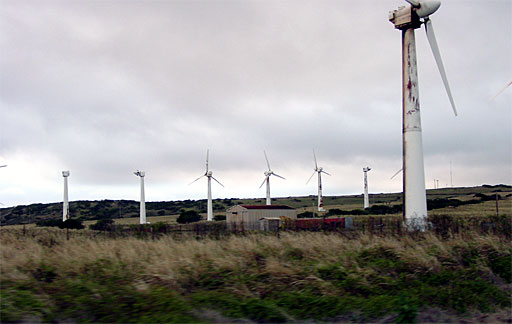
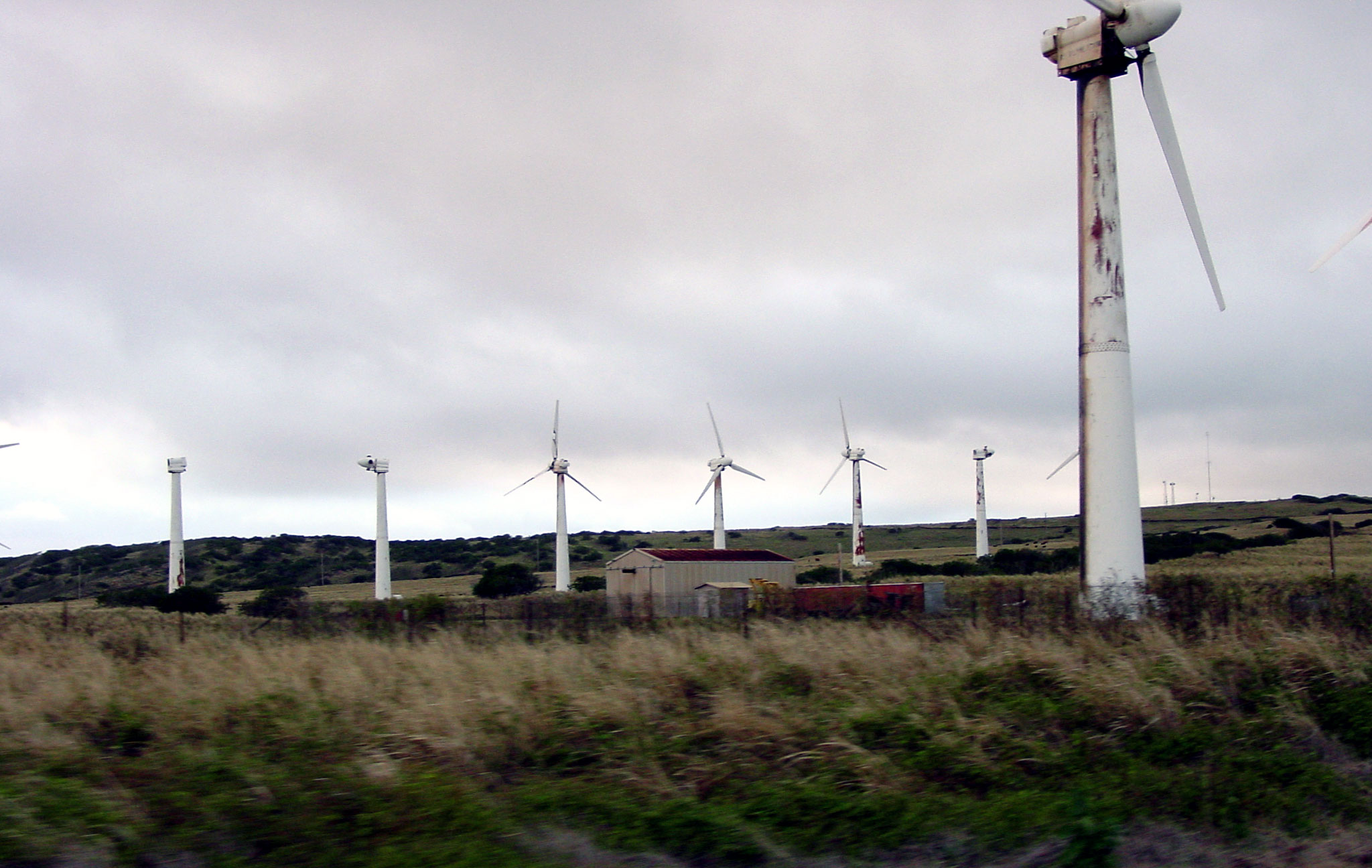
I took this photo when I went home to Hawaii for Christmas:

Image

Click here for a larger version.

It's the windfarm at Kau, built in 1986. Most of the turbines no longer work. Many of the rusting hulks no longer have any blades at all. There's talk of replacing them, but I don't know if it will ever happen.

Only 20 years old, and already decrepit. How are we going to maintain our infrastructure without cheap oil, let alone build new?
User avatar
Leanan
News Editor
News Editor
 
Posts: 4582
Joined: Thu 20 May 2004, 03:00:00

Re: Simple questions for doomers

Unread postby miniTAX » Tue 24 Jan 2006, 14:04:27

$this->bbcode_second_pass_quote('Leanan', 'O')nly 20 years old, and already decrepit. How are we going to maintain our infrastructure without cheap oil, let alone build new?

I think it's just a matter of oil price. If oil was not dirt cheap in the US, maybe American would start building wind farms like the europeans. Here is a Dane off-shore farm (more constant winds), completed almost 10 years ago, with giant turbines (1.5 MW). A wind generator has an uptime of about 25 years. Private investors start to gain money after 10 years. That's already how things are done for some years now in Europe.
Image
User avatar
miniTAX
Lignite
Lignite
 
Posts: 368
Joined: Wed 18 Jan 2006, 04:00:00
Location: Bordeaux
Top

Re: Simple questions for doomers

Unread postby eastbay » Tue 24 Jan 2006, 14:32:52

Ok, these blades seem to have a 25 year lifespan , or thereabouts. In 25 or 50 years from now, what will be used to manufacture the steel for the towers, blades and other mill components and the delivery of these components up the high hills or to isolated locations and offshore locations? Electric ships and heavy trucks? That will be a neat trick.

Steel and other metal production as well as it's mining (or remelting) and transportation requires an incredible amount of oil and is required for the construction of windmills. Is it possible that wind power is basically only a creative way to stretch electricity production a few more months or years past the oil peak?

I suppose we should try anything, but placing our trust in the our energy future in windmills seems like... well, simply jousting at windmills.
Got Dharma?

Everything is Impermanent. Shakyamuni Buddha
User avatar
eastbay
Expert
Expert
 
Posts: 7186
Joined: Sat 18 Dec 2004, 04:00:00
Location: One Mile From the Columbia River

Re: Simple questions for doomers

Unread postby Leanan » Tue 24 Jan 2006, 14:55:34

$this->bbcode_second_pass_quote('', 'I') think it's just a matter of oil price.


I don't. High oil prices also increase the cost of the parts, materials, and transportation. And they depress the economy, making it less likely companies will be willing to invest money.

$this->bbcode_second_pass_quote('', 'I')f oil was not dirt cheap in the US, maybe American would start building wind farms like the europeans. Here is a Dane off-shore farm (more constant winds), completed almost 10 years ago, with giant turbines (1.5 MW).


If that's the Danish windfarm I read about, its existence is due more to government subsidies than private investors.
User avatar
Leanan
News Editor
News Editor
 
Posts: 4582
Joined: Thu 20 May 2004, 03:00:00
Top

Re: Simple questions for doomers

Unread postby miniTAX » Tue 24 Jan 2006, 16:46:59

$this->bbcode_second_pass_quote('eastbay', 'I') suppose we should try anything, but placing our trust in the our energy future in windmills seems like... well, simply jousting at windmills.

Neither do I trust in windmills to solve our problem. It was just an example of how an oil price increase can spur the use of other forms of energy (nuclear, solar, wind, coal...).
Prices will increase to the point that the remaining oil will no more be used for automobiles, but for Kerosene, plastics, fertilizer... which means that the consumption rate will be lower and therefore the after oil time will be delayed.
An abrupt disparition of oil is just mathematically impossible. It's just like other physical phenomena : an exponential decay (radioactivity, fish stock...). There are already posts which talk about this, for example in a replacement-by-coal scenario (see http://peakoil.com/fortopic4367-0-asc-195.html).
As long as oil remains under 100 or even 150$/b, it's still dirt cheap (regarding its precious usage such as plastic, synthetic rubber, cosmetics or fertilizer instead of automobile carburant).
That's the main explanation for why nothing is done yet in the US but I see no reason things won't change with a price hike.

BTW, windmill blades are made from composites of glass fibers and plastic. It's a much better (and low) usage of oil, compared to car propulsion.
User avatar
miniTAX
Lignite
Lignite
 
Posts: 368
Joined: Wed 18 Jan 2006, 04:00:00
Location: Bordeaux
Top

Re: Simple questions for doomers

Unread postby miniTAX » Tue 24 Jan 2006, 16:54:16

$this->bbcode_second_pass_quote('Leanan', '
')If that's the Danish windfarm I read about, its existence is due more to government subsidies than private investors.

It's due to both : governement subsidies AND private investment, just like in France, Spain, Germany...
And the subsidies are just a form of tax lowering or distribution, given the fact that automobile gaz tax accounts for about 80% of gas price (in France).
It's to deter the use of automobile (and home heating with oil) and to encourage the use of energy that doesn't require oil.
User avatar
miniTAX
Lignite
Lignite
 
Posts: 368
Joined: Wed 18 Jan 2006, 04:00:00
Location: Bordeaux
Top

Re: Simple questions for doomers

Unread postby Leanan » Tue 24 Jan 2006, 16:59:28

I think it's going to be harder and harder for nations to subsidize energy. You see that already with developing countries. Even oil-rich Iraq has been forced to raise the price of gasoline, and the people are furious.

The breaking point, I suspect, will be when the average citizen cannot afford whatever it takes to use the energy. (A car, perhaps. Or just the monthly power bill.) They will not want to pay taxes so rich people can still drive their limos. Even if they are hybrid limos.
User avatar
Leanan
News Editor
News Editor
 
Posts: 4582
Joined: Thu 20 May 2004, 03:00:00

PreviousNext

Return to Open Topic Discussion

Who is online

Users browsing this forum: No registered users and 7 guests

cron