


PeakOil is You
how is water brought into our homes ?
Re: how is water brought into our homes ?
 by Doly » Mon 12 Dec 2005, 10:58:16
I don't think oil is very important at all in our water systems. They do need some kind of energy, but I don't have the impression that it's very energy-intensive.
-

Doly - Expert

- Posts: 4370
- Joined: Fri 03 Dec 2004, 04:00:00
Re: how is water brought into our homes ?
by Ancien_Opus » Mon 12 Dec 2005, 12:16:45
Water towers do not normally freeze, especially if they're the correct size.
This is the same concept that water flowing in a river does not freeze, with a little geothermal consideration. Superficial surface ice does form in the elevated tank. Typical water towers are turned over in 24 hours, many are turned over in less time. This means the entire volume of water is exchanged with the users. The water coming into the tower from groundwater is about 50 degrees F and contains a great deal of heat compared to ambient air temperature that may be say -2 degrees F. It will lose some heat to the tower but will regain heat underground during transmission to the homes. The same 50 degree water will feel cool in the heat of summer, even though it was stored above ground as well. Think of this as a collosal heat pump, which could fail if the water stops moving.
A water tower is a form of providing constant pressure to a water system by gravity. The water pump can be run a short amount of time to lift the water into the reservoir when it is needed. Otherwise a pump would have
to run continually either pumping water or air (hydropneumatic systems) to keep water pressure constant in the system. There are variable pressure water pump demand systems in use but they are not very common.
Moving water requires energy. The basic construct of that energy source matters a great deal in light of peak oil. The infrastructure is usually dependent upon transporting and excavating which are largely dependent upon liquid fuels. Considering the most basic components steel, ductile iron, cement or plastic pipes the impact of peak oil will be significant. Most water utilities use electricity to provide the main source of energy for water supply.
Regards,
This is the same concept that water flowing in a river does not freeze, with a little geothermal consideration. Superficial surface ice does form in the elevated tank. Typical water towers are turned over in 24 hours, many are turned over in less time. This means the entire volume of water is exchanged with the users. The water coming into the tower from groundwater is about 50 degrees F and contains a great deal of heat compared to ambient air temperature that may be say -2 degrees F. It will lose some heat to the tower but will regain heat underground during transmission to the homes. The same 50 degree water will feel cool in the heat of summer, even though it was stored above ground as well. Think of this as a collosal heat pump, which could fail if the water stops moving.
A water tower is a form of providing constant pressure to a water system by gravity. The water pump can be run a short amount of time to lift the water into the reservoir when it is needed. Otherwise a pump would have
to run continually either pumping water or air (hydropneumatic systems) to keep water pressure constant in the system. There are variable pressure water pump demand systems in use but they are not very common.
Moving water requires energy. The basic construct of that energy source matters a great deal in light of peak oil. The infrastructure is usually dependent upon transporting and excavating which are largely dependent upon liquid fuels. Considering the most basic components steel, ductile iron, cement or plastic pipes the impact of peak oil will be significant. Most water utilities use electricity to provide the main source of energy for water supply.
Regards,
-

Ancien_Opus - Peat

- Posts: 142
- Joined: Thu 21 Jul 2005, 03:00:00
Re: how is water brought into our homes ?
by Pops » Mon 12 Dec 2005, 12:29:39
"Globally, commercial energy consumed for delivering water is more than 26 Quads, 7% of total world consumption."
http://www.iags.org/n0813043.htm
http://www.iags.org/n0813043.htm
The legitimate object of government, is to do for a community of people, whatever they need to have done, but can not do, at all, or can not, so well do, for themselves -- in their separate, and individual capacities.
-- Abraham Lincoln, Fragment on Government (July 1, 1854)
-- Abraham Lincoln, Fragment on Government (July 1, 1854)
-

Pops - Elite
- Posts: 19746
- Joined: Sat 03 Apr 2004, 04:00:00
- Location: QuikSac for a 6-Pac
Re: how is water brought into our homes ?
by Kaare_Mai » Mon 12 Dec 2005, 13:57:24
" There are variable pressure water pump demand systems in use but they are not very common. "
This is not true here in Denmark Here we seldom use water towers.. Instead we use pumps which are controlled the way i described in my earlier post.
Water towers are something that is seen upon for their historic value here and nothing more.
Btw. ist some funny looking water towers you guys have over there!
This is not true here in Denmark
Here we seldom use water towers.. Instead we use pumps which are controlled the way i described in my earlier post.
Water towers are something that is seen upon for their historic value here and nothing more.
Btw. ist some funny looking water towers you guys have over there!
-

Kaare_Mai - Peat
- Posts: 59
- Joined: Sun 02 May 2004, 03:00:00
- Location: Denmark (Scandinavia)
Re: how is water brought into our homes ?
by Leanan » Mon 12 Dec 2005, 15:18:03
I bet manufacturing chlorine is going to get a lot more expensive post-peak.
-

Leanan - News Editor

- Posts: 4582
- Joined: Thu 20 May 2004, 03:00:00
Re: how is water brought into our homes ?
by aflatoxin » Mon 12 Dec 2005, 15:41:24
Sewer plants can pull a neat trick:
The sewage is processed in a "digester" The low BTU gas (CO2 and Methane) in burned in generators. The electricity is used to run everything in the plant. The waste heat is used to replace boilers.
In Albuquerque, NM, four generators provide enough power to run the entire plant, and export about 1 meg to the grid. The actual output varies based on the ambient temperature.
Anyone with enough mechanical ability can build one of these devices and produce gas from manure.
Landfills can do this as well. Big landfills can produce enough gas to run large turbines.
The sewage is processed in a "digester" The low BTU gas (CO2 and Methane) in burned in generators. The electricity is used to run everything in the plant. The waste heat is used to replace boilers.
In Albuquerque, NM, four generators provide enough power to run the entire plant, and export about 1 meg to the grid. The actual output varies based on the ambient temperature.
Anyone with enough mechanical ability can build one of these devices and produce gas from manure.
Landfills can do this as well. Big landfills can produce enough gas to run large turbines.
-
aflatoxin - Lignite
- Posts: 278
- Joined: Sun 31 Jul 2005, 03:00:00
Re: how is water brought into our homes ?
by thorn » Mon 12 Dec 2005, 16:08:12
It also must take a lot of energy to filter/clean the water and chemicals.
For people with wells, one could use solar power:

http://www.windsun.com/Water/pumpinfo1.htm
Or wind/solar:
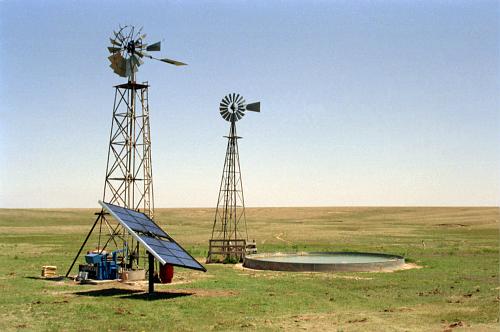
Or if you can not afford the PVs, human power :
:

My well is 450ft deep, it took a large drill rig all day to drill it, lots of diesel fuel!
For people with wells, one could use solar power:
http://www.windsun.com/Water/pumpinfo1.htm
Or wind/solar:
Or if you can not afford the PVs, human power
:
My well is 450ft deep, it took a large drill rig all day to drill it, lots of diesel fuel!
-

thorn - Lignite
- Posts: 263
- Joined: Tue 29 Mar 2005, 04:00:00
- Location: Maryland
Re: how is water brought into our homes ?
by Leanan » Mon 12 Dec 2005, 16:16:40
I saw a news story awhile back about a new kind of manual water pump. I guess you can't really call it a hand pump, because it's actually a foot pump. It has a peddle you push with your foot, instead of a lever you pump by hand. They claimed it was very sturdy, built to last generations, but cheap and low-tech. They are installing them in Third World rural areas, where electric pumps are out of the question. Supposedly, they were much more efficient and easy to operate than traditional hand pumps.
-
Leanan - News Editor
- Posts: 4582
- Joined: Thu 20 May 2004, 03:00:00
Re: how is water brought into our homes ?
by nth » Mon 12 Dec 2005, 17:32:00
Talking about water, surprisingly U.S. water usage has been the same for many years.
I wonder how long this can last with some experts claiming the relative stable usage is still too high.
I wonder how long this can last with some experts claiming the relative stable usage is still too high.
-

nth - Heavy Crude

- Posts: 1978
- Joined: Thu 24 Feb 2005, 04:00:00
Re: how is water brought into our homes ?
by The_Toecutter » Mon 12 Dec 2005, 20:17:53
$this->bbcode_second_pass_quote('', 'A')ncient Rome had ONE million people, I wouldn't exactly call it "few people"! Laughing
They had fresh water, pipes running under the streets like today, taps and basins. So I guess we could do without oil (dunno about purification...).
They're always proudly saying that actually Rome still uses that system in some areas. I tried but I didn't find any reference about the area I live.
They had fresh water, pipes running under the streets like today, taps and basins. So I guess we could do without oil (dunno about purification...).
They're always proudly saying that actually Rome still uses that system in some areas. I tried but I didn't find any reference about the area I live.
Please re-read my statment. I didn't say the population was few, just far much fewer than those 12 million population megacities we have today.
The unnecessary felling of a tree, perhaps the old growth of centuries, seems to me a crime little short of murder. ~Thomas Jefferson
-

The_Toecutter - Intermediate Crude
- Posts: 2142
- Joined: Sat 18 Jun 2005, 03:00:00
Re: how is water brought into our homes ?
by TnAndy » Thu 15 Dec 2005, 17:55:19
Dunno about the rest of ya'll, but my water source is a spring that the water gravity feeds into a couple of 1500 gallon tanks, then gravity feeds on down to my house......and I own the mountain that is the watershed......so unless we get a protracted drought, my water is energy free.....also monetarily free.

-
TnAndy - Peat
- Posts: 100
- Joined: Wed 31 Aug 2005, 03:00:00
31 posts
• Page 2 of 2 • 1, 2
Return to Open Topic Discussion
Who is online
Users browsing this forum: No registered users and 2 guests