Donate Bitcoin

Donate Paypal


PeakOil is You

PeakOil is You

M. King Hubbert on

General discussions of the systemic, societal and civilisational effects of depletion.

Re: Hubbert's peak derived

Unread postby hybrid » Thu 27 Oct 2005, 12:52:59

In response to WebHubbleTelescope:

$this->bbcode_second_pass_quote('WebHubbleTelescope', 'I') don't understand how the term A(t) can be separated out of the solution. If this really did solve the partial differential equation, A(t) should reduce to a constant. Otherwise A(t) is a function of Ve(t), which is what you are trying to solve for!


Thanks for your posting. However, A(t) represents the variable in the model that is controlled. When oil is extracted someone determines how many wells to drill and how much to open the flow through these wells, etc. Notice when Smiley numerically solves the toy model, the first step is to specify a function for A(t) and then to see what d(Ve)/dt results. Our only point is that it is possible to choose an A(t) that results in an analytic solution and this solution is a form of the logistic curve. Of course, the obvious question is then, is this a plausible A(t)? Does this even remotely resemble how the number of wells in a real field might be deployed. And, in fact, the A(t) that gives a nice analytic solution is arguably reasonable. It initially increases, as it must, to drive up the extraction rate. But after the extraction rate peaks the A(t) we chose also peaks, suggesting that wells are being shut down as a field matures. Remember the point of Smiley's toy model is not to predict the behavior of real fields--much more sophisticated models exist to do that. The point is to give a bit of physical insight as to why peaking occurs at about the time that half the recoverable oil has been extracted. Our analytic solution makes this point nicely.
User avatar
hybrid
Wood
Wood
 
Posts: 3
Joined: Mon 17 Oct 2005, 03:00:00

Re: Hubbert's peak derived

Unread postby WebHubbleTelescope » Thu 27 Oct 2005, 22:41:02

$this->bbcode_second_pass_quote('hybrid', 'I')n response to WebHubbleTelescope:

$this->bbcode_second_pass_quote('WebHubbleTelescope', 'I') don't understand how the term A(t) can be separated out of the solution. If this really did solve the partial differential equation, A(t) should reduce to a constant. Otherwise A(t) is a function of Ve(t), which is what you are trying to solve for!


Thanks for your posting. However, A(t) represents the variable in the model that is controlled. When oil is extracted someone determines how many wells to drill and how much to open the flow through these wells, etc. Notice when Smiley numerically solves the toy model, the first step is to specify a function for A(t) and then to see what d(Ve)/dt results. Our only point is that it is possible to choose an A(t) that results in an analytic solution and this solution is a form of the logistic curve. Of course, the obvious question is then, is this a plausible A(t)? Does this even remotely resemble how the number of wells in a real field might be deployed. And, in fact, the A(t) that gives a nice analytic solution is arguably reasonable. It initially increases, as it must, to drive up the extraction rate. But after the extraction rate peaks the A(t) we chose also peaks, suggesting that wells are being shut down as a field matures. Remember the point of Smiley's toy model is not to predict the behavior of real fields--much more sophisticated models exist to do that. The point is to give a bit of physical insight as to why peaking occurs at about the time that half the recoverable oil has been extracted. Our analytic solution makes this point nicely.


No, if you want to see how peaking is physically derived, deconvolve the production curve with the discovery curve. If you do that right, you get a scalar extraction rate that is proportional to how much is left in the reservoir. You will notice this is largely a constant proportional to how much is left to be extracted, except for slight perturbations around the times of oil shocks.
User avatar
WebHubbleTelescope
Tar Sands
Tar Sands
 
Posts: 950
Joined: Thu 08 Jul 2004, 03:00:00

Re: Hubbert's peak derived

Unread postby hybrid » Fri 28 Oct 2005, 16:57:52

Keep in mind that even though initial P and T could be specified in the toy model based on conditions for a real field, T would change as the oil is extracted from the field over many years. The water/oil contact line will rise, driving the oil up, and since depth is changing, temperature will change. However the toy model assumes isothermal conditions. Again it is probably best to think of the toy model as giving physical insight and a very rough description of how one might expect the extraction rate in a field to vary. It cannot likely compare closely with real quantitative data for real fields.
User avatar
hybrid
Wood
Wood
 
Posts: 3
Joined: Mon 17 Oct 2005, 03:00:00

Re: Hubbert's peak derived

Unread postby WebHubbleTelescope » Fri 28 Oct 2005, 20:29:41

$this->bbcode_second_pass_quote('hybrid', 'K')eep in mind that even though initial P and T could be specified in the toy model based on conditions for a real field, T would change as the oil is extracted from the field over many years. The water/oil contact line will rise, driving the oil up, and since depth is changing, temperature will change. However the toy model assumes isothermal conditions. Again it is probably best to think of the toy model as giving physical insight and a very rough description of how one might expect the extraction rate in a field to vary. It cannot likely compare closely with real quantitative data for real fields.


Those are all second and third-order effects. No use going to all that trouble when the first-order effects give the macro effects. You can say the same thing about how an electrical capacitor works. If you look closely at the problem, you get stuck in the world of quasi-static electromagnetics; however, make the "toy" approximation that C varies in proporation to A and inversely to D, then you can basically predict behavior. So it is with the first-order oil depletion model.

So too, it is not important that you can disprove my first-order model. I can easily disprove the first-order capacitor model. On the other hand, what you can't do is disprove it's utility.
User avatar
WebHubbleTelescope
Tar Sands
Tar Sands
 
Posts: 950
Joined: Thu 08 Jul 2004, 03:00:00

Who was this Hubbert fella really?

Unread postby rockdoc123 » Tue 22 Nov 2005, 19:29:16

It's likely safe to say that virtually everyone who spends sometime on this website knows about "Hubberts Peak". But I don't think they really understand who the man was and the large impact he had on the geologic sciences.
So I thought I would summarize my knowledge of who Marion “King” Hubbert was. He obtained a BSc and MSc in 1928 from U of Chicago, PhD. 1937 from Columbia. In 1937 we see some of the first evidence of Hubbert’s out of the box thinking whereby he came up with the view that even though rocks behave as brittle material at standard temperature and pressure when they are buried at great depths and under slow strain rates, rocks tend to behave more plastically (imagine a bucket of wet fine grained sand).His paper entitled “Theory of scale models as applied to the study of geologic structures” published in the Geologic Society of America Bulletin volume 48 was the start of a whole range of research into rock mechanics, basically through the use of scaling equations which allow geologic structures to be replicated by trying to find materials and conditions that mimic geometric, kinematic and dynamic boundary conditions the real structures experienced. Over the following years numerous Ph.D. theses and NRC grants were awarded for modeling work conducted in real rock as well as analog materials…..much of the work having direct applications in earthquake research.
Another fallout of his thesis research appeared as a paper entitled “The theory of ground-water motion”, which was published in the Journal of Geology in 1940. This was one of the first attempts to look at the flow of subsurface fluids using the equations developed for fluid dynamics. This paper along with more in-depth analysis that Hubbert published later formed the basis for research into how fluids (oil, water, gas) migrate in the subsurface and how flow from boreholes can be predicted and analyzed. His much later paper published in Transactions of the American Institute of Mining and Metalurgical Engineering in 1956 “Darcy’s law and the field equations of the flow of underground fluids” really made a difference with application of Darcy’s law eventually becoming one of the pillars of reservoir engineering. It also helped to focus attention on what were thought to be non-conventional hydrocarbon trapping mechanisms previously, basically opening up a whole new area for exploration….the so-called hydrodynamic trap. It was through this work that we saw the first mathematical rationale for tilted oil/water contacts, a phenomena that is quite common in the Middle East oilfields.

In 1943, Hubbert joined the Shell Oil Company in Houston, where for several years he directed the Shell research laboratory, which was at the time where a lot of ground breaking petroleum related research was being conducted. A great number of scientists who would become famous in their own right worked under his direction (Bert Bally’s name comes to mind). While at Shell, Hubbert published a number of papers in the fifties that changed conventional thinking in the field of rock mechanics and structural geology. His paper published in the Geologic Society of America Bulletin in 1951 entitled “Mechanical basis for certain familiar geologic structures” was really the first piece of work that got structural geologists thinking in a “cause-effect” relationship and became the foundation by which geologists to this day attempt to reconstruct deformational histories from the rock record. In 1957, along with D. Willis, Hubbert published a paper “Mechanics of hydraulic fracturing” (Journal of Petroleum Technology, volume 9) which was probably the first bit of work that got structural geologists thinking about the importance of fluids and fluid pressures to rock strength and hence basin deformation. The two classic papers by Hubbert and Rubey and Rubey and Hubbert in 1959 “The role of fluid pressure in mechanics of overthurst faulting, Part I and Part II” were truly ground breaking papers in that they explained how it was possible for massive thrust sheets tens of kilometers in length and thickness to move….their theory being that increased confining pressure of fluids in pore spaces enabled the thrust sheets to basically “float”. Suddenly we could look to the Rockies, the Andes or the Alps and not have the question in our mind….”how the hell did that happen?”.

Of course during this period at Shell Hubbert also published his theories on Darcy’s law application to analysis of oil and gas accumulations and production as well as the work everyone here is most familiar with….his projections for oil production decline in the US. After retiring from Shell in 1964, Hubbert joined the United States Geological Survey as a senior research geophysicist, a position he held until 1976. Throughout that period he concentrated his publication efforts in areas that we now call Technocracy, some to do with energy usage, some to do with population increases and demands.

All in all an amazing career. Although he has gained recent popularity amongst the general populace for his Peak Oil related research, it is in fact his research into fluids, rock mechanics and structural geology that influenced an entire generation of geoscientists. :)
User avatar
rockdoc123
Expert
Expert
 
Posts: 7685
Joined: Mon 16 May 2005, 03:00:00

Re: Trying to understrand geology behind Hubbert's Method

Unread postby rockdoc123 » Tue 06 Dec 2005, 20:06:29

I think simply what Hubbert was illustrating is that any individual pool has a finite amount of oil but perhaps an infinite amount of water (assuming water drive that is continually replinished). So as time goes on you can produce at X rate but your water cut continues to rise. Before you know it you are producing mostly water and it isn't too long (for smaller reservoirs) before you are producing almost all water. As a consequence you can drill infill wells to increase the overall fluid offtake (the more fluid you produce the more oil) but no matter what the oil is limited....it isn't replenished and there is an economic limit to how many wells you can drill and hence the maximum water cut you can manage.
There are of course other issues specific to certain reservoirs including fines migration (higher flow rates can migrate clays into pore throats and completely plug off production), water by-passing, water coning etc. that can make fields see a premature rapid decline (often can be recovered with various technologies). But the over riding point is the oil is limited.
User avatar
rockdoc123
Expert
Expert
 
Posts: 7685
Joined: Mon 16 May 2005, 03:00:00

Re: Trying to understrand geology behind Hubbert's Method

Unread postby EnergySpin » Wed 07 Dec 2005, 03:32:32

$this->bbcode_second_pass_quote('pstarr', 'T')hanks a lot for the answers. I am must curious, but are all oil wells susceptible to water incursion? Are there no wells anwhere above local water tables or in very dry deserts?

pete

To answer the point in your second post:

I believe that at some point one has to flood the reservoir with water no matter what. Even in the desert there bound to be underground water formations ... and IIRC there is water in any oil field.

Regarding Hubbert and the origin of the curve in general. It might help your understanding of the problem if you looked at the man himself, not just at the mathematical model.

Rockdoc posted an abbreviated biography of Hubbert at po.com
http://peakoil.com/post220975.html#220975

It is likely that he thought of his curve as an approximation to the more detailed mathematical models that he developed. If this is the case, then Hubbert was probably the first person to think along the lines of model embedding.

It is also equally possible that the curve stemmed from his association with the Technocracy movement in the 1930s. The 30s was a wild period for science. Lotka had just published his system of differential equations which we use to model populations in ecology, and Volterra had just did the same for chemical reactions. To the engineers/scientists of that era , the fact that these two widely different phenomena could be described with the same equation this must have been quite a shocking discovery. From a historical perspective it makes a lot of sense that Hubbert did start processing this idea subconsciously back then ... and it only emerged much later.
But I do not think we will ever know ... but it is very interesting indeed.
"Nuclear power has long been to the Left what embryonic-stem-cell research is to the Right--irredeemably wrong and a signifier of moral weakness."Esquire Magazine,12/05
The genetic code is commaless and so are my posts.
User avatar
EnergySpin
Intermediate Crude
Intermediate Crude
 
Posts: 2248
Joined: Sat 25 Jun 2005, 03:00:00
Top

Re: Trying to understrand geology behind Hubbert's Method

Unread postby bobcousins » Wed 07 Dec 2005, 08:07:13

We seem to have got a little sidetracked about water cut due to a misunderstanding by Rockdoc. But the picture is a bit more complex than just permeability. Water wells simply bore into a water table, but oil is held in reservoirs which are under pressure (due to the buoyancy of the oil, and a cap of impermeable rock). The pressure effectively increases the 'natural' recharge rate related to flow of oil through the rock. So a single well in a large field would initially quickly reach a maximum flow, which would reduce slowly as pressure declines.

I think your observation that there is a diminishing return for wells per unit area hits the nail on the head, and is the key reason why we get the classic curve.

In principle, there is no reason why we start producing with one well and increase the number of wells. You could drill all the wells first and then start production, in which case the production curve would look very different to the familiar shape.

In practice, economic reasons dictate starting with one producing well, and then increasing the number. You need to start making money as soon as possible, which then funds further drilling.

You can read the 1956 paper by Hubbert here. In fact he doesn't seem to consider geology much. He looks at production data from oil fields, then derives a model from first principles and fits it to the production curves. Hubbert's model in fact allows for an infinite variety of possible production curves, and does not predict or require a "classic" bell curve with a single peak.
It's all downhill from here
User avatar
bobcousins
Heavy Crude
Heavy Crude
 
Posts: 1164
Joined: Thu 14 Oct 2004, 03:00:00
Location: Left the cult

Re: Trying to understrand geology behind Hubbert's Method

Unread postby rockdoc123 » Wed 07 Dec 2005, 11:26:59

$this->bbcode_second_pass_quote('', 'W')e seem to have got a little sidetracked about water cut due to a misunderstanding by Rockdoc. But the picture is a bit more complex than just permeability. Water wells simply bore into a water table, but oil is held in reservoirs which are under pressure (due to the buoyancy of the oil, and a cap of impermeable rock). The pressure effectively increases the 'natural' recharge rate related to flow of oil through the rock. So a single well in a large field would initially quickly reach a maximum flow, which would reduce slowly as pressure declines.


not a misunderstanding at all (this is a field of endeavour I have been working in for about 30 years so I think I understand it fairly well). Of course oil is under pressure...but presence of a strong water drive keeps it under pressure (hence high primary recovery rates)...your model speaks only to fields which produce under their own energy.....ie. depletion drive or gas expansion drive. In a field where there is a strong water drive (there are many of these...a good example would be the Miocene sand reservoirs in the Gulf of Suez) there is complete voidage replacement of oil by formation water....the pressure of the overall reservoir does not deplete. This is the exact reason why you can not do material balance calculations of reserves in fields with natural water drives. In practice a field under water injection (eg. Ghawar) behaves exactly like a field with a strong natural water drive as long as voidage replacement is met. As well conventional practice in reservoirs that produce under gas expansion or depletion drive is to reinject gas into the gas cap and inject water to replace voidage...thus simulating the effect you would have in a field with natural water drive.

As to pstars question regarding fields without water. Not all fields have natural water drives (endless supply of formation water). That being said all fields have some amount of water present in the pore space. This water is derived from various sources. It could be old water from seas or lakes that was trapped in pore space during burial and lithification, it could be water that formed through various chemical reactions...either organic (source rock maturation process releases H2O in the early phases) or inorganic (mineralogic changes due to soluability changes can release water). The difference is that natural water drives have almost limitless water whereas you could presumeably produce all of the other water (with the exception of that which is bound and remains as irreduceable water) prior to finishing producing all of the oil. In the latter case water cut in the field would not increase.
User avatar
rockdoc123
Expert
Expert
 
Posts: 7685
Joined: Mon 16 May 2005, 03:00:00
Top

How Reliable is the Hubbert Linearization Method?

Unread postby khebab » Sun 08 Jan 2006, 00:44:37

Motivation:

The Hubbert linearization is a simple method to estimate the parameters (URR and growth rate K) of the logistic model. It consists in plotting the ratio of Production on cumulative production versus cumulative production (P/Q vs Q). This representation is often used as a predictive tool, see for instance the excellent threads posted by Stuart staniford on TOD:

Four US Linearizations
Hubbert Theory says Peak is Slow Squeeze

This method gives impressive results on mature countries. For instance Norway:

ImageImage

I'm trying to answer the following questions:
    1- is the Hubbert linearization a good approach in the estimation of the URR and production growth rate?
    2- what confidence levels can I have on these estimates?
    3- is it a good predictive tool on immature data (far from the production midpoint)?

I'm not discussing here the validity of the logistic model for the depletion modeling of oil fields. I'm assuming that it is a valid model.

Methodology:

The proposed approach consists in generating a pool of random datasets from a known logistic curve on which we apply the Hubbert linearization method to estimate the URR and K. The true parameter values are the following (Hubbert model for the US production):
$this->bbcode_second_pass_code('', 'URR= 222.34 Gb
K= 6.08 %')
I consider 7 levels of maturity (20%, 30%, 40%, 50%, 60%, 70%, 80%). 50% corresponding to the production midpoint and below this value the dataset is considered immature. For each level, I simulate 1,000 datasets constructed from the true logistic curve on which I add a gaussian random noise of standard-deviaiton equals to 0.12 Gb (Note: this value is derived from the residuals of the logistic model applied on the US production data).
[align=center]Image
Example of a random data set: simulated production on the left and hubbert linearization on the right. The red curve corresponds to the true logistic curve. The blue points are the data used for the Hubbert Linearization. [/align]

Results:

The distribution of the relative error is derived from all the estimates from which we produce the following curves:

[align=center]Image
Observed precision for the URR parameter estimation for different levels of maturity.
We define Precision as the maximum absolute relative error wanted on the parameter. The confidence is the percentage of estimates that have reached a particular precision.
[/align]
[align=center]Image
Observed precision for the K estimation for different levels of maturity.
We define Precision as the maximum absolute relative error wanted on the parameter. The confidence is the percentage of estimates that have reached a particular precision.
[/align]
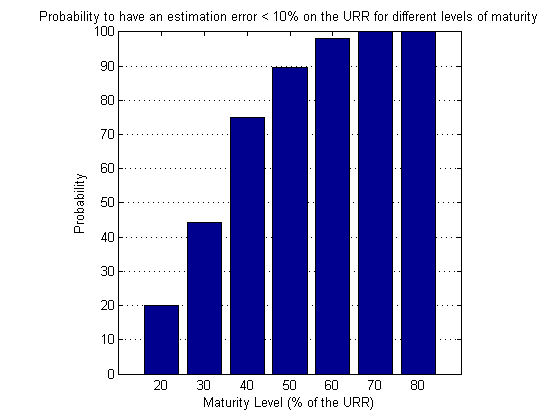
We can observe that the estimation is much more precise for K than for the URR. If we decide to tolerate a maximum of relative error below 10%, we have the following probabilities to be sucessful:

[align=center]Image
[/align]

[align=center]Image[/align]

Discussion:

The Hubbert linearization seems to be a good tool to estimate the growth rate even on immature production data (we have 90% of chance to estimate K with less than 10% of error when only 30% of the URR has been produced). However, for the URR estimation we need to reach the production midpoint to have the same confidence level.

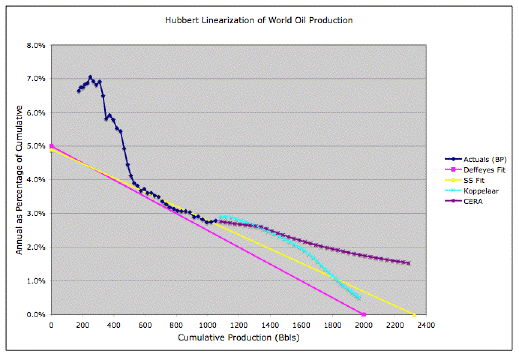
Regarding the Hubbert Linearization applied to the world production, there are a lot of evidence that we are now near 45% of the URR which means that we can be about 80% confident that the URR is around 2,350 Gb+/- 10% which is the value resulting from the Hubbert linearization (see figure below).

[align=center]Image
From Stuart Staniford on TOD (Hubbert Theory says Peak is Slow Squeeze)
[/align]
Last edited by khebab on Sat 14 Jan 2006, 10:30:12, edited 2 times in total.
______________________________________
http://GraphOilogy.blogspot.com
khebab
Tar Sands
Tar Sands
 
Posts: 899
Joined: Mon 27 Sep 2004, 03:00:00
Location: Canada

Re: How Reliable is the Hubbert Linearization Method?

Unread postby bantri » Sun 08 Jan 2006, 08:49:34

nice graphs khebab

here´s a little more inspiration to the linearization process

important: cumulative production graphs are analog to overshoot graphs, hence, they are squished beetween two exponentials, consequently they
linearize very fast

Image

it´s easy to "cook" the angular factor of the linearized graph and a small rotation in the line produces a wide result in the crossing beetween the linearized line and the X axis, but when extraction data is true, the linearization allows predictions like hubbert´s one, 14 years (-+)1year.

when you deal with random data squished beetween two exponentials (narrowing or widening along time), it´s possible to fit the data using black and scholes model which is being done for triggering decision making in stock options.

Image

and the decision process is done using this kind of graphic:

Image

does the curve on the right looks familiar?
User avatar
bantri
Wood
Wood
 
Posts: 43
Joined: Thu 24 Feb 2005, 04:00:00

Re: How Reliable is the Hubbert Linearization Method?

Unread postby pup55 » Sun 08 Jan 2006, 09:52:26

$this->bbcode_second_pass_quote('', 'R')egarding the Hubbert Linearization applied to the world production, there are a lot of evidence that we are now near 45% of the URR which means that we can be about 80% confident that the URR is around 2,350 Gb+/- 10% which is the value resulting from the Hubbert linearization (see figure below).


Khebab:

Congratulations on an excellent post!

I think the key point is the one above: accuracy of the method improves the farther to the right on the extraction curve you go.

If Spike were to review this, he would say that at present levels of apparent extraction, there is still a possibility of new discoveries, etc. that would extend the oil supply sufficiently to give us more time before the peak. What you are saying is that there is indeed this possibility, and it's about 10% that the URR will be greater than 2580 gb (2350+10%). It's also 10% possible that URR will be less than about 2000 gb.

This is just about enough chance to give the cornucopians some hope, but allow the doomers to continue to make their survival plans. Ironically, even at 90% extraction, there is still some uncertainty, which says that the cornucopians will be able to hang on to some hope right up until the end.

Gives one something to think about.....
User avatar
pup55
Light Sweet Crude
Light Sweet Crude
 
Posts: 5249
Joined: Wed 26 May 2004, 03:00:00
Top

Re: How Reliable is the Hubbert Linearization Method?

Unread postby khebab » Sun 08 Jan 2006, 11:32:01

$this->bbcode_second_pass_quote('bantri', 'h')ere´s a little more inspiration to the linearization process

important: cumulative production graphs are analog to overshoot graphs, hence, they are squished beetween two exponentials, consequently they
linearize very fast

Thanks for the comments, very interesting! It seems that the properties of the Hubbert linearization are quite general and are independent of the function considered as long as it is a positive function. For instance, If I strongly pertubate the curve with a periodic signal (cosinus), I still have a good fit:
Image
Curiously, there is no litterature on that subject.
$this->bbcode_second_pass_quote('pup55', 'I')f Spike were to review this, he would say that at present levels of apparent extraction, there is still a possibility of new discoveries, etc. that would extend the oil supply sufficiently to give us more time before the peak.

In a next post, I wish to explore the link between the discovery pattern (i.e. the amount of yet to be find discoveries) and the result of Hubbert linearization but it's a complex problem.
$this->bbcode_second_pass_quote('pup55', 'W')hat you are saying is that there is indeed this possibility, and it's about 10% that the URR will be greater than 2580 gb (2350+10%). It's also 10% possible that URR will be less than about 2000 gb.

Yes, you're right, the estimate could be lower but the error is not spread uniformly and estimates for the URR have a tendency to be underestimated before maturity. I will try to make another figure about that.
______________________________________
http://GraphOilogy.blogspot.com
khebab
Tar Sands
Tar Sands
 
Posts: 899
Joined: Mon 27 Sep 2004, 03:00:00
Location: Canada
Top

Re: How Reliable is the Hubbert Linearization Method?

Unread postby WebHubbleTelescope » Mon 09 Jan 2006, 00:07:19

$this->bbcode_second_pass_quote('khebab', 'F')or instance, If I strongly pertubate the curve with a periodic signal (cosinus), I still have a good fit:


Such is the power of integration.
User avatar
WebHubbleTelescope
Tar Sands
Tar Sands
 
Posts: 950
Joined: Thu 08 Jul 2004, 03:00:00
Top

Re: How Reliable is the Hubbert Linearization Method?

Unread postby WebHubbleTelescope » Mon 09 Jan 2006, 00:15:23

Actually that brings up a very good point. The peak region is the only meaty part of the fit. Any curve that has a parabolic fit around the peak will give a good Hubbert Linearization. And since every symmetric peak is approximated by an upside-down parabola (i.e. quadratic) due to Taylor-series, that means that just about any peaked curve will work.
User avatar
WebHubbleTelescope
Tar Sands
Tar Sands
 
Posts: 950
Joined: Thu 08 Jul 2004, 03:00:00

Re: How Reliable is the Hubbert Linearization Method?

Unread postby Raminagrobis » Mon 09 Jan 2006, 04:22:59

Good post.

Your calcuations show good precision of hubbert prediction, but one could object than you take as guaranted that production is generally hubbert-shaped, with some random variations around the base hubbert curve.

There are countries where production is not Hubbert-shaped at all, for one of the following reasons :
# Production quotas (opec countries)
# disruption by war, embargo (Iraq), political collapse (FSU)
# several distinct production zones with large time lag, then production can be modelled as the sum of two or more hubbert cycles.
# production is constrainbed by pipeline capacity (Chad, Ecuador...).

Now, according to your results, if the production is "free" (no constraint => hubbert shape), we can have a reasonnably good estimation of URR even with only the 20% first percents of it gone. Then perharps we could get some rough estimation of Middle East's ultimate using figures up to 1980, before the quota were established ?

Also, any model is only as good as th input data you throw in. For historical figure, I currently use BP statistical review, but it has some flaws.
It only starts in 1965. For some countries, I'd like to have figures going somewhat further in the past.

Also, it includes refinry gain. Refinery gain has nothing to do with production, it can be done from imported crude, and depends of the market structure (it is higher when refiners maximize gasoline output, like in the us).

Where could I find historical figures excludin refinery gain? It would be even better to have a split into crude, NGL's, and non-conventionnal production.
User avatar
Raminagrobis
Wood
Wood
 
Posts: 25
Joined: Mon 18 Jul 2005, 03:00:00

Re: How Reliable is the Hubbert Linearization Method?

Unread postby bantri » Mon 09 Jan 2006, 12:24:19

$this->bbcode_second_pass_quote('', '
')Curiously, there is no litterature on that subject.


To my current knowledge there´s none.
(just sharing a little 2+2=4 here:)
Just assume that separate areas of knowledge (financial, physical and energy related, in this case) connect at some point, and keep researching.

Extra Hint:
The simulation using the sum of a hubbert curve and a constant amplitude cosine wave is useful to reach the conclusion that the linearization process narrows along time, but, when comparing with real models, it´s possible to conclude that this simulation doesn´t narrow as fast as the real ones.
i suggest a simulation using a DAMPED cosine wave, where it´s possible to adjust the damping factor to fit the curve better for comparison with true and real measurements (like Norway´s) without "human adjusted" factors.
more on this later....
User avatar
bantri
Wood
Wood
 
Posts: 43
Joined: Thu 24 Feb 2005, 04:00:00
Top

Re: How Reliable is the Hubbert Linearization Method?

Unread postby khebab » Mon 09 Jan 2006, 13:02:04

$this->bbcode_second_pass_quote('WebHubbleTelescope', 'S')uch is the power of integration.

Exactly :)
$this->bbcode_second_pass_quote('WebHubbleTelescope', 'A')ctually that brings up a very good point. The peak region is the only meaty part of the fit. Any curve that has a parabolic fit around the peak will give a good Hubbert Linearization. And since every symmetric peak is approximated by an upside-down parabola (i.e. quadratic) due to Taylor-series, that means that just about any peaked curve will work.

You're right, for a small time step d around the production peak at t[sub]mid[/sub], Q is a straight line and P a quadratic:
P(t[sub]mid[/sub]+d)= P(t[sub]mid[/sub]) + P''(t[sub]mid[/sub]).d[sup]2[/sup]/2+O(d[sup]3[/sup])
Q(t[sub]mid[/sub]+d)= Q(t[sub]mid[/sub]) + P(t[sub]mid[/sub]).d+O(d[sup]3[/sup])

Therefore, a first order approximation of P/Q around the peak should be a decreasing straight line:

(P/Q)(t[sub]mid[/sub]+d)~ (P/Q)(t[sub]mid[/sub])(1-P(t[sub]mid[/sub]).d)+O(d[sup]2[/sup])
______________________________________
http://GraphOilogy.blogspot.com
khebab
Tar Sands
Tar Sands
 
Posts: 899
Joined: Mon 27 Sep 2004, 03:00:00
Location: Canada
Top

PreviousNext

Return to Peak Oil Discussion

Who is online

Users browsing this forum: No registered users and 26 guests

cron