PeakOil is You
Waiting for the lights to go out
Re: Waiting for the lights to go out
 by rogerhb » Wed 26 Oct 2005, 03:24:45
$this->bbcode_second_pass_quote('lotrfan55345', 'D')on't worry, I can turn it off for you.

Well done, that man.
"Complex problems have simple, easy to understand, wrong answers." - Henry Louis Mencken
-

rogerhb - Light Sweet Crude

- Posts: 4727
- Joined: Mon 06 Sep 2004, 03:00:00
- Location: Smalltown New Zealand
Re: Waiting for the lights to go out
by bobcousins » Wed 26 Oct 2005, 07:55:59
$this->bbcode_second_pass_quote('Omnitir', ' ')The fact is, the technology to save us from peak oil largely already exists, and has for many decades.
The requirements to implement a tech-fix to PO isn’t radical new developments in technology,
The requirements to implement a tech-fix to PO isn’t radical new developments in technology,
Technology is the answer!
No wait, technology is NOT the answer!
Changing people's mindset is the problem. Technology is the equivalent of a mechanical digger; it leverages the power of thought (instead of muscles). Like the digger, people use technology to accelerate resource depletion. But technology is not the cause of resource depletion, and therefore not the solution.
It's all downhill from here
-

bobcousins - Heavy Crude

- Posts: 1164
- Joined: Thu 14 Oct 2004, 03:00:00
- Location: Left the cult
Re: Waiting for the lights to go out
by doufus » Wed 26 Oct 2005, 08:38:25
$this->bbcode_second_pass_quote('Russian_Cowboy', 'T')here are some hard facts supporting the hypothesis that the rate of inventions is declining. I can come up with two. The first one is the shrinking salaries of research workers and growing unemployment among them. The second fact is more specific to the pharmaceutical industry:

Err, this is yr of first launch- i assume that means to market...?
Could this be explained by tougher regulatory requirements?
A better index is just new molecules/yr.
-

doufus - Lignite

- Posts: 202
- Joined: Tue 02 Aug 2005, 03:00:00
Re: Waiting for the lights to go out
by doufus » Wed 26 Oct 2005, 09:04:45
$this->bbcode_second_pass_quote('Jack', 'R')egarding the Peak Oil Problem, from the article:
$this->bbcode_second_pass_quote('', '
')Even if we did throw money at the problem, it's not certain we could fix it. One of the strangest portents of the end of progress is the recent discovery that humans are losing their ability to come up with new ideas.
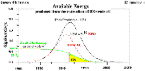
Jonathan Huebner is an amiable, very polite and very correct physicist who works at the Pentagon's Naval Air Warfare Center in China Lake, California. He took the job in 1985, when he was 26. An older scientist told him how lucky he was. In the course of his career, he could expect to see huge scientific and technological advances. But by 1990, Huebner had begun to suspect the old man was wrong. "The number of advances wasn't increasing exponentially, I hadn't seen as many as I had expected — not in any particular area, just generally."
Puzzled, he undertook some research of his own. He began to study the rate of significant innovations as catalogued in a standard work entitled The History of Science and Technology. After some elaborate mathematics, he came to a conclusion that raised serious questions about our continued ability to sustain progress. What he found was that the rate of innovation peaked in 1873 and has been declining ever since. In fact, our current rate of innovation — which Huebner puts at seven important technological developments per billion people per year — is about the same as it was in 1600. By 2024 it will have slumped to the same level as it was in the Dark Ages, the period between the end of the Roman empire and the start of the Middle Ages.
$this->bbcode_second_pass_quote('', '
')Even if we did throw money at the problem, it's not certain we could fix it. One of the strangest portents of the end of progress is the recent discovery that humans are losing their ability to come up with new ideas.
Jonathan Huebner is an amiable, very polite and very correct physicist who works at the Pentagon's Naval Air Warfare Center in China Lake, California. He took the job in 1985, when he was 26. An older scientist told him how lucky he was. In the course of his career, he could expect to see huge scientific and technological advances. But by 1990, Huebner had begun to suspect the old man was wrong. "The number of advances wasn't increasing exponentially, I hadn't seen as many as I had expected — not in any particular area, just generally."
Puzzled, he undertook some research of his own. He began to study the rate of significant innovations as catalogued in a standard work entitled The History of Science and Technology. After some elaborate mathematics, he came to a conclusion that raised serious questions about our continued ability to sustain progress. What he found was that the rate of innovation peaked in 1873 and has been declining ever since. In fact, our current rate of innovation — which Huebner puts at seven important technological developments per billion people per year — is about the same as it was in 1600. By 2024 it will have slumped to the same level as it was in the Dark Ages, the period between the end of the Roman empire and the start of the Middle Ages.
Much more at: LINK
So, if Huebner is correct, it is most unlikely that technology will save us.
Still, my doomer index remains at 5.25. For the time being.
If the article stuck to technology it might have some cred but it's a mish
mash of everything up to and including the ethics of torture. jeez.
There may be some element of truth. Perhaps the easy problems are
solved e.g. 2 logs make a lever and u can build a pyramid with that.
A fusion reactor is much harder but immensely more significant.
A great deal of science gets stuck at hard problems then gets a
breakthrough and the subsequent technologies reach a very quick
peak e.g. aircraft. The peak aircraft of the 30s had the performance
of most modern light aircraft.
The next biggie is definitely biotech. slow and difficult though it is,
consider what it might offer to solve the despair of the doomers:
1. Living houses that grow themselves, repair themselves, power themselves with photosynthesis and break down with an injection.
2. genetically engineered, happy, nonviolent and productive
people living within the sustainability of their biosphere.
3. Super crops and fish that use a fraction of current resources to
grow.
4. fast growing forests to reverse erosion, salination and global
warming.
5. new plants to breakdown water and soil pollution.
etc etc.
Impossible? It took 20 yrs to take me from a computing environment
where absolutely f %^^^& g nothing talked to anything else 5 ft
away let alone across the planet via a plethora of formats, media
and devices. And THAT is a simple problem compared to deep
understanding of the genetic code.
It will happen and in spurts. And when it does, nothing will be the
same. No ethics committee or religious loonies will stop it. 20 yrs
ago it was inconceivable for a human being to be concieved in a
test tube. Now several are my friends. We'll accept clones like
we accept lesbians with adopted kids or anything else that pushes
society's boundaries for a little while.
Errk. engineered people- how unnatural. So is an appendectomy
and the surgical removal of cancer. Strange how we got used to these
unnatural practices. The truth is that nature ain't perfect unless
you prefer to be a moth consumed by a candle.
Don't slump in despair. technology will most definitely help. Get ready for the ride and hang on...
-
doufus - Lignite
- Posts: 202
- Joined: Tue 02 Aug 2005, 03:00:00





 ) is that sided by side with the cost of innovation is the cost of implementation – when new tech becomes the new standard every system becomes more expensive, complex and fragile.

 ) and one a Saturn - that have both been in and out of the garage due to malfunctions in the computer diagnostic sensors. There was absolutely nothing wrong with either car's ability to function as a vehicle, mind you. The sensors that were theoretically there to warn when something went bad were