
PeakOil is You
THE Oil and Inflation Thread (merged)
First signs of Inflation because of oil price
 by Sys1 » Thu 24 Mar 2005, 11:52:50
link Some economists pretend that a 90$ barrel won't hurt the economy...while a 55$ barrel triggers inflation.
Last edited by Ferretlover on Wed 04 Mar 2009, 12:41:07, edited 1 time in total.
Reason: Merged with THE Oil and Inflation Thread.
Reason: Merged with THE Oil and Inflation Thread.
-

Sys1 - Tar Sands

- Posts: 983
- Joined: Fri 25 Feb 2005, 04:00:00
inflation and peak oil
by Armageddon » Mon 27 Jun 2005, 16:09:30
a top economist said 'real' inflation has been running at around 15 % for a few years now. The government uses guages to show low inflation so they dont have to pay out as much money for benefits. With rising energy prises , we havent seen anything yet. Its going to get ugly very quickly. im scared to see what things will cost at $ 100.00 per barrel oil. $4.00 gas, $5.00 gallon milk, $3.00 loaf of bread, etc. Can you say major economic depression ?
Last edited by Ferretlover on Wed 04 Mar 2009, 12:42:12, edited 1 time in total.
Reason: Merged with THE Oil and Inflation Thread.
Reason: Merged with THE Oil and Inflation Thread.
-

Armageddon - Light Sweet Crude

- Posts: 7450
- Joined: Wed 13 Apr 2005, 03:00:00
- Location: St.Louis, Mo
by Sgs-Cruz » Mon 27 Jun 2005, 16:26:49
You're going to see about 10 posts in a moment complaining about hedonic indexes and how they're used to disguise the inflation rates.
Do yourself a favour and read some real information on hedonics, and don't listen to the people who assume that every bureaucrat is out to get us. (Hedonics do cause the inflation rate to be reported as less than it would be, but it's not as bad as many here think.)
Do yourself a favour and read some real information on hedonics, and don't listen to the people who assume that every bureaucrat is out to get us. (Hedonics do cause the inflation rate to be reported as less than it would be, but it's not as bad as many here think.)
-

Sgs-Cruz - Lignite

- Posts: 238
- Joined: Wed 23 Feb 2005, 04:00:00
- Location: Kingston, ON, Canada
by jaws » Mon 27 Jun 2005, 17:36:00
Jim Puplava wrote a great article on the rigging of CPI. It all really boils down to this:
$this->bbcode_second_pass_quote('', ' ')In the early 90’s the government realized it had a problem with rising entitlement costs for Social Security, Medicare, and government pensions. These entitlement payments were indexed by the inflation rate each year. With inflation on the rise it meant these costs were rising faster, thus making government deficits much worse. In order to bring the government deficits under control, it would be necessary to bring rising entitlement costs down.
One way to lower entitlements would be to bring the inflation rates down, which would translate into lower Cost of Living Adjustments (COLA). The way to do this was to bring down the rate of inflation. However, this was not done by natural means, but artificially through statistical manipulation. The supply of money and credit began to go parabolic in the 1990s as shown in the graph of M3. The rise in money and credit would mean higher inflation rates. Higher inflation rates would mean higher COLA adjustments, which would lead to bigger deficits.
The solution was to change the way inflation is measured. Media reports began to surface on how CPI was overstated. The real inflation rate was actually much lower according to government and Federal Reserve officials. The Senate Finance Committee appointed the Boskin Commission to study the problem and find a solution. The Boskin Commission published its final report ”Toward a More Accurate Measure of the Cost of Living,“ and submitted its findings to the Senate on December 4, 1996. The Boskin report recommended downward adjustments in the CPI of 1.1%. The CPI, which is used as the basis for COLAs to Social Security and government pensions, if lowered as recommended by the commission, would reduce future entitlement payments as well as impact other government programs. The CBO estimated that by overstating CPI by 1.1% it added $691 billion to the national debt by 2006. By then the annual deficit would rise anywhere from $148 billion to $200 billion annually by overstating the inflation rate. In effect the government was overpaying because the actual inflation rate was much lower.
The Boskin Commission recommended several changes to the CPI index which included:
* develop and publish two indexes
* abandon the fixed-weight formula for CPI goods
* change the weight of items in the index from arithmetic weighting to geometric weighting
* introduce substitutions in the index
* seasonal adjustments to account for price increases that occur on a seasonal basis, which would smooth out the fluctuations
* Reduce prices by quality improvements
The result of their implemented suggestions is the mish mash we have today, which bears no resemblance to reality. The Commissions recommendations had widespread support in the Clinton Administration, a Republican Congress and from financial luminaries such as Alan Greenspan, who was expanding the money supply at a very rapid rate as shown in the graph above.
$this->bbcode_second_pass_quote('', ' ')In the early 90’s the government realized it had a problem with rising entitlement costs for Social Security, Medicare, and government pensions. These entitlement payments were indexed by the inflation rate each year. With inflation on the rise it meant these costs were rising faster, thus making government deficits much worse. In order to bring the government deficits under control, it would be necessary to bring rising entitlement costs down.
One way to lower entitlements would be to bring the inflation rates down, which would translate into lower Cost of Living Adjustments (COLA). The way to do this was to bring down the rate of inflation. However, this was not done by natural means, but artificially through statistical manipulation. The supply of money and credit began to go parabolic in the 1990s as shown in the graph of M3. The rise in money and credit would mean higher inflation rates. Higher inflation rates would mean higher COLA adjustments, which would lead to bigger deficits.
The solution was to change the way inflation is measured. Media reports began to surface on how CPI was overstated. The real inflation rate was actually much lower according to government and Federal Reserve officials. The Senate Finance Committee appointed the Boskin Commission to study the problem and find a solution. The Boskin Commission published its final report ”Toward a More Accurate Measure of the Cost of Living,“ and submitted its findings to the Senate on December 4, 1996. The Boskin report recommended downward adjustments in the CPI of 1.1%. The CPI, which is used as the basis for COLAs to Social Security and government pensions, if lowered as recommended by the commission, would reduce future entitlement payments as well as impact other government programs. The CBO estimated that by overstating CPI by 1.1% it added $691 billion to the national debt by 2006. By then the annual deficit would rise anywhere from $148 billion to $200 billion annually by overstating the inflation rate. In effect the government was overpaying because the actual inflation rate was much lower.
The Boskin Commission recommended several changes to the CPI index which included:
* develop and publish two indexes
* abandon the fixed-weight formula for CPI goods
* change the weight of items in the index from arithmetic weighting to geometric weighting
* introduce substitutions in the index
* seasonal adjustments to account for price increases that occur on a seasonal basis, which would smooth out the fluctuations
* Reduce prices by quality improvements
The result of their implemented suggestions is the mish mash we have today, which bears no resemblance to reality. The Commissions recommendations had widespread support in the Clinton Administration, a Republican Congress and from financial luminaries such as Alan Greenspan, who was expanding the money supply at a very rapid rate as shown in the graph above.
And here's the outcome:

-

jaws - Heavy Crude

- Posts: 1228
- Joined: Sun 24 Apr 2005, 03:00:00
Inflation adjusted
by MagnoliaFan » Wed 10 Aug 2005, 12:39:18
On October 21, 2004, the Ministry of Plentry told us that $55 oil was nothing to worry about because the "inflation adjusted" all time high was $66 in 1980:  Link broken
Now the figure has been re-adjusted to $94: Link broken
Note to moderator: These images were already posted in the "Current Events" section, but they're too good to pass up and I want as many people as possible to see these.
Link brokenNow the figure has been re-adjusted to $94:
Link brokenNote to moderator: These images were already posted in the "Current Events" section, but they're too good to pass up and I want as many people as possible to see these.
Last edited by Ferretlover on Wed 04 Mar 2009, 13:03:26, edited 3 times in total.
Reason: Merged with THE Oil and Inflation Thread.
Reason: Merged with THE Oil and Inflation Thread.
-

MagnoliaFan - Peat
- Posts: 119
- Joined: Sun 17 Apr 2005, 03:00:00


by FoxV » Wed 10 Aug 2005, 13:01:06
Hey not to worry, the real inflation rate has been almost 3X higher than the official inflation rate.
So using the official inflation rate to adjust the price means that they're actually far shorter that what it really should be. The real inflation adjusted price should be around $112.
now doesn't that make you feel better about it all
So using the official inflation rate to adjust the price means that they're actually far shorter that what it really should be. The real inflation adjusted price should be around $112.
now doesn't that make you feel better about it all
Angry yet?
- FoxV
- Heavy Crude
- Posts: 1321
- Joined: Wed 02 Mar 2005, 04:00:00
- Location: Canada
by MagnoliaFan » Wed 10 Aug 2005, 13:07:37
$this->bbcode_second_pass_quote('FoxV', 'H')ey not to worry, the real inflation rate has been almost 3X higher than the official inflation rate.
So using the official inflation rate to adjust the price means that they're actually far shorter that what it really should be. The real inflation adjusted price should be around $112.
now doesn't that make you feel better about it all
So using the official inflation rate to adjust the price means that they're actually far shorter that what it really should be. The real inflation adjusted price should be around $112.
now doesn't that make you feel better about it all
Heh, I was thinking of that after I posted the graph--that they have stopped using the "fake" inflation data in favor of the "real" data.
Anybody with a calculator can see that the stuff they write in newspapers is all lies. Problem is--not everyone is smart enough to use a calculator to verify the assertions of the talking heads. The sheeple would rather defer to the "experts" rather than rub two of their own brain cells together.
Maybe they'll fess up and say, "it was $66 but that's because we were using the fake inflation data, now we're using a combination of the real and fake data, so what we're telling you now is more true than it was before--trust us".

-
MagnoliaFan - Peat
- Posts: 119
- Joined: Sun 17 Apr 2005, 03:00:00
by kambei » Wed 10 Aug 2005, 13:58:09
Maybe the top one is the average yearly price. The bottom one the average monthly price. It is the sustained high prices that matter, such as over a year.
What is the one year moving average price now? Can't be too far off.
What is the one year moving average price now? Can't be too far off.
A king can't swagger, nor drink like a beggar,
Nor be half so happy as I.
Nor be half so happy as I.
- kambei
- Wood
- Posts: 31
- Joined: Fri 03 Dec 2004, 04:00:00
- Location: UK
by nero » Wed 10 Aug 2005, 14:09:31
And another graph:
Price history analysis
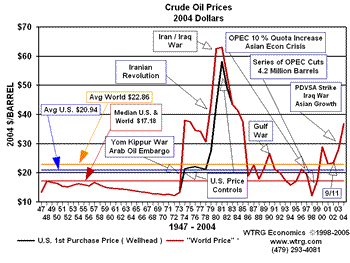
I think the different data sources for the price of crude is an important factor. The nominal prices of the two graphs are quite different. Another factor is that the first one looks like it has been smoothed out. It is probably the yearly average price which would tend to reduce the 1980 peak, which afterall was fairly brief.
Price history analysis
I think the different data sources for the price of crude is an important factor. The nominal prices of the two graphs are quite different. Another factor is that the first one looks like it has been smoothed out. It is probably the yearly average price which would tend to reduce the 1980 peak, which afterall was fairly brief.
Biofuels: The "What else we got to burn?" answer to peak oil.
-

nero - Heavy Crude
- Posts: 1433
- Joined: Sat 22 May 2004, 03:00:00
- Location: Ottawa, Ontario

by MagnoliaFan » Wed 10 Aug 2005, 16:18:31
$this->bbcode_second_pass_quote('kambei', 'M')aybe the top one is the average yearly price. The bottom one the average monthly price. It is the sustained high prices that matter, such as over a year.
What is the one year moving average price now? Can't be too far off.
What is the one year moving average price now? Can't be too far off.
Yeah, maybe I jumped to conclusions too quickly, but why is the media now using the monthly all time high as opposed to the yearly? The 1980 price spike came all of a sudden, the recent price increases have been going up steadily (two steps forward, one step back).
I think it's a rather duplicitous way to talk down the problem on their part.
-
MagnoliaFan - Peat
- Posts: 119
- Joined: Sun 17 Apr 2005, 03:00:00
by kambei » Wed 10 Aug 2005, 16:40:34
$this->bbcode_second_pass_quote('MagnoliaFan', '')$this->bbcode_second_pass_quote('kambei', 'M')aybe the top one is the average yearly price. The bottom one the average monthly price. It is the sustained high prices that matter, such as over a year.
What is the one year moving average price now? Can't be too far off.
What is the one year moving average price now? Can't be too far off.
Yeah, maybe I jumped to conclusions too quickly, but why is the media now using the monthly all time high as opposed to the yearly? The 1980 price spike came all of a sudden, the recent price increases have been going up steadily (two steps forward, one step back).
I think it's a rather duplicitous way to talk down the problem on their part.
True, that's what it is. If the price hovers around this level for a bit, it's going to push up the 1 year average a lot, and we'll be at potentially recession causing 1979 prices.
A king can't swagger, nor drink like a beggar,
Nor be half so happy as I.
Nor be half so happy as I.
- kambei
- Wood
- Posts: 31
- Joined: Fri 03 Dec 2004, 04:00:00
- Location: UK