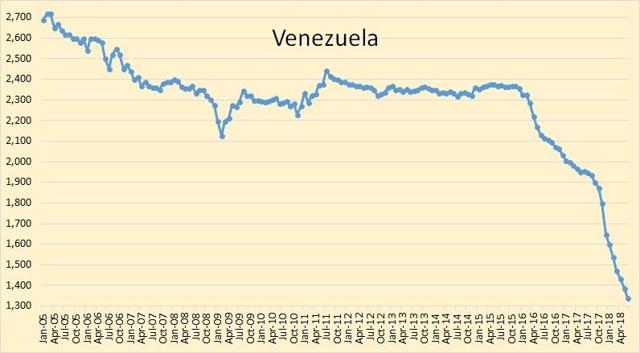
Missiles...or just a cyber attack to bring down the power grid and plunge a nation into darkness and chaos. Just to help the Communist fail a little bit faster.
China is worried about the reports of a cyber attack on Venezuela. Maybe Communist China should be?



PeakOil is You
Is EROEI Important Pt. 5
Re: Is EROEI Important Pt. 5
 by Yoshua » Wed 13 Mar 2019, 10:30:32
- Yoshua
- Heavy Crude

- Posts: 1977
- Joined: Sat 28 May 2016, 06:45:42
Re: Is EROEI Important Pt. 5
by shortonoil » Wed 13 Mar 2019, 11:31:40
$this->bbcode_second_pass_quote('', 't')he EIA in its monthly Short-Term Energy Outlook trimmed American crude output this year to 12.3 million barrels a day -- 110,000 barrels lower than it had forecast previously.
It appears that the EIA will be introducing Peak one barrel at a time. Those who believe the price will go to the sky will be greatly disappointed. Each barrel of production that is cut will also reduces the economy by an amount that was powered by that barrel. Oil is an energy producing process, and the economy needs energy to function.
-
shortonoil - False ETP Prophet

- Posts: 7132
- Joined: Thu 02 Dec 2004, 04:00:00
- Location: VA USA
Re: Is EROEI Important Pt. 5
by vtsnowedin » Wed 13 Mar 2019, 11:44:38
If it isn't produced here it will just be imported from Canada or elsewhere. Only loss to the economy being the transport and profit margin costs in excess of the local cost.
-

vtsnowedin - Fusion

- Posts: 14897
- Joined: Fri 11 Jul 2008, 03:00:00
Re: Is EROEI Important Pt. 5
by shortonoil » Wed 13 Mar 2019, 16:25:41
$this->bbcode_second_pass_quote('', 'I')f it isn't produced here it will just be imported from Canada or elsewhere. Only loss to the economy being the transport and profit margin costs in excess of the local cost.
Well - if that's not bizarre what is, since Canadian production is also falling, and has been for some time. And for elsewhere did you mean Venezuela, the North Shore, the North Sea? US Shale production has been the only reason that the world has not Peaked since 2007, and the decline rate in existing formations means that once Shale begins its decline so also will the remainder of the world. As we said last year:
$this->bbcode_second_pass_quote('', '1')2/08/18 Peak Oil
$this->bbcode_second_pass_quote('', 'F')ighting over scraps is what humans are good at.
It now takes 90.3% of its production to replace shale's legacy decline. What happens when that hits 100%? Since we can say that 2005 was 0% (there was only a couple thousand operating shale wells, and almost zero legacy decline), and in 2018 legacy decline is 90.3% the rate of change is 7.525% per year. Which puts Peak at about March 2019. I would suspect to see a significant decline in the economy no more than a few months later. If you use the national news media as an informational source, you will find out about it maybe by 2023 (month unknown).
Shale added 117,000 barrels to its production in November, that is 3,900 barrels per day. On production of 6.15 mb/d, shale is growing by 0.06%. By next year it will be zero. Its legacy decline will have over taken it, and production will fall. Once the ramifications of Peak become understood there will be panic. The worse possible response to Peak will be fighting over the scraps; which is why that is most likely to be the exact thing that will happen. We will attempt to hold on to our last tiny bit of reserves by expending them on some totally useless, bloody, stupid war.
Although the impact of Peak will be interesting, it will not likely be very healthy![quote]
-
shortonoil - False ETP Prophet
- Posts: 7132
- Joined: Thu 02 Dec 2004, 04:00:00
- Location: VA USA