The point of Autonomous Armored Trucks/cars/Tanks is obvious:
Concentrate Power and Wealth
The point of Automation
Concentrate Power and Wealth
The point of Digital wallets
Concentrate Power and Wealth
etc etc...
The GOOD TIMES that enabled the Welfare State were not due to tech, but to the special characteristics of an oil reservoir such as Ghawar Oilfield. Tech didn't invent Ghawar and it cant replace it.
The Fourth "Industrial Revolution" aka Internet of Things is a Manufactured Dieoff of 8 billion people because Ghawar is in decline and declining hard currency from oil from the right kind of reservoir means most customers have no means of income and are peasants.
The Internet of Things is resilience and redundancy so the billionaires can survive the inevitable chaos, ITS NOT MEANT TO BENEFIT YOU!


PeakOil is You
THE Self-Driving Car / Ridesharing Thread
Re: THE Self-Driving Car / Ridesharing Thread
 by StarvingLion » Thu 18 Aug 2016, 23:03:02
Outcast_Searcher is a fraud.
- StarvingLion
- Permanently Banned
- Posts: 2612
- Joined: Sat 03 Aug 2013, 18:59:17
Re: THE Self-Driving Car / Ridesharing Thread
by evilgenius » Fri 19 Aug 2016, 12:15:16
$this->bbcode_second_pass_quote('vox_mundi', '[')b] Your Self-Driving Car Will Be Programmed To Kill You - Deal With It
$this->bbcode_second_pass_quote('', ' ')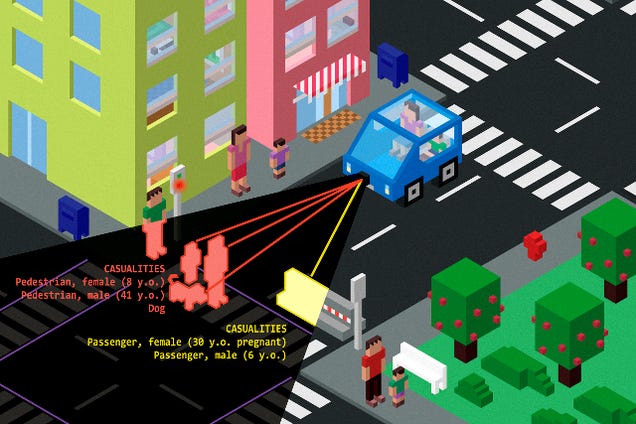
A new study published in Science shows there’s a big disconnect between the kinds of ethical programming we want these vehicles to have, and the kinds of cars we actually want to ride in. Surveys done last year demonstrate that people tend to take a utilitarian approach to safety ethics. That is, they generally agree that a car with one rider should swerve off the road and crash to avoid a crowd of 10 pedestrians. But when the survey’s respondents were asked if they’d actually ride in a vehicle programmed in this way, they said no thanks.
$this->bbcode_second_pass_quote('', ' ')
A new study published in Science shows there’s a big disconnect between the kinds of ethical programming we want these vehicles to have, and the kinds of cars we actually want to ride in. Surveys done last year demonstrate that people tend to take a utilitarian approach to safety ethics. That is, they generally agree that a car with one rider should swerve off the road and crash to avoid a crowd of 10 pedestrians. But when the survey’s respondents were asked if they’d actually ride in a vehicle programmed in this way, they said no thanks.
$this->bbcode_second_pass_quote('', '[')img]https://i.kinja-img.com/gawker-media/image/upload/s--A0BM66cl--/c_fit,fl_progressive,q_80,w_636/oa1xtvbk26a0r6ua6iuu.png[/img]
Situations involving imminent unavoidable harm: the autonomous vehicle must decide between (A) killing several pedestrians or one passerby, (B) killing one pedestrian or its own passenger, and (C) killing several pedestrians or its own passenger. (Image and caption credit: J. Bonnefon et al., 2016)
Results of the survey showed that people are on board with utilitarian-minded robotic vehicles, and would be content to see others buy them. This is an easy sell; the needs of one or two individuals, we tend to agree, is greatly outweighed by the needs of the many. The more lives saved, the more inclined people are towards this utilitarian attitude. As shown in the survey, as many as 76 percent of respondents were cool with a vehicle being programmed to sacrifice one passenger if it meant saving the lives of 10 pedestrians.
But these same people showed considerably less enthusiasm when it came to their desire to purchase or ride in one of these autonomous vehicles. When asked to rate the morality of a car programmed to crash and kill its own passenger to save 10 pedestrians, the favorable rating dropped by an entire third when respondents had to consider the possibility that they’d be the ones riding in that car.
$this->bbcode_second_pass_quote('', ' ') “What we intellectually believe is true and what we in fact do may be two very different things,” ... “Humans are often selfish even as they profess altruism.”
“It shouldn’t be surprising that ordinary people haven’t thought deeply enough about ethics to be consistent,” said Lin, who wasn’t involved in the study. “Most people think that ethics is just about your ‘gut instinct’, but there’s so much more to that.
Humans are notoriously bad at risk assessments: we drink and drive, we text and drive, we go way over the speed limit, and so on,” he said. “If we really didn’t care about being killed, we wouldn’t be in a car in the first place or allow guns in society.” To which he added: “So, by asking for opinions from ordinary people, the study is collecting uninformed answers, and that’s not very helpful in resolving dilemmas, which may be useful in advertising and marketing, but not so much for law and ethics.”
For most people the road is a place to exercise dominance over their fellow man. That's the way people drive right now, like it was one big competition. Unless they make it illegal to tamper with your self-driving car's programming, that's also the way it will be going forward with self-driving cars.
That being said, your example regarding the ethics of who dies is flawed in a deep way. It doesn't include fault. If a group of ten people are in the road who shouldn't be there, and I have driven as I should by exercising prudence in terms of speed and direction, should I kill myself in order to save all of those scofflaws? I will come to a complete stop, if I have to. I won't swerve into a lane or area within which I have no idea whether there are other people who haven't violated the rules. Mind you, if I am driving correctly I should know what is going on next to or behind me all of the time, but that doesn't always happen. Why should I kill somebody who is not at fault in order to save a whole group of people who have abdicated their responsibility to yield to the right of way? Why do you insist that self-driving cars go forward under this paradigm? The driver, no matter who it is, will do whatever they can within reason, but what is more likely is that they will wind up like the large group of people I heard about years ago who tried to cross in front of the TGV because they wanted a quicker way to the beach that was close by. Some things can't be helped. But, if you wish to bring an ethics that is not tied to action or is devoid of responsibility into the framework, then you are bound to enter into a quandry. There isn't any answer when you simply say that human life has value, and, therefore, more lives outweigh fewer lives. If you give no concession to right of way, and, therefore, the responsibility to yield to it, then you will get nowhere.
-

evilgenius - Intermediate Crude

- Posts: 3730
- Joined: Tue 06 Dec 2005, 04:00:00
- Location: Stopped at the Border.