http://www.forbes.com/sites/arthurberma ... -peak-oil/
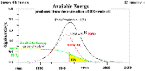
Conventional oil production peaked in January 2011 at 86.2 mmbpd unconventional oil 2015?
=>
oil-barrel-pyramid-model-by-m-b-s-peak-2011-t33970.html#p550313
PEAK OIL!
q.e.d.
M_B_S



PeakOil is You
Forbes: PEAK OIL was 2011 and 2015
Forbes: PEAK OIL was 2011 and 2015
 by M_B_S » Sun 03 Jan 2016, 00:10:31
-

M_B_S - Intermediate Crude

- Posts: 3770
- Joined: Sat 20 Aug 2005, 03:00:00
Re: Forbes: PEAK OIL was 2011 and 2015
by dolanbaker » Sun 03 Jan 2016, 06:46:33
It will be interesting to see how this affects future investments in oil production, after all Forbes readers are generally people who would make these decisions.
Religion is regarded by the common people as true, by the wise as false, and by rulers as useful.:Anonymous
Our whole economy is based on planned obsolescence.
Hungrymoggy "I am now predicting that Europe will NUKE ITSELF sometime in the first week of January"
Our whole economy is based on planned obsolescence.
Hungrymoggy "I am now predicting that Europe will NUKE ITSELF sometime in the first week of January"
-

dolanbaker - Intermediate Crude
- Posts: 3855
- Joined: Wed 14 Apr 2010, 10:38:47
- Location: Éire
Re: Forbes: PEAK OIL was 2011 and 2015
by vtsnowedin » Sun 03 Jan 2016, 09:36:32
$this->bbcode_second_pass_quote('dolanbaker', 'I')t will be interesting to see how this affects future investments in oil production, after all Forbes readers are generally people who would make these decisions.
Watch the smart money with a long term view buy up proven recoverable land based reserves while the present owners are financially stressed.
-

vtsnowedin - Fusion

- Posts: 14897
- Joined: Fri 11 Jul 2008, 03:00:00
Re: Forbes: PEAK OIL was 2011 and 2015
by Pops » Sun 03 Jan 2016, 10:10:13
The legitimate object of government, is to do for a community of people, whatever they need to have done, but can not do, at all, or can not, so well do, for themselves -- in their separate, and individual capacities.
-- Abraham Lincoln, Fragment on Government (July 1, 1854)
-- Abraham Lincoln, Fragment on Government (July 1, 1854)
-

Pops - Elite

- Posts: 19746
- Joined: Sat 03 Apr 2004, 04:00:00
- Location: QuikSac for a 6-Pac
Re: Forbes: PEAK OIL was 2011 and 2015
by dolanbaker » Sun 03 Jan 2016, 10:52:39
I thought I'd seen that story somewhere already. 
Religion is regarded by the common people as true, by the wise as false, and by rulers as useful.:Anonymous
Our whole economy is based on planned obsolescence.
Hungrymoggy "I am now predicting that Europe will NUKE ITSELF sometime in the first week of January"
Our whole economy is based on planned obsolescence.
Hungrymoggy "I am now predicting that Europe will NUKE ITSELF sometime in the first week of January"
-
dolanbaker - Intermediate Crude
- Posts: 3855
- Joined: Wed 14 Apr 2010, 10:38:47
- Location: Éire
Re: Forbes: PEAK OIL was 2011 and 2015
by Pops » Sun 03 Jan 2016, 11:00:34
Yeah but it wasn't in ALL CAPS!
lol
lol
The legitimate object of government, is to do for a community of people, whatever they need to have done, but can not do, at all, or can not, so well do, for themselves -- in their separate, and individual capacities.
-- Abraham Lincoln, Fragment on Government (July 1, 1854)
-- Abraham Lincoln, Fragment on Government (July 1, 1854)
-
Pops - Elite
- Posts: 19746
- Joined: Sat 03 Apr 2004, 04:00:00
- Location: QuikSac for a 6-Pac
Re: Forbes: PEAK OIL was 2011 and 2015
by GHung » Sun 03 Jan 2016, 11:16:03
I just did a search of the Oil Drum archives, going back 5-6 years, and it's remarkable how many commenters expected a long undulating plateau in oil production. " ...that Peak Oil seems to be shaping up into Peak Plateau" (2013); "Production may have already peaked, but I think it will plateau and remain fairly constant for a while" (2011); "All I can see is plateaus and peaks...." (2011).....
Seems some over at TOD weren't so wrong after all.
Seems some over at TOD weren't so wrong after all.
Blessed are the Meek, for they shall inherit nothing but their Souls. - Anonymous Ghung Person
-

GHung - Intermediate Crude
- Posts: 3093
- Joined: Tue 08 Sep 2009, 16:06:11
- Location: Moksha, Nearvana
Re: Forbes: PEAK OIL was 2011 and 2015
by Pops » Sun 03 Jan 2016, 12:44:09
$this->bbcode_second_pass_quote('pstarr', '(')mods: if the search function worked better or I knew how to use it better, then oh well . . . . is there search function help?)
New search button in the sidebar just for you Pete!
The legitimate object of government, is to do for a community of people, whatever they need to have done, but can not do, at all, or can not, so well do, for themselves -- in their separate, and individual capacities.
-- Abraham Lincoln, Fragment on Government (July 1, 1854)
-- Abraham Lincoln, Fragment on Government (July 1, 1854)
-
Pops - Elite
- Posts: 19746
- Joined: Sat 03 Apr 2004, 04:00:00
- Location: QuikSac for a 6-Pac
Re: Forbes: PEAK OIL was 2011 and 2015
by ennui2 » Sun 03 Jan 2016, 14:38:55
$this->bbcode_second_pass_quote('GHung', 'I') just did a search of the Oil Drum archives, going back 5-6 years, and it's remarkable how many commenters expected a long undulating plateau in oil production. " ...that Peak Oil seems to be shaping up into Peak Plateau" (2013); "Production may have already peaked, but I think it will plateau and remain fairly constant for a while" (2011); "All I can see is plateaus and peaks...." (2011).....
Seems some over at TOD weren't so wrong after all.
Seems some over at TOD weren't so wrong after all.
You are misreading it. By 2011, according to TOD's logic, peak was already 6 years in the past. So it's not that TOD were correct, as much as the discussion there had already shifted to trying to make sense of the sky not having fallen before they just stopped visiting altogether, after which TOD shut down.
"If the oil price crosses above the Etp maximum oil price curve within the next month, I will leave the forum." --SumYunGai (9/21/2016)
-

ennui2 - Permanently Banned
- Posts: 3920
- Joined: Tue 20 Sep 2011, 10:37:02
- Location: Not on Homeworld
Re: Forbes: PEAK OIL was 2011 and 2015
by Outcast_Searcher » Sun 03 Jan 2016, 14:47:45
$this->bbcode_second_pass_quote('dolanbaker', 'I')t will be interesting to see how this affects future investments in oil production, after all Forbes readers are generally people who would make these decisions.
Meh. While I'll agree Forbes readers are generally business people and at least aspiring to be capitalists (or the captains of industry), given the generally moderate (and below) quality of MANY of the articles of magazines like Forbes (and many of its peers) -- I strongly doubt the people actually making major investments in anything would waste their time reading it regularly. (Perhaps having a minion scan such periodicals for something actually significant for them, instead. And if you think that such scanning for executives doesn't happen, I had a part time job during college in '78 - '79 scanning EVERY newspaper (in all 120 counties) of KY, looking for ANY articles on energy, clipping, and saving them for my employer -- the head of P.R. at KY Utilities. If ANY issue on energy in the state came up, he had immediate access to all the relevant stories in the press, in a well organized and detailed and long term filing system on energy).)
I would point to "The Economist" as an example of a high quality economics periodical accessible by the layman, to back me up on this. IMO, there is no comparison. The Economist is much more expensive -- and in a class by itself compared to periodicals like Forbes. (I'll include The WSJ in the Forbes quality class, BTW. It's more about marketing, politics, and saving money on editors and proof readers than producing high quality financial journalism, which is why I quit reading it).
Last edited by Outcast_Searcher on Sun 03 Jan 2016, 14:54:15, edited 1 time in total.
Given the track record of the perma-doomer blogs, I wouldn't bet a fast crash doomer's money on their predictions.
-

Outcast_Searcher - COB

- Posts: 10142
- Joined: Sat 27 Jun 2009, 21:26:42
- Location: Central KY