Just wait 'till tomorrow, I'll likely be predicting doom by afternoon!


PeakOil is You
The Economy Appears To Be On Solid Ground
Re: The Economy Appears To Be On Solid Ground
 by Pops » Thu 26 Feb 2015, 16:00:37
Just wait 'till tomorrow, I'll likely be predicting doom by afternoon!The legitimate object of government, is to do for a community of people, whatever they need to have done, but can not do, at all, or can not, so well do, for themselves -- in their separate, and individual capacities.
-- Abraham Lincoln, Fragment on Government (July 1, 1854)
-- Abraham Lincoln, Fragment on Government (July 1, 1854)
-

Pops - Elite

- Posts: 19746
- Joined: Sat 03 Apr 2004, 04:00:00
- Location: QuikSac for a 6-Pac
Re: The Economy Appears To Be On Solid Ground
by ralfy » Thu 26 Feb 2015, 21:33:33
$this->bbcode_second_pass_quote('Pops', '')$this->bbcode_second_pass_quote('', 'T')he Bloomberg Commodity index, which tracks the prices of 22 different commodity prices such as gold, natural gas and oil, fell 0.3pc to 99.84 in early trading, the lowest point since August 2002.
Come on ralfy, we know the price of oil is down, but the demand is up so where is the deflation?
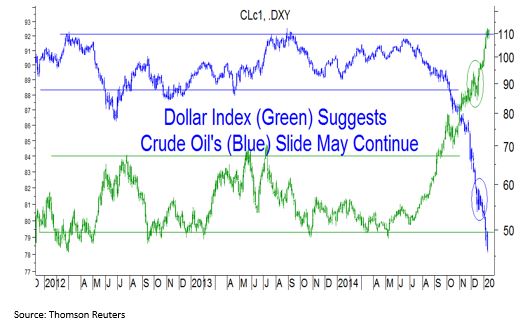
When everything is priced in dollars and the dollar is strong, everything is going to be cheaper:
--
Here is Dollar Index vs commodities index, notice the correlation?

Now if all currencies were strengthening and not just the dollar, that would be a good deflation argument.
But as it is the dollar is super strong, because
we QE'd and it helped compared to the EU austerity,
we fracked and that lowered our imports, which raised our trade balance
now the EU is gonna QE so their paper is cheaper and the US$ higher
our gov budget deficit is even lower.
You all act like it pains you that Mad Max ain't knocking, take advantage.
I don't know about deflation. I shared that to show that it's not just oil prices that are being affected. At the same time, the dollar is getting stronger because speculators are running for it because of problems with commodities.
Next, my understanding is that QE is not a good idea. That is, it's the same type of credit creation that led to the U.S. crash. Will EU and other economies experience similar?
Third, I think "solid ground" means a steady but slow increase in prices as demand steadily increases, met by steadily increasing production, and all three going on indefinitely. That's not what we've been seeing the past decade, at least that's what I've been gathering from information shared in this forum.
Given that, I don't understand why it has to be either a "solid ground" or "Mad Max." Why not something between the two?
-

ralfy - Light Sweet Crude

- Posts: 5651
- Joined: Sat 28 Mar 2009, 11:36:38
- Location: The Wasteland
Re: The Economy Appears To Be On Solid Ground
by SILENTTODD » Fri 27 Feb 2015, 04:10:23

A close Real Estate friend of mine says Warren Buffett just bought out Prudential Real Estate. Plans are already rolling to rebrand it as Berkshire Hathaway Real Estate by May 1st.
Obviously Buffett thinks there is money to bed made in Real Estate for the next few years.
Skeptical scrutiny in both Science and Religion is the means by which deep thoughts are winnowed from deep nonsense-Carl Sagan
-

SILENTTODD - Tar Sands

- Posts: 928
- Joined: Sat 06 May 2006, 03:00:00
- Location: Corona, CA
Re: The Economy Appears To Be On Solid Ground
by Pops » Fri 27 Feb 2015, 10:20:50
Buffet accidentally acquired a bunch of real estate brokerages back in 1999 when he bought an energy company of all things. He has been buying up brokerages ever since. This story says they had 75,000 agents as of 2012 when they bought Prudential!
http://www.usatoday.com/story/money/bus ... e/1668649/
http://www.usatoday.com/story/money/bus ... e/1668649/
The legitimate object of government, is to do for a community of people, whatever they need to have done, but can not do, at all, or can not, so well do, for themselves -- in their separate, and individual capacities.
-- Abraham Lincoln, Fragment on Government (July 1, 1854)
-- Abraham Lincoln, Fragment on Government (July 1, 1854)
-
Pops - Elite
- Posts: 19746
- Joined: Sat 03 Apr 2004, 04:00:00
- Location: QuikSac for a 6-Pac
Re: The Economy Appears To Be On Solid Ground
by SILENTTODD » Sat 28 Feb 2015, 03:13:29
Thanks Pops for the article. Referred it to my friend who had been a Prudential realtor for the last 15 years. She's one of her office's top producers and she's impressed with the way they are making the change over now.
Skeptical scrutiny in both Science and Religion is the means by which deep thoughts are winnowed from deep nonsense-Carl Sagan
-
SILENTTODD - Tar Sands
- Posts: 928
- Joined: Sat 06 May 2006, 03:00:00
- Location: Corona, CA
Re: The Economy Appears To Be On Solid Ground
by shortonoil » Sun 01 Mar 2015, 16:25:40
Come on ralfy, we know the price of oil is down, but the demand is up so where is the deflation?
Of course demand is up? They are pumping almost a million barrels per day into storage, and that oil gets counted into demand. With Cushing now over 80% full things are likely to change real fast in the demand department real soon!
http://www.thehillsgroup.org/
Of course demand is up? They are pumping almost a million barrels per day into storage, and that oil gets counted into demand. With Cushing now over 80% full things are likely to change real fast in the demand department real soon!
http://www.thehillsgroup.org/
-
shortonoil - False ETP Prophet

- Posts: 7132
- Joined: Thu 02 Dec 2004, 04:00:00
- Location: VA USA
Re: The Economy Appears To Be On Solid Ground
by Pops » Sun 01 Mar 2015, 22:41:29
$this->bbcode_second_pass_quote('shortonoil', '[')i]Come on ralfy, we know the price of oil is down, but the demand is up so where is the deflation?
Of course demand is up? They are pumping almost a million barrels per day into storage, and that oil gets counted into demand. With Cushing now over 80% full things are likely to change real fast in the demand department real soon! /
Of course demand is up? They are pumping almost a million barrels per day into storage, and that oil gets counted into demand. With Cushing now over 80% full things are likely to change real fast in the demand department real soon! /
Oh that's right, your premiss is that gasoline no longer has value so consumers don't want it. So someone is storing all that oil - to do what?
Let's look, here is Gasoline "product supplied"

Definitely more folks drove to Granny's for Christmas
Here are gasoline stocks:

Gasoline storage is definitely down, doesn't look good for the "peak demand" contingent.
Crude storage on the other hand is up a bunch:

Obviously demand fell on high price, but price is down 50% on increased production (see the crude storage chart) Consumption looks like it might be increasing already which would be a surprise considering the EIA thinks a 50% drop in price only gives a 1% increase in consumption - eventually.

The legitimate object of government, is to do for a community of people, whatever they need to have done, but can not do, at all, or can not, so well do, for themselves -- in their separate, and individual capacities.
-- Abraham Lincoln, Fragment on Government (July 1, 1854)
-- Abraham Lincoln, Fragment on Government (July 1, 1854)
-
Pops - Elite
- Posts: 19746
- Joined: Sat 03 Apr 2004, 04:00:00
- Location: QuikSac for a 6-Pac
Re: The Economy Appears To Be On Solid Ground
by GoghGoner » Mon 02 Mar 2015, 11:30:43
Gasoline is now blended at the end of the pipeline. This has been a structure change in the last decade and that is why the finished gasoline chart is down.
Total gasoline stocks are not influenced by the change in delivery:
http://www.eia.gov/dnav/pet/hist/LeafHandler.ashx?n=PET&s=WGTSTUS1&f=W
Total gasoline stocks are not influenced by the change in delivery:
http://www.eia.gov/dnav/pet/hist/LeafHandler.ashx?n=PET&s=WGTSTUS1&f=W
- GoghGoner
- Heavy Crude

- Posts: 1827
- Joined: Thu 10 Apr 2008, 03:00:00
- Location: Stilłwater subdivision
Re: The Economy Appears To Be On Solid Ground
by Pops » Mon 02 Mar 2015, 12:39:03
Thanks G, I wondered what I did wrong, missed it by "that much"!
The legitimate object of government, is to do for a community of people, whatever they need to have done, but can not do, at all, or can not, so well do, for themselves -- in their separate, and individual capacities.
-- Abraham Lincoln, Fragment on Government (July 1, 1854)
-- Abraham Lincoln, Fragment on Government (July 1, 1854)
-
Pops - Elite
- Posts: 19746
- Joined: Sat 03 Apr 2004, 04:00:00
- Location: QuikSac for a 6-Pac
Re: The Economy Appears To Be On Solid Ground
by Outcast_Searcher » Mon 02 Mar 2015, 12:56:18
$this->bbcode_second_pass_quote('GHung', 'U')sing the stock market to assess overall conditions is a bit like saying the cancer patient is doing better because he's gained weight due to the giant watery tumor growing in his abdomen.
Since when is GDP and the overall economic outlook the stock market? If you're going to criticize a post, if you don't refer to the actual data/points being discussed, what is the point? (Hint, only the link talked about the stock market. The main body of the post said nothing about that -- only the overall economy or GDP).
Given the track record of the perma-doomer blogs, I wouldn't bet a fast crash doomer's money on their predictions.
-

Outcast_Searcher - COB

- Posts: 10142
- Joined: Sat 27 Jun 2009, 21:26:42
- Location: Central KY