$this->bbcode_second_pass_quote('', 'A')ccording to the industry group American Wind Energy Association, the U.S. wind power industry not only had its best year ever in 2012, but exceeded natural gas in the installation of new electric generating capacity.
The $25 billion in private investment alone wind energy projects attracted produced over 13,000 megawatts (MW) of new wind power capacity last year.
The peaks and valleys the wind power sector experiences will continue, but watch for this source of energy to grow in size between environmental concerns over sources such as natural gas and coal; plus fossil fuels continue their overall climb in price as well. Throw in the mix of next-generation technologies, and the future of wind will be bright–and exciting.



PeakOil is You
Energy Infrastructure Progress Report
Re: Energy Infrastructure Progress Report
 by kublikhan » Fri 01 Feb 2013, 16:08:19
The oil barrel is half-full.
-

kublikhan - Master Prognosticator

- Posts: 5064
- Joined: Tue 06 Nov 2007, 04:00:00
- Location: Illinois
Re: Energy Infrastructure Progress Report
by kublikhan » Mon 03 Jun 2013, 17:26:51
$this->bbcode_second_pass_quote('', 'A')ccording to the latest "Energy Infrastructure Update" report from the Federal Energy Regulatory Commission's Office of Energy Projects, renewable energy sources (i.e., biomass, geothermal, solar, water, wind) accounted for 82 percent of all new domestic electrical generating capacity installed in the first three months of 2013 for a total of 1,546 MW.
The balance (340 MW) came from natural gas. Coal, nuclear power, and oil have provided no new generating capacity thus far this year.
Renewable sources now account for nearly 16 percent of total installed U.S. operating generating capacity: water - 8.53 percent, wind - 5.18 percent, biomass - 1.30 percent, solar - 0.44 percent, and geothermal - 0.32 percent. This is more than nuclear (9.15 percent) and oil (3.54 percent) combined. (Note that generating capacity is not the same as actual generation. Actual net electrical generation from renewable energy sources in the United States now totals a bit more than 13% according to the most recent data)
Month after month, renewable energy sources continue to dominate the new electrical generating capacity being brought on-line in the United States. The path towards a zero-coal, zero-nuclear future becomes clearer with each new report.
Renewables Provide 82% of New US Electrical Generating Capacity in 1Q2013The balance (340 MW) came from natural gas. Coal, nuclear power, and oil have provided no new generating capacity thus far this year.
Renewable sources now account for nearly 16 percent of total installed U.S. operating generating capacity: water - 8.53 percent, wind - 5.18 percent, biomass - 1.30 percent, solar - 0.44 percent, and geothermal - 0.32 percent. This is more than nuclear (9.15 percent) and oil (3.54 percent) combined. (Note that generating capacity is not the same as actual generation. Actual net electrical generation from renewable energy sources in the United States now totals a bit more than 13% according to the most recent data)
Month after month, renewable energy sources continue to dominate the new electrical generating capacity being brought on-line in the United States. The path towards a zero-coal, zero-nuclear future becomes clearer with each new report.
The oil barrel is half-full.
-
kublikhan - Master Prognosticator
- Posts: 5064
- Joined: Tue 06 Nov 2007, 04:00:00
- Location: Illinois
Re: Energy Infrastructure Progress Report
by ROCKMAN » Mon 03 Jun 2013, 19:32:44
k - Nice links...thanks. And have you noticed who leads the nation in wind: Texas with as much as the #2 and #3 combined. And we're about to take a big leap with offshore wind. Odd for the state that produces more oil than any other, eh?
-

ROCKMAN - Expert

- Posts: 11397
- Joined: Tue 27 May 2008, 03:00:00
- Location: TEXAS
Re: Energy Infrastructure Progress Report
by kublikhan » Mon 03 Jun 2013, 20:41:02
Texas also has more CO2 emissions than numbers #2 and #3 combined, you pigs! Meanwhile Illinois is in a distant 6th place 
$this->bbcode_second_pass_quote('', 'T')exas led the pack in state-level energy-related carbon dioxide emissions from 2000-2010, having produced more than 7.5 billion metric tons of CO2 over the period, according to the U.S. Energy Information Administration (EIA).
The EIA has begun to provide state-level energy-related carbon dioxide emissions data, showing that over the 2000-2010 period, Texas far outpaced other states in energy-related CO2 emissions, exceeding total emissions from its closest competitor, California, by over 75%
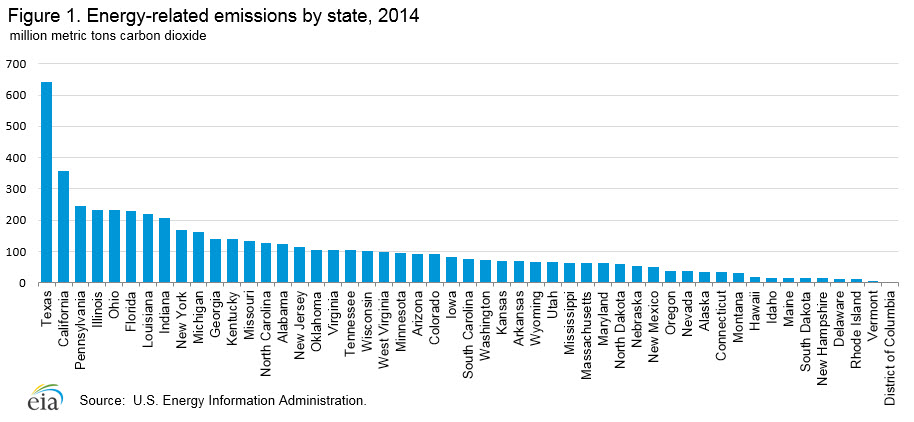
$this->bbcode_second_pass_quote('', 'T')exas led the pack in state-level energy-related carbon dioxide emissions from 2000-2010, having produced more than 7.5 billion metric tons of CO2 over the period, according to the U.S. Energy Information Administration (EIA).
The EIA has begun to provide state-level energy-related carbon dioxide emissions data, showing that over the 2000-2010 period, Texas far outpaced other states in energy-related CO2 emissions, exceeding total emissions from its closest competitor, California, by over 75%
$this->bbcode_second_pass_quote('', '[')img]http://media.treehugger.com/assets/images/2011/10/top-ten-co2-emitting-states-electricity-image.jpg[/img]
Top-ten US states for power plant CO2 emissions, 2009 & 2010.
The oil barrel is half-full.
-
kublikhan - Master Prognosticator
- Posts: 5064
- Joined: Tue 06 Nov 2007, 04:00:00
- Location: Illinois


