Donate Bitcoin

Donate Paypal


PeakOil is You

PeakOil is You

Peak Oil - Important points, but wrong!

General discussions of the systemic, societal and civilisational effects of depletion.

Re: Peak Oil - Important points, but wrong!

Unread postby dissident » Fri 28 Jun 2013, 08:06:47

$this->bbcode_second_pass_quote('ROCKMAN', '')How do we explain to them that there is now so much around that if we are willing to pay a little more”.

Fantastic. I love starting the day off with a good laugh. Pay a little more? Yes….I suppose if one considers paying a few hundred % more is a little bit. I suppose if spending $trillions and thousands of lives protecting ME oil is insignificant. I suppose if the US consumers and businesses spending many 100’s of $billions more on energy in the last several years and the impact that has had on economic growth and unemployment is insignificant.

Again my worn out rant: when oil production levels peak is not very relevant when it comes to how every person on the planet lives. It’s all about the costs of energy along with those little sidebars like various military adventures past and future.

Again it’s all easily explained by the POD. Increasing US oil production is a direct result of the POD. IOW the increase in Bakken and shale production is one of the most obvious proofs of peak oil. And will continue to be so as long as oil prices stay elevated. IMHO the critical metric of PO isn’t the oil production rate but the price of oil and the economic and political responses. IOW the POD. Letting ourselves get drawn into endless debates about rates and reserves just deflects the discussion from THE critical dynamic IMHO: the price of energy and that impact on the lives of the world’s population.



Very good point. The ability of the vast number of consumers to pay for a commodity has to be taken into account in the discussion about "peak oil". The price is not going to ramp up ad infinitum since the market cannot bear it. As happened with other commodities in the past (e.g. whale bone) the price will spike and then crash and spike again and crash again in an oscillation. So any extraction predicated on price will be constrained in a major way. Instead of anticipating the hard to access dregs will become available to the market people should admit that much of this hard to produce oil is likely never going to be extracted since there will be too few consumers for it.
dissident
Expert
Expert
 
Posts: 6458
Joined: Sat 08 Apr 2006, 03:00:00

Re: Peak Oil - Important points, but wrong!

Unread postby Tanada » Fri 28 Jun 2013, 08:25:00

I have seen a certain metric, almost a talking point, repeated in variation here over the last week.$this->bbcode_second_pass_quote('', 'S')o you are paying a little more, so what you can still get all the oil/gas/diesel/jet fuel you want. Isn't it really worth it anyhow?

It almost seems like a clumsy attempt at a coordinated effort.

Sure we can still get fuel at a higher price. How much higher? In 2005 when I joined this forum the average price was in the $50.00/bbl range for the year going as high as $66.00/bbl in August. Some people here looked at a graph like this one except it ended in 2005;
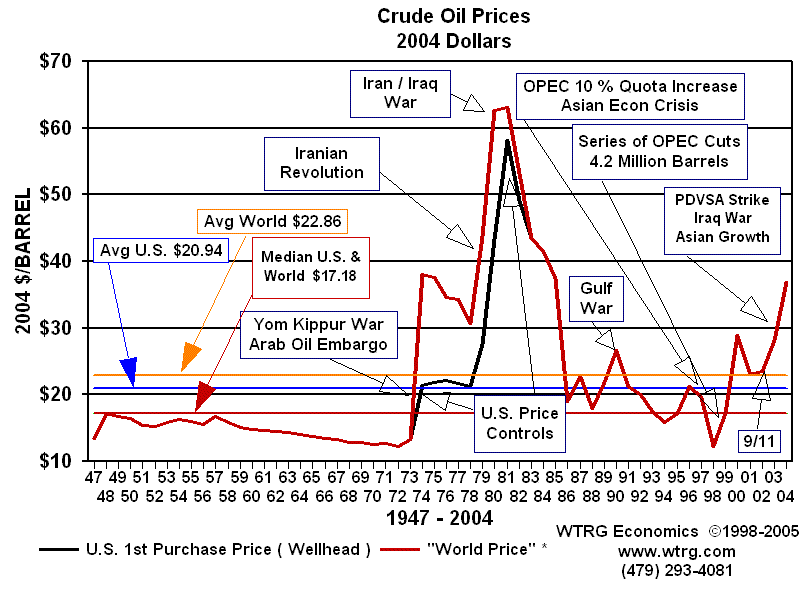
Image
Many of them concluded the price was going to rise to infinity based on its behavior in 2003 and 2004 into 2005. They bought into the mad max the end is nigh all is lost Olduvai gorge scenario stream and readied themselves for The End!!!

They were wrong. However what Rockman said above is 100% true. In 2006, 2007, 2008, 2009, 2010, 2011, 2012 and now we have been paying more for energy than at any time except the brief spike in late 1978 early 1979. In fact we had been in a cheap oil price band from 1986-2003 which is a long time to get used to things being a certain way and plan on it staying there. We pay between twice and three times as much for energy as we did in 1986-2003 and in the USA that means 20 MMbbl/@ $30.50 vs 17 MMbbl/@95.00. We don't buy as much fuel because we can't afford as much fuel. Worse even though we are using less fuel we are paying 265% of the 2003 price for what we do use compared to what we spent then to get more. It works out like this, 20 Million * 30.50=610,000,000.00 were being spent on a random day in 2003. 17 Million * 95.00=1,615,000,000.00 The difference is $1,005,000,000.00 taken out of spending on everything besides energy every day of the year. Worse than just that is the feedback effect, because hauling everything else from food to Christmas toys to market costs 265% more than it used too it impacts the retail price of everything in an upward direction. So our consumer society not only has less money for consumer goods, consumer goods cost more than they used to as well.

Why anyone doesn't understand this causes negative economic growth is beyond me. Real world economic growth, not digital growth of digital money, stopped dead in its tracks several years ago.
$this->bbcode_second_pass_quote('Alfred Tennyson', 'W')e are not now that strength which in old days
Moved earth and heaven, that which we are, we are;
One equal temper of heroic hearts,
Made weak by time and fate, but strong in will
To strive, to seek, to find, and not to yield.
Tanada
Site Admin
Site Admin
 
Posts: 17094
Joined: Thu 28 Apr 2005, 03:00:00
Location: South West shore Lake Erie, OH, USA

Re: Re:

Unread postby John_A » Fri 28 Jun 2013, 11:03:47

$this->bbcode_second_pass_quote('dsula', '')$this->bbcode_second_pass_quote('John_A', '
')How do we explain to them that there is now so much around that ..... blabla


Luckily we don't have to explain. We simply live a happy productive and joyful life.

And BTW, I forgot to add. Halfway point is not where the peak is.


Someone will have to tell those who keeping making graphics like this to STOP already then.

Image
45ACP: For when you want to send the very best.
John_A
Heavy Crude
Heavy Crude
 
Posts: 1193
Joined: Sat 25 Jun 2011, 21:16:36
Top

Re: Peak Oil - Important points, but wrong!

Unread postby John_A » Fri 28 Jun 2013, 11:07:21

$this->bbcode_second_pass_quote('ROCKMAN', '
')Again it’s all easily explained by the POD. Increasing US oil production is a direct result of the POD. IOW the increase in Bakken and shale production is one of the most obvious proofs of peak oil.


Have you written up anywhere the relationship between POD and how much of the total resource base it will allow access to with respect to time? There is a production curve sitting at the juncture of those two pieces of inforation, and it can be substituted for what to date has been a more random fitting of time series data.
45ACP: For when you want to send the very best.
John_A
Heavy Crude
Heavy Crude
 
Posts: 1193
Joined: Sat 25 Jun 2011, 21:16:36
Top

Re: Re:

Unread postby dsula » Fri 28 Jun 2013, 11:13:56

$this->bbcode_second_pass_quote('John_A', '
')Someone will have to tell those who keeping making graphics like this to STOP already then.

Image


Na. Just ignore them. They don't do much harm. You probably know from your own accounts that there a lot of people who can talk and write, but a lot less who can think.
User avatar
dsula
Tar Sands
Tar Sands
 
Posts: 982
Joined: Wed 13 Jun 2007, 03:00:00
Top

Re: Peak Oil - Important points, but wrong!

Unread postby C8 » Fri 28 Jun 2013, 11:15:56

$this->bbcode_second_pass_quote('', 'S')ure we can still get fuel at a higher price. How much higher? In 2005 when I joined this forum the average price was in the $50.00/bbl range for the year going as high as $66.00/bbl in August. Some people here looked at a graph like this one except it ended in 2005;


Broadly speaking I agree with you here Tanada- however, I do think there is still an awful lot of waste in the US with our massive vehicles and minimal public transit. Europe did very well with gas prices almost twice as high for decades (I think their present problems are not related much to energy but bubble economics, demographics and unrealistic pension promises). The US can still do well with $200 barrel oil IMHO as long as it comes gradually.

Or maybe not... here's why:

Every field creates its own biases. A lot of folks studying PO tend to view it as the major cause of almost every important trend- this is natural and to be expected. I have seen PO contorted to explain the strangest things. We need to guard against this bias as we look at PO. There many be other forces that are far more powerful than PO in causing changes in the US.

My candidate? There has been a dramatic shift in the concentration of wealth in the past 30 years that is far more powerful than any other trend I have noticed. Quite simply, the middle class is disappearing. This also explains a lot of the drop of consumer spending, rise in debt, market bubbles, lack of infrastructure investment, etc.

Many of the current economic problems in the US result from massive wealth redistribution to the upper classes and the destruction of middle class wages. This is why many can't afford to buy a more fuel efficient car. If you destroy unions, outsource tech jobs overseas, let health care costs run wild- then, yes, people will be too poor to make the energy transition. But our problem won't be $200 a barrel oil, it will be the absence of a middle class that can afford to make the changes. PO does not happen in a vacuum.
User avatar
C8
Heavy Crude
Heavy Crude
 
Posts: 1074
Joined: Sun 14 Apr 2013, 09:02:48
Top

Re: Peak Oil - Important points, but wrong!

Unread postby ROCKMAN » Fri 28 Jun 2013, 12:04:19

C8 – “There has been a dramatic shift in the concentration of wealth in the past 30 years that is far more powerful than any other trend I have notice.” That’s a very valid point IMHO. But let’s consider at least one contributing factor: capital availability. The middle class is very dependent upon someone paying them a salary. True some run their own businesses. But those businesses are still dependent on the same capital availability as the companies that employ the middle class.

So who is more subject to economic hardship in the face of rising energy costs: someone like my very rich owner or someone working in a business which is the sole source of their $80k/yr pay check? So my owner’s energy bill (for all his companies) goes up 30%. He adjusts his business plan. Which he has and has increased the value of his assets…not the least of which is his oil company. And what of the guy that loses his middle income pay check (or at least gets a pay cut) because higher energy costs has cut profits from his company’s bottom line? Folks talk about the lack of growth in the US economy. But they are talking about the big picture number. But look at the subsets. There are portions of the economy that are doing very well as a result of increased energy costs…as well as others that are being crippled by those same costs. Talk to a long haul trucker lately? I have a couple of friends in that line of work. They are no longer in the middle class and spend 21 days a month on average paying for their truck and fuel. And if they only roll 3 of those other 9 days they qualify for food stamps.

Again, all the negatives can’t be laid solely at the feet of energy costs. But those costs affect every aspect of our economy. As Tanada points out $trillions have been removed from the economy. My owner might have lost a few tens of $millions from some of his companies as a result of the shifting economics. But he’s still a billionaire. And the guy that lost his $80k/yr job who’s now working part time making $25k/yr? He’s not middle class anymore. The majority of folks making a middle class income are getting a pay check from some company. If those companies can’t afford to keep writing all of those pay checks then the results are unavoidable: a shrinking middle class. If the govt took half of all the money from every millionaire in the country they would still be every wealth. And if they gave every penny to the lower income earners they would give a short term economic boost but as soon as those monies are spent they are back to being dependent upon someone for a pay check. And given that the govt just removed a large amount of capex from the folks who create those companies there might not be as many jobs around as there were before.

I’m not saying your observation isn’t correct…the numbers don’t lie. But you have to keep clear the cause and effect. The middle class isn’t disappearing because someone else in getting their money IMHO. It’s because there is less money to share. I’ve never met a business owner that didn’t wish they could greatly increase the payroll simply because it meant they were doing more business and thus making more money themselves. There used to be 4 very well paid middle income geologists in my company. With the bust in NG prices there are now 2.

Nothing personal…just business.
User avatar
ROCKMAN
Expert
Expert
 
Posts: 11397
Joined: Tue 27 May 2008, 03:00:00
Location: TEXAS

Re: Peak Oil - Important points, but wrong!

Unread postby Tanada » Fri 28 Jun 2013, 13:44:54

If you really want to know how much difference fuel costs make to consumer spending you could do a quick and easy experiment. Right now the Federal and State governments are collecting around $0.35 per gallon in fuel taxes. I propose that for the next Stimulus package the Federal government remove all Federal fuel tax and institute a Federal fuel subsidy of $1.00 per gallon for all road fuels. Average nation wide fuel price for Gasoline and Diesel decreases by $1.18 from whatever it is where you are right now.

What do the average consumers do with the extra money they now have in their pockets? What do the retailers do to attract customers back now that their transportation costs have been cut 30% for all the goods they are selling?

But wait, how much does it cost for the subsidy? 370 Million gallons of gasoline and 61 Million gallons of diesel a day, 430 Million dollars a day. Boy that sounds like a lot doesn't it? That's a touch over 3 Billion per week in subsidy or 156,520,000,000 per year. Except the budget for 2013 is 3,803,000,000,000 so the subsidy works out to be 4% of the budget.

Does anyone think a recovery for 156 Billion dollars is too high of a price to pay? If Peak Oil didn't exist then it would be a cheap price to pay.
$this->bbcode_second_pass_quote('Alfred Tennyson', 'W')e are not now that strength which in old days
Moved earth and heaven, that which we are, we are;
One equal temper of heroic hearts,
Made weak by time and fate, but strong in will
To strive, to seek, to find, and not to yield.
Tanada
Site Admin
Site Admin
 
Posts: 17094
Joined: Thu 28 Apr 2005, 03:00:00
Location: South West shore Lake Erie, OH, USA
Top

Re: Peak Oil - Important points, but wrong!

Unread postby C8 » Fri 28 Jun 2013, 16:03:13

Rockman and Tanada: there are several problems with equating higher oil prices with increased inequality

1. European nations such as Germany, France etc. along with Japan have also been subjected to higher oil prices- in fact, since they produce so little oil themselves, they have been even harder hit. These nations have lost trillions to exporters. Yet these nations have not seen such a dramatic shift in wealth distribution as we have (USA)

2. Oil exporting nations, such as SA, Canada, Russia have not shown a dramatic decrease in wealth inequality. All that new oil money flowing in hasn't drastically changed their wealth distribution profile. Shouldn't the middle class be growing rapidly in these places?

Your analysis has to account for these inconsistencies

my own belief is that rising oil prices don't influence social change as much as politics does
User avatar
C8
Heavy Crude
Heavy Crude
 
Posts: 1074
Joined: Sun 14 Apr 2013, 09:02:48

Re: Peak Oil - Important points, but wrong!

Unread postby Keith_McClary » Sat 29 Jun 2013, 01:12:53

$this->bbcode_second_pass_quote('Tanada', 'W')hy anyone doesn't understand this causes negative economic growth is beyond me.
But if a new field of oil gushers is opened up, everyone understands it causes positive economic growth. :?
Facebook knows you're a dog.
User avatar
Keith_McClary
Light Sweet Crude
Light Sweet Crude
 
Posts: 7344
Joined: Wed 21 Jul 2004, 03:00:00
Location: Suburban tar sands
Top

Re: Peak Oil - Important points, but wrong!

Unread postby agramante » Sat 29 Jun 2013, 04:54:18

Keith--not nearly enough of those new fields and gushers, particularly when you consider decline rates. The oil industry's been playing the red queen's game for a while now.

c8--I agree with you that income inequality here in the US is particularly bad, and it's very much a political issue. In my opinion the economic constraints of peak oil have been made much worse by the constriction of the middle class and the grotesque expansion of the wealth of the richest. I suspect we've all seen the reports of how the Walton heirs have as much wealth as the bottom 40% of Americans altogether. That in itself is bad news for a society. The corollary in another recent report--that the employees of a big Wal-Mart estimatedly require $1M per year in social spending, i.e. taxpayer money is subsidizing Wal-Mart's employee salaries--is cause for shame. (And it's basically double-dipping by the Waltons.) But I think the underlying problem is stagnant and soon-to-decrease oil supply. The frontal assault on labor during Reagan's years was the first serious public campaign to demolish the middle class as we knew it, but this wasn't even the beginning of the econmic unwinding. I think that happened in the 70's, first with US crude production peaking, and then the rise of the mideast as a geopolitical power when they realized their economic influence. (Jimmy Carter being honest, and absolutely correct, about the nation's energy situation did nothing for his re-election prospects. Or rather, actively damaged them.)

Fast-forward to now. A wealthier and more robust middle class would have helped provide a faster and more complete recovery from the 2008 crash. Our current federal debt/deficit problem wouldn't be as bad, perhaps not nearly as bad. And there are other dimensions to this supposition too, such as, without the neoliberal free-trade agreements offshoring and effectively destroying much American manufacturing, would economies like China's be as big, or growing as much, as they are now? A valid question, I think. Perhaps a stronger middle-class America, with fewer offshored industries, would use about as much oil as other nations do now. Perhaps we'd use less. It's possible that oil production would not have grown as quickly as it did to its 2005 level, so that we might still not yet be at peak.

But that changes nothing in the big picture. Oil is still a finite resource, and the global economy would still have expanded while oil production allowed it to. With a stronger middle class and less offshoring, the US would perhaps sit even more firmly atop the world economic pyramid than it does even now. But the dynamic would not be changed. (Analogous to Meadows & co. increasing raw material availabilities in their models.) Peak production might be pushed out a few years, but the same set of conditions would still govern. Eventually, the world would find itself in the same predicament of largely flat oil production, with increasingly high and variable prices, eventually becoming a downtrend in production with even higher and more variable prices.
agramante
Peat
Peat
 
Posts: 131
Joined: Fri 31 May 2013, 23:06:39

Re: Peak Oil - Important points, but wrong!

Unread postby ROCKMAN » Sat 29 Jun 2013, 10:48:28

C8 – “Yet these nations have not seen such a dramatic shift in wealth distribution as we have (USA)”. Really? Please show me the supporting stats.

And: “Oil exporting nations, such as SA, Canada, Russia have not shown a dramatic decrease in wealth inequality.” Russia doesn’t have a huge differential between wealthy and poor? You and I must read very different news reports. And you don’t believe the owners of private Canadian oil companies haven’t gotten sticking rich since oil jumped from $20/bbl? And Saudi Arabia? They probably have the highest income differential on the planet. Unless you count govt welfare as income…which I don’t. Just because they provide financial support to most of their population doesn’t change the fact that just several thousand Saudis control 90% of the wealth.

In the US there are 8 million small businesses each of which employs less than 100 employees. The produce a larger cash flow than all the larger corporations including those owned by the rich. They employ more folks than all the other bigger companies. They produce the majority of the products the US exports. They contribute more to the tax base than the other companies. They represent more than 90% of the companies in the US. Just out of curiosity please point the stats of other countries that have a wider distribution of their respective economies.

As always your opinions are welcomed. But let’s see some stats, please.
User avatar
ROCKMAN
Expert
Expert
 
Posts: 11397
Joined: Tue 27 May 2008, 03:00:00
Location: TEXAS

Re: Peak Oil - Important points, but wrong!

Unread postby John_A » Sat 29 Jun 2013, 12:23:13

$this->bbcode_second_pass_quote('agramante', 'K')eith--not nearly enough of those new fields and gushers, particularly when you consider decline rates. The oil industry's been playing the red queen's game for a while now.


The oil industry has been chasing declines since 1859. It is the nature of the business, and hasn't rested or even slowed down since the beginning.
45ACP: For when you want to send the very best.
John_A
Heavy Crude
Heavy Crude
 
Posts: 1193
Joined: Sat 25 Jun 2011, 21:16:36
Top

Re: Peak Oil - Important points, but wrong!

Unread postby Subjectivist » Sat 29 Jun 2013, 20:22:41

If the government did subsidize fuel wouldn't that make fuel use go up so that more subsidies would be needed?
II Chronicles 7:14 if my people, who are called by my name, will humble themselves and pray and seek my face and turn from their wicked ways, then I will hear from heaven, and I will forgive their sin and will heal their land.
Subjectivist
Volunteer
Volunteer
 
Posts: 4705
Joined: Sat 28 Aug 2010, 07:38:26
Location: Northwest Ohio

Re: Peak Oil - Important points, but wrong!

Unread postby ROCKMAN » Sat 29 Jun 2013, 20:41:15

pstarr – “How much of that $365 billion per year is reinvested into our own useful economy? Most goes into large oil companies…” If it makes you feel any better:

http://money.cnn.com/2013/05/08/news/ec ... index.html

More than $5 trillion is expected to be invested in U.S. shale and other "unconventional" energy developments by 2035, according to the consultancy IHS. The money is coming from both U.S. companies and foreign firms eager to get in on the boom.

And from http://www.api.org/statistics/earnings/ ... ective.pdf

During the last 6 years US oil companies have spent between $250 billion and $320 billion on US projects. That would be monies paid to land owners and US companies employing US citizens.

Some 1.7 million people currently work in or around these new energy plays. By 2035, IHS expects the energy boom to directly or indirectly support 3.5 million American jobs. Around 700,000 of those jobs are expected to materialize within the next two years.

And who owns Big Oil? A shade more than 90% is owned by American citizens: 18% IRA’s (49 million household), 21% by mutual funds (51 million households), 31% by individual investors and 31% by pension funds (61 million households).
“Contrary to popular belief, and what some politicians might say, America’s oil companies aren’t owned just by a small group of insiders. Only 2.8 percent of industry shares are owned by corporate management. The rest is owned by tens of millions of Americans, many of them middle class.

"A strong oil and natural gas industry is a vital part of the retirement security for millions of Americans. Including state pension fund investments in oil and natural gas. When politicians talk about taxing “Big Oil” or taking their “record profits,” they should think about who they really would be hurting. Companies are providing strong returns for teachers, firefighters, police officers, and other public pension retirees, according to a Sonecon study. Returns on oil and natural gas assets in the top two state funds in 17 states, which include almost half of all the people covered by state and local pension plans in the U.S., averaged 42 cents for each dollar invested compared to just 6 cents for other assets in these funds from 2005 through 2009.”

And none of the benefits above include the hundreds of $billions paid over the decades in royalties to the fed govt and private landholders and via the severance taxes paid directly to the states.

As far as our monies going overseas we are getting some back. According to the IEA: In the US shale plays foreign oil and gas companies invested 20 percent, or nearly $27 billion, of the $133.7 billion total investment from 2008 to 2012 as part of 73 deals.
User avatar
ROCKMAN
Expert
Expert
 
Posts: 11397
Joined: Tue 27 May 2008, 03:00:00
Location: TEXAS

Re: Peak Oil - Important points, but wrong!

Unread postby agramante » Sun 30 Jun 2013, 08:09:33

Keith - since 2005, it's been the red queen's game.

ksgIR.gif


Back in the early days of the 1800's and early 20th century, producers were more worried about running out, in absolute terms. I haven't read much about how they thought the supply rate was peaking. Obviously we've learned a lot about the chemistry and geology of oil since then.
You do not have the required permissions to view the files attached to this post.
agramante
Peat
Peat
 
Posts: 131
Joined: Fri 31 May 2013, 23:06:39

Re: Peak Oil - Important points, but wrong!

Unread postby agramante » Sun 30 Jun 2013, 08:26:29

Oh, and Rock, on the topic of income inequality. The Economist published a study in 2012 on global trends on income disparity within countries, and they came up with a few intriguing plots. In general, the US is among the more, but not most, inequal of countries, and the trend toward greater inequality is continuing, if not accelerating:

20121013_srm002.png


20121013_srm003.png


Screen Shot 2012-10-18 at 8.41.56 AM.png


I don't ascribe peak oil, or the POD, to rising inequality in this country or elsewhere. But I do think inequality exacerbates it somewhat. Even the working poor need their cars to survive, even if they're not using them as much for recreation any more.
You do not have the required permissions to view the files attached to this post.
agramante
Peat
Peat
 
Posts: 131
Joined: Fri 31 May 2013, 23:06:39

Re: Peak Oil - Important points, but wrong!

Unread postby ROCKMAN » Sun 30 Jun 2013, 10:27:19

pstarr – “$315 billion/year deficit”: read it again: $250 - $320 billion PER YEAR. And it’s good to point out that this is a force multiplier: what is spent reduces the cost of domestic energy by increasing supplies and thus reduces what the public spends for energy as well as decreasing our trade deficit. If we hadn’t increased oil production from the Bakken and shales what would gasoline costs today? And if companies had not used some of their revenue to expand the oil transport system, like the movement of Canadian oil to the Gulf Coast as well as the east coast, would we still be paying the same price for fuel?

“…give or take a few, is somewhat not a big deal.” Obviously it’s a very big deal if you’re one of those 1.7 million with an oil patch job. Along with maybe another million families members. And then there’s that force multiplier effect again: those folks contribute $30 billion to taxes and social security and at least another $100 billion in sales revenue for non-oil patch business. Aside from the fed govt name another group that has a much bigger impact.

“the folks who are hurting by this current petroleum-inflated economy (-$365 billion/year) do not benefit from those investment dollars.” You completely lost me there. I just ran down the list of many tens of millions of folks who are directly benefiting (i.e. making $billions) from their oil patch investments. And even those that own no part of those returns are benefitting indirectly: US oil patch activity is directly increasing domestic oil and NG production so every consumer is getting a piece of the revenue pie.

You complain about inflation? What would NG inflation be like the last few years if the oil patch had not invested $trillions (and lost $billions) developing the shale gas plays 5+ years ago? Are you conveniently forgetting NG was heading over $12/mcf before NG crashed to about $2/mcf. From the high point to today the US consumer has utilized over 100 billion mcf of NG. If the industry hadn’t foolishly spent all that capital on shale gas and prices had stayed at even $10/mcf the public would have spent about a HALF $TRILLION more just for NG. Can we say DEFLATION? Would you have preferred the oil patch not spend those $’s on the gas shales? Maybe you would have been happier had they spent all that capital developing offshore Africa oil reserves and elsewhere transferring those $trillions other economies?

“but shale is failing.” Then that assumption should make you very happy. The “evil oil patch” is investing hundreds of $billions (and in the process returning those ill-gotten gains back to the economy) in a failing effort that will not benefit it. Win-win from your perspective I would imagine. OTOH those many $billions in bad investments are being made with assets that belong for the most part to the American public. Lose-lose?

But in the end all this verbiage ignores the basic fact: the owners of the vast majority of the US oil and NG industry are many tens of millions of US citizens. I suspect that most of the folks on this site are owners of the US oil patch…maybe even you. So whatever criticism you want to lay at the foot on the oil patch you're really taking a shot at millions of Americans.

Or even more simply put: there is no Mr. ExxonMobil for you to rail against. You’re throwing stones at our own glass house IMHO. Duck, succa! LOL.
User avatar
ROCKMAN
Expert
Expert
 
Posts: 11397
Joined: Tue 27 May 2008, 03:00:00
Location: TEXAS

PreviousNext

Return to Peak Oil Discussion

Who is online

Users browsing this forum: No registered users and 5 guests