 by kublikhan » Tue 28 Feb 2012, 17:06:44
$this->bbcode_second_pass_quote('misterno', 'w')ell that means reuters is acknowledging a new record in oil production in KSA which is 11MMbd
who knows maybe that can push it to 15MMbd if they want to. Interesting times. And all that talk about "Ghaffar oil field hit the peak" goes down the drain. Or maybe they had new oil fields producing to make up for the loss production in Ghaffar. Who knows?
I don't think they could go to 15MMBD with their current infrastructure, nor that the extra oil is coming from Ghawar. Saudi Arabia announced their maximum production was 12.5 MMBD. And much of the new production is heavy sour crude, not the light sweet stuff that Ghawar or Libya produce. The increase in heavy sour crude produced is widening the gap between light sweet crude, which is in high demand and short supply, and heavy sour crude, which is in low demand and high supply.
$this->bbcode_second_pass_quote('', 'T')op oil exporter Saudi Arabia is nearing its comfortable operational production limits and may struggle to do much to make up for shortages that arise from new sanctions imposed on Iran by the West, Gulf-based sources said.
The kingdom, now pumping just under record rates of 10 million barrels per day, has poured billions of dollars into its vast oil fields, which on paper should ensure it has the ability to ramp up to 12.5 million bpd.
Long-standing oil policy by Riyadh, the heavyweight in the Organization of the Petroleum Exporting Countries (OPEC), sets aside some 1.5 million bpd as protective spare capacity.
But industry sources said pumping anywhere near the declared production capacity might involve extracting heavy crudes the market might not want. It would also be difficult to sustain higher rates for lengthy periods. "There is very little unused capacity in the Gulf," said an oil official in the region."Saudi Arabia could comfortably manage an extra 500,000 barrels a day or so and, if pushed, could go up to 11 million (barrels a day)." A steady rate beyond 10 million bpd would offer immediate relief to world oil markets, but it would take the kingdom's production to untested levels. Saudi officials are confident, however, of achieving higher flows. "Saudi Arabia can easily make 1 million to 1.5 million (barrels per day) available," a Saudi source said about output beyond current volumes.
Saudi Oil Output Nearing Capacity LimitOlder articles, before the recent supply increase:
$this->bbcode_second_pass_quote('', 'I')f only more people liked sour products (think crude, not candy), maybe Saudi Arabia wouldn't have taken an axe to its oil output.
Much to cash-strapped consumers' dismay, the Saudis last weekend revealed that they slashed crude oil production due to what they see as a glut in supplies -- despite painfully-high gasoline prices.
The main reason behind the move, and confusing price action, appears to be a lack of global appetite for the sour blend of crude oil produced by Saudi Arabia and the intense desire for the light, sweet blend produced by wartorn Libya.
“There is a glut of supply of the type of crude that Saudis produce, but nobody wants: heavy crude,” said Phil Flynn, an energy analyst at PFGBEST and a FOX Business contributor.
In an effort to offset the losses from the crisis in Libya, Saudi Arabia sold 2 million barrels of a special blend of crude that attempted to mimic its high-quality counterpart. Unfortunately for the Saudis, buyers were scarce. Saudis produce what’s known as Arab heavy crude, a more sour blend of oil that is harder for Western refiners like Italy’s Eni (E) to clean. There is a greater need for the very high quality light crude oil produced by war-torn Libya.
So it’s not that demand for oil worldwide is too low. It’s that there isn't much desire for blends of crude the Saudis produce.
Sour Demand for Saudi Crude Leads to Output Cut$this->bbcode_second_pass_quote('', 'S')audi Arabia's solo move to boost output is widening the price gap between undersupplied light crude and abundant lower-quality oil, and will force producers to offer their heavy grades to customers at deeper discounts.
Lower relative values for high-sulphur crude hurt most members of the Organisation of Petroleum Exporting Countries (Opec) and benefit refiners that have the upgrading capacity to process heavy oil into light fuels. Brent, a light sweet crude benchmark, touched a five-week high above $120 a barrel yesterday. The discount for Dubai crude, the Middle East heavy sour oil marker, widened to $7.67 a barrel.
"The sweet-sour spread is going to widen because we are going to have to cope with more heavy crude in a market that needs light sweet grades," said Tony Nunan, a risk manager with Tokyo-based Mitsubishi Corp.
CapacitySaudi Arabia's spare capacity is mostly of sulphurous crude, of little use for simple refiners who need lighter grades to substitute Libya's high-quality output.
"There is too much Arab Heavy," said a trader with a refiner that buys Saudi crude in northeast Asia. "Even before the Opec meeting, I have been hearing that they had been offering more barrels to some end-users."










 It's not just you, it's ... half this forum. And 3/4 of every peaker on the planet.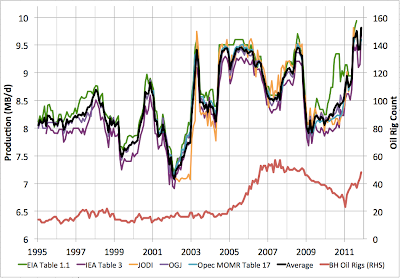
 The only way that small an amount of storage could be filled for YEARS is if they regularly draw down a lot of the storage too. Which gets back to what I said in my post above about it being used for short-term storage. They probably just put it there until some tankers arrive for delivery, then draw it down, then fill it up again, etc etc.


 At your expense!