$this->bbcode_second_pass_quote('Pops', 'T')ight oil & gas doesn't "bubble up" that's kind of the problem.
$this->bbcode_second_pass_quote('Graeme', 'Y')ou'll know the U.S. energy industry is really on the rebound when North Dakota's newfangled Bakken oil field starts pumping more crude than Alaska's stalwart Prudhoe Bay.



PeakOil is You
Oil In The Ground, Fantasy vs. Reality
Re: Oil and Gas Bubble Up All Over
 by Graeme » Tue 03 Jan 2012, 18:18:36
That's pretty disappointing Graeme, usually you post better puffery than that.
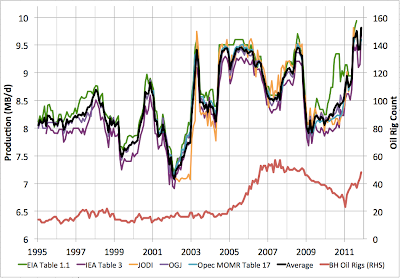
Here's a picture of "...really on the rebound...":

Just to clarify, here's what "bubbling up" looks like:

Don't get me wrong, I'm glad those guys on the drilling rigs are working, the way it looks with the steep depletion rates of these wells they are going to be busy making holes for a long time.
According to the IEA, you are right in a sense (see page 73). Falling production will occur in the US but not in North America as a whole. Strong growth in Canada is offset by hefty decline in US and Mexico. So the quote from WSJ is misleading.
Human history becomes more and more a race between education and catastrophe. H. G. Wells.
Fatih Birol's motto: leave oil before it leaves us.
Fatih Birol's motto: leave oil before it leaves us.
-

Graeme - Fusion

- Posts: 13258
- Joined: Fri 04 Mar 2005, 04:00:00
- Location: New Zealand
Re: Oil and Gas Bubble Up All Over
by Crazy_Dad » Wed 04 Jan 2012, 08:11:11
This is an interesting thread.
But what is the cost of the uptick in Canadian production?
Are we factoring in the long term environmental damage of Tar Sands exploitation?
What is the long term prognosis of this level of planetary vandalism?
Food for thought.
But what is the cost of the uptick in Canadian production?
Are we factoring in the long term environmental damage of Tar Sands exploitation?
What is the long term prognosis of this level of planetary vandalism?
Food for thought.
- Crazy_Dad
- Lignite

- Posts: 258
- Joined: Fri 10 Oct 2008, 03:00:00
- Location: Perth, Australia
Re: Oil and Gas Bubble Up All Over
by MD » Wed 04 Jan 2012, 08:29:21
$this->bbcode_second_pass_quote('Crazy_Dad', 'T')his is an interesting thread.
But what is the cost of the uptick in Canadian production?
Are we factoring in the long term environmental damage of Tar Sands exploitation?
What is the long term prognosis of this level of planetary vandalism?
Food for thought.
But what is the cost of the uptick in Canadian production?
Are we factoring in the long term environmental damage of Tar Sands exploitation?
What is the long term prognosis of this level of planetary vandalism?
Food for thought.
Unfortunately the environmental concerns will take a back seat as there are not enough humans occupying the area to support legal efforts to stop it. The environmentalists aren't strong enough on their own. They need injured parties to win their agenda, and there aren't enough.
Stop filling dumpsters, as much as you possibly can, and everything will get better.
Just think it through.
It's not hard to do.
Just think it through.
It's not hard to do.
-

MD - COB

- Posts: 4953
- Joined: Mon 02 May 2005, 03:00:00
- Location: On the ball
Re: Oil and Gas Bubble Up All Over
by seahorse3 » Wed 04 Jan 2012, 10:00:36
Graeme, I haven't seen the reports that Canadian production will save the day, certainly not enough to make NA energy independent. All the reports from Canada suggest they can, in the next decade, increase oil production to about 3mbpd (going from memory). Even if it's 5mbpd in the next 10 years that's not enough to make NA energy independent. At best we would probably be on a plateau, but to grow GDP we need production growth. The downside is as far as I know the canadiens are still using masive amounts of NG to produce the oil from their shale, which is dumb if you ask me. We simply deplete two resources to get one. Instead of transitioning to NG like you always argue will happen, we are burning it to get oil from rocks. This tells me that the transition to NG is just not going to happen. It's so cheap we burn it to make oil but not cheap enough to transition to it as a transportation fuel? The market isn't going to make the transition. It will take govt action as Hirsch argues to force a transition. But maybe the market is right. Maybe we aren't using NG as a transportation fuel bc it's not the right choice. Maybe it means NG isn't the right choice ever. Maybe it takes more money and resources than we have available to make a big jump into NG in a way that would significantly dent out demand for oil. I ask these questions earnestly bc it is a fact that we are burning NG to make oil in Canada andnit makes me asks why? If the market is always right, why do we still burn NG to make oil when NG is so cheap and oil so expensive? I would like to know the answer to that question. It seems NG would be best used to generate electricity for powering EV cars bc that does away with the need for NG infrastructure for NG cars, but the market isn't doing that.
- seahorse3
- Lignite
- Posts: 375
- Joined: Tue 01 Mar 2011, 16:14:13
Re: Oil and Gas Bubble Up All Over
by Frank » Wed 04 Jan 2012, 19:08:51
Re the Obama Administration and peak oil, the ~35 mpUSg mileage standard already mandated by executive order and the discussion on 54 mpUSg seem to acknowledge the problem. I too would like to see a more comprehensive energy policy but every time the government tries to "pick a winner" they are criticized. Granted, the above numbers are an end-run around CAFE via air pollution/CO2 emissions but they accomplish the same thing.
-

Frank - Tar Sands

- Posts: 556
- Joined: Wed 15 Dec 2004, 04:00:00
- Location: Maine/Nova Scotia
Re: Oil and Gas Bubble Up All Over
by peripato » Wed 04 Jan 2012, 23:41:43
$this->bbcode_second_pass_quote('seahorse3', 'U')nfortunately these new technologies have yet to refill once mighty reservoirs now depleted or depleting. This mighty Baken touted in the article barely offsets the decline of Alaska. So, the article is misleading about the reality of the energy situation. Why the slant? Why the omission of key facts? There's an angle.
It's all the optimists have got left to mask conventional fields decline (4mbs p/d?) leading to a constant upwards pressure on price. That's the angle which explains the Yerginite media blitz of the last few months.
"Don’t panic, Wall St. is safe!"
-

peripato - Heavy Crude

- Posts: 1335
- Joined: Tue 03 May 2005, 03:00:00
- Location: Reality





 So assuming everyone is telling the truth,
  all we need is a shortage of 3.0 mpd to kick off a world changing event. Anybody know of any producer that could fill such a major gap between demand and production on short notice?