A few things that run through so many threads here, as well as the national consciousness, are starting to bother me. First of all, there is a difference between the two parties. That difference is not going to go away because a person looking at the political situation has lost hope and become apathetic. Realize the parties are made up of people that have believed in a worldview, usually from a very early age. It is absolute crap to dismiss that simply because you can't see it from the couch. Second, why does everybody want to bring back relatively unskilled and low paid manufacturing jobs? Is anti-intellectualism so rampant and deeply entrenched in America that people would honestly rather carp on rather than learn something new. What the crisis seems to me to be is a crisis of self-confidence where the people don't believe in their ability to adapt intellectually to the knowledge age. That and political gamesmanship augering away at the collection of memes and stop gap measures that people have put in place. America has been hobbling around on a broken leg for a long time, but that broken leg has not had to do as much with bleeding jobs overseas or bankster fraud nearly so much as with an acceptance of the twenty first century.
The world has been changing out of the old Marxist/Capitalist paradigm for lo these many decades. Even so very many wish to see the potential for utopia somehow wrapped up in Marxist ideals, whether it is a statement in opposition of or in favor. Try post-capitalism, it fits better. The workers now own the store. The real divide is between knowledge workers and service workers in terms of social questions. The failure to even address that is preventing application of science as an organizing force in order to increase productivity. We are experiencing this dystopia because we can't let go of the twentieth century and we can't step up and blame ourselves for not being brave enough to take the promised land. This applies both to understanding ourselves and our role vis a vis capital such that we as a people did not long ago address the agency problem in corporate management which is now hemorrhaging.
It is fashionable, even here on PeakOil, to look for easy, non-chaotic answers in the face of resource depletion and other crises. Simply put, backyard chickens are not going to save you from the crisis which will develop in your life resulting from not making the right decision about adapting in a knowledge manner to the future. Backyard chickens work, but they don't cover that one.



PeakOil is You
THE Economic Collapse Thread Pt 2 (merged)
Re: Refresher: The Economic Collapse
 by evilgenius » Sun 03 Oct 2010, 10:50:35
-

evilgenius - Intermediate Crude

- Posts: 3730
- Joined: Tue 06 Dec 2005, 04:00:00
- Location: Stopped at the Border.
Re: Refresher: The Economic Collapse
by Pops » Sun 03 Oct 2010, 11:28:53
I thought I'd vote for McCain because (after the campaign) I thought he'd be most "independent" and I was afraid of how the right would react to O and what Fox News would goad some psycho into doing - I became especially worried after O selected Biden. But then old-fart McCain selected Palin and I threw up my hands. It came down to the choice for VP between Jibber Jabber and Drill Baby.
In my mind there was never a question if the Dems would lose in the mid-terms, the economy was trashed and wouldn't get better, we were in two unjustified wars that we couldn't get out of easily and no one in congress was talking to independents let alone the other party. The Republicans had nothing to gain by compromising with the Dems (since of course being re-elected is what's important and not doing what's right for the country) and I soon realized that O was a nice talker but not necessarily a great leader. He had a pretty good mandate so I thought and if the opposition simply wouldn't play, he should have rammed through his agenda without them instead of dinking around pretending to build a consensus that anyone could see just isn't going to happen till the next 9/11.
In my mind there was never a question if the Dems would lose in the mid-terms, the economy was trashed and wouldn't get better, we were in two unjustified wars that we couldn't get out of easily and no one in congress was talking to independents let alone the other party. The Republicans had nothing to gain by compromising with the Dems (since of course being re-elected is what's important and not doing what's right for the country) and I soon realized that O was a nice talker but not necessarily a great leader. He had a pretty good mandate so I thought and if the opposition simply wouldn't play, he should have rammed through his agenda without them instead of dinking around pretending to build a consensus that anyone could see just isn't going to happen till the next 9/11.
The legitimate object of government, is to do for a community of people, whatever they need to have done, but can not do, at all, or can not, so well do, for themselves -- in their separate, and individual capacities.
-- Abraham Lincoln, Fragment on Government (July 1, 1854)
-- Abraham Lincoln, Fragment on Government (July 1, 1854)
-

Pops - Elite

- Posts: 19746
- Joined: Sat 03 Apr 2004, 04:00:00
- Location: QuikSac for a 6-Pac
Re: Refresher: The Economic Collapse
by Ludi » Sun 03 Oct 2010, 12:34:18
$this->bbcode_second_pass_quote('evilgenius', ' ')why does everybody want to bring back relatively unskilled and low paid manufacturing jobs? Is anti-intellectualism so rampant and deeply entrenched in America that people would honestly rather carp on rather than learn something new.
Manufacturing jobs in the US used to be well-paid. A man could support a middle-class life for his family on his single income with a manufacturing job.
As someone who makes things for a living, I resent the implication that making things is "anti-intellectual."

- Ludi
Re: Refresher: The Economic Collapse
by Ludi » Sun 03 Oct 2010, 12:41:58
$this->bbcode_second_pass_quote('evilgenius', '
')It is fashionable, even here on PeakOil, to look for easy, non-chaotic answers in the face of resource depletion and other crises. Simply put, backyard chickens are not going to save you from the crisis which will develop in your life resulting from not making the right decision about adapting in a knowledge manner to the future. Backyard chickens work, but they don't cover that one.
')It is fashionable, even here on PeakOil, to look for easy, non-chaotic answers in the face of resource depletion and other crises. Simply put, backyard chickens are not going to save you from the crisis which will develop in your life resulting from not making the right decision about adapting in a knowledge manner to the future. Backyard chickens work, but they don't cover that one.
I don't recall you posting many answers, easy or otherwise. Can you link to some of your threads about what new things we should be learning or what answers you've found that might be helpful?
How have you made the right decisions to adapt in a "knowledge manner"?
Obviously the rest of us need some schoolin'. So school us.
- Ludi
Re: Refresher: The Economic Collapse
by Cloud9 » Sun 03 Oct 2010, 14:47:27
It is going to be extremely difficult to let go the twentieth century. It was built by cheap energy. The unfolding dystopia we have coming at us is going to demand ever higher inputs of labor. I fear many will not be able to successfully make the transition. In despair, people have a tendency to turn to fanaticism. There is a real yearning in this country for a messiah. Messiahs all tend to end in the same way. They are crucified and their followers are murdered and scattered to the wind. We run a real risk of voting in some guy with a funny little mustache.
-

Cloud9 - Intermediate Crude
- Posts: 2961
- Joined: Wed 26 Jul 2006, 03:00:00
Re: Refresher: The Economic Collapse
by efarmer » Sun 03 Oct 2010, 17:42:31
I find fault with the notion that Americans are against intellectualism or afraid to learn new skills as a central theme to what is taking place. More to the point is that the practical experience over the last 20 years or so, as we have seen the information economy and service economy touted as the wave to ride for response to the older industrial economy seeking the global destination of cheapest labor, least environmental regulation, least taxation / most emerging economy government subsidy, etc., a simple fact that strikes people right between the eyes in their everyday experience has become manifest.
There is often no reason for the service economy and information technology sectors not to simply seek the equivalent offshoring the industrial economy has for the exact same reasons. China builds things and more and more designs them. The contract manufacturer of the 1980's is now a turnkey design, manufacture, and more and more often a product support source with American companies providing concepts, brand names, and consumer interfaces for goods that are thin shells and simply market American consumers to Asian manufacturing and Indian (subcontinent) or alternative English speaking and well educated telephone support, or online support. American enterprises have shifted from being vertical integrations to being advertisers, order processing, and grunts in vans to install and swap modules and boxes. This is true for IT, automobiles, and on a increasing basis for a wide range of industries. The service and support aspects of this system on the American end of the global corporation are often borderline living wage affairs. Some voices tout that a national goal would be to ramp up to attempt to now maintain a vast infrastructure we implemented during the waxing our our economic prowess and then during the leveraging and derived wealth manipulation of same until it simply exploded in our faces. Does anyone have a real plan here?
As Nasim Taleb (Black Swan) pointed out on the financial industry in particular, the approach is that exceptionally large systems are built and managed by globalizing supply chains, monetary as well as material, manufactured, and increasingly service products and reducing inefficiencies to build a structure that is managed with the mathematically derived data from it's own past existence to carve away at any inefficiencies and leverage from the strengths to as great of a level as can be done and to design stability into the system from metrics acquired by intensive analysis of the past performance and upsets that have taken place within the structure. We build huge sleek global machines that can't take a punch without collapsing because they are not designed for anything unexpected. We know on this forum that resource limits and climate change will deliver great blows and unpredictable civil and social aftermaths of those blows on a rotating basis around the world, and yet our economic system is building systems without redundancy and compartments because that's how you make the fastest money possible, and in fact, the most money until the system is destroyed by a Black Swan.
This is a crippling strategy and philosophy, because in the pursuit of the efficiencies anything redundant is cut out and everything useful is pushed to it's highest performance to produce the most profit. It sounds wonderful. But in practice it is not. It is like making a large ship without individual compartments that can be damaged and flooded and sealed off to stay afloat, or like the Titanic, a ship that relies on barriers that contain flooding so pumps can be used to keep up with damage.
When a nation that is large enough to be fundamentally self sufficient, like America, pursues an approach based on highest profit and strips away it's internal compartmentalization in the vertical stack of critical industries and activities that makes it 'seaworthy' it gives away it's ability to provide for itself and it's people in return for the opportunity to return the highest profit on economic activity until such time as an accident takes place and it does not have the internal structures to stay afloat.
As we moved further and further into this vulnerability, each compartment to be abandoned railed against the notion, manufacturing, small farming, local retail, domestic technical support, etc.
The rallying cry was that we would retrain, and embrace the high technology and new technology growth areas as if they for some reason are a uniquely American niche that was immune from the pressures that felled the employment bastions that fell to globalization preceding these new great hopes. I see no reason if the global communications and transportation systems stay intact that American high technology, portions of health care, and service industries that are not actually hands on, will be immune from the forces that hold sway. I fully expect to see a brutal doubling down of the past trends to manifest as the way American corporations will seek profit at reduced overhead to recoup stock values as/if we abate from the present economic slump.
It is cynical, but I see the retraining and re-educating push being made in America as being another wealth extraction game for the higher education mills and associated finance (with auspicious Federal, State, and local taxpayer funding rolled in) to train people for jobs that will simply not emerge here, but will emerge in the cheapest place they can be accomplished globally instead.
The American government did not have a long term plan, they had a series of exploits and had fallen into lucrative military industrial and petroleum centric global strategies by simply staying at them in the 65 years since the end of WWII. They do not have a plan at compartmentalizing the nation to make it a persistent and resilient (resilience is inefficient and is slain like a vermin for profit) place that can weather the shocks that get delivered region by region globally, in such a fashion and pattern to be a
a long term global player.
I don't think the intellectual argument about the American workforce moving into the future and being retrained will find real purchase until the people promoting it have a plan for where the nation is headed, and they do not, as well as a promise for protecting the economic pursuits associated with the new field or endeavor they are imploring their citizens to educate themselves to inhabit.
Our government is sold out to corporate influence on a massive basis, corporations pursue profit and abandon national compartmentalization and resilience as an affront to global efficiency. Our government does not have a comprehensive plan, because they serve corporations that have global plans and dare not and need not formulate one.
Our national strategy is essentially that we are too big to fail and will not be allowed to because so many others need our military protection and we owe them too much to allow us to fail.
It is so obvious, we go into tribal societies as part of the terror wars and are amazed that the people in comparative abject poverty would rather be left alone that become liberated and a part of a great global enterprise and all it would take it their minerals or perhaps labor. We don't understand people who have lived locally resilient lives for thousands of years, and they understand why we are so damned interested in saving them all of a sudden.
We might try to figure out what we are going to do over the long term before we feel like our way of life is an export product of great value.
We might start with showing people where to win in America and putting in place the plan and protections required to protect the win if it can be achieved. Otherwise this whole line of challenge and bait crap is just another versions of the great wealth extraction that began with Reagan and culminated with the Necon debacle and Obama smelling salts and glucose IV line of the recent past.
This was a stream of passion rant, forgive me the typos and such.
There is often no reason for the service economy and information technology sectors not to simply seek the equivalent offshoring the industrial economy has for the exact same reasons. China builds things and more and more designs them. The contract manufacturer of the 1980's is now a turnkey design, manufacture, and more and more often a product support source with American companies providing concepts, brand names, and consumer interfaces for goods that are thin shells and simply market American consumers to Asian manufacturing and Indian (subcontinent) or alternative English speaking and well educated telephone support, or online support. American enterprises have shifted from being vertical integrations to being advertisers, order processing, and grunts in vans to install and swap modules and boxes. This is true for IT, automobiles, and on a increasing basis for a wide range of industries. The service and support aspects of this system on the American end of the global corporation are often borderline living wage affairs. Some voices tout that a national goal would be to ramp up to attempt to now maintain a vast infrastructure we implemented during the waxing our our economic prowess and then during the leveraging and derived wealth manipulation of same until it simply exploded in our faces. Does anyone have a real plan here?
As Nasim Taleb (Black Swan) pointed out on the financial industry in particular, the approach is that exceptionally large systems are built and managed by globalizing supply chains, monetary as well as material, manufactured, and increasingly service products and reducing inefficiencies to build a structure that is managed with the mathematically derived data from it's own past existence to carve away at any inefficiencies and leverage from the strengths to as great of a level as can be done and to design stability into the system from metrics acquired by intensive analysis of the past performance and upsets that have taken place within the structure. We build huge sleek global machines that can't take a punch without collapsing because they are not designed for anything unexpected. We know on this forum that resource limits and climate change will deliver great blows and unpredictable civil and social aftermaths of those blows on a rotating basis around the world, and yet our economic system is building systems without redundancy and compartments because that's how you make the fastest money possible, and in fact, the most money until the system is destroyed by a Black Swan.
This is a crippling strategy and philosophy, because in the pursuit of the efficiencies anything redundant is cut out and everything useful is pushed to it's highest performance to produce the most profit. It sounds wonderful. But in practice it is not. It is like making a large ship without individual compartments that can be damaged and flooded and sealed off to stay afloat, or like the Titanic, a ship that relies on barriers that contain flooding so pumps can be used to keep up with damage.
When a nation that is large enough to be fundamentally self sufficient, like America, pursues an approach based on highest profit and strips away it's internal compartmentalization in the vertical stack of critical industries and activities that makes it 'seaworthy' it gives away it's ability to provide for itself and it's people in return for the opportunity to return the highest profit on economic activity until such time as an accident takes place and it does not have the internal structures to stay afloat.
As we moved further and further into this vulnerability, each compartment to be abandoned railed against the notion, manufacturing, small farming, local retail, domestic technical support, etc.
The rallying cry was that we would retrain, and embrace the high technology and new technology growth areas as if they for some reason are a uniquely American niche that was immune from the pressures that felled the employment bastions that fell to globalization preceding these new great hopes. I see no reason if the global communications and transportation systems stay intact that American high technology, portions of health care, and service industries that are not actually hands on, will be immune from the forces that hold sway. I fully expect to see a brutal doubling down of the past trends to manifest as the way American corporations will seek profit at reduced overhead to recoup stock values as/if we abate from the present economic slump.
It is cynical, but I see the retraining and re-educating push being made in America as being another wealth extraction game for the higher education mills and associated finance (with auspicious Federal, State, and local taxpayer funding rolled in) to train people for jobs that will simply not emerge here, but will emerge in the cheapest place they can be accomplished globally instead.
The American government did not have a long term plan, they had a series of exploits and had fallen into lucrative military industrial and petroleum centric global strategies by simply staying at them in the 65 years since the end of WWII. They do not have a plan at compartmentalizing the nation to make it a persistent and resilient (resilience is inefficient and is slain like a vermin for profit) place that can weather the shocks that get delivered region by region globally, in such a fashion and pattern to be a
a long term global player.
I don't think the intellectual argument about the American workforce moving into the future and being retrained will find real purchase until the people promoting it have a plan for where the nation is headed, and they do not, as well as a promise for protecting the economic pursuits associated with the new field or endeavor they are imploring their citizens to educate themselves to inhabit.
Our government is sold out to corporate influence on a massive basis, corporations pursue profit and abandon national compartmentalization and resilience as an affront to global efficiency. Our government does not have a comprehensive plan, because they serve corporations that have global plans and dare not and need not formulate one.
Our national strategy is essentially that we are too big to fail and will not be allowed to because so many others need our military protection and we owe them too much to allow us to fail.
It is so obvious, we go into tribal societies as part of the terror wars and are amazed that the people in comparative abject poverty would rather be left alone that become liberated and a part of a great global enterprise and all it would take it their minerals or perhaps labor. We don't understand people who have lived locally resilient lives for thousands of years, and they understand why we are so damned interested in saving them all of a sudden.
We might try to figure out what we are going to do over the long term before we feel like our way of life is an export product of great value.
We might start with showing people where to win in America and putting in place the plan and protections required to protect the win if it can be achieved. Otherwise this whole line of challenge and bait crap is just another versions of the great wealth extraction that began with Reagan and culminated with the Necon debacle and Obama smelling salts and glucose IV line of the recent past.
This was a stream of passion rant, forgive me the typos and such.
Last edited by efarmer on Sun 03 Oct 2010, 18:18:31, edited 3 times in total.
-

efarmer - Intermediate Crude
- Posts: 2003
- Joined: Fri 17 Mar 2006, 04:00:00
Re: Refresher: The Economic Collapse
by Ludi » Sun 03 Oct 2010, 17:51:32
Super essay, efarmer. 
$this->bbcode_second_pass_quote('efarmer', 'I')t is cynical, but I see the retraining and re-educating push
$this->bbcode_second_pass_quote('efarmer', 'I')t is cynical, but I see the retraining and re-educating push
Retraining and re-educating for what?

- Ludi
Re: Refresher: The Economic Collapse
by dissident » Sun 03 Oct 2010, 22:09:15
$this->bbcode_second_pass_quote('', 'W')hat the crisis seems to me to be is a crisis of self-confidence where the people don't believe in their ability to adapt intellectually to the knowledge age.
God, what utter inanity. You actually think that we can all write cell phone apps for each other and have an economy? BTW, all such "knowledge" age jobs are being offshored too. The cell phone jobs aren't in the US either.
You are completely out of touch with reality. Sounds like you got your "knowledge" age job and could give a rat's a** about the fact that people lose real jobs and have to settle for third rate, joke pay service jobs. They don't become highly paid consultants.
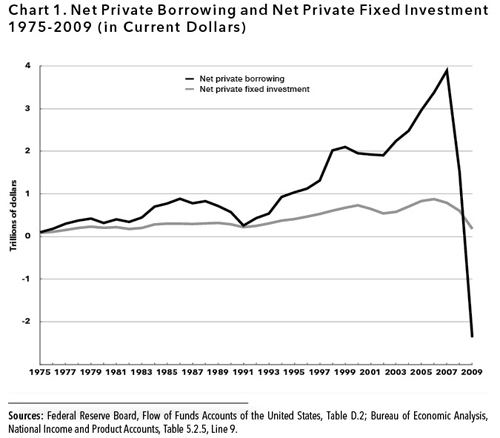
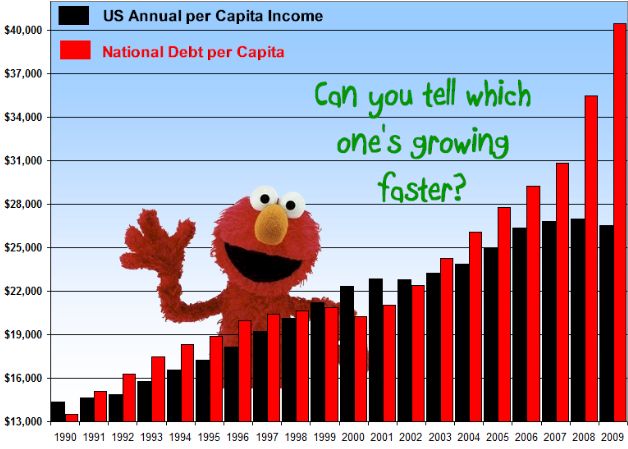
The US economy has been living on borrowed time. Consumers accumulate debt to buy junk imported from offshore sweatshops. Some genius decided to make the interest rates really low to sustain this hollow shell, trickle down economy. That produced the housing bubble where everyone decided house prices are a substitute for income. Well, the time is running out and there aren't enough "knowledge" age jobs to make a bit of difference.
- dissident
- Expert
- Posts: 6458
- Joined: Sat 08 Apr 2006, 03:00:00