PeakOil is You
Peak Oil: The Big Fizzle
Re: Peak Oil: The Big Fizzle
 by TonyPrep » Mon 17 Dec 2007, 05:21:45
$this->bbcode_second_pass_quote('JohnDenver', '')$this->bbcode_second_pass_quote('TonyPrep', 't')he scale of energy we need to substitute for the energy dense sources of oil, then gas, then coal is almost mind boggling [...] Even if the decline is slow (perhaps an undulating downslope with occasional, but lower, upturns), it is this scale of energy substitution that you never seem to address.
I address it often: If the decline is slow, substitution will start from a small base, but will grow exponentially, and the substitution will be completed over a long period of time. As you know, exponential growth is an amazing thing, and can grow very large, given *time*.
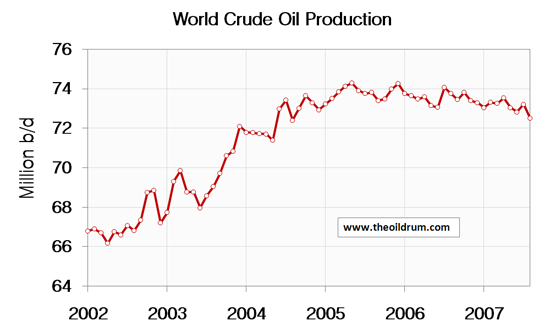
But you are falsely associating my position with a fast decline. In case you didn't read my previous post, scale is not about the speed of decline, it's about replacing a declining energy dense source (and, in particular, a liquid one) with other energy sources. Eventually, we'd need to substitute for almost all the energy we get from oil and gas and coal and, based on economic forecasts, which assume no limits on energy for decades, the world will need the energy contained in something like 120 mbpd by 2030, at a time when oil production is in a plateau and nearing decline. Within this time frame, gas and coal could also peak (an event which would be accelerated by attempts to substitute for oil declines), which is why I mention them. What you are wishing for is that somehow the growth in alternatives can continue indefinitely, that they can substitute for all uses of oil, gas and coal smoothly, and that there will be no adverse consequences of doing so. This is all wishful thinking. Since you haven't addressed scale in any depth here (except to say that exponential growth will take care of it), I assume that you are unable to do so.$this->bbcode_second_pass_quote('JohnDenver', 'Y')our talk about the scale of oil, gas and coal is just a red herring. Essentially, you are arguing like this:
1) We use mindboggling amounts of oil, gas and coal
2) Therefore we can't divert 1-2% per annum of oil use over to other power sources like electricity (generated by nuclear, wind, solar, coal, NG, tar sands, oilshale etc.)
There's no connection between 1) and 2). Can you please explain to me more clearly why 1) implies 2)?
Address the scale issue, without wishful thinking, if you can. That would be most helpful.
-

TonyPrep - Intermediate Crude

- Posts: 2842
- Joined: Sun 25 Sep 2005, 03:00:00
- Location: Waiuku, New Zealand