
Peak Oil is You

Donate Bitcoins ;-) or Paypal :-)


Page added on October 5, 2014

Is Current Oil Glut Symptomatic of Long-Term Consumption Depletion
As the short-term oil price scenario continued a post-Labor Day swoon, well into the latter part of September, questions began to be raised as to whether an inverted supply/demand direction was in store for the fourth quarter of 2014.
The current commodity surplus, which has also affected copper, steel, iron ore, and assorted agricultural products, conjured up a wave of concern as to the global economy’s direction going forward.
A re-examination of our calculations regarding future activity indicates that the current lower demand, and a net inventory supply increase, engendered primarily by the success of U.S. hydraulic fracking, which has unleashed an additional five million oil barrels a day in the last six years, is a major cause.
While the Saudis increased their daily “pumping” from eight to ten millions barrels a day, due to the disintegration of Libya’s capacity, as well as a shortfall in Iraq and Syria, due to the ISIS cabal, previously-built-up inventories overrode whatever shortages had been expected to occur from these geopolitical displacements.
Even the relatively soft sanctions imposed by the West on Iran and Russia did not prevent an overall world surplus. This tended to accumulate, bringing about spot prices substantially under the long-term contracts for both U.S.-based West Texas Intermediate (WTI) and worldwide Brent crude oil.
Although this imbalanced demand/supply situation may drive down short term oil pricing well into the fourth quarter, (normally a traditionally low demand period), major production cutbacks by the OPEC monopoly, together with a worsening of Mideast geopolitical events, will likely cut new supply flow substantially.
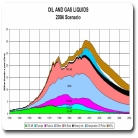
The long-term quarter century demand of up to120 million barrels a day over the current 90 million is still expected sooner, rather than later. In the meantime, trading turbulence, spot shortages, and the severity of the ISIS crisis will play a further role in parlaying the aforementioned uncertainties into an over-reaction by international producers. This will likely cause a major fossil fuel demand and price rebound before the New Year 2015 chimes echo throughout the world. It certainly will manifest itself throughout most of the next calendar year.
12 Comments on "Is Current Oil Glut Symptomatic of Long-Term Consumption Depletion"
Northwest Resident on Mon, 6th Oct 2014 12:49 am
Falling demand in a shrinking global economy brought on by oil prices which are far too high for the global economy to long endure is probably the bullet point that you can file all the other speculations, “reasons” and excuses for low oil prices under. That’s just my guess.
Of course TPTB are manipulating the price of oil to some extent, and probably to a great extent. Maybe the lower prices we are seeing is being purposely orchestrated to achieve geopolitical goals — hurting Russia, for example.
Here’s an article that makes some very good points on the current oil situation. It will probably be posted on this forum later, but for an early start, here it is:
Does Oil Have A Future?
ht tp://www.theautomaticearth.com/does-oil-have-a-future/
Perk Earl on Mon, 6th Oct 2014 2:10 am
Yeah, NWR, but the corns can still muster up some really fanciful stuff, I mean 120 mbd?!
“The long-term quarter century demand of up to 120 million barrels a day over the current 90 million is still expected sooner, rather than later.”
Where will the capex come from for all that fracking around the world? That would the red queen scenario going so fast it would be a blur.
Davy on Mon, 6th Oct 2014 7:42 am
NR, you are spot on as usual. I personally think the oil price weapon is being too generous to TPTB in particular the DC/Wall street mafia. They are taking advantage of this market self-organization not influencing it much. This unstable oil price/supply/demand situation has been a long time in the making. It is wrapped up in so many layers of dysfunction. We see the dysfunctional politics, economics, finance, and social fabric manifested in the oil market nearing limits of growth and diminishing returns. Czar Putt is a smart guy and I am sure he anticipated this turbulence. He is a patient guy but the question is how patient and meek the Russian people can be. The modern Russian is nothing like their grandparents were. They have been spoiled by oil wealth and the BAU life like the rest of us. This Russian gamble will be interesting to watch. I think Putt can pull it off myself but pull it off to what? Will it be an independence from an already spent US hegemony in a destroyed BAU? He has made the necessary arrangements at the top to control dissent just enough. With Russia on a war footing the people will find it hard to voice dissent. This was true in the US with the Bush adventures. Yet, my feelings are all the polarizing TPTB are going to play their own part in BAU’s destruction. BAU is becoming interesting and scary at the same time. Your 2015 prediction is closer to reality than ever.
GregT on Mon, 6th Oct 2014 9:25 am
As this mess continues to play out, economies worldwide will continue to decline until tipping points have been reached, and then they will collapse. In the end, all that will matter is who has access to the remaining oil and gas reserves. Russia is a major exporter of both.
shortonoil on Mon, 6th Oct 2014 9:43 am
Although depletion is basically a rather simple concept, and is as sure to occur as the sun will rise tomorrow, it is one that few seem willing to accept. We have already extracted 75% of the world’s usable petroleum reserve, and the 25% remaining is of a much lower quality, and will be much more expensive to extract than what we have already used. Being of lower quality, the value of it to the economy is lower. Thus, the economy can not afford to pay an ever increasing price for it. Being more expensive to extract and process, producers can not afford to keep increasing production.
We have entered into an era where what the economy can afford, and what producers can afford to extract have met. The legacy fields of conventional are now in direct competition with higher cost non-conventional. There is little doubt as to who will win. Production will not further increase to any substantial level, and price has reached its maximum point. We are now in the last few years of the oil age, and irrational hope is likely to be our most deleterious enemy.
More to come –
http://www.thehillsgroup.org/
Northwest Resident on Mon, 6th Oct 2014 10:22 am
Davy — Great feedback. Regarding Russia, my guess is that because they have their own oil and NG resources and are truly energy independent, they’ll do better than most in the long run. Also, their communities are for the most part already localized in terms of their food production and local economies, as Orlov very intelligently pointed out before fame got to his head and he went over to the dark side.
I believe that in order for America to become “energy independent”, there are about a half billion private autos that are going to have to be more or less permanently parked, and the neighborhoods and communities that those former long-distance commuters used to drive back and forth too repetitively will have to be reorganized for a more local self-sufficiency in terms of food production especially, and generalized local economy. That will be an extremely painful change for Americans, and many or perhaps most won’t be able to make the adjustment (too old, too sick, too mentally incapacitated, too lazy, too weak, too god damn stupid). But adjustment time is coming, ready or not. You know it, I know it, most of us here know it. It is getting real…
rockman on Mon, 6th Oct 2014 11:10 am
NR – Your Russian “energy independence” got me thinking: are they (and the KSA et al) really energy independent? They may have enough oil/NG to fuel their societies but how well could their societies function without the revenue from the hydrocarbon sales? In that sense what countries are truly “energy independent”? In one manner Norway may be the closest since they aren’t living off their oil/NG revenue to a significant extent. Likewise countries with little production or imports aren’t very dependent either. But of course that doesn’t mean these countries have robust economies either.
Russia and the other exporters are not dependent upon anyone supplying them with energy. But they are very dependent upon others buying their production. The current EU/Russia hissy fit over the Ukraine is as good example as any other: is either country independent from the production of hydrocarbons? One might be able to handle a cut in exports better than the other in the short term. But long term each would suffer significant economic damage.
Nothing independent about that IMHO.
JuanP on Mon, 6th Oct 2014 11:24 am
Rock, Just look at Russia in the 90s for an answer to your question. It was a very rogh time for the Russians and it was all caused by lower oil prices, IMO. The USSR fell because of low oil prices in the 80s and mismanagement, IMO. Russians will be just where they were 20 years ago, a bad place, but they will get by because many of them can still remember what it was like and they are used to suffering. It will be toughest for the younger generations with unrealistic expectations and a more prosperous life experience under Putin and Medvedev.
Northwest Resident on Mon, 6th Oct 2014 11:43 am
rockman — Excellent points! Maybe the definition of “energy independence” could be “In the total absence of global economic activity, the country can still produce the energy it needs to keep the electrical grid up, the water/sewer systems operative, the heat on in the winter, and the farm equipment moving.”
That’s a lame attempt at a good definition, of course. But the idea is, when the global economy crashes and burns, will a country be able to produce enough of its own energy to keep the very basic necessities powered up?
Then of course we get into the question of will even those countries that produce their own energy be able to get all the spare parts and technology and resources needed to keep the basic necessities powered up? And I think there are very good arguments that demonstrate the answer to that question is “no”.
True energy independence may be an unattainable figment of the imagination that drives us all to insanity in the end.
Davy on Mon, 6th Oct 2014 12:32 pm
I would have to say allot will matter on degree and duration of problems any of the regions and countries experience in a descent. Who is going to bite the dust first and the worst may make a difference. Will there be war, civil war, social collapse. Most countries have comparative advantages/disadvantages that may make a difference good or bad. We do know the ones in overshoot and lacking food/energy/water resources. These areas lacking the basics face uncertain times that seems certain.
Northwest Resident on Mon, 6th Oct 2014 12:49 pm
Davy — “These areas lacking the basics…”
That would be most of Europe. Philippines for sure and any other Asian country that has way too many people and are dependent on millions of metric tons of chemical nitrogen to grow their rice. ME countries are so, so screwed. China is toast. That’s an incomplete list. America and Russia have enough of their own oil/NG, and plenty of good farmland and fresh water resources. There are other smaller examples where those countries/areas might be energy and resource “self sufficient” — but there aren’t a lot of them. Things could get ugly.
Harquebus on Mon, 6th Oct 2014 5:03 pm
There is not enough oil left for governments to be able to pay off their debts. Credit is keeping the oil industry alive.