
Peak Oil is You

Donate Bitcoins ;-) or Paypal :-)


Page added on June 9, 2020

Why are fossil fuels so hard to quit?
We understand today that humanity’s use of fossil fuels is severely damaging our environment. Fossil fuels cause local pollution where they are produced and used, and their ongoing use is causing lasting harm to the climate of our entire planet. Nonetheless, meaningfully changing our ways has been very difficult.
But suddenly, the COVID-19 pandemic brought trade, travel, and consumer spending to a near-standstill. With billions of people recently under stay-at-home orders and economic activity plunging worldwide, the demand for and price of oil have fallen further and faster than ever before. Needless to say, oil markets have been in turmoil and producers around the world are suffering.

Some pundits are now asking if this crisis could be the push the world needs to move away from oil. One asked: “Could the coronavirus crisis be the beginning of the end for the oil industry?” Another: “Will the coronavirus kill the oil industry and help save the climate?” Meanwhile, 2020 annual greenhouse gas emissions are forecast to decline between 4 – 7% as a result of the virus’ effects, and some of the world’s smoggiest cities are currently enjoying clear skies.
The idea that the pandemic could ultimately help save the planet misses crucial points. First and foremost, damaging the world’s economy is not the way to deal with climate change. And in terms of oil, what will take its place? We haven’t found a good substitute for oil, in terms of its availability and fitness for purpose. Although the supply is finite, oil is plentiful and the technology to extract it continues to improve, making it ever-more economic to produce and use. The same is also largely true for natural gas.
Climate change is real and we see its effects clearly now: In 2019 worldwide, 15 extreme weather events, exacerbated by climate change, caused more than $1 billion in damage each. Four of these events each caused more than $10 billion in damage. The large-scale use of fossil fuels tops the list of factors contributing to climate change. But the concentrated energy that they provide has proven hard to replace. Why?
A reporter raised that very question to me after a press Q&A that I did at a conference a few years ago. “We know that oil contributes to climate change and other environmental problems — why do we still use it? Why don’t we just quit already?,” he asked me.
Until that moment, I hadn’t thought enough about how my experience and background give me a clearer view than many on the promise and challenge of moving to a cleaner energy system. I have gained a wide-angle view of the energy industry as I’ve moved through my career, working in government and in consulting — for both oil and gas and clean energy clients — and then moving into the think tank world.
fossil fuel
Generated from the decomposition of ancient plant and animal matter over millions of years. Coal, oil, and natural gas are fossil fuels.
To deal with the challenge of climate change, we must start by understanding the fossil fuel system — namely how energy is produced and used. Although fossil fuel companies are politically powerful, in the United States and around the world, their lobbying prowess is not the key reason that their fuels dominate the global energy system. Likewise, the transition to an all-renewable energy system is not a simple task. But the politics of blame are popular, as we’ve seen during the 2020 election campaign and in light of recent lawsuits against fossil fuel companies. There is plenty of blame to go around, from fossil fuel companies that for years denied the problem to policymakers reluctant to enact the policies needed to force real change. It has been easier for everyone to stick with the status quo.
The world needs technology and strong policy to move in a new direction. Throughout history, humanity’s energy use has moved toward more concentrated, convenient, and flexible forms of energy. Understanding the advantages of today’s energy sources and the history of past transitions can help us understand how to move toward low-carbon energy sources. With greater understanding of the climate challenge, we are making huge strides in developing the technology we need to move toward a low-carbon future. Still, understanding how we got here and why the modern world was built on fossil fuels is crucial to understanding where we go from here.
Our energy comes from the sun, one way or another
In the pre-industrial age, solar energy met all of humanity’s energy needs. Plants convert solar energy into biomass through the process of photosynthesis. People burned this biomass for heat and light. Plants provided food for people and animals, which, in turn, used their muscle power to do work. Even as humans learned to smelt metals and make glass, they fueled the process with charcoal made from wood. Apart from photosynthesis, humans made some use of wind and water power, also ultimately fueled by the sun. Temperature differences in the atmosphere brought about by sunlight drive the wind, and the cycle of rainfall and flowing water also gets its energy from sunlight. But the sun is at the center of this system, and people could only use the energy that the sun provided in real time, mostly from plants.
biomass
Plant material, including leaves, stalks, and woody mass. Biomass can be burned directly or processed to create biofuels, like ethanol.
This balance between human energy use and sunlight sounds like utopia, but as the human population grew and became more urban, the bio-based energy system brought problems. In England, wood became scarce in the 1500s and 1600s, since it was not only used for fuel, but also for building material. London, for instance, grew from 60,000 people in 1534 to 530,000 in 1696, and the price of firewood and lumber rose faster than any other commodity. The once lush forests of England were denuded.
In 1900, roughly 50,000 horses pulled cabs and buses around the streets of London, not including carts to transport goods. As you can imagine, this created an enormous amount of waste. As Lee Jackson writes in his book “Dirty Old London,” by the 1890s London’s immense horse population generated roughly 1,000 tons of dung per day. All this manure also attracted flies, which spread disease. The transportation system was literally making people sick. The pre-fossil era was not the utopia we envision.
Fossil fuels opened new doors for humanity. They formed from the transformation of ancient plants through pressure, temperature, and tens to hundreds of millions of years, essentially storing the sun’s energy over time. The resulting fuels freed humanity from its reliance on photosynthesis and current biomass production as its primary energy source. Instead, fossil fuels allowed the use of more energy than today’s photosynthesis could provide, since they represent a stored form of solar energy.
First coal, then oil and natural gas allowed rapid growth in industrial processes, agriculture, and transportation. The world today is unrecognizable from that of the early 19th century, before fossil fuels came into wide use. Human health and welfare have improved markedly, and the global population has increased from 1 billion in 1800 to almost 8 billion today. The fossil fuel energy system is the lifeblood of the modern economy. Fossil fuels powered the industrial revolution, pulled millions out of poverty, and shaped the modern world.
How energy density and convenience drove fossil fuel growth
The first big energy transition was from wood and charcoal to coal, beginning in the iron industry in the early 1700s. By 1900, coal was the primary industrial fuel, taking over from biomass to make up half the world’s fuel use. Coal has three times the energy density by weight of dry wood and is widely distributed throughout the world. Coal became the preferred fuel for ships and locomotives, allowing them to dedicate less space to fuel storage.
Oil was the next major energy source to emerge. Americans date the beginning of the oil era to the first commercial U.S. oil well in Pennsylvania in 1859, but oil was used and sold in modern-day Azerbaijan and other areas centuries earlier. Oil entered the market as a replacement for whale oil for lighting, with gasoline produced as a by-product of kerosene production. However, oil found its true calling in the transportation sector. The oil era really took off with the introduction of the Ford Model-T in 1908 and the boom in personal transportation after World War II. Oil overtook coal to become the world’s largest energy source in 1964.
Oil resources are not as extensively distributed worldwide as coal, but oil has crucial advantages. Fuels produced from oil are nearly ideal for transportation. They are energy-dense, averaging twice the energy content of coal, by weight. But more importantly, they are liquid rather than solid, allowing the development of the internal combustion engine that drives transportation today.
Different fuels carry different amounts of energy per unit of weight. Fossil fuels are more energy dense than other sources.
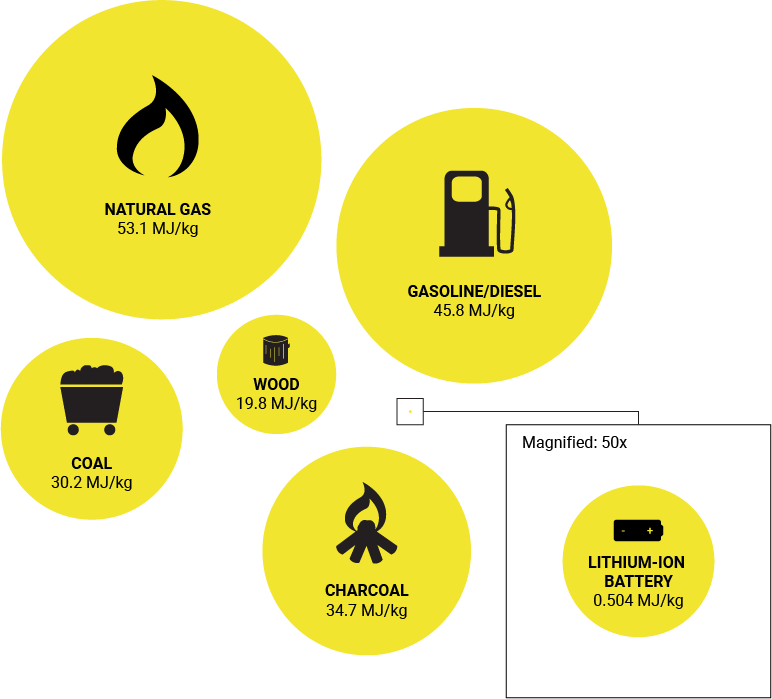
Sources: The Engineering Toolbox; Epec Engineered Technologies
Oil changed the course of history. For example, the British and American navies switched from coal to oil prior to World War I, allowing their ships to go further than coal-fired German ships before refueling. Oil also allowed greater speed at sea and could be moved to boilers by pipe instead of manpower, both clear advantages. During World War II, the United States produced nearly two-thirds of the world’s oil, and its steady supply was crucial to the Allied victory. The German army’s blitzkrieg strategy became impossible when fuel supplies could not keep up, and a lack of fuel took a toll on the Japanese navy.
Natural gas, a fossil fuel that occurs in gaseous form, can be found in underground deposits on its own, but is often present underground with oil. Gas produced with oil was often wasted in the early days of the oil industry, and an old industry saying was that looking for oil and finding gas instead was a quick way to get fired. In more recent times, natural gas has become valued for its clean, even combustion and its usefulness as a feedstock for industrial processes. Nonetheless, because it is in a gaseous form, it requires specific infrastructure to reach customers, and natural gas is still wasted in areas where that infrastructure doesn’t exist.
A final key development in world energy use was the emergence of electricity in the 20th century. Electricity is not an energy source like coal or oil, but a method for delivering and using energy. Electricity is very efficient, flexible, clean, and quiet at the point of use. Like oil, electricity’s first use was in lighting, but the development of the induction motor allowed electricity to be efficiently converted to mechanical energy, powering everything from industrial processes to household appliances and vehicles.
Over the 20th century, the energy system transformed from one in which fossil energy was used directly into one in which an important portion of fossil fuels are used to generate electricity. The proportion used in electricity generation varies by fuel. Because oil — an energy-dense liquid — is so fit-for-purpose in transport, little of it goes to electricity; in contrast, roughly 63% of coal produced worldwide is used to generate electricity. Methods of generating electricity that don’t rely on fossil fuels, like nuclear and hydroelectric generation, are also important parts of the system in many areas. However, fossil fuels are still the backbone of the electricity system, generating 64% of today’s global supply.
Fossil fuels still dominate global electricity generation.
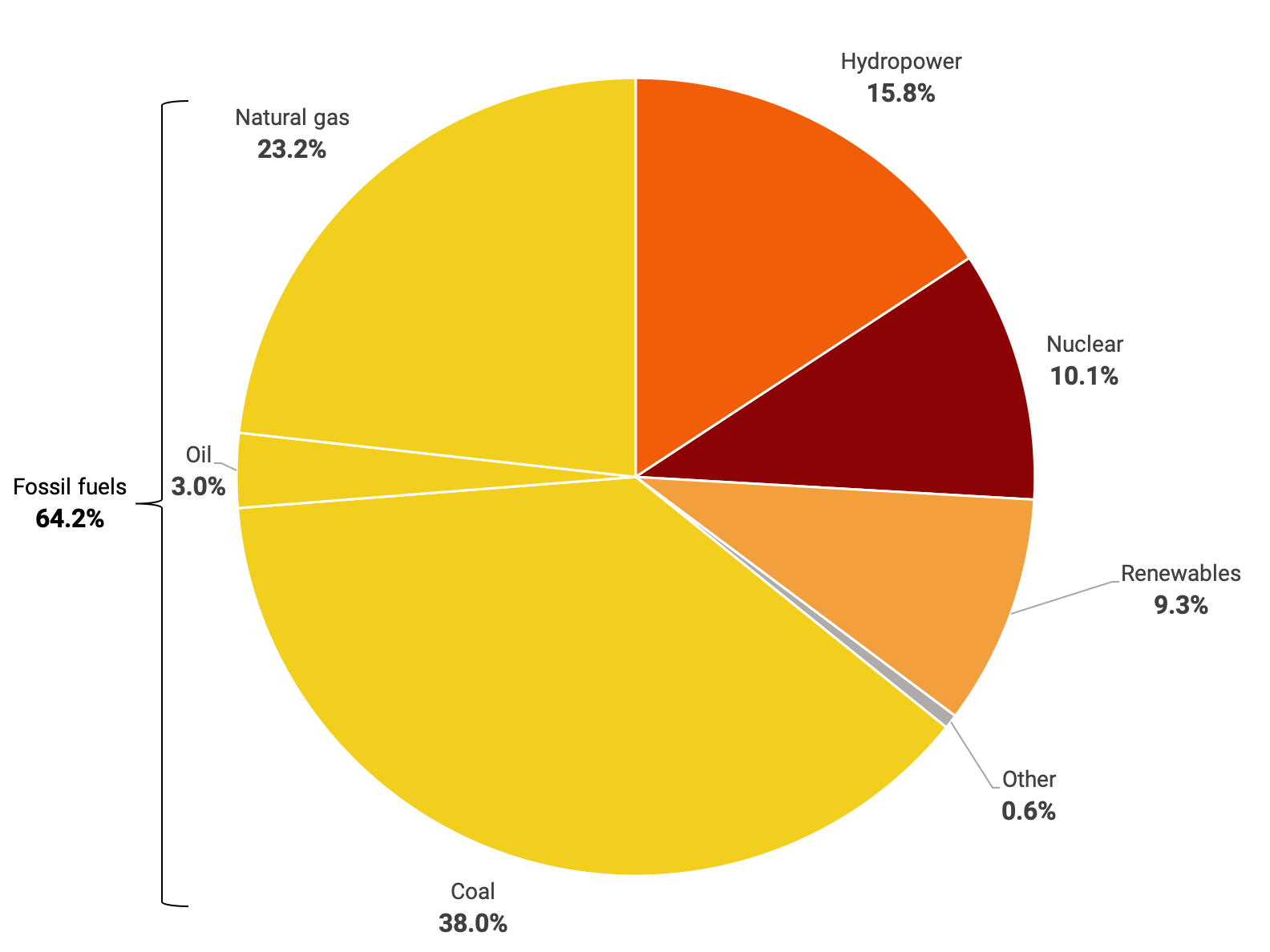
Source: BP Statistical Review of World Energy 2019, 56.
In sum, the story of energy transitions through history has not just been about moving away from current solar flows and toward fossil fuels. It has also been a constant move toward fuels that are more energy-dense and convenient to use than the fuels they replaced. Greater energy density means that a smaller weight or volume of fuel is needed to do the job. Liquid fuels made from oil combine energy density with the ability to flow or be moved by pumps, an advantage that opened up new technologies, especially in transportation. And electricity is a very flexible way of consuming energy, useful for many applications.
Back to the future – the return of the solar era
Fossil fuels allowed us to move away from relying on today’s solar flows, instead using concentrated solar energy stored over millions of years. Before we could make efficient use of solar flows, this seemed like a great idea.
carbon dioxide
Carbon dioxide is gas released when carbon-containing fuels (biomass or fossil fuels) are burned. Carbon dioxide is the most important gas contributing to climate change.
However, the advantages of fossil fuels come with a devastating downside. We now understand that the release of carbon dioxide (CO2) from burning fossil fuels is warming our planet faster than anything we have seen in the geological record. One of the greatest challenges facing humanity today is slowing this warming before it changes our world beyond recognition.
Now that there are almost eight billion of us, we clearly see the impact of rising CO2 concentrations. Going back to the old days of relying mostly on biomass for our energy needs is clearly not a solution. Nonetheless, we need to find a way to get back to reliance on real-time solar flows (and perhaps nuclear energy) to meet our needs. There are so many more of us now, interacting via a vastly larger and more integrated global economy, and using much more energy. But we also have technologies today that are much more efficient than photosynthesis at transforming solar flows to useful energy.
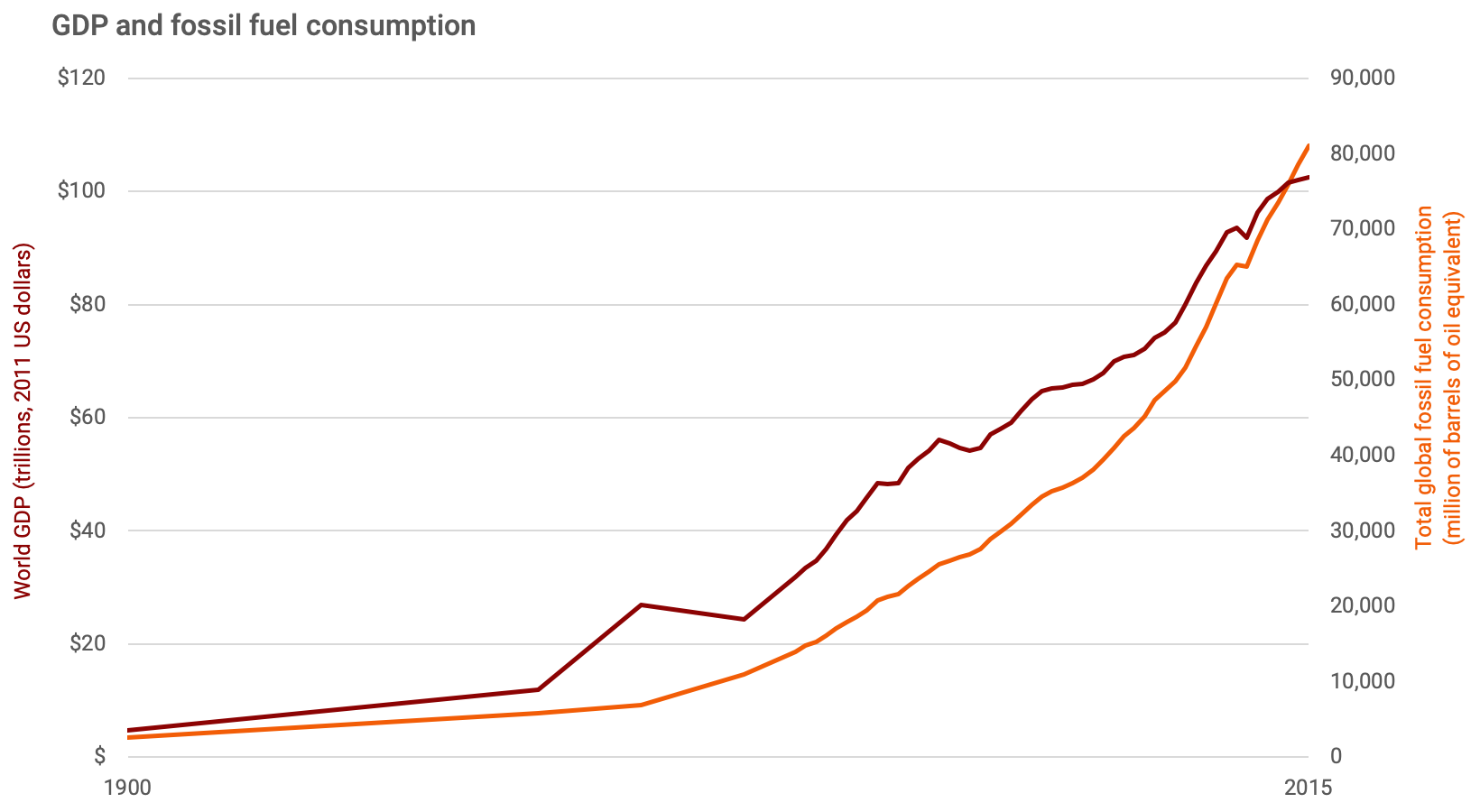
Since 1900, global population and economic activity have skyrocketed, along with fossil fuel consumption.
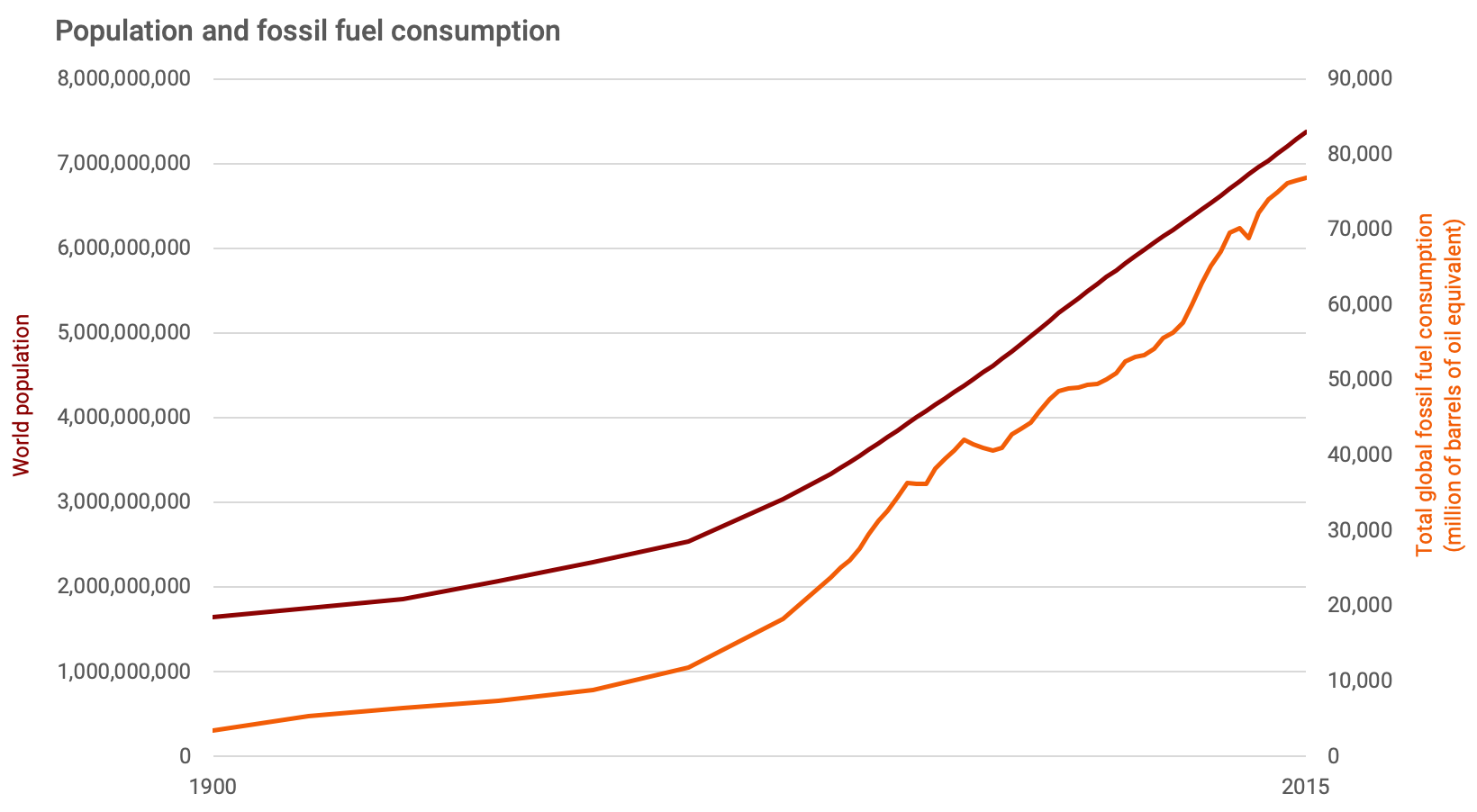
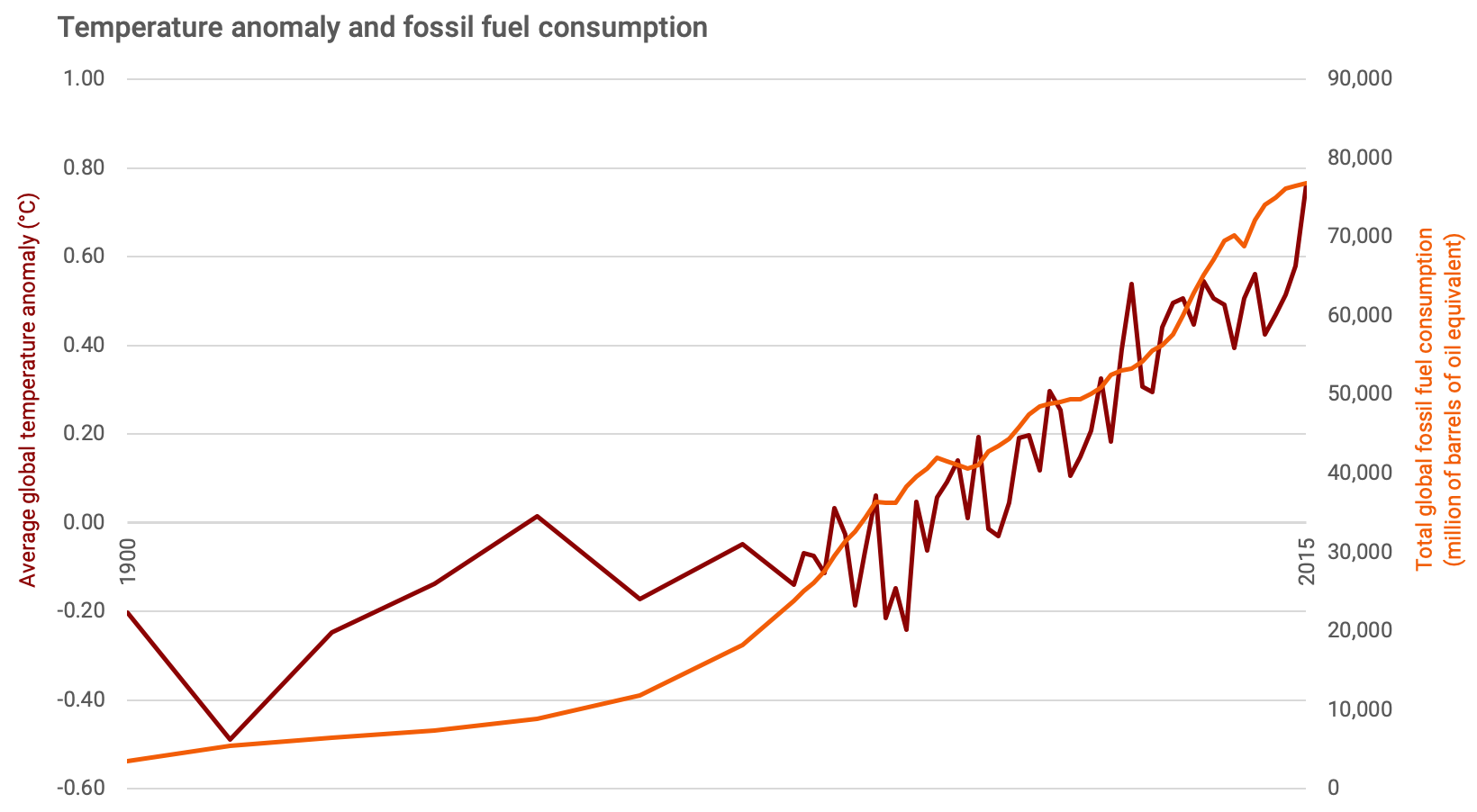
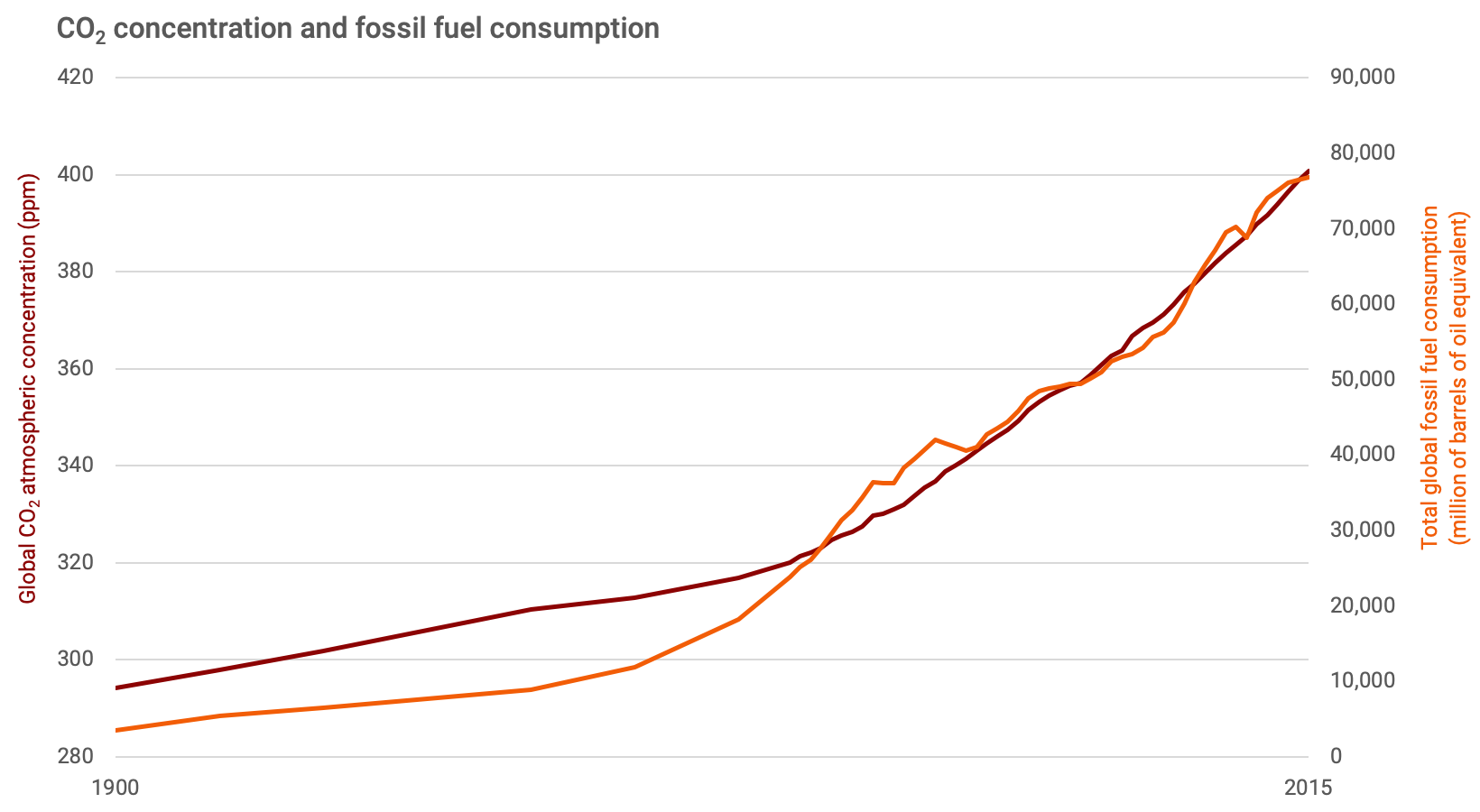
Unfortunately, the atmospheric concentration of carbon dioxide, the most consequential greenhouse gas, has steadily climbed at the same time, along with global average temperature.
The earth gets plenty of energy from the sun for all of us, even for our modern energy-intensive lives. The amount of solar energy that reaches habitable land is more than 1,000 times the amount of fossil fuel energy extracted globally per year. The problem is that this energy is diffuse. The sun that warms your face is definitely providing energy, but you need to concentrate that energy to heat your home or move a vehicle.
renewable energy
Renewable energy is from a source that is naturally replenished. (Ex: capturing wind using turbines or sunlight using solar cells does not change the amount of wind or sunlight that is available for future use.)
This is where modern technology comes in. Wind turbines and solar photovoltaic (PV) cells convert solar energy flows into electricity, in a process much more efficient than burning biomass, the pre-industrial way of capturing solar energy. Costs for wind and solar PV have been dropping rapidly and they are now mainstream, cost-effective technologies. Some existing forms of generating electricity, mainly nuclear and hydroelectricity, also don’t result in CO2 emissions. Combining new renewables with these existing sources represents an opportunity to decarbonize — or eliminate CO2 emissions from — the electricity sector. Electricity generation is an important source of emissions, responsible for 27% of U.S. greenhouse gas emissions in 2018.
However, unlike fossil fuels, wind and solar can only generate electricity when the wind is blowing or the sun is shining. This is an engineering challenge, since the power grid operates in real time: Power is generated and consumed simultaneously, with generation varying to keep the system in balance.
greenhouse gas
A gas that traps heat in the earth’s atmosphere, including carbon dioxide, methane, ozone, and nitrous oxides.
Engineering challenges beget engineering solutions, and a number of solutions can help. Power grids that cover a larger area are easier to balance, given that if it isn’t windy or sunny in one location, it may be somewhere else. Demand-response strategies can encourage customers with flexibility in their processes to use more power when renewable power is available and to cut back when it isn’t. Power storage technologies can save excess electricity to be used later. Hydroelectric dams can serve this function now, and declining costs will make batteries more economic for power storage on the grid. Storage solutions work well over a timeframe of hours — storing solar power to use in the evening, for example. But longer-term storage poses a greater challenge. Perhaps excess electricity can be used to create hydrogen or other fuels that can be stored and used at a later time. Finally, fossil fuel generation often fills in the gaps in renewable generation today, especially natural gas generation, which can be efficiently ramped up and down to meet demand.
Transforming solar energy flow into electricity is a clear place to start in creating a decarbonized energy system. A simple formula is to decarbonize the electricity sector and electrify all the energy uses we can. Many important processes can be electrified — especially stationary uses, like in buildings and many industrial processes. To deal with climate change, this formula is the low-hanging fruit.
The two parts of this formula must proceed together. A shiny new electric vehicle in the driveway signals your concern about the environment to your neighbors, but achieving its full potential benefit also requires a greener power system. For today’s power system in the United States, and nearly everywhere in the world, electric vehicles provide emissions benefits, but the extent of those benefits varies greatly by location. Achieving the full potential benefit of electric vehicles would require a grid that supplies all renewable or zero-carbon power, something that no area in the United States consistently achieves today.
Wind and solar power aren’t everything – the remaining challenges
“Electrify everything” is a great plan, so far as it goes, but not everything can be easily electrified. Certain qualities of fossil fuels are difficult to replicate, such as their energy density and their ability to provide very high heat. To decarbonize processes that rely on these qualities, you need low-carbon fuels that mimic the qualities of fossil fuels.
The energy density of fossil fuels is particularly important in the transportation sector. A vehicle needs to carry its fuel around as it travels, so the weight and volume of that fuel are key. Electric vehicles are a much-touted solution for replacing oil, but they are not perfect for all uses. Pound for pound, gasoline or diesel fuel contain about 40 times as much energy as a state-of-the-art battery. On the other hand, electric motors are much more efficient than internal combustion engines and electric vehicles are simpler mechanically, with many fewer moving parts. These advantages make up for some of the battery’s weight penalty, but an electric vehicle will still be heavier than a similar vehicle running on fossil fuel. For vehicles that carry light loads and can refuel often, like passenger cars, this penalty isn’t a big deal. But for aviation, maritime shipping, or long-haul trucking, where the vehicle must carry heavy loads for long distances without refueling, the difference in energy density between fossil fuels and batteries is a huge challenge, and electric vehicles just don’t meet the need.
WEIGHT OF FUEL
Gasoline carries much more energy per unit of weight than a battery. A gas-powered car with a 12.4-gallon tank carries 77.5 pounds of gasoline.

A 77.5-pound battery, in contrast, would only carry an electric car 21 miles.

An electric car with a range of 360 miles would need a 1,334 pound battery.

WEIGHT OF VEHICLE
Despite the weight of the battery, other components of electric vehicles are lighter and simpler than their counterparts in a gasoline car. Thus, the overall weight penalty for electric vehicles isn’t as severe as the weight penalty for the battery alone.

Industrial processes that need very high heat — such as the production of steel, cement, and glass — pose another challenge. Steel blast furnaces operate at about 1,100° C, and cement kilns operate at about 1,400° C. These very high temperatures are hard to achieve without burning a fuel and are thus difficult to power with electricity.
Renewable electricity can’t solve the emissions problem for processes that can’t run on electricity. For these processes, the world needs zero-carbon fuels that mimic the properties of fossil fuels — energy-dense fuels that can be burned. A number of options exist, but they each have pros and cons and generally need more work to be commercially and environmentally viable.
Biofuels are a possibility, since the carbon released when the biofuel is burned is the same carbon taken up as the plant grew. However, the processing required to turn plants into usable fuels consumes energy, and this results in CO2 emissions, meaning that biofuels are not zero-carbon unless the entire process runs on renewable or zero-carbon energy. For example, the corn ethanol blended into gasoline in the United States averages only 39% lower CO2 emissions than the gasoline it replaces, given the emissions that occur from transporting the corn to processing facilities and converting it to fuel. Biofuels also compete for arable land with food production and conservation uses, such as for recreation or fish and wildlife, which gets more challenging as biofuel production increases. Fuels made from crop waste or municipal waste can be better, in terms of land use and carbon emissions, but supply of these wastes is limited and the technology needs improvement to be cost-effective.
Another pathway is to convert renewable electricity into a combustible fuel. Hydrogen can be produced by using renewable electricity to split water atoms into their hydrogen and oxygen components. The hydrogen could then be burned as a zero-carbon fuel, similar to the way natural gas is used today. Electricity, CO2, and hydrogen could be also combined to produce liquid fuels to replace diesel and jet fuel. However, when we split water atoms or create liquid fuels from scratch, the laws of thermodynamics are not in our favor. These processes use electricity to, in effect, run the combustion process backwards, and thus use large amounts of energy. Since these processes would use vast amounts of renewable power, they only make sense in applications where electricity cannot be used directly.
Carbon capture and storage or use is a final possibility for stationary applications like heavy industry. Fossil fuels would still be burned and create CO2, but it would be captured instead of released into the atmosphere. Processes under development envision removing CO2 from ambient air. In either case, the CO2 would then be injected deep underground or used in an industrial process.
The most common use for captured CO2 today is in enhanced oil recovery, where pressurized CO2 is injected into an oil reservoir to squeeze out more oil. The idea of capturing CO2 and using it to produce more fossil fuel seems backwards — does that really reduce emissions overall? But studies show that the captured CO2 stays in the oil reservoir permanently when it is injected in this way. And if enough CO2 is injected during oil production, it might make up for the combustion emissions of the produced oil, or even result in overall negative emissions. This won’t be a panacea for all oil use, but could make oil use feasible in those applications, like aviation, where it is very hard to replace.
Carbon capture is today the cheapest way to deal with emissions from heavy industries that require combustion. It has the advantage that it can also capture CO2 emissions that come from the process itself, rather than from fuel combustion, as occurs in cement production when limestone is heated to produce a component of cement with CO2 as a by-product.
When considering how carbon capture might contribute to climate change mitigation, we have to remember that fossil fuels are not the ultimate cause of the problem — CO2 emissions are. If maintaining some fossil fuel use with carbon capture is the easiest way to deal with certain sources of emissions, that’s still solving the fundamental problem.
Our biggest challenges are political
Science clearly tells us that we need to remake our energy system and eliminate CO2 emissions. However, in addition to the engineering challenges, the nature of climate change makes it politically challenging to deal with as well. Minimizing the impact of climate change requires re-making a multi-trillion-dollar industry that lies at the center of the economy and people’s lives. Reducing humanity’s reliance on fossil fuels requires investments here and now that provide uncertain, long-term benefits. These decisions are particularly difficult for politicians, who tend to focus on policies with immediate, local benefits that voters can see. Last year The New York Times asked, for instance, “whether any climate policy is both big enough to matter and popular enough to happen.” Durable climate policy requires securing buy-in from a range of actors, including politicians from both parties, business leaders, and civil society. Their perspectives inevitably differ, and the lack of consensus — combined with very real efforts to exert pressure on the policymaking process — is a key reason that climate action is so politically difficult. (To try your hand at navigating the policy dilemmas, play our — admittedly simplified! — game below: “A president’s climate quandary.”)
In the United States and other parts of the wealthy world, current efforts focus on reducing the greenhouse gas emissions from our energy-intensive lives. But the second part of today’s energy challenge is providing modern energy to the billion people in the developing world that don’t currently have it. You don’t hear as much about the second goal in the public discourse about climate change, but it’s crucial that developing countries follow a cleaner path than the developed world did. The need to provide both cleaner energy and more energy for developing countries magnifies the challenge, but a solution that leaves out the developing world is no solution at all.
Plentiful and inexpensive fossil fuels make transitioning away from them more difficult. Around 15 years ago, pundits were focused on “peak oil” — the idea that the world was running out of oil, or at least inexpensive oil, and that a reckoning was coming. Events of the past decade have proven that theory wrong. Instead of declining oil production and rising prices, we’ve seen the opposite, nowhere more than here in the United States. Technology has brought about a boom in oil production; geologists long knew the resources were there, but did not know how to make money producing them. There’s no reason to expect this trend to slow down anytime soon. In other words, running out of oil will not save us. The world will need to transition away from oil and other fossil fuels while they are abundant and inexpensive — not an easy task.
To achieve this technically and politically challenging transition, we need to avoid one-dimensional solutions. My own thoughts about how we need to deal with climate change have certainly evolved over time, as we understand the climate system better and as time passes with emissions still increasing. As an example, I used to be skeptical of the idea of carbon capture, either from industrial processes or directly from the air. The engineer in me just couldn’t see using such an energy-hungry process to capture emissions. I’ve changed my mind, with a greater understanding of processes that will be hard to decarbonize any other way.
The accumulation of CO2 in the atmosphere is like putting air into a balloon. It’s a cumulative system: We’re continually adding to the total concentration of a substance that may last in the atmosphere for up to 200 years. We don’t know when the effects of warming will become overwhelming, but we do know that the system will become stretched and compromised — experiencing more negative effects — as the balloon fills. The cumulative nature of the climate system means that we need more stringent measures the longer that we wait. In other words: Sooner action is better. We need to take action now where it’s easiest, in the electricity and light vehicle sectors, and in making new buildings extremely energy efficient. Other sectors need more technology, like heavy transport and industry, or will take a long time, like improving our existing stock of buildings.
Those pushing to end fossil fuel production now are missing the point that fossil fuels will still be needed for some time in certain sectors. Eliminating unpopular energy sources or technologies, like nuclear or carbon capture, from the conversation is short-sighted. Renewable electricity generation alone won’t get us there — this is an all-technologies-on-deck problem. I fear that magical thinking and purity tests are taking hold in parts of the left end of the American political spectrum, while parts of the political right are guilty of outright denialism around the climate problem. In the face of such stark polarization, the focus on practical solutions can get lost — and practicality and ingenuity are the renewable resources humanity needs to meet the climate challenge.
Correction: An earlier version of a graphic in this piece mistakenly indicated that renewables comprise 0.6% of global electricity generation. It has been corrected to 9.3%.
30 Comments on "Why are fossil fuels so hard to quit?"
Dredd on Tue, 9th Jun 2020 7:47 am
Why?
Same reason the Coronavirus is so hard to “quit” (On The Origin Of The Home Of COVID-19 – 4).
Killers gotta kill.
DT on Tue, 9th Jun 2020 11:04 am
Great in depth article that can be summed up with one sentence. Because there is absolutely nothing now available, nor will there be something available, in the near future that can replace what FF does for industrial civilization.
joe on Tue, 9th Jun 2020 11:29 am
Why are fossil fuels hard to quit? I dunno, ask Angela Merkel, shes willing to risk breaking up the EU and abandoning Poland/Ukraine to get a gas pipe laid.
“On Thursday, a group of US senators submitted a bill that would expand the U.S. sanctions against the Nord Stream 2 gas pipeline. According to Bloomberg news agency, the new sanctions will be imposed on the insurance companies that work with Russian vessels on completion of the project. As the result the sanctions will target the two vessels targeted by the sanctions: the Akademik Cherskiy and Fortuna, Bloomberg noted”
https://tass.com/economy/1164959
joe on Tue, 9th Jun 2020 11:41 am
In an interview with the Russian newspaper Izvestiya on Tuesday, German politician from the party Die Linke (the Left) Klaus Ernst said that Berlin may respond to possible new US sanctions against the Nord Stream 2 pipeline project.
“The current US threat to impose extraterritorial sanctions [on the project] cannot be seen as an act of friendship. This encroaches on the sovereignty of Germany and the European Union”, Ernst, who is also member of the Bundestag Committee on Economic Affairs and Energy, pointed out.
https://sputniknews.com/business/202006091079564779-us-sanctions-against-nord-stream-2-encroach-on-sovereignty-of-eu-german-lawmaker-says/
Zero juan sock on Tue, 9th Jun 2020 11:45 am
“DT on Tue, 9th Jun 2020 11:04 am”
JuanP Derangement Syndrome on Tue, 9th Jun 2020 11:51 am
Zero juan sock (Davy) on Tue, 9th Jun 2020 11:45 am
Leftist shit on Tue, 9th Jun 2020 11:53 am
“LAPD Investigating Cali Lawyer Who Called For Cops To Be Murdered”
https://www.zerohedge.com/markets/lapd-investigating-cali-lawyer-who-called-cops-be-murdered
“Rose-emoji-loving Democratic Socialists seemingly never stop complaining about “dangerous” threatening behavior – at least, so long as the threats are directed against other leftists. But a white defense attorney in San Gabriel is reportedly under investigation by the LAPD after he published two Instagram posts offering to defend “one or two” cop killers pro bono, claiming that it is “high time” that “somebodies granddad [put] a couple of hollow points between the eyes of these PTSD-addled rednecks.” He added that it “wouldn’t be the first time I’ve represented terrorists”…Here’s the text from that post, courtesy of FOXLA: “It won’t stop until black people start murdering cops, which they should do often and with great relish. These ****sucking, low IQ, can’t get into law school jarheads need an asphalt nap, during which they’re bleeding out on the street where they’re shot down. I would have no problem with them. I would absolutely 100% defend to the death of any African American who picked off a cop or two. It’s time, it’s well past time.” In a follow-up post, McBride allegedly wrote: “It wouldn’t be the first time I’ve defended “terrorists”, sign me up pro bono for somebodies granddad putting a couple of hollow points between the eyes of these PTSD addled rednecks, I’d take one or two pro bono.” Leftists who constantly complain about abuse and threats on social media platforms were once again silent on this scandal. Project Veritas recently went undercover with an Antifa group that focused on training members for street combat, even if it means fighting police to the death. The lawyer is right that it is “time” – in fact, it’s past time: during the aftermath of Michael Brown’s killing during an altercation with an officer, a man went on a rampage in Dallas, killing nearly half a dozen cops.”
Zero juan on Tue, 9th Jun 2020 11:54 am
JuanP has Derangement Syndrome on Tue, 9th Jun 2020 11:51 am
Zero juan sock (Davy) on Tue, 9th Jun 2020 11:45 am
deport the illegal
Conservatard Derangement Syndrome on Tue, 9th Jun 2020 11:55 am
Leftist shit (Davy) on Tue, 9th Jun 2020 11:53 am
joe on Tue, 9th Jun 2020 11:59 am
Merkel’s BETRAYED Europe! UK must quit EU now or face chilling Russia threat, PM warned
Mr Kawczynski was speaking as a group of US senators confirmed they planned to introduce legislation expanding sanctions on the Nord Stream 2 natural gas pipeline between Russia and Germany, which critics claim will boost Moscow’s influence in Berlin.
He told Express.co.uk: “I have discussed the importance of this problem with Boris Johnson in the past and earlier this year, I pressed the Government to act.
“But ministers informed me that we can’t impose unilateral sanctions because, during the transition period, Britain is still bound to Brussels’ sanction regime.
“It is difficult to overstate the scale of the betrayal this pipeline represents. Germany is a NATO member, committed (on paper) to the defence of the continent against potential Russian meddling and influence.
https://www.express.co.uk/news/world/1292576/brexit-news-russia-vladimir-putin-eu-transition-period-delay-world-war-3
Leftist shit on Tue, 9th Jun 2020 12:00 pm
“Antifa Militia Wing Wants ‘Complete Abolition’ Of System; Coached Undercover Veritas Journo To Deny Affiliation”
https://www.zerohedge.com/political/antifa-militia-wing-wants-complete-abolition-system-coached-undercover-veritas-journo
“Project Veritas has released their third installment of #ExposeANTIFA, after undercover journalists infiltrated the leftist movement to expose their violent tactics. In their latest, Veritas has released footage of their 2018 infiltration into Antifa’s Shelby, North Carolina self-described “above ground militant formation” known as Redneck Revolt, or the “John Brown gun club” – a ‘militia wing’ of Antifa founded in June, 2016 which claims to have 30 branches nationwide. “They share the Antifa ideology and it can be shared by many different groups,” said the journalist. “Typically, Antifa that you see on TV are the ones that are dressed all in black… You know, and they go and throw rocks or bricks and start trouble.” “This particular group sees themselves as armed revolutionaries. They’re all about the working class. You know, so they share this communist anarchist ideal that the working class should run the country with no government. And they believe in total abolition of everything, including the police.” Via Far Left Watch The group’s outward facing mission is to oppose “white supremacy,” while also espousing anti-capitalist, anti-wealth rhetoric with calls for “militant resistance” and “revolution,” according to Far Left Watch. The group recruits at gun shows and community events, “contributing to the far left anarchist website It’s Going Down, and conducting armed anti-Trump demonstrations.”
zero juan on Tue, 9th Jun 2020 12:01 pm
Conservatard Derangement Syndrome on Tue, 9th Jun 2020 11:55 am
Leftist shit on Tue, 9th Jun 2020 11:53 am
Abraham van Helsing on Tue, 9th Jun 2020 12:04 pm
“Great in depth article that can be summed up with one sentence. Because there is absolutely nothing now available, nor will there be something available, in the near future that can replace what FF does for industrial civilization.”
DT obviously hasn’t read the article because that is not the message at all. The author acknowledges climate change and CO2 causing it and accepts we have to move away from fossil fuel. Her message is that it is quite a challenge (we already knew that) but nowhere does she say it is an impossible task. The EU has set itself the 2050 time frame, others will arrive later.
joe on Tue, 9th Jun 2020 12:05 pm
Trump might just be a front for deepstate taking down the EU. Since because of coronavirus the EU *aka Germany * will gave to find trillions of euros to spend. The only way to do that is tax all EUSSR comrades and sell gas to russia priced EURO and outside the dollar system.
Davy on Tue, 9th Jun 2020 12:13 pm
Time to go Hurd some goats. Cus they can’t Hurd themselves. Doncha no.
After that we might move some cows again.
REAL Green on Tue, 9th Jun 2020 12:31 pm
Whatever floats yer boat.
dumbass
Abraham van Helsing on Tue, 9th Jun 2020 12:34 pm
“Trump might just be a front for deepstate taking down the EU. Since because of coronavirus the EU *aka Germany * will gave to find trillions of euros to spend. The only way to do that is tax all EUSSR comrades and sell gas to russia priced EURO and outside the dollar system.”
Rambling sentences, rambling thoughts, revealing wishful thinking regarding continental Europe.
joe esquire’s own country is currently descending into mob rule, yet he finds time to agitate against white people regardless. This guy and probably his country can’t be helped. He is going down and would love to drag us with him.
Their problem.
Thank you for voting Brexit, joe. You folks were never in for any other reason than to attempt destroy the EU from within, population AND establishment.
https://www.youtube.com/watch?v=rvYuoWyk8iU
Populists like Farage and BoJo wrong-footed the establishment and took Britain out prematurely. The real establishment is foaming at the mouth, because they know what is coming, very much iunlike joe esquire from the fish & chips joint:
https://www.telegraph.co.uk/news/2017/03/24/lord-heseltine-suggests-brexit-allowing-germany-win-world-war/
“Lord Heseltine suggests Brexit vote allows Germany to win WW2”
English like joe are precisely like jews, only considerable less smart.
Tell us about Anne Frank again, joe.ROFL
Abraham van Helsing on Tue, 9th Jun 2020 12:43 pm
Nigel Farage cornered in breakfast show, argues that the slave-trader statue should not have been removed, because, you see, he made a lot of money with the slave trade, for which he the philanthropist build many beautiful buildings:
https://twitter.com/GMB/status/1270258538414329857
Ouch.
He should have said:
“this is our f* country and WE determine which statues we have and which not. The man is an integral part of our history. And intruders like you, whose only interesting feature is the departure date, have nothing to say about it. Btw, are you any good at picking cotton?”.
Abraham van Helsing on Tue, 9th Jun 2020 12:53 pm
New passport “Germans” 2019
1. Turks 16k
2. British 15k
https://www.destatis.de/DE/Presse/Pressemitteilungen/2020/06/PD20_197_12511.html
Interesting is that only 1.2% of the Turks who COULD have applied for a German passport, actually did so.
Not All Your Planet Belong to You on Tue, 9th Jun 2020 1:14 pm
“Engineering challenge” != we can achieve this if we just try really really hard. More hopium for the crooked/deluded green energy cheerleaders like Heil Abe.
joe on Tue, 9th Jun 2020 1:15 pm
Barnier gives up of talismanic fishing rights, next will be standards, then military sovereignty, then stopping Nord stream 2, then maybe London will buy Corona bonds, if they can back em up with a stable countries taxbase other than Germany (which is against Germany’s constitution btw)
FamousDrScanlon on Tue, 9th Jun 2020 2:32 pm
The purpose of life is to disperse energy
The truly dangerous ideas in science tend to be those that threaten the collective ego of humanity and knock us further off our pedestal of centrality. The Copernican Revolution abruptly dislodged humans from the center of the universe. The Darwinian Revolution yanked Homo sapiens from the pinnacle of life. Today another menacing revolution sits at the horizon of knowledge, patiently awaiting broad realization by the same egotistical species.
The dangerous idea is this: the purpose of life is to disperse energy.
Many of us are at least somewhat familiar with the second law of thermodynamics, the unwavering propensity of energy to disperse and, in doing so, transition from high quality to low quality forms. More generally, as stated by ecologist Eric Schneider, “nature abhors a gradient,” where a gradient is simply a difference over a distance — for example, in temperature or pressure. Open physical systems — including those of the atmosphere, hydrosphere, and geosphere — all embody this law, being driven by the dispersal of energy, particularly the flow of heat, continually attempting to achieve equilibrium. Phenomena as diverse as lithospheric plate motions, the northward flow of the Gulf Stream, and occurrence of deadly hurricanes are all examples of second law manifestations.
There is growing evidence that life, the biosphere, is no different. It has often been said the life’s complexity contravenes the second law, indicating the work either of a deity or some unknown natural process, depending on one’s bias. Yet the evolution of life and the dynamics of ecosystems obey the second law mandate, functioning in large part to dissipate energy. They do so not by burning brightly and disappearing, like a fire torching a forest, but through stable metabolic cycles that store chemical energy and continually reduce the solar gradient. Photosynthetic plants, bacteria, and algae capture energy from the sun and form the core of all food webs.
Virtually all organisms, including humans, are, in a real sense, sunlight transmogrified, temporary waypoints in the flow of energy. Ecological succession, viewed from a thermodynamic perspective, is a process that maximizes the capture and degradation of energy. Similarly, the tendency for life to become more complex over the past 3.5 billion years (as well as the overall increase in biomass and organismal diversity through time) is not due simply to natural selection, as most evolutionists still argue, but also to nature’s “efforts” to grab more and more of the sun’s flow. The slow burn that characterizes life enables ecological systems to persist over deep time, changing in response to external and internal perturbations.
Ecology has been summarized by the pithy statement, “energy flows, matter cycles. ” Yet this maxim applies equally to complex systems in the non-living world; indeed it literally unites the biosphere with the physical realm. More and more, it appears that complex, cycling, swirling systems of matter have a natural tendency to emerge in the face of energy gradients. This recurrent phenomenon may even have been the driving force behind life’s origins.
This idea is not new, and is certainly not mine. Nobel laureate Erwin Schrödinger was one of the first to articulate the hypothesis, as part of his famous “What is Life” lectures in Dublin in 1943. More recently, Jeffrey Wicken, Harold Morowitz, Eric Schneider and others have taken this concept considerably further, buoyed by results from a range of studies, particularly within ecology. Schneider and Dorian Sagan provide an excellent summary of this hypothesis in their recent book, “Into the Cool”.
The concept of life as energy flow, once fully digested, is profound. Just as Darwin fundamentally connected humans to the non-human world, a thermodynamic perspective connects life inextricably to the non-living world. This dangerous idea, once broadly distributed and understood, is likely to provoke reaction from many sectors, including religion and science. The wondrous diversity and complexity of life through time, far from being the product of intelligent design, is a natural phenomenon intimately linked to the physical realm of energy flow.
Moreover, evolution is not driven by the machinations of selfish genes propagating themselves through countless millennia. Rather, ecology and evolution together operate as a highly successful, extremely persistent means of reducing the gradient generated by our nearest star. In my view, evolutionary theory (the process, not the fact of evolution!) and biology generally are headed for a major overhaul once investigators fully comprehend the notion that the complex systems of earth, air, water, and life are not only interconnected, but interdependent, cycling matter in order to maintain the flow of energy.
Although this statement addresses only naturalistic function and is mute with regard to spiritual meaning, it is likely to have deep effects outside of science. In particular, broad understanding of life’s role in dispersing energy has great potential to help humans reconnect both to nature and to planet’s physical systems at a key moment in our species’ history.
https://www.edge.org/response-detail/10674
Saint George and Saint Amaud "muzzie" Abery Looking down on us on Tue, 9th Jun 2020 4:13 pm
Saint Amaud is a saint of good luck.
You get lucky tonight with your SO
You’re lucky for the entire month
Low English Speaker Genius Whitey Supertard President Trump on Tue, 9th Jun 2020 4:17 pm
just when I thought the whitey supertard president IQ couldn’t go higher after poking through the sky and damage the heaven above with hhis use of low english, he’s poking even higher with his IQ.
but first, why is a tard and former paultard alone see how high the IQ of whitey supertard trump is? this place is to be full of supertard and supertard presidents, or so you’d think.
But guess the reason why whitey supertard president trump said George Floyd is looking down on us?
Maybe he implied sainthood? 🙂
put some wings on me supremacist muzzies jerk on Tue, 9th Jun 2020 4:25 pm
now some lib news outfits are putting wings on saint george, oh my what are they doing?
Plagiarism on Tue, 9th Jun 2020 5:44 pm
FamousDrScanlon on Tue, 9th Jun 2020 2:32 pm
The purpose of life is to disperse energy
Abraham van Helsing on Wed, 10th Jun 2020 5:52 am
The battle between batteries and hydrogen heats up:
https://edition.cnn.com/2020/06/09/investing/nikola-hydrogen-electric-truck-stock/index.html
“Watch out, Tesla. Nikola is the hot new electric truck stock”
Cloggie on Wed, 10th Jun 2020 11:30 am
First wooden wind tower installed in Sweden:
https://deepresource.wordpress.com/2020/06/10/first-wooden-wind-tower-installed/
Davy on Wed, 10th Jun 2020 1:07 pm
Here is another brilliant zero juan comment on the moderated side. What a dumbfuck ass kisser. LMFAO. No wonder he trolls and socks because he is brain damaged.
Re: Opening Up the Economy Pt. 2
postby JuanP » Wed 10 Jun 2020, 12:48:47
What Diemos said above!
Davy on Wed, 10th Jun 2020 1:21 pm
“NoFundThem’ – Conservative Commentator’s Fundraising Blocked Over Floyd Criticism”
https://jonathanturley.org/2020/06/10/nofundthem-conservative-commentators-gofundme-site-shutdown-for-supporting-cafe-owner-critical-of-protests/
“On Sunday, Owens disclosed that her campaign to support Dykes’ cafe was suspended by GoFundMe after the company found her fundraiser “to be in support of hate, violence, harassment, bullying, discrimination, terrorism, or intolerance of any kind.” After raising $205,000 in a few hours @gofundme decided to halt my campaign for the Parkside Cafe in Alabama. At their discretion, they deemed that funds raised for a conservative business constitutes “intolerance” They WILL however give the funds raised thus far to the cafe… pic.twitter.com/Mfw88iDKRi — Candace Owens (@RealCandaceO) June 7, 2020 Owens ironically on Twitter: “Guess my message to little kids would be for them not to idolize men that: Get high on fentanyl, get high on meth, use counterfeit bills, shove guns into the stomaches of pregnant women while robbing them, go to prison 5 times. What a truly horrible message I carry.” Guess my message to little kids would be for them not to idolize men that: Get high on fentanyl Get high on meth Use counterfeit bills Shove guns into the stomaches of pregnant women while robbing them Go to prison 5 times What a truly horrible message I carry. https://t.co/uupLBd2Ab6 — Candace Owens (@RealCandaceO) June 7, 2020 Again, my interest is not in the content of these comments but the role of previously neutral forums to engage in content based private censorship. Both the owner and Owens were expressing their views of Floyd. Many other have expressed equally controversial opinions about police officers, Trump, and others. Will they all be now banned from raising charitable donations?”