



The world economy can appear to be operating quite well but can be hiding a major problem that causes it to be fragile. My presentation The World’s Fragile Economic Condition (PDF) explains why we should expect financial problems if energy consumption stops growing sufficiently rapidly. In fact, a global sell off in the equity markets, such as we have started to see recently, is one of the kinds of energy-related impacts we would expect.
This is Part 2 of a two-part write up of the presentation. In Part 1 (The World’s Fragile Economic Condition – Part 1), I explained that a large portion of the story that we usually hear about how the world economy operates and the role energy plays is not really correct. I explained that the world economy is a self-organized system that depends upon energy growth to support its own growth. In fact, there seems to be a “dose-response.” The faster energy consumption grows, the faster the world economy seems to grow. The period with fastest growth occurred between 1940 and 1980. During this period, interest rates were rising and workers saw their wages increase as fast as, or faster than, inflation. After 1980, the rate of growth in energy consumption fell, and the world needed to tackle its growth problems with a different approach, namely growing debt.
In this post, I explain how debt (and its partner, the sale of shares of stock) help pull the economy forward. With these types of financing, investment in new production becomes almost effortless as long as the return on investment stays high enough to repay debt with interest and to repay shareholders adequately. At some point, however, diminishing returns sets in because the most productive investments are made first.
The way diminishing returns plays out in energy extraction is by raising the cost of producing energy products. In order for the sales prices of energy products to rise to match the rising cost of production, rising demand is needed to give an upward “tug” on sales prices. This rising demand is normally produced by adding increasing amounts of debt at ever-lower interest rates. At some point, the debt bubble created in this manner becomes overstretched. We seem to be reaching that point now, especially in vulnerable parts of the world economy.

Let’s first look at a slide from Part 1, explaining the way in which the economy works like a giant factory.

As long as energy products are very inexpensive, it is possible for the economy to expand very rapidly. When this happens, the Goods and Services produced in Box 4 are able to grow so rapidly that all of the Resource Providers in Box 1 can be well compensated, simply by using a quasi-barter arrangement, facilitated by the use of money. With this approach, Resource Providers can get adequately paid using the Goods and Services produced in close to the same time period. Something of this nature occurred prior to 1970, when inflation-adjusted oil prices were less than $20 per barrel (Part 1, Slide 26).

If the growth of the economy slows, so that not enough Goods and Services are being created by the economy to use this approach, it is possible to work around the problem by adding debt. Adding debt makes it possible to substitute promised future Goods and Services for not-yet-produced Goods and Services.

Added debt makes it seem like more goods and services are available to pay resource providers.
Selling shares of stock acts very much like debt, because the funds provided by these shares also provide access to goods and services that others have already produced. In the case of the sale of shares of stock, the promises are for future dividends, capital appreciation, and partial ownership of the company.

Growing debt looks like it can solve all problems! No wonder that Keynesian economists found it so useful. But the return must remain high enough to repay debt with interest.

Borrowing money generally comes with the requirement that the amount borrowed be repaid with interest. If the energy purchased using debt allows the economy to grow fast enough, there is no difficulty in repaying debt with interest. If energy is very inexpensive (equivalent to oil cost less than $20 per barrel in inflation-adjusted price), this payback system generally works, because a large amount of energy can be purchased for a small quantity of debt.
If the price of the energy rises, much more debt is required for the same amount of energy produced. For example, if oil is $80 per barrel, the affordability is much lower. It takes four times as much debt to pay for a barrel of oil. Repayment of debt with interest becomes more difficult.

In Part 1, we observed that US long-term interest rates have been falling almost continuously since 1981. This situation of falling interest rates led to falling mortgage payments for a given amount borrowed. Because of the lower monthly payments, homes became more affordable; in other words, there tended to be more potential buyers for homes at a given price level. Indirectly, the increased affordability of home ownership tended to raise the resale value of homes. It also encouraged the building of additional homes.
Building homes indirectly requires the use of many different types of commodities. Metals are used in pipes and in wiring. Wood is used for framing. Concrete is often used for the basement. Oil is needed to haul these goods to the site where the home is to be built. Thus, indirectly, falling interest rates tend to raise commodity prices.

Many assets are purchased with debt. If interest rates are very low, purchasing these assets becomes more affordable. The sale of shares of stock provides another way of raising capital for a company. In the case oil-producing companies, purchasers of shares of stock often think, “If extraction costs are rising, surely oil prices and other energy prices will rise as well.” This belief allows the price of shares to stock to be bid up to a high level.

When asset prices rise, economists sometimes refer to the “wealth effect.” Homeowners feel richer if their homes are worth more, and they can borrow more against them. Owners of shares of stock feel richer if their shares of stock have higher values. Owners of pension plans are happy when stock prices are high, because it looks as if these shares can be sold, allowing the plans to meet their pension obligations.
If the debt bubble stops growing, then the commodity price bubble cannot continue to grow. In fact, it may abruptly “pop.” This is what happened in the second half of 2008, when oil prices dropped precipitously, from $147 per barrel to the low $30s.

Government pension plans such as Social Security are not treated as debt because they are not guaranteed, but they act in much the same way as debt.

The gray bars on Slide 45 indicate recessions. These recessions often seem to be intentionally caused. If a person looks closely, it is possible to see that in most cases, increases in US short-term interest rates preceded recessions. In fact, if a person looks at the minutes of the Federal Reserve Open Market Committee, it is sometimes clear that the Open Market Committee raised interest rates to intentionally pop asset bubbles in order to “reduce volatile food and energy prices.”

The huge interest rate spike to 18% in 1981 on Slide 43 corresponds with the big drop in oil prices on Slide 44. Interest rates were so high that buyers could no longer afford new homes or factories. Prices seem to have been brought down by falling demand.

If we look at recent oil prices, we can also see that they also depend very much on interest rates. In my paper, Oil Supply Limits and the Continuing Financial Crisis, I show that the US debt bubble popped precisely when oil prices hit a peak in July 2008. That is when US consumer credit and mortgage debt started falling.
On Slide 45, QE stands for Quantitative Easing. This was a program that allowed lower long-term interest rates in addition to lower short-term interest rates. Thus, it gave the Federal Reserve (and other central banks) the power to reduce interest rates to an even greater extent than was possible by reducing short-term interest rates alone.

The Federal Reserve seems to have been instrumental in causing the Great Recession, as well. Slide 46 shows a larger scale of the same information about oil prices and short-term interest rates shown on Slide 43. There can be several years between the time interest rates are raised and the resulting recession occurs, so most people miss the role that intentionally raising short-term interest rates plays.
Also, high oil prices also tend to have an adverse impact on the economy because energy prices rise, but wages do not rise at the same time (Part 1, Slide 28). Consumers are forced to cut back on discretionary goods when the cost of necessities (such as the cost of commuting and the cost of food) rise.
In fact, it seems to be the combination of rising energy prices and increased interest rates that leads to recessions.

On this chart, I show some of the comments heard about oil prices. In mid-2008, it was clear that high oil prices were becoming a problem, especially for those with subprime mortgages, living in homes that were distant from their work. By early 2014, we started hearing that oil prices had been too low for oil producers in 2013. Because of the unprofitability of oil production, some oil producers were cutting back on investment in new production. See my post, Beginning of the End? Oil Companies Cut Back on Spending.
Now, it is fairly clear that no oil price will work for both producers and consumers. Today’s Brent oil price of about $80 per barrel is both too low for producers and too high for some consumers. Consumers who are particularly affected are those whose currencies are falling relative to the dollar, such as consumers in Turkey and Argentina. Even countries with more modest decreases, such as China and India, are cutting back on automobile purchases. This change will affect future oil demand.
If, by some chance, oil prices should spike to a high level such as $100 per barrel, the affordability problem pretty much guarantees that oil prices will fall back fairly quickly. This issue, by itself, makes it impossible to believe that oil prices will increase endlessly.
I should mention, too, that we are also at a point where no interest rate works for everyone. Those buying new homes and new cars need low interest rates, in order for these goods to be affordable. Pension plans, on the other hand, need high interest rates, in order to meet their pension promises. There is no one interest rate that works for every purpose.
Thus, we have a combination problem: no interest rate works for everyone, and no set of energy prices works for everyone.

The Federal Reserve is now in the process of raising short term-interest rates (see Slide 43). It is also selling the QE securities that it previously acquired to reduce long-term interest rates. If buying these QE securities lowered long-term interest rates, selling them should raise long-term interest rates. Raising both short- and long-term interest rates sounds like a formula for creating a huge number of debt defaults and lowering prices of shares of stock. It is likely that these actions will also start a major recession.

–

On Slide 50, “earlier” refers to Slide 16 in Part 1 of this presentation. From Part 1, we remember that the first small peak refers to the California gold rush; the second larger peak about 1910 refers to “Electrification and Early Farm Mechanization.” The third peak about 1970 refers to the “Postwar Boom.” The last small peak refers to the expansion made possible by China’s growth, and the growth of other Asian countries.
Slide 50 shows that the troughs refer to periods that were bubble collapses, or the collapse of the central government of the Soviet Union. Slide 51 (next) gives details with respect to these low periods. These were bad times for economies: depression, debt collapses, and periods with significant wage disparity. They were not periods with high energy prices.

Clearly, none of these low periods was a good period for the economy. While we can see that there was low energy consumption during the periods, the primary reason for this low energy consumption was the collapse of a debt bubble or of a government.
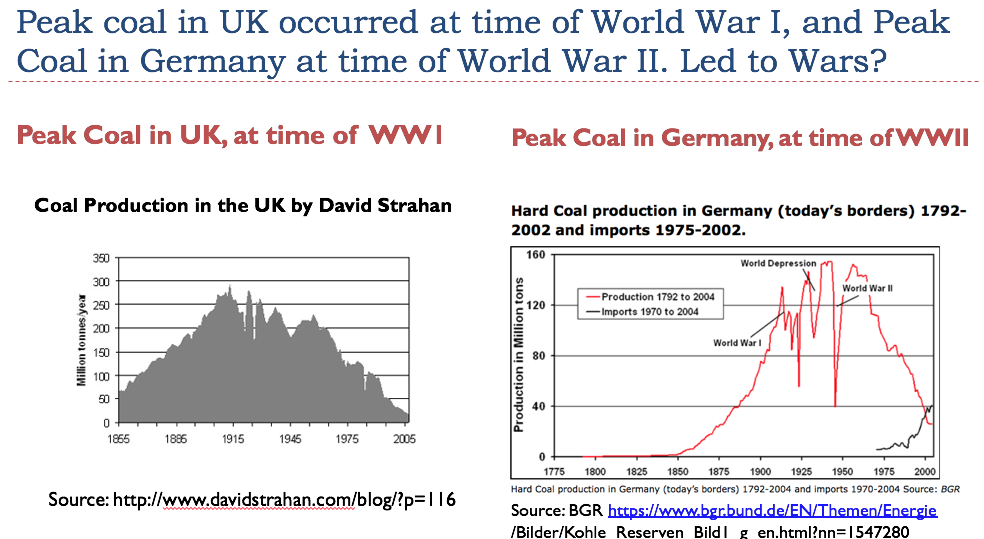
Peak coal occurred in the United Kingdom in 1913, and World War I began shortly thereafter, in 1914. When peak coal occurred, wages for workers were very low, because diminishing returns had made the operation of coal mines increasingly expensive, but those purchasing coal could not afford higher coal prices. Thus, mining companies could not afford to pay workers adequate wages. World War I gave an alternative employment opportunity for coal miners and others with low wages.
Entering World War I was a very successful strategy for the UK. The fact that the UK was on the winning side allowed the UK to retain its role as the holder of the reserve currency. In this position, it was fairly easy for the UK to borrow the funds needed to obtain coal and other energy imports.
Germany seems to have encountered peak coal about the time World War II began. Was this an attempt to cover up Peak Coal? We don’t know for certain, but the timing certainly looks suspicious.
In both of these cases, low energy supply seems to have led to fighting, rather than high prices.

The collapse of the central government of the Soviet Union seems to be an indirect impact of the long term low oil prices in the 1981-1991 period. The high oil prices of the 1970s had encouraged the Soviet Union to ramp up oil production. Once the US raised interest rates and oil prices fell, there were no longer funds for investing in new oil production. The Soviet Union was dependent on oil exports. It was able to continue for quite a few years with low prices, but eventually its central government collapsed. Over the long term, consumption has continued to be much lower, reflecting the permanent loss of industry.

Slide 55 is a graph of the “peaks” on Slide 50. If we listen to mainstream economists (including Paul Romer and William Nordhaus, who recently received the Nobel Prize in economics), improved technology can allow the world economy to become increasingly efficient, and thus overcome the problem of diminishing returns. Slide 55 shows that over a period of nearly 200 years, this has never happened in the past. The troughs represent collapses of one kind or another. These low periods did not represent sustainable situations.
The problem is that diminishing returns leads to the need for very different techniques to work around new problems. For example, if there are diminishing returns with respect to extracting fresh water from wells, the first alternative is to dig deeper wells. Efficiency gains can somewhat help offset the cost of deeper wells. But once the problem advances to the point where desalination is needed, plus remineralizing the water with the correct minerals after desalination, the cost of fresh water becomes much higher. It becomes impossible for improved technology to work around the very large increase in costs that diminishing returns seems to cause.
We haven’t been able to work around diminishing returns with increased efficiency before; we are likely kidding ourselves if we think we can do so now.

–

–

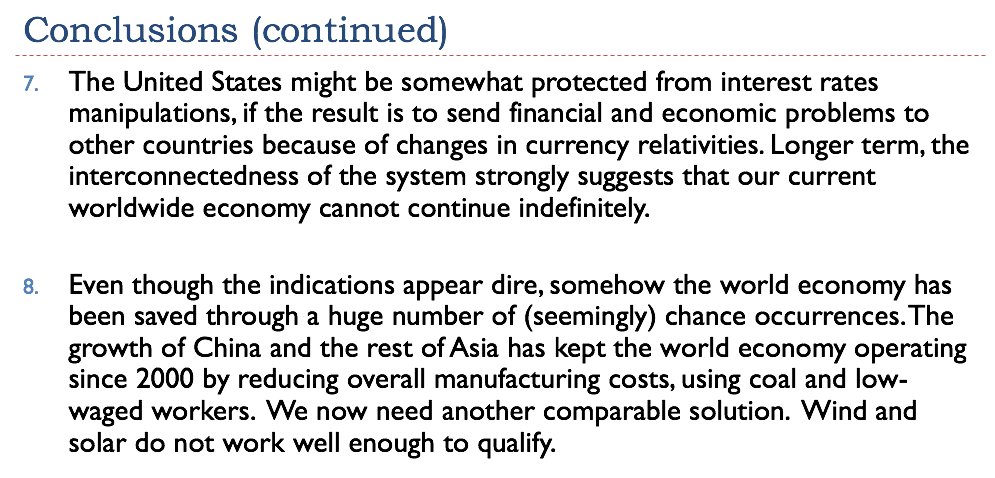
The point that should be emphasized is that the reason why the United States economy now looks fairly good is because we are at the top of a debt bubble. This bubble is partly the result of world’s long running low interest rates, and partly because of the United States’ recent tax cuts. Thus, the situation today is a lot like 1929 before the debt bubble collapsed, or a lot like 2007 before the economy derailed. Things look good, but they won’t necessarily stay favorable for very long.
Separate Additional Conclusions for Various Audiences
At this writing, I have actually given variations on this talk three different times, to different audiences. The first audience (which is the one I mentioned at the beginning of Part 1) was a meeting of about 100 property-casualty actuaries. These actuaries help determine rates and financial statement amounts for lines of insurance such as automobile, homeowners, and medical malpractice. The specialized conclusions I added for that audience were the following:

–

The second version of my talk was given at the 2018 Bermuda International Life and Annuity Conference, to a group of 300+ insurance executives of various kinds. This talk was called Energy Economics: Is a Discontinuity Ahead? This audience was especially interested in my talk because interest rates are central to the operation of pension plans. If interest rates do not rise, this is a major concern for this group.
The conclusion slides to that presentation were the following:

–

The third version of the presentation I gave was to a group of followers of Peak Oil theory. This presentation was somewhat shorter and slightly rearranged. The title of this presentation was How the Energy System Really Works and What Seems to Be Going Wrong.
Its short conclusions’ sheet mentions the following dangers:

makati1 on Sun, 14th Oct 2018 6:27 pm
A long rant about things awake and intelligent people already know. Must be difficult to keep writing about tired subjects. Guesses and maybes. Gotta keep those paychecks rolling in.
twocats on Sun, 14th Oct 2018 8:32 pm
this was actually one of her better lectures vs. the 800 slide “how energy works” presentation.
the key takeaway is the dual-goldilocks impossibility:
1) interest rates low enough for borrowers, high enough for pensions
2) oil price high enough for producers, low enough to run economy.
neither one has a goldilocks now and that has been the state of affairs for a period I sometimes like to refer to as “Peak Oil Era” – kind of catchy I think. I’m Copywriting that.
Davy on Mon, 15th Oct 2018 6:12 am
“Shocktober’s Not Over – McElligott Sees More “Rolling Minsky Moments” As “Pseudo-Stability” Unravels”
https://tinyurl.com/yc5whqzd
“Again, if I’m really stepping back and talking almost more philosophically, it’s the bigger picture here is that a higher real interest rate environment is resetting term premiums. And, with that, the cost of leverage, cross-asset correlations, asset price valuation – all of these constructs built into the post-crisis quantitative easing era are now ripe to tip over. And we’re seeing these rolling Minsky moments as the pseudo-stability of lower interest rates, flatter curves, and suppressed volatility breeds instability through the leverage. And the leverage that’s had to have been deployed on strategies over the past few years as yield was chased. And that’s what we’re coming out of right now.”
Gail Tverberg on Mon, 15th Oct 2018 6:31 am
I should point out that my “profit” from these talks is virtually nil. I did get a free dinner at a restaurant the night before my talk to the casualty actuaries, plus free attendance at the one day meeting (which included free lunch).
On the Bermuda trip, I had all my expenses paid for the trip out there. But I received $0 for my time.
The peak oil group talk was similar. I did get a free dinner out of it.
I don’t accept donations on my website, and my own site (OurFiniteWorld.com) is advertising-free. I allow organizations such as peak oil.com to repost my articles at no charge. I do not have anything for sale on my website.
Saying things like, “Gotta keep those paychecks rolling in,” indicates the author has not researched the situation at all.
Davy on Mon, 15th Oct 2018 6:41 am
Gail, disregard makati1 he has polluted this site for years now with exaggerations and distortions. He is an anti-American extremist who has turned this energy site into a hate America place. If you offer material that is counter to his agenda he will author things like “Gotta keep those paychecks rolling in”. BTW, how do I put a picture on my comments? I am having problems with people stealing my handle.
marmico on Mon, 15th Oct 2018 7:14 am
The chart that informs all of Tverberg’s blatherings when she is not playing pickup sticks or riding a bicycle.
https://gailtheactuary.files.wordpress.com/2014/01/tverberg-estimate-of-future-energy-production.png
onlooker on Mon, 15th Oct 2018 8:35 am
I find this presentation quite revealing in informing the interested reader of the inevitable economic pitfalls going forward. I wonder Gail how this economic trap of the inevitably of rising interest rates and subsequent market sell off will be responded to? As it seems the next economic crash will be devastating and monetary policy seems ill equipped to ease this eventuality
Uncle Bill on Mon, 15th Oct 2018 9:15 am
Real Smart over at Tverbergs’s blog
Here is a sample posted by her Pet Star student and cheerleader…
He is alot like the crowd here
Fast Eddy says:
October 13, 2018 at 1:07 am
Facts? Well these are the facts:
The kkkkkkkkklimate change debate went nuclear Sunday over a whistleblower’s explosive allegation that the National Oceanic and Atmospheric Association manipulated data to advance a political agenda by hiding the g lob al wa rm ing “pause.”
In an article on the C limate Etc. blog, John Bates, who retired last year as principal scientist of the National Climatic Data Center, accused the lead author of the 2015 NOAA “pausebuster” report of trying to “discredit” the hiatus through “flagrant manipulation of scientific integrity guidelines and scientific publication standards.”
https://www.washingtontimes.com/news/2017/feb/5/c
limate-change-whistleblower-alleges-noaa-manipula/
How anyone can possible believe in this bull shi t after reading this … is beyond me
The stoooopidity is just… epic
Sure…Gail we take your repeat over and over very seriously….really we do
Uncle Bill on Mon, 15th Oct 2018 9:18 am
Another one..
And in spite of the above …. the GGG WWW Grooopies will dig in hard…. because people are so invested in the myth… that they are embarrassed to stand up and say ‘I WAS WRONG’
Well… I stood up and said it … and it feels so GOOD! It’s like unloading a 50kg sack from your shoulders… it’s like breathing pure clean oxygen from the alps…. drinking ice cold water….
Rejoice — unburden yourself — say it … I Was Wrong!!!
And guess what – if you have kids — they aren’t going to broil — so get out there and burn more coal…. it does not f789ing matter!
Uncle Bill says:
Your comment is awaiting moderation.
October 12, 2018 at 4:44 pm
Just a Troll..ignore
Of course, my responses never get posted there..
onlooker on Mon, 15th Oct 2018 9:44 am
Uncle, you are addressing the Great Conundrum of our time. The economic system which sustains us is very system which is ever more destabilizing the climate system and the Environment in general. So that my inquiry into economics is simply out of curiosity.
I AM THE MOB on Mon, 15th Oct 2018 9:53 am
Bill
I know that is why I stopped commenting on Gails blog..her blog has become a cesspool for climate deniers and lunatic conspiracy theories..
Duncan Idaho on Mon, 15th Oct 2018 10:37 am
“her blog has become a cesspool for climate deniers and lunatic conspiracy theories..”
That is being diplomatic——-
Davy on Mon, 15th Oct 2018 11:01 am
Idaho, ahhh, and what is going on here with our group of extremist? Surely we would look stupid pointing fingers.
Uncle Bill on Mon, 15th Oct 2018 11:12 am
The difference is Tverberg encourages and promotes this silliness and uses “moderation” (censorship) to silence valid responses.
Her feeling in a nutshell… Can’t do anything about it regardless…
That goes for other issues as well.
Hey, it’s her blog…if it promotes readership and click visits…good for her!
Great entertainment….
Yorchichan on Mon, 15th Oct 2018 11:34 am
Gail simply wants her blog to be about energy and finance and NOT about climate change, because she believes there is nothing to be done about climate change. She has repeatedly asked that people do not comment on climate change, but to no avail (mentioning no names).
Gail is not over-zealous in her moderation of OFW, but any comment containing such words as warming or climate will automatically be put into moderation. Likewise, any first time comment or comment from someone who has caused offence will be put into moderation.
Uncle Bill on Mon, 15th Oct 2018 11:52 am
Obviously she’s not, just ask that buffoon of hers Fast Eddy…seems she’s tolerant of his imbecile antics regarding AGW and conspiracy.
Sorry, Yorchian, don’t buy your explanation.
Just another “Watts up with That” mentality
regardless of the body of evidence and research.
Green People's Media on Mon, 15th Oct 2018 1:37 pm
Gail, I suspected this was your piece so I quick-scrolled to the bottom to verify it was from Our Finite World.
I’ll scurry over the internet to your site to read this piece.
I find the posted comments on ALL stories found on Peak Oil dot com to be extremely toxic and, unlike the Peakoilbarrel’s comments, contribute nothing to the discussion at all.
marmico on Mon, 15th Oct 2018 2:09 pm
Wow, Green People Mudhut is a defender of Miss Gail Malthus. Tverberg is an endless blatherer with toxic comments from MOB aka Baby Doomer on her blog which contribute nothing.
Try this chart Miss Doomtard Malthus:
https://www.eia.gov/todayinenergy/detail.php?id=36754
Yorchichan on Mon, 15th Oct 2018 2:37 pm
Uncle Bill
If you won’t take my word for it, just ask Gail. She’s quite amenable. In fact, it was me that asked her to defend herself on here against Mak’s accusation she’s in it for the money.
I admit FE gets a lot of leeway from Gail, but he’s a good guy really and always entertaining in his put downs.
Uncle Bill on Mon, 15th Oct 2018 3:56 pm
Just ask Gail …PLEASEEEE…the proof is in the pudding Yorkie…been reading her comments for a while now….some contributors did and have provided insightful leads.
Harry Gibb is worth following there now.
Most others have left because of the reason I stated…..OK..bye
Duncan Idaho on Mon, 15th Oct 2018 5:32 pm
Fast Eddy is one clueless imbecile.
I enjoy Gail’s site, even if it is several layers below what is actually happening.
The same message over and over just is part of the process.
Uncle Bill on Mon, 15th Oct 2018 6:48 pm
Duncan, thank you. The fact is Gail is the overseer of her comment section and moderates
and censors. She does repeat the same message to renew the comment section.
There are just a few contributors that provide insight.
Many readers will breath a sign of relief when the SHTF and puts an end to Fast Eddy
GetAVasectomyAndLetTheHumanSpecieDie on Mon, 15th Oct 2018 6:50 pm
People are leaving the internet. You see less and less people commenting on blogs, YouTube, Face Book. People have realized that commenting on the internet is a waste of time and must blog are garbage anyway. Hail blog is the typical garbage you find now. So people are moving to something else. Maybe it is opioid for Whites.
The world is going down the shitter.
Either people are fed up with the intenert or have abondona it.
Chrome Mags on Mon, 15th Oct 2018 7:52 pm
“…the Great Conundrum of our time. The economic system which sustains us is very system which is ever more destabilizing the climate system and the Environment in general.”
That’s it onlooker; stuck between a rock and a hard place, growing the world economy, burning ever more FF while giving lip service to how we need to burn less. Our species is like the proverbial frog in the rising temp. pot of water, but what’s worse is we keep reaching outside the pot to turn up the heat.
What if after our demise, a lot of that carbon in the atmosphere ends up sequestered in sinking blooms of algae, then over 150 million years is compressed into NG, oil and coal at shallow depths. They start burning the stuff to take advantage of all that cheap abundant energy. Then as the carbon builds in the atmosphere to 400 ppm, a team of their geologists discovers a sediment layer that indicates a bipedal species 150 million years ago did themselves in using this stuff. Of course it wouldn’t stop them. They’d still reach outside the proverbial pot and turn up the wick, because greed is what is it, greed, and anything that breathes and eats only knows one thing; it wants MORE!
makati1 on Mon, 15th Oct 2018 8:17 pm
Of course, some species will evolve in a few million years, but it will not necessarily be sentient. Had the comet, or whatever, not hit the earth 65 million years ago, dinosaurs may still be the dominant species. A lot of “what if”s…
Chrome Mags on Mon, 15th Oct 2018 9:09 pm
“Many readers will breath a sigh of relief when the SHTF and puts an end to Fast Eddy”
Cheers to that! For some reason unbeknownst to me, Gail let’s FE do just about whatever he wants on that site.
Sissyfuss on Mon, 15th Oct 2018 9:52 pm
Chrome, that layer of bipedal hominids will be the energy source for the apex species that appears in 100 million years. We are the dinosaurs now.
Chrome Mags on Mon, 15th Oct 2018 10:01 pm
“Fast Eddy is one clueless imbecile.”
Another anti-FE poster. Well, just on this thread that makes 3 of us.
Davy on Tue, 16th Oct 2018 7:01 am
“Chris Wood: The Biggest Risk To The World Economy Is Not What You Think”
https://tinyurl.com/y98dyp4v
“THE BOTTOM LINE FOR THE US ECONOMY The issue now remains whether US cyclical momentum, in terms of both earnings and GDP growth, is peaking. The base case here remains that cyclical momentum has probably peaked, but that America is more likely to slow back to the trend real GDP growth rate of 2.2% prevailing since 2009 prior to the tax cut than enter an outright recession. And that any such renewed slowdown is likely to lead to a stepped-up effort by Donald Trump to implement his infrastructure agenda in the second half of his administration; though the practical ability to do that will be influenced significantly by the outcome of the November mid-term elections. Meanwhile, America is unlikely to face an outright recession, as opposed to a slowdown to trend growth, without the negative catalyst of a financial shock. And this financial shock will need to be reflected in a surge in credit spreads”
“This raises the question of where the private-sector borrowing has been in this cycle. The answer at the macro level is that the US corporate sector has increased debt while the household sector has reduced it, relative to GDP. Thus, nonfinancial corporate debt as a percentage of GDP has risen from a low of 39.7% at the end of 2010 to a record 46.2% in 2Q18, while the household debt to GDP ratio has declined from a peak of 98.4% in 1Q08 to 75.4% in 2Q18, the lowest level since 2Q02 (see following chart).”
“A problem in the above area or another one is the sort of shock that can trigger a risk-off move in markets and a Fed U-turn, in terms of monetary policy. This is because surging credit spreads raise the risk of an asset deflation cycle since they indicate forced deleveraging. And it is a decline in asset prices, not conventional “overheating” concerns, which is the biggest risk to the American economy and indeed the world economy, given that asset inflation has been the prime driver of growth in the developed world since the global financial crisis 10 years ago on the back of such a long period of ultra-easy monetary policy.”
Davy on Tue, 16th Oct 2018 7:12 am
China May Have $5.8 Trillion in Hidden Debt With ‘Titanic’ Risks”
https://tinyurl.com/yaxfo8r7 https://tinyurl.com/y94vh3cf
“China’s local governments may have accumulated 40 trillion yuan ($5.8 trillion) of off-balance sheet debt, or even more, suggesting further defaults are in store, according to S&P Global Ratings. “The potential amount of debt is an iceberg with titanic credit risks,” S&P credit analysts led by Gloria Lu wrote in a report Tuesday. Much of the build-up relates to local government financing vehicles, which don’t necessarily have the full financial backing of local governments themselves.”
Davy on Tue, 16th Oct 2018 10:56 am
Ten Years After The Last Meltdown, Ron Paul Asks “Is Another One Around the Corner?”
https://tinyurl.com/y9bqeha4
“September marked a decade since the bursting of the housing bubble, which was followed by the stock market meltdown and the government bailout of the big banks and Wall Street. Last week’s frantic stock market sell-off indicates the failure to learn the lesson of 2008 makes another meltdown inevitable.”
“In 2001-2002 the Federal Reserve responded to the economic downturn caused by the bursting of the technology bubble by pumping money into the economy. This new money ended up in the housing market. This was because the so-called conservative Bush administration, like the “liberal” Clinton administration before it, was using the Community Reinvestment Act and government-sponsored enterprises Fannie Mae and Freddie Mac to make mortgages available to anyone who wanted one — regardless of income or credit history.”
“Today credit card debt is over a trillion dollars, student loan debt is at 1.5 trillion dollars, there is a bubble in auto loans, and there is even a new housing bubble. But the biggest part of the everything bubble is the government bubble. Federal debt is over 21 trillion dollars and expanding by tens of thousands of dollars per second.”
“The Fed will be unsuccessful in keeping the everything bubble from exploding. When the bubble bursts, America will experience an economic crisis much greater than the 2008 meltdown or the Great Depression.”
Davy on Tue, 16th Oct 2018 11:19 am
Only Davy didn’t post the above. I imagine it was one of
The gang stealing my handle again. The article is fine and the format alright. One problem I see with this handle thief is he forgot quotations at the very start of the title.
GregT, why not just come out and be yourself instead of the sock puppet lies and handle theft?
Anonymouse1 on Tue, 16th Oct 2018 2:05 pm
Greg is not here you delusional dumbass. And if he were, he would not lower himself to your standards. Go seek some, no, a LOT of mental health care. If you cannot afford to check yourself into the local nuthouse, ask cloggenyid. I’ll bet he would be happy to wire you some shekels. OR, you could ask your one of your sock-puppets if cloggraham wont help out.
You are a delusional chasing ghosts. So you forgot a stupid quotation mark on one of your stupid tinyURL ZeroIQ farticles that no one pays any attention to.
Try not to be so hard on yourself, dumbass.
Davy on Tue, 16th Oct 2018 2:27 pm
Maybe it is you a-noise, stealing handles. You seem so obsessed with the whole stupidity of socks and handle theft. Must be a cowardly west coast Canadian thing to play these games because you and GregT do it once you are intellectually wounded. You guys are cowards. Debate me like a man. Quit being a whining sniveling wimp.
ct65.aspx on Sat, 6th Jun 2020 6:37 am
14m up front with the rest in add-ons after Gabbiadini agreed a four-year, 锟?0,000-a-week move.