
Peak Oil is You
Donate Bitcoins ;-) or Paypal :-)


Page added on August 28, 2018

Richard Heinberg: Human Predators, Human Prey

Society as Ecosystem in a Time of Collapse, Part II
This is part 2 of my 3-part essay that uses predation as a metaphor to unpack power relations in human societies. For part 1 see here.
4. Our current context: the adaptive cycle, conservation, and release
As we’ve seen, predator-prey relationships shape the flow of energy through ecosystems. But what happens in either a natural ecosystem or a human social “ecosystem” when energy flows increase? As long as sufficient basic nutrients are available and other conditions (such as climate) are stable, the system tends to grow in size (in terms of biomass) and/or complexity.
And that is exactly what has happened within the human “ecosystem,” especially during the past century or so. We humans learned to use exosomatic energy (that is, energy apart from what is released from food through metabolism) when we started using fire several hundred thousand years ago. The domestication of draft animals (primarily horses, oxen, and mules), and the harnessing of waterpower and wind power (at first with sails, later windmills) increased our access to exosomatic energy. More recently, technological developments including metallurgy and the invention of the steam engine opened the way to our use of fossil fuels—coal, oil, and natural gas.
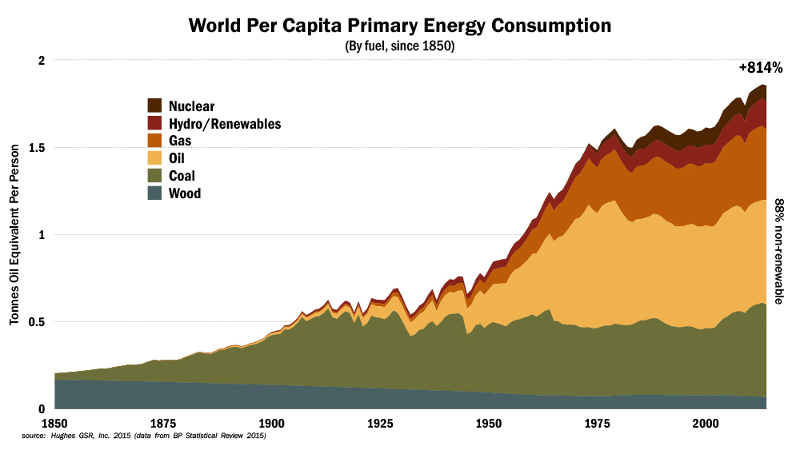
Fossil fuels, representing tens of millions of years’ worth of chemically stored sunlight, enabled our global per-capita use of energy to grow by more than 800 percent in the past 150 years. With the confluence of science, technology, and fossil energy, many things became possible that were barely dreamt of previously—including aviation, global electronic communications, the mass production of goods, and a way of life (for some, at least) characterized by lavish consumption. Human population grew from under a billion two centuries ago to 7.5 billion today; cities and nations exploded in size; trade soared in volume, speed, and distance; and the destructive power of weaponry became global in scope.
The environmental impacts of human activities also skyrocketed. The rate of extinctions of species, mostly due to habitat destruction, rose to 1,000 times the normal rate. Glaciers began melting due to a warming atmosphere (itself due to the buildup of greenhouse gases from the burning of fossil fuels), raising sea levels. Topsoil began disappearing at higher rates (currently at a rate of over 25 billion tons per year). Dead zones appeared in oceans around the mouths of rivers due to fertilizer runoff. Huge gyres comprised of bits of discarded plastic (made from fossil fuels) appeared in oceans, endangering sea life. Fish species began dying off due to over-predation by humans. Indeed, nearly all classes of wild animals declined severely in number, with half of all wildlife having disappeared in the last 40 years. It has been estimated that humans—along with our cattle, pigs, dogs, cats, and other domesticates—now make up over 95 percent of all terrestrial mammalian biomass.
It is clear that humans’ impacts on the biosphere will ultimately be self-limiting. Economic growth and population growth, which have driven those impacts, are subject to ultimate checks including the depletion of fossil fuels, minerals, soils, and water; as well as the buildup of pollution, including greenhouse gases causing climate change. As I have written elsewhere, it is extremely unlikely that humanity will be able to keep the growth party raging by other means (such as renewable energy or nuclear power); the best we can hope for is an equitable, peaceful, and relatively happy descent from current levels of population and consumption.
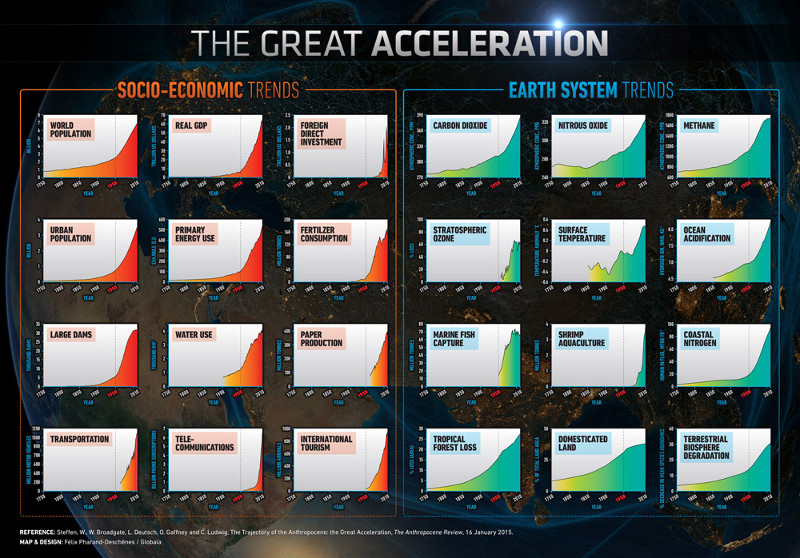
Any population biologist looking at recent trends in human population would conclude that our species is in overshoot—a condition in which a population temporarily exceeds its environment’s long-term carrying capacity. In nature, overshoot is always temporary, and is followed by die-off. One accounting tool for measuring the degree of our overshoot is the ecological footprint, which represents the demand on biocapacity, i.e., area of biologically productive land and water required to produce the ecological services (including resource regeneration and waste absorption) for a given population. According to the Global Footprint Network, humanity is currently using over 1.5 Earth’s worth of resources annually (though this consumption is not distributed equally; it would take four Earths’ worth of resources to support U.S. consumption levels). This is only possibly by drawing down future productive capacity—in effect, borrowing from future generations.
To the extent that we are today eroding the carrying capacity on which future generations would otherwise depend, our way of life could be characterized as intergenerational “predation”; to put it crudely, the old are “eating” the young.
Here’s yet another way to look at our dilemma: the fossil-fueled industrial age represents an unprecedented growth phase in a grand, historic adaptive cycle.

We have seen growth phases before (as ancient empires expanded), but such booms always led to periods of consolidation (the conservation phase) and collapse (or release), in which population declines and cultural achievements were lost. It could be argued that the last few decades have represented a global conservation phase, as the world has enjoyed a period of relative peace and stability, with rates of growth in population and GDP beginning to slow.
Meanwhile, we are confronted with a paradox. On one hand, since there is now more to go around (in terms of energy and wealth), there is a lot to share. During the 20th century, the “domesticated” classes (i.e., workers) in industrial societies gained access to unprecedented benefits, including education, health care, improved housing conditions, cheap and rapid transportation, and entertainment. Life in liberal democracies implies universal access to certain social services, freedom of speech, and social mobility. But on the other hand, the “prey” classes are often “predated” upon in more subtle ways, often having to do with debt.
Interest-bearing debt is nothing new; it has a 5,000-year history. And for millennia debt and interest have served as tools for the owning classes to “predate” upon borrower classes. The rapid growth of energy supplies during the 20th century implied the possibility of a rapid growth in money supplies. Since energy is required for all work (whether done by humans or machines), more available energy meant more work could be done, and thus more money could be generated by work or used to pay for work. During the 20th century the link between money and precious metals (which were inherently limited in quantity) was gradually severed, and money was instead linked to debt (the making of a bank loan calls the money into existence). Hence nearly all money is now tied to interest-bearing debt, with the ever-growing stream of interest flowing to the financial sector. As economist Michael Hudson explains, the financial system has become the primary means of enslavement and plunder in the modern world.
But debt itself eventually becomes a limit to growth. Following the Great Depression of the 1930s, economist Irving Fisher developed the theory of debt deflation, which holds that as debt levels rise to the point at which repayment becomes impossible, a moment arrives when large numbers of people default on their loans and mortgages, causing banks to fail and economies to implode. In present circumstances, soaring debt levels temporarily mask rising systemic problems that could undermine the wealth-generation system supporting modern industrial societies. Modern societies run on oil (which powers most ways of transporting food, raw materials, manufactured goods, and people). As high-quality, easily accessed oil deposits deplete, a greater percentage of overall world petroleum supply comes from marginal sources such as U.S. tight oil—produced by hydrofracturing (“fracking”) and horizontal drilling. However, such production is unprofitable with oil prices at affordable levels, and the companies specializing in extracting these resources are therefore deeply in debt. In effect, debt is acting as an energy extender, enabling the current conservation phase of the grand adaptive cycle to continue—but only until the moment when debt deflation arrives. Other characteristic symptoms of a societal conservation phase arguably include increasing wealth inequality, a decline in growth of workers’ wages, and declining economic prospects for younger generations. While these now appear to be gradual trends, when the release phase arrives it could do so with a vengeance (see the “Seneca Effect”).
5. The world turned upside down: “predators” and “prey” in times of growth, and in times of ecological release
How ever such “predation” occurs, it must somehow be justified—at least in the minds of “predators,” if not in those of “prey” as well. Religion served this function in many ancient complex societies (the followers of the “true faith” having been given divine license to subjugate non-believers), while economic and political ideology do so today more frequently. Priests served the kings of ancient civilizations, channeling myths and rituals that valorized the divine right of the monarch. The king claimed ultimate ownership of everything and everybody within the borders of the state, as ordained by the dictates of the sky god—of which he was regarded as an earthly embodiment. Later, as the state became more culturally diverse and more secularized, philosophers and economists served a function similar to that of the ancient priesthood, explaining why the rich deserved their riches and the poor their poverty, and why everyone owed loyalty to the state, the economic system, or both.
One ideological system for the justification of “predation” stands out as particularly influential in the last few hundred years—namely, racism. The circumstances that gave rise to racism centered on the brutal and blatant form of “predation” involving the kidnapping and intergenerational enslavement of Africans by Europeans and European-Americans. The practice occurred within wealthy, sophisticated societies that fancied themselves rational, moral, and religious. Thus it required a new and compelling ideological basis.
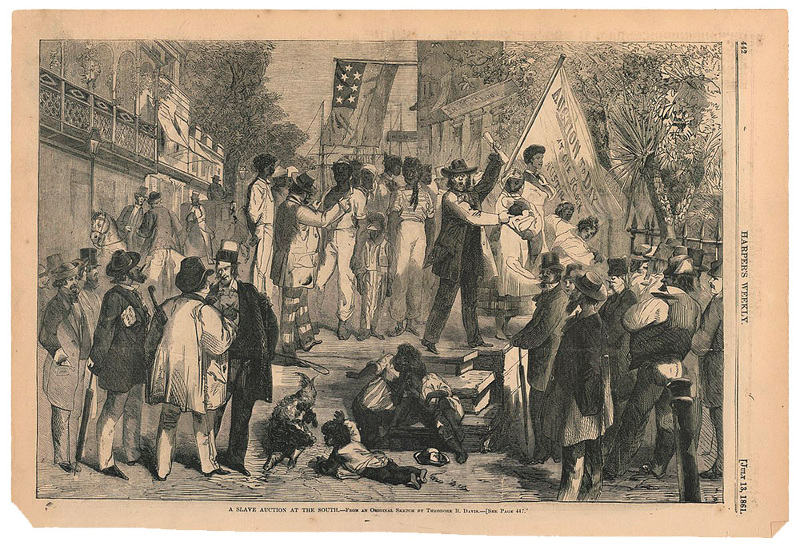
Before the 15th century, the European slave trade centered on East European Slavs (hence the term “slave”). By the 1400s, the Slavs had improved their self-defenses and slave traders turned to Africa for victims. As Portuguese Prince Henry the Navigator explored the West African coast in the early 15th century searching for sources of wealth, his chronicler Gomes Eanes de Zurara described the burgeoning Portuguese slave trade, categorizing Africans as a separate and inferior “black” race and Europeans as a “white” and superior race (previously, “white” had not existed as a racial category). The idea caught on among other Europeans, who drew on textual sources from classical antiquity to sort humans into groups based on physical appearance, attributing deeply ingrained behaviors and capacities to those groups. Quickly the notion arose that people of the allegedly superior “white” race were not only right in enslaving what amounted cumulatively to several million “inferior” people of color, but were doing God’s work by bringing civilization to the “savages” (an idea later encapsulated in the title of Rudyard Kipling’s poem “The White Man’s Burden”). In the southern United States, where slavery became the basis of the agricultural economy, race came to serve as an organizing social principle.
Slavery ended in the U.S. in 1865 due to resistance on the part of slaves and ex-slaves, campaigns of persuasion by abolitionists, and a bloody Civil War that entailed up to 750,000 deaths out of a total population of 34,000,000. But racism continued—and does to this day, not just in the American South but throughout the nation and internationally as well. For the “white” upper classes, it ensures the solidarity of much of the “white” working class with elites, rather than with people of color of similar economic status. Meanwhile, the poor of all ethnicities (including poor European-Americans) remain subject to a “predatory” economic system.
From the “prey’s” point of view, “predation” looks and feels like persistent poverty, lack of opportunity, cultural oppression, and much higher rates of incarceration and police violence. The lower-class person is encouraged to think, “If I’m not getting ahead, it’s my fault”—or it’s the fault of other groups who are competing unfairly for scarce resources.
From the elites’ point of view, “predation” looks quite different. The upper classes are encouraged to think, “We deserve all that we have because we are superior: we’re smarter, we work harder, and we are the result of good breeding.” The “prey,” in contrast, are often conceived of by elites as unintelligent, lazy, and lacking in breeding. They are to be managed like cattle or sheep, for their own good, via low-wage jobs, drugs, debt, and prisons. Often elites turn reality on its head, painting the poor as “parasites,” and themselves as the producers of all that is worthwhile in society. The ideology of the elites is inculcated in each new generation in exclusive schools, and reinforced through “high-class” amusements (including memberships in country clubs) and symbols of achievement. The upper and lower classes alike tend to share the view that “it is better to be a ‘predator.’”
However, such “predator-prey” relationships are not stable over long periods of time. As we have seen, human society is subject to environmental carrying capacity limits, population cycles, and debt cycles analogous to the adaptive cycle in ecosystems. During the growth phase of such cycles, society as a whole tends to become more complex. “Predators” and “prey” may all benefit, though to differing degrees. But during the release phase, revolution, civil war, invasion, and collapse may ensue. The system of domestication partially breaks down, to the detriment of both “predators” and “prey.”
For “prey” classes, which are already living with little or no surplus or cushion against hard times, collapse brings immediate and severe hardship. Nevertheless “prey” may have opportunity to escape from dreary routines as the mechanisms for the maintenance of the means of “predation” (including the financial system) fail. There is the opportunity to form cooperative efforts to meet basic needs directly, rather than via elite-managed systems of production and distribution.
“Predator” classes are initially at least somewhat insulated from hard times as the release phase of the cycle approaches; after all, they have plenty of surplus, including money and means of mobility (hence the current elite craze for building bunkers in New Zealand). But wealth held in stocks, bonds, and derivatives can disappear virtually overnight during times of financial crisis. Under such circumstances, elites can find themselves in mortal competition not just with angry mobs of former “prey,” but with other elites as well.
In effect, the human ecosystem in times of ecological release finds itself plagued with an overabundance of “predators.” During times of growth and conservation, elites maintain gatekeeping mechanisms and forms of intra-elite competition to ensure that the “predatory” class does not become overpopulated in relation to available “prey.” As the release phase approaches, an “overproduction of elites” (to use Peter Turchin’s phrase) leads to much fiercer intra-elite competition, which can take the forms of coups and revolutionary movements.
This leads us to the consideration of still more biological metaphors.
17 Comments on "Richard Heinberg: Human Predators, Human Prey"
Cloggie on Tue, 28th Aug 2018 3:38 pm
The idea is to substantially cut cost installing a wind turbine by using the turbine itself as a crane. The first (positive) experiences are now in with the construction of a 4.5 MW turbine. Large cranes are no longer necessary anymore for installation of large wind turbines:
https://deepresource.wordpress.com/2018/08/28/self-climbing-crane-making-progress/
makati1 on Tue, 28th Aug 2018 8:20 pm
Another sick joke for stupid people.
And how does the crane get to the tower site?
And how does the tower materials get to the crane site?
And how does the tower get erected?
And How do the fins get to the site and get installed?
And who makes the parts in the first place?
And where does the materials to make the tower, etc. come from?
And the machines that mine the resources?
And how does the road to the site get maintained?
And…
Another load of bullshit for the stupid dreamers.
fmr-paultard on Tue, 28th Aug 2018 8:36 pm
prof. heinberg is supertard. i was the first and only one to line up in my college bookstore to buy his book “the party’s over”. It later was republished with a different front cover. I didn’t like the new cover.
Dredd on Wed, 29th Aug 2018 1:09 am
“But what happens in either a natural ecosystem or a human social “ecosystem” when energy flows increase?”
What happens when “the human ecosystem” (metaphor) begins to accelerate the generation of pollution?
That is the big question (Etiology of Social Dementia – 18).
deadly on Wed, 29th Aug 2018 7:13 am
Almost all the inhabitants of the village of Baltimore, in Ireland, were captured in 1631, by Muslim slave traders.
The Catholic Church has been filled with predators for centuries.
Predators everywhere throughout all of history.
Not a big surprise there. Plenty of prey out there for Catholics and Muslims to bag.
The Gypsies in Europe have been prey for centuries and still are.
Anthony Johnson was an Angolan, person of color, who owned a plantation in the colony of Virginia and owned slaves in the sixteen hundreds.
A predator.
Anthony Johnson
Davy on Wed, 29th Aug 2018 7:16 am
I have explored the existential issues of our industrial age and come to the conclusion a more durable survival means not leaving it completely. How can we adapt it by slowing its growth and reducing the damaging results sould be or motivation? I have not seen how we can quickly leave fossil fuels without failure. Renewables are only part of the solution. Behavior is the key but I don’t see much of a chance for major behavioral changes until a crisis and the wrong kind of crisis may not be survivable. I have come to conclusions on different levels.
On the theoretical general level of what could work if there was proper behavior and policy I see basics that are well known that would have to be embraced rather quickly. Population control and gradual degrowthing around altered behavior would permeate the conversation of all like if we knew an earth killing asteroid was on the way. Bad behavior and extreme consumption would be the low hanging fruit to reduce immediately to get us closer to a more sustainable future. Granted it is unclear such changes could be made and a productive economy maintained. Let’s be clear there is no sustainable future for modern man in my opinion only a slower rate of decline. Modern civilization is not sustainable and will end eventually. Some areas with comparative advantage need to be focused on and other areas with no future triaged out. This sounds very much controlling from the top down and it is. This is not democracy this is benign authoritative rule that is unthinkable today and likely not humanly capable at the level needed.
We need to incorporate a significant amount of fossil fuel supported renewables around those core functions that require energy intensity. These important functions would be around areas were manufacturing, communication, and transport type functions would need to be maintain. In rural areas we would have a significant amount of people back on the land living a simple agrarian life as it once was. This would be very close to how the Amish live. I am not talking their social arrangement. I am talking the way they incorporate the new and the old in a hybrid way of working the land. This would involve returning to a way of working the land closer to the carbon, nutrient, and hydrologic cycles of nature. Consumerism would need to be diminished to the basics. Affluence would be greatly reduced but basics to health and happiness still maintained. There would have to be some way to protect this hybrid way of life because it requires deep sacrifices. The urban components to society would have to realize the value to this arrangement. We need to take people out of industrial living, high consumption, and leisure related activities and put them back on the land close to the natural cycles of preindustrial society yet still with some modernism where it leverages happiness. In the urban areas that produce, manage, and control vital social and economic functions there would be social and economic energy strata. Since we will have to be significantly renewable based then intermittency and demand management will have to be incorporated as the central activity. Vital functions will have access to 24/7 power. As you go lower down the energy strata intermittency increases. For this to work bad behavior on all levels would need to be wringed out of the system. Populations will have to be much less and mega urban areas depopulated. Complexity would have to be more in some areas of the living arrangement and less in others. In other words this is a fictional civilization that is likely unattainable.
Davy on Wed, 29th Aug 2018 7:17 am
Since it appears society is a self-organizing train wreck without much ability to adapt and change bad behaviors then we have to focus on what individuals and small communities can do that can change and want to change. The ideas express above are good ones and the general outline still needs emulation. Individuals and small communities that can change should try to adapt good behavior and good technology to mitigating the coming decline from an unsustainable liberal democracy driven market based capitalism. You can’t leave it but you can make the best of it by following best practices and supported by enlightened behavior. Embrace renewables both technological and natural while eliminating bad behaviors of consumption and nonrenewables. Family planning is naturally part of this. Localism and adapted diet are essential to the success of small communities and individuals. A culture of less material affluence but more spiritual satisfaction needs to be cultivated. A turning away from the sugar highs of mass culture that are now out of control and turning inward to family, friends, and community. This is more about attitude changes than technology. We can at least embrace what could work as best practices that we hope a good comes out of.
For the most part the damaging results of an unsustainable modern life will drown out most efforts and crush most grass root momentum. In other words the chances of widespread success are slim because the forces at work from what society has morphed into are so powerful. We are a late term civilization brittle to change and this means there is no existential transcendence just because you embrace the truth. The truth does empower and satisfy. The bottom with individuals and small communities are trapped in this trend but the truth does offer hope.
The best you and your community can do is begin the process of collapsing and adapting. Get your attitudes right and clean out the deadwood in your life. This is general to all but specific to your local. What we are looking for is right in front of us we are just confused. Get lean and mean for what will likely be a tough life ahead for most. Get out of the way of trouble that will be everywhere. Yield to forces that are more powerful than you. Try to remain under the radar of forces of destruction. Decline with dignity knowing you are embracing what appears to be truer. Embrace nature and her cycles. Do random acts of kindness to nature and this will have a knock on effect nudging others to do the same. This is about realizing we are on a descending existential gradient but also realizing material and social decline can be slowed. This is likely the best we can do. Slow the inevitability of a terminal decline of a late term civilization in your little world
JuanP on Wed, 29th Aug 2018 7:34 am
Fmr “prof. heinberg is supertard. i was the first and only one to line up in my college bookstore to buy his book “the party’s over”. It later was republished with a different front cover. I didn’t like the new cover.”
Where else on the planet could I read such nonsense? Only here at PO! We are such a collection of lunatics here!
Theedrich on Fri, 31st Aug 2018 12:21 pm
Ah yes, again we read it: Whites must commit genosuicide for the crimes of their ancestors. No other subspecies is guilty of anything. All the colored are victims.Of course, RH has no idea about what will happen once push really comes to shove.
Antius on Fri, 31st Aug 2018 3:42 pm
Richard Heinberg. Is he a Jew?
Cloggie on Fri, 31st Aug 2018 4:43 pm
No.
He is a gamma male dreamer from Missouri.
Jews don’t wrote books with titles like these:
– Memories and Visions of Paradise: Exploring the Universal Myth of a Lost Golden Age (1989; revised edition, 1995; British edition, 1990; Portuguese edition, 1991)
– Celebrate the Solstice: Honoring the Earth’s Seasonal Rhythms through Festival and Ceremony (1993; Italian edition, 2002; Portuguese edition, 2002)
– A New Covenant with Nature: Notes on the End of Civilization and the Renewal of Culture (1996; Portuguese edition, 1998) ISBN 978-0-8356-0746-9
Cloggie on Fri, 31st Aug 2018 4:46 pm
Btw, millimind hasn’t posted his German Army 2010 peak oil link yet.
Is he ill?
Dead, perchance?
Duncan Idaho on Fri, 31st Aug 2018 5:06 pm
“The weak crumble, are slaughtered and are erased from history while the strong, for good or for ill, survive. The strong are respected, and alliances are made with the strong, and in the end peace is made with the strong.”
–Benjamin Netanyahoo
Cloggie on Fri, 31st Aug 2018 5:13 pm
Quote from Newsweek, not Stormfront.
https://www.newsweek.com/weak-are-slaughtered-strong-prevail-netanyahu-says-israel-will-not-shy-away-1098567
Antius on Fri, 31st Aug 2018 5:22 pm
“No.
He is a gamma male dreamer from Missouri.
Jews don’t wrote books with titles like these:
– Memories and Visions of Paradise: Exploring the Universal Myth of a Lost Golden Age (1989; revised edition, 1995; British edition, 1990; Portuguese edition, 1991)
– Celebrate the Solstice: Honoring the Earth’s Seasonal Rhythms through Festival and Ceremony (1993; Italian edition, 2002; Portuguese edition, 2002)
– A New Covenant with Nature: Notes on the End of Civilization and the Renewal of Culture (1996; Portuguese edition, 1998) ISBN 978-0-8356-0746-9”
Ah. Heinberg’s personal obsession with oil depletion is now somewhat explained. He is a utopian, with an idealistic view of preindustrial civilisation. He sees peak oil as a means of bringing about a transition to a simpler and better world.
Cloggie on Fri, 31st Aug 2018 5:48 pm
Indeed.
For Heiny peak oil is program, hidden in a (hopefully self-fulling) prophecy. He is no fan of industrial civilization, although he loved jetting to Australia, telling everybody there who wanted to hear that oil was running out.
Honest.
Lain Berrien on Sun, 12th Feb 2023 10:01 am
[herre](https://writepaper.com/reviews)