



Across the globe, a collective freak-out spanning the whole political system is picking up steam with every new “surprise” election, rush of tormented souls across borders, and tweet from the star of America’s great unreality show, Donald Trump.
But what exactly is the force that seems to be pushing us towards Armageddon? Is it capitalism gone wild? Globalization? Political corruption? Techno-nightmares?
Rajani Kanth, a political economist, social thinker, and poet, goes beyond any of these explanations for the answer. In his view, what’s throwing most of us off kilter — whether we think of ourselves as on the left or right, capitalist or socialist —was birthed 400 years ago during the period of the Enlightenment. It’s a set of assumptions, a particular way of looking at the world that pushed out previous modes of existence, many quite ancient and time-tested, and eventually rose to dominate the world in its Anglo-American form.
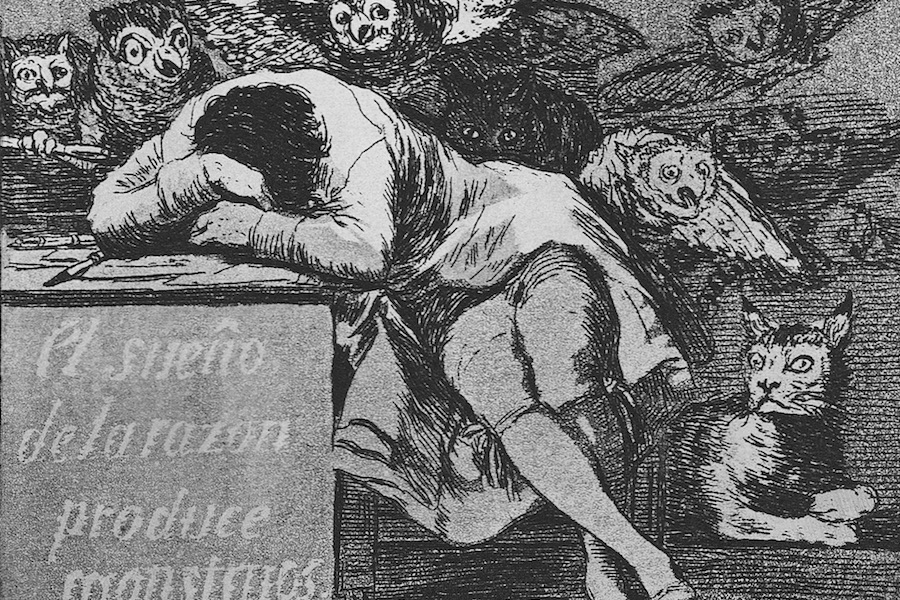
We’re taught to think of the Enlightenment as the blessed end to the Dark Ages, a splendid blossoming of human reason. But what if instead of bringing us to a better world, some of this period’s key ideas ended up producing something even darker?
Kanth argues that this framework, which he calls Eurocentric modernism, is collapsing, and unless we understand why and how it has distorted our reality, we might just end up burnt to a crisp as this misanthropic Death Star starts to bulge and blaze in its dying throes.
A mass incarceration of humanity
Kanth’s latest book, Farewell to Modernism: On Human Devolution in the Twenty-First Century, tells the history of a set of bad ideas. He first caught the scent that something was off as an economics student in India, wondering why, despite his mastery of the mathematics and technology of the discipline, the logic always escaped him. Then one day he had an epiphany: the whole thing was “cockeyed from start to finish.” To his amazement, his best teachers agreed. “Then why are we studying economics?” demanded the pupil. “To protect ourselves from the lies of economists,” replied the great economist Joan Robinson.
Kanth realized that people are not at all like Adam Smith’s homo economicus, a narrowly self-interested agent trucking and bartering through life. Smith had turned the human race — a species capable of wondrous caring, creativity, and conviviality — into a nasty horde of instinctive materialists: a society of hustlers.
Using his training in history and cultural theory, Kanth dedicated himself to investigating how this way of thinking took hold of us, and how it delivered a society which is essentially asocial — one in which everybody sees everybody else as a means to their own private ends. Eurocentric modernism, he argues, consigned us to an endless and exhausting Hobbesian competition. For every expansion of the market, we found our social space shrunk and our natural environment spoiled. For every benefit we received, there came a new way to pit us against each other. Have the costs become too high?
The creed of capture
The Eurocentric modernist program, according to Kanth, has four planks: a blind faith in science; a self-serving belief in progress; rampant materialism; and a penchant for using state violence to achieve its ends. In a nutshell, it’s a habit of placing individual self-interest above the welfare of community and society.
To illustrate one of its signature follies, Kanth refers to that great Hollywood ode to the Western spirit, “The Sound of Music.” Early in the film, the Mother Superior bursts into song, calling on the nun Maria to “climb every mountain, ford every stream.”
Sounds exhilarating, but to what end? Why exactly do we need to ford every stream? From the Eurocentric modernist viewpoint, Kanth says, the answer is not so innocent: we secretly do it so that we can say to ourselves, “Look, I achieved something that’s beyond the reach of somebody else.” Hooray for me!
“That’s our big dream,” says Kanth. “Everyone and everything is a stepping stone to our personal glorification.” When others get in our way, we end up with a grim take on life described succinctly by Jean Paul Sartre: “Hell is other people.”
Sounds bad, but didn’t Eurocentric modernism also give us our great democratic ideals of equality and liberty to elevate and protect us?
Maybe these notions are not really our salvation, suggests Kanth. He notes that when we replace the vital ties of kinship and community with abstract contractual relations, or when we find that the only sanctioned paths in life are that of consumer or producer, we become alienated and depressed in spirit. Abstract rights like liberty and equality turn out to be rather cold comfort. These ideas, however lofty, may not get at the most basic human wants and needs.
What we lack, according to Kanth, is a realistic approach to anthropology, without which our forays into economics, psychology, sociology, and pretty much everything are hopelessly skewed. In his view, the Eurocentric modernist tradition, influenced by the Judeo-Christian idea that we are distinct from the world of nature, seeks to separate us from the animal world. We are supposed to be above it, immortal, transcending our bodies and the Earth.
But it doesn’t quite work.
We may be able to perform dazzling technical feats, like putting a colony on Mars, but we will pay for it by working even harder and longer hours so that a few may get the benefit. A whole lot of lost time and suffering, and for what? Kanth points out that the Bushmen do not have a Mars rocket, but they do have a two-and-a-half-day workweek — something that most modern humans can only dream of. What’s more significant to the lives of most of us?
“We have become unhinged from our own human nature as heat-seeking mammals,” says Kanth. “What we really crave is warmth, security, and care — the kinds of things we get at home and in close social units.” Our greatest human need, he says, is something far more humble than launching rockets: we want to huddle.
Why we don’t need utopias
Utopian dreamers have often longed for a more hospitable way of living. But Kanth believes that when they look to politics, economics or philosophy for answers, they are missing the best inspiration: human anthropology. The key is not to project ourselves into the future, but to learn from the practical, beneficial ways humans have lived in the past and still do, in some cases, in the present — places where our worst instincts are contained through affective reciprocities, goodwill, and care.
Kanth thinks what we’d much prefer is to live in what he calls a “social economy of affections,” or, put more simply, a moral economy. He points out that the simple societies Europeans were so moved by when they first began to study them, conjuring images of the “noble savage,” tended toward cooperation, not competition. They emphasized feeling and mutual affection. Karl Marx got his idea of communism from looking at the early anthropological studies of simple societies, where he was inspired by the way humans tended to relate to each other.
“Today we are taught to believe that society doesn’t owe us a living,” says Kanth. “Well, in simple societies they felt the exact opposite. Everybody owed everybody else. There were mutual ties. People didn’t rely on a social contract that you can break. Instead, they had a social compact. You can’t break it. You’re born with it, and you’re delighted to be part of it because it nurtures you. That’s very different from a Hobbesian notion that we’re all out to zap each other.”
Kanth points out that you don’t have to just look to the Bushmen or to Aboriginals for examples: you can find them in America and elsewhere in networks of women and workers, as well as traditional and tribal societies that have carried on the tradition of a moral economy.
Women, he emphasizes, have retained the instinct to nurture because the human child is especially vulnerable compared to the young of many animal species. They have to create peaceful, nurturing conditions or the human race can’t survive.
“There is no other fount of social morality itself,” says Kanth. He faults Eurocentric modernists for centering on male aggression and taking it to represent everybody, which is unfair.
As Kanth sees it, most of our utopian visions carry on the errors and limitations born of a misguided view of human nature. That’s why communism, as it was practiced in the Soviet Union and elsewhere, projected a materialist perspective on progress while ignoring the natural human instinct for autonomy— the ability to decide for ourselves where to go and what to say and create. On flip side, capitalism runs against our instinct to trust and take care of each other.
So what do we do?
Kanth, like many, senses that a global financial crisis, or some other equivalent catastrophe, like war or natural disaster, may soon produce painful and seismic economic and political disruptions. Perhaps only then will human nature reassert itself as we come to rediscover the crucial nexus of reciprocities that is our real heritage. That’s what will enable us to survive.
Hopefully it won’t come to that, but right now, we can learn to “step out and breathe again,” says Kanth. We can “reclaim our natural social heritage, which is our instincts for care, consideration, and conviviality.” Even in large cities, he observes, we naturally tend to function within small groups of reference even though we are forced into larger entities in the workplace and other arenas. There, we can build and enrich our social ties, and seek to act according to our moral instincts. We can also resist and defy the institutions that deny our real humanity. Rather than violence or revolution, we can engage in “evasion and disobedience and exile.”
We had better get to it, he warns. To put it bluntly, Eurocentric modernism is not compatible with human civilization. One of them has got to go.
makati1 on Mon, 13th Mar 2017 6:26 pm
“The key is not to project ourselves into the future, but to learn from the practical, beneficial ways humans have lived in the past and still do, in some cases, in the present — places where our worst instincts are contained through affective reciprocities, goodwill, and care.”
BINGO!
“That’s what will enable us to survive.”
joe on Mon, 13th Mar 2017 7:01 pm
The enlightenment happened as a rejection of the priciples of the church which were about established order of tight social structures and obedience to authority, an authority which arose from the ashes of a previous apex civilisation, the Romans. If you want to understand the truth take a look at the marxists view who say that humans exploit the world and each other for their own benefit, the baker sells to the wife, she raises a family while her husband the soldier goes out and works to get money and so on. To break this cycle then we are to belive that all the previous human generations didnt care about each other cause its brought us to this threat of inflection but rather we need to start caring now to fix it. I find that concept the most dehumanising and foolish. Humans may be irredeemable but its not cause we dont care, if we didnt care we would already be all dead. The problem with humans is our gift of intelligence, most of us need certain things to reproduce and raise a family and the human miracle is that we are smart enough to do it. Moreover, we can do it either in great cities OR on our own. We are too good at what we do so evolution clearly shows that species that are successful will expand until they are FORCED to live in equilibrium, so far we havent reached it yet, when we do, history tells us we will reorganise ourselves and the consequences of that process will be remembered as ‘wars’ etc. Imho.
Cloggie on Mon, 13th Mar 2017 7:21 pm
https://www.amazon.com/Farewell-Modernism-Devolution-Twenty-First-University/dp/1433134551/ref=sr_1_1?ie=UTF8&qid=1489450129&sr=8-1&keywords=Rajani+Kanth
Refreshing to see people protesting against rampant materialism.
His book can be had for $90,-
GregT on Tue, 14th Mar 2017 12:12 am
“To put it bluntly, Eurocentric modernism is not compatible with human civilization. One of them has got to go.”
And go they will. Eurocentric modernism is well into the process of taking out human civilization, and most of the rest of life on Earth.
Cloggie on Tue, 14th Mar 2017 12:52 am
I smell that Chief Seattle isn’t very far away.
Sissyfuss on Tue, 14th Mar 2017 1:06 am
Stop sneering, Cloggedlogbutt.
Davy on Tue, 14th Mar 2017 2:40 am
“The creed of capture: The Eurocentric modernist program, according to Kanth, has four planks: a blind faith in science; a self-serving belief in progress; rampant materialism; and a penchant for using state violence to achieve its ends. In a nutshell, it’s a habit of placing individual self-interest above the welfare of community and society…..We had better get to it, he warns. To put it bluntly, Eurocentric modernism is not compatible with human civilization. One of them has got to go.”
Eurocentric modernism is a failure but all civilizations are a failure it is just the European brand is one that took it to the extreme and killed a planet in the process. All past civilizations have failed even the semi-nomadic hunter gathers that were the most promising in a grand relationship with nature measured in many thousands of years. The last of the significant hunter gathers were in the “new world” and ended by the “creed of capture” of Eurocentric modernism. The last of them in the 18th and 19th century especially the Native Americans were ruined from within and from the outside by Eurocentric progressivism.
These lost cultures may be the future. It will be thinking like the 18th and 19th century Native Americans that experienced modernism as it tore apart their naturalism that may offer hope. This process may reverse with modernism being destroyed and naturalism offering the path forward. Although they were primitives they were far in advance to moderns in regards to their relationship to nature. Maybe it will be a new naturalism that learns from the mistakes of modernism that offers a path forward.
Homo sapiens are not a sustainable species and has always left extinction in their path but there are worse degrees of this extinction(ism) and the Eurocentric kind is the end game of a planetary ecosystem that developed into something outstanding probably in relation to the entire Universe and Europeans want to brag about their culture after that destruction. What a bunch of savages. Yea and I am one and I have the right to reflect on myself.
Cloggie on Tue, 14th Mar 2017 5:00 am
And go they will. Eurocentric modernism is well into the process of taking out human civilization, and most of the rest of life on Earth.
I hope that your satellite connection in the middle of the Canadian jungle works properly in your no doubt convenient doomstead, as well as your internet connection. Oh and don’t forget to check the anti-freeze level in the coolant of your truck. I have read that the winter is pretty cold high up north in global warming stricken North America:
http://tinyurl.com/gmg852a
Lake Michigan, warning: graphic
Additionally I hope you made a good price for your private airplane recently and that you visited by airliner the remnants of the Inca civilization of South-America, as you said you intended to do. It would be a good start to get the anti-Euro-centric life style started.lol
Remember though that roughly half of the population in North-America is not too keen to abandon Euro-centrism and follow its 1% “elite” into third-worldism, like promoted by this Kanth chap, or native Americanism.
Going to result in a spectacular fire work.
Cloggie on Tue, 14th Mar 2017 7:25 am
This is mister Kanth:
http://umonarch.ch/wp-content/uploads/2014/08/RajaniKannepalliKanth.jpg
…not to be confused by Immanuel Kant, the great German philosopher.
It is immediately clear why he is not too Euro-centric.lol
https://en.wikipedia.org/wiki/Rajani_Kannepalli_Kanth
His Marxist supporter base obviously loves him, including luminaries like Chomsky and Wallerstein. Ah well, as long as he is non-white, the Anglo-Zionist elite loves folks like Kanth.
Kanth maybe professing that the Euro-centric life must disappear, but he is smart enough not to live in his native India but instead in the US, where he no doubts leads a very comfortable Euro-centric life.
The chap is deep into teaching women’s issues and as a consequence has a typical non-Euro-centric four daughters, who no doubt are even more Marxist than daddy and who will continue his war against European civilization, supported by the libtard Anglo elite. Furthermore he makes a lot of money from counseling the UN, that obsolete globalist institution and 1945-left over, that would love to be the world’s government. It should be replaced by something Eurasian and dominated by Paris-Berlin-Moscow and China, but I digress.
Here mr Kanth lecturing his anti-European culture message at Harvard:
https://www.youtube.com/watch?v=ZDwQrpfom9M
A refreshing change from the usual BLM Great Thinkers at Harvard, who also promote their anti-Euro-centric views, albeit with less subtlety:
https://www.youtube.com/watch?v=RC-Cqkq6zWc
Write off Harvard.
It is completely clear where this excessive sense of doom comes from, put on display by the North-American posters here; it has little to do with peak-oil and/or climate change. It is the complete moral collapse of people who have no sense of identity and desperately try to find it with Chief Seattle or this Kanth fella.
Timber!
sidzepp on Tue, 14th Mar 2017 7:27 am
So the world was just this bucolic place before the age of enlightenment. All the world lived in small nomadic tribes, communed with nature, and practiced peaceful harmony with their neighbors. Methinks not. We can go back five thousand years and see that our ancestors were very much into war and genocide. The only difference is that they could only conquer as far as they could march in a day. What the enlightenment gave birth to was rise of industrialization and the birth of better and more efficient methods to eliminate the competition.
Perhaps the above writer thinks like The Donald and wants to make the world great again and return to the days of the Hittites, or Xerxes, or Alexander, or the Romans, or Attila, or Genghis Kahn. I am sure the people who found themselves in the paths of those noble figures conquerors have fond memories of their subjugation.
GregT on Tue, 14th Mar 2017 12:10 pm
“Going to result in a spectacular fire work.”
Unless some psychopath starts a nuclear exchange, more likely a long, drawn out, festering, fizzle.
DerHundistlos on Tue, 14th Mar 2017 4:35 pm
@ Davy
YES, “Eurocentric modernism is a failure but all civilizations are a failure.”, your observation is spot on.
If the skeptics want proof look no further than the history of Easter Island. Understand why Easter Island is today a desolate and parched landscape bereft of flora and fauna.
Before the arrival of man, Easter Island was a paradise- a despoiled utopian Nirvana with rich volcanic soils, moderate temperatures, abundant rainfall, and forests teeming with unique wildlife including the now extinct world’s largest Palm tree at 100 ft. in height and a trunk girth of 6 ft., and surrounded by an ocean brimming with marine life.
Then the Destroyer of Worlds arrived in the form of seafaring Polynesians devoid of Eurocentric vice, nevertheless just as destructive . For a time, the land produced such bounty that plentiful leisure time existed, which afforded the residents with the requisite time to carve the toppled over ghostly stone statues that still dot the island. Human population numbers grew far out of proportion to what was sustainable- poor farming practices stripped the land of its fertile soil, animal species found nowhere else were hunted into extinction. Then the decision was made to cut down the very last tree on the island. What kind of stupidity would allow this to happen (sound familiar)? Following this, no more timber existed to build the canoes necessary to harvest the only remaining source of protein.
When Captain Cook discovered the island, he was shocked to discover that the descendants of the people who carved the great stone heads existed in a filthy, parasite-ridden state of being and engaged in internecine warfare for the only available source of protein- human flesh. Welcome to the future folks.
Remember to arrive early on Tuesday for your Soylent rations as a new and improved Soylent Green will becmoe available for the first time!!!!!!
Cloggie on Tue, 14th Mar 2017 7:28 pm
The new Canadians:
https://m.youtube.com/watch?v=o-LkEaDhB3I
Expect euro-centrism to become very rare in Canada.
GregT on Tue, 14th Mar 2017 8:22 pm
With a population density of 3.7 people per square kilometre, and 85% of those people living within a short distance of the US border, you can expect political discourse to be very rare in Canada.
Just like everywhere else, however, best to move away from densely populated areas, ASAP.
Cloggie on Wed, 15th Mar 2017 1:03 am
“New York state is poised to scrap a literacy test for people trying to become teachers, in part because an outsized percentage of black and Hispanic candidates were failing.
The state Board of Regents on Monday is expected to adopt the recommendation of a task force to eliminate the exam, known as the Academic Literacy Skills Test.”
https://redice.tv/news/new-york-scraps-literacy-test-for-teachers-after-it-weeds-out-minorities
Mr Kanth can be satisfied that anti-Euro-centrism is proceeding fast in NYC.
Strategists in Europe, Russia and China are probably satisfied as well in observing that the US is committing racial suicide. For them it is merely a matter of sitting America out.
For the rest what Greg says: stay as far away as possible from centers of anti-Euro-centrism, ly under the table, put your fingers in your ears and wait for Euro-Siberian troops to liberate you from anti-Euro-centrism.