



 We are in a crisis of civilization but most people, by and large, have not realized it yet. It is as if we are a prizefighter in the ring with a stronger opponent and we have just been dealt a knockout punch but we are still on our feet, uncomprehending of what has just happened. It is not as though the fight can continue. We will shortly be on the floor. It is not as though we will suddenly bounce back, alert and still fighting. We are done. We just don’t know it yet. If we are lucky, our opponent will relent for the moment it takes us to go down, sparing us another, potentially lethal blow from which we would be completely defenseless.
Lets bore in on the illusion that the Intergovernmental Panel on Climate Change (IPCC), having been awarded the Nobel Prize, has prescribed a rescue remedy to “avoid dangerous interference with climate” if nations are willing to take it.
Perhaps you concur with that conventional wisdom even while lamenting that national governments lack spine.
“The scientists have been the finger-pointy adults in the room on this issue,” said Andrew Revkin, former NY Times reporter and author of the dot earth blog. But the IPCC quickly learned that not only did it not have any authority to set policy, it was an object of ridicule. It came to expect that any advice it gave would be resisted and so it took measures to soften its approach. It fed governments baby food — sugar coated, easy to digest, and somewhat shy of full nutrition.
Case in point: the IPCC future scenarios (RCPs for “Representative Concentration Pathways”, and ECP’s for “Extended Concentration Pathways”).
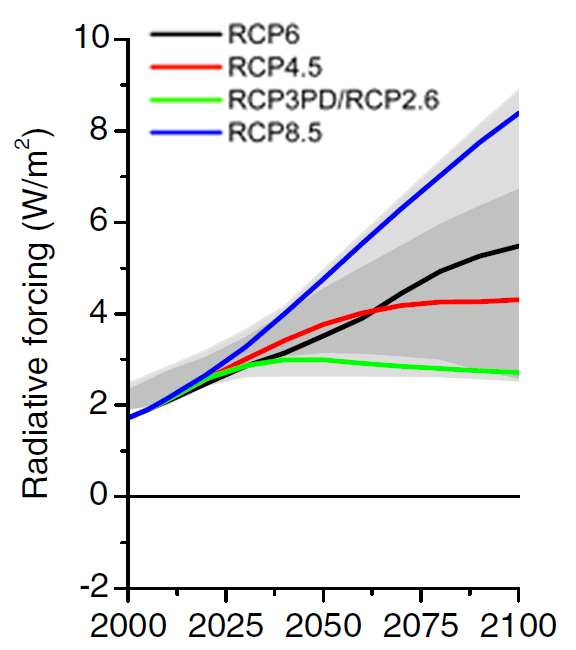
Over the course of many years the IPCC science community produced RCP and ECP models representing a broad range of climate outcomes, based on the peer-reviewed literature. The RCPs and ECPs are defined by their total radiative forcing (cumulative measure of human emissions of atmospheric pollution from all sources expressed in Watts per square meter) starting in 2005 and accumulated change by 2100 in the case of the RCPs and 2300 in the case of the ECPs.
 They are not forecasts, just a survey of known possibilities. Assessing likelihoods requires comparisons of the projections with observations in real time.
In 2011 the figure to the right appeared in the journal, Climatic Change:
The dark grey area contained the range of estimates previously deemed to be 90% certain. The blue line — RCP 8.5 — is tracking closest to actual data at the moment, and so the light great area was added to extend the range to a 98% certainty for 2050-2100.
If you were assigning likelihoods, you would probably give RCP 8.5 a pretty high probability now, but bear in mind you are just looking at where the line begins to arc upwards in 2016 and there is no real evidence that the arc will then settle into a straight line and even bend back down a little in the 2090s. It could as easily turn straight up and shoot off the top of this chart in the 2040-2075 interval.
The other three lines were chosen in 2011 to represent a few selected RCPs that expressed the confidence range. Each RCP could result from different combinations of economic, technological, demographic, policy, and institutional futures. For example, the second-to-lowest RCP assumes technological improvements and a shift from manufacturing economies to service industries but does not make any efforts to reduce greenhouse gas (“GHG”) emissions as a goal in itself. The highest line represents industrial expansion as usual, or, alternatively, industrial contraction supplanted by runaway methane releases, radical deforestation, change of arctic albedo or some other phenomenon, or combination, that keeps the rate of forcing growing even though industrial GHG emissions decline.
The scenario process then moves to translating what effect each Watts per meter change would have on the biosphere.
These scenarios have been developed by the same means humans have planned for their future since we first started keeping history: by observing past events and projecting that process of development into the future. It is entirely linear. Pattern recognition.
Granted, when you are projecting an observed exponential rate of growth into the future (such as a doubling rate for CO2 concentration, which can be taken from Keeling’s Mauna Loa data) at some point the curve turns a corner and rockets upward until the distinction between linearity and non-linearity becomes moot. Like a broken clock, even linear models will be right occasionally in a non-linear world. What the IPCC models do not do, and cannot do, is predict the geobiological results of non-linear change. That’s unknowable.
[T]he present anthropogenic carbon release rate is unprecedented during the past 66 million years. We suggest that such a ‘no-analogue’ state represents a fundamental challenge in constraining future climate projections.
— Zeebe, R., A. Ridgwell, and J. Zachos. 2016. Anthropogenic Carbon Release Rate Unprecedented during the Past 66 Million Years. Nature Geoscience 9:325–29.
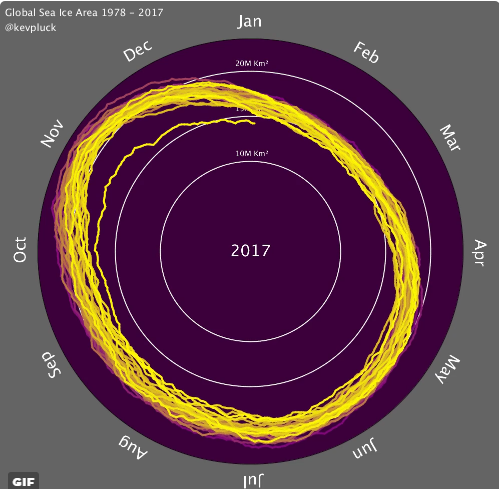 |
| Observed decline in global sea ice to Jan 2017 |
A second problem is that the RCPs only look from 2005 to 2100, a little less than a century. Consequently, they do not consider what changes may occur before Earth’s systems may recover equilibrium with the new forcings, a process that can require millennia. For example, estimates of global average sea level rise were recently revised to 2 meters this century, based on observations of ice loss in Antarctica. Those studies did not include observed loss of ice in Greenland and so the revision is still too low. And yet, we know from the geologic record and the equations of thermodynamics that equilibrium for present concentrations of GHGs take global sea level to about 23 m (75 feet) higher than today and average global temperature to about 17 degrees C (30 F) warmer. (Goreau, T.J.F., 2016. Regenerative Development for Rapid Stabilization of CO2 and Climate at Safe Levels, Soil Carbon Alliance White Paper). Even applying the ECPs, the equilibrium state will not likely be achieved by 2300. It could take a few thousand years.
The only thing holding this global tsunami back is the cold depth of the deep blue sea. Deep sea holds around 95% of the heat in the climate system. It is the biosphere’s thermal battery. The deep sea is now just above freezing, but it is warming. If we stopped adding GHGs today, it would take about 1600 years for the ocean to stop warming. Additions are not slowing down however — they are speeding up.
Implicit in the failure of the IPCC to model non-linear dynamics and long-term equilibrium is the gap in information being communicated to decisionmakers regarding the potential for the unexpected. One “known unknown” is the capacity of critical failures to cascade complimentary forcings. Any sound policy response should be building resilience and antifragility to buffer against these unknowns. Employ nature as a hedge. Instead, nature is being rapidly removed and in its place we are being sold risky geoengineering schemes.
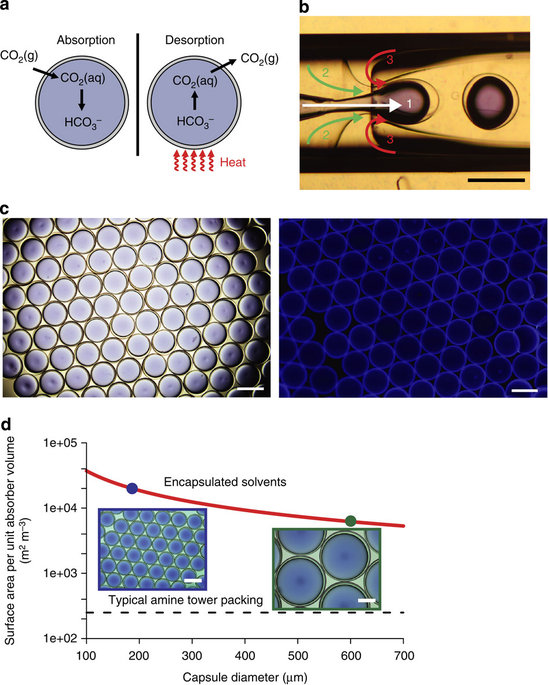
IPCC prides itself on taking the conservative approach and being non-alarmist, but it does not offer hedges. To the contrary, it makes grand speculations based on science fiction. The most recent annual reports assume that as we pass some as yet unknown threshold of political pain, presumedly around mid-Century, human civilization will implement large scale CCS (Carbon Capture and Storage) and begin pulling legacy carbon back from the atmosphere.
Anyone who has seriously studied this assumption (the US National Academy of Sciences and the UK Royal Society, for instance) has concluded it is one part wishful thinking and 9 parts fairy dust.
CCS does not exist.
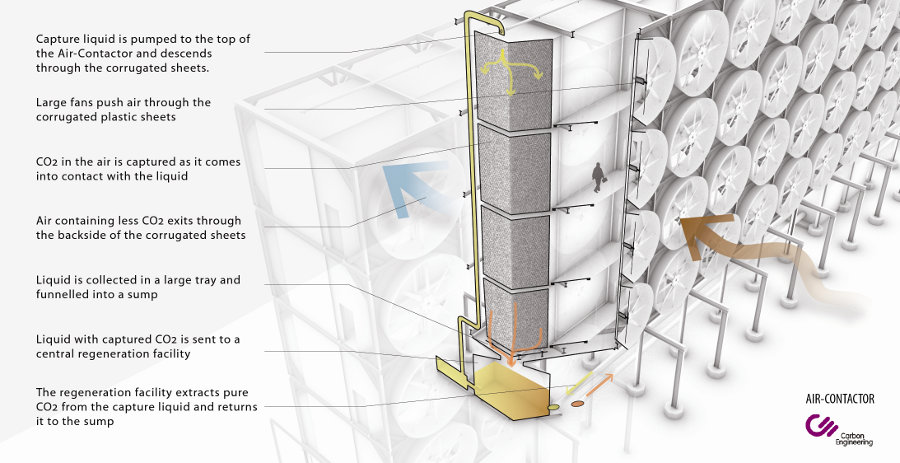 Experiments at putting liquefied carbon dioxide into geological storage have been both horrendously expensive and remarkably ineffective — leaking back to the atmosphere relatively quickly. The technology only holds promise for those unwilling to crunch the numbers. In that camp are most of the national delegations to the UN climate talks and much of the business world.
Technological fixes, after all, would be so much easier than systemic social change.
Of the 400 scenarios that have a 50% or better chance of no more than 2°C warming . . . 344 assume the successful and large-scale uptake of negative-emission technologies. Even more worryingly, in all 56 scenarios without negative emissions, global emissions peak around 2010 . . . In plain language, the complete set of 400 IPCC scenarios for a 50% or better chance of meeting the 2°C target work on the basis of either an ability to change the past, or the successful and large-scale uptake of negative-emission technologies.
— Anderson, K. 2015. “Duality in Climate Science.” Nature Geoscience 8:898–900.
Over the next few months, this weekly blog will sketch our manifesto. We will try to set forward a multitrack approach that has a realistic chance of reversing climate change within the short window of time required. It is no secret — it does it by building resilience and letting nature do the heavy lifting.
 Motivating this change is another matter. It is our view, born of our experience, that nothing short of extreme social change is capable of relieving the existential crisis of climate change and nothing short of extreme crisis will be capable of motivating that kind of extreme social change. If we learned anything from 2016, it is that people are clamoring for change.
So, buckle your seatbelts. We are going to crash. What it looks like on the other side of that crash, however, is utterly charming. It is not like being hit by Conor McGregor and going down hard in the first round. It is more like a snowboarder’s crash in powder or a kiteboarder on water. You can get back up.
We need not fear the power zone, but we should be cautious as we approach.
penury on Sun, 15th Jan 2017 8:24 pm
Sort of the long way to say “Humans are going away, Along with all the other animals, birds,reptiles and fauna.
makati1 on Sun, 15th Jan 2017 8:46 pm
“So, buckle your seatbelts. We are going to crash. What it looks like on the other side of that crash, however, is utterly charming.”
Charming? As in Extinction? Interesing!
dave thompson on Sun, 15th Jan 2017 11:42 pm
Most are oblivious, most will not pay any attention, most will go down with the ship singing the refrain, most will end up in the place of denial that most of us live in.
GregT on Mon, 16th Jan 2017 1:45 am
“Motivating this change is another matter. It is our view, born of our experience, that nothing short of extreme social change is capable of relieving the existential crisis of climate change and nothing short of extreme crisis will be capable of motivating that kind of extreme social change.”
There’s that predicament thingy again. Utterly charming, apparently. Definitely wouldn’t be my choice of words. To each their own, I guess.
Karle on Mon, 16th Jan 2017 4:50 am
Ted Cruz: Is it correct that the satellite data over the last 18 years demonstrate no significant warming?
Aaron Mair, Sierra Club: No.
Ted Cruz: How is it incorrect?
Aaron Mair: (Has no answer, asks his experts)
Based upon our experts it has been refuted long ago and it is not up for scientific debate.
Ted Cruz: Are you familiar with the phrase The Pause?
Aaron Mair: (Has no answer, asks his experts)
Yes, and essentially we rest on our position.
Ted Cruz: You said you are familiar with the The Pause, so to what does the Phrase The Pause refer?
Aaron Mair: (Has no answer, asks his experts, no reply)
Ted Cruz: I am sorry you said you were familiar with that term, so I asked to what does it refer?
………………
More interesting stuff in the linked video. Have fun, warmistas!
https://www.youtube.com/watch?v=QR_tF5CYlPM
PS: I cannot get away here since we are snowed in. Once I can get out I will fly to Greece to help the refugees on those sunny island who are suffering from records snowfalls and record freezing temperatures.
Dredd on Mon, 16th Jan 2017 5:28 am
IOW Civilization Is Now On Suicide Watch
Davy on Mon, 16th Jan 2017 6:51 am
This is where I am at in my thinking. From the article: “It is our view, born of our experience, that nothing short of extreme social change is capable of relieving the existential crisis of climate change and nothing short of extreme crisis will be capable of motivating that kind of extreme social change.”
We no longer have problems that can be solved. We are in predicaments that are traps. When you try to solve them with status quo behavior they become catch 22 traps. Some traps you can get out of but not whole. Coyotes will chew off a paw and get away but not whole. This is the kind of extreme actions required to transition out of our trap. No one wants extreme so what we get is more of the same that takes us deeper into crisis.
It is likely this existential crisis is a process interspersed with events. It will average out with jagged occurrences that will be extreme only to be relieved by forces that balance. What should also be obvious is the possibility of civilization ending forces are a clear and present danger. We cannot rule out sudden failure. An asteroid can do that so really it is just an adding of ourselves to that extinction list.
Society is in denial of these forces at the level of considering them predicaments and traps. Status quo society knows we have serious issues ahead but status quo society will never admit we cannot fix what is ahead or they say what is ahead is further out or better yet, less bad. This is a human survival mechanism that is truly amazing. It allows humans to walk into impossible odds thinking they are invincible. What results is cannon fodder.
We have created extreme change by years of poor behavior and extreme change is what is in store for us. The scale of this and the time frame are the unknowns that are critical. The reason for this is it is well known that the degree and duration of disruption in an ecosystem determines survivability. Can humans avoid too much extremes of degree and duration? This is really where policy should be. It should be a lifeboat and hospice mentality to mitigate and adjust to extreme change. Instead what we have is a process of fighting destructive change and continuing on with progressive changes that got us into this unsustainable existential mess. We want to progress with more affluence when it is unrestrained affluence that got us to where we are.
Maybe extreme social change can be the magic elixir to adapt us to something postmodern that is survivable. Even if this is the case I do not see us getting there whole without a die off to at least half the current population. What is even more disturbing is the act of changing policy will be the open door to destructive change. Once we are through this door there is no turning back.
We need a hospice mentality. We can allow people to die with dignity instead of a cruel and horrible last breaths. If hell is here on earth then a horrible and cruel last breath is hell. We can mitigate and adapt to some of the storm coming but most of what is coming will have to be lived through and increasingly many will have to be left to die. “Live and let die” is a social expression of the end of denial of death at the societal level. That is a tall order when you consider our efforts are all about saving everything we can. We even have pet extremist who spend huge amounts of money saving abused animals. I am all for that in theory but we are going to have to let go of some of this because death is the new trend. Soon it will be people close to us dying.
Sissyfuss on Mon, 16th Jan 2017 10:23 am
Kousin Karle, quoting Ted(I want to be king of the world!) Cruz as your science expert immediately disqualifies you as a cognitive being. If the artic is 50 degrees above normal at times and the jet stream is unhinging, abnormal temps are a given. We’ve had the three hottest planetary years in a row and the only pause occurring is taking place in your prefrontal cortex.
Apneaman on Mon, 16th Jan 2017 10:52 am
Jennifer Francis: A New Arctic Feedback
“A key idea in climate science is that the system contains multiple feedback loops, that can make warming worse.
For instance, as white, reflective ice is replaced by Dark, absorbing water – more of the sun’s warmth is absorbed – a positive feedback. Here, Arctic expert Jennifer Francis describes a new, emerging feedback process, as the arctic warms and affects jet stream flow.”
https://www.youtube.com/watch?v=w_EzF4k9_QY&t=7s
Apneaman on Mon, 16th Jan 2017 6:54 pm
The Climate “Doomsday” is Already Here
“What most people don’t realize is that this shutdown of the Sahel Monsoon is the result of human-caused climate change. We created apocalyptic conditions for roughly 1 billion people — and we did this fifty years ago!”
https://extranewsfeed.com/the-climate-doomsday-is-already-here-556a0763c11d#.pc836d1zo
Midnight Oil on Mon, 16th Jan 2017 7:02 pm
The main premise of what I was taught in business school was to maximize, not minimize.
So, it stands to reason other variables will follow suit. No reason to be startled on what happens in the future.
Apneaman on Mon, 16th Jan 2017 7:32 pm
Global sea ice is at lowest level ever recorded
https://www.newscientist.com/article/2118093-global-sea-ice-is-at-lowest-level-ever-recorded/#.WH0kMt_XGgI.twitter
Apneaman on Tue, 17th Jan 2017 2:52 am
2016 Was Second Hottest Year on Record in U.S., With 15 ‘Billion-Dollar’ Weather Disasters
http://www.nbcnews.com/science/environment/2016-was-second-hottest-year-record-u-s-15-billion-n705281
2016 set to be hottest year on record
http://www.dw.com/en/2016-set-to-be-hottest-year-on-record/a-36867062
2016: A historic year for billion-dollar weather and climate disasters in U.S.
https://www.climate.gov/news-features/blogs/beyond-data/2016-historic-year-billion-dollar-weather-and-climate-disasters-us
Apneaman on Tue, 17th Jan 2017 3:12 am
Daily CO2
January 15, 2017: 404.98 ppm
January 15, 2016: 402.11 ppm
December CO2
December 2016: 404.48 ppm
December 2015: 401.85 ppm
https://www.co2.earth/earths-co2-main-page
Jef on Tue, 17th Jan 2017 10:19 am
So what we need is a climate change false flag catastrophe so we can then take advantage of it and implement the change that is needed.
You know, just like 9 1 1 .
Apneaman on Tue, 17th Jan 2017 10:50 am
Crack is whack
Drone footage shows scale of the Antarctic ice crack
http://news.sky.com/video/drone-footage-shows-scale-of-the-antarctic-ice-crack-10731897
Apneaman on Tue, 17th Jan 2017 12:19 pm
Climate change, not conflict, was cause of Middle East dust storm
“Many newspapers touted the Middle East dust storm of September 2015 as caused by conflict in the region and a sign of an impending Dust Bowl. Now a team from the US and Israel has shown that the storm was instead largely due to historically unprecedented aridity and unusual weather conditions.”
http://environmentalresearchweb.org/cws/article/news/67522
Apneaman on Tue, 17th Jan 2017 12:49 pm
Catastrophic Thai floods expected to worsen as death toll rises
“BANGKOK: Thailand faces more hardship from unseasonable floods that have killed 40 people in its south, with more rain expected in the major rubber-producing and tourist region in coming days, a top disaster agency official said on Sunday.”
Read More : http://www.nst.com.my/news/2017/01/204359/catastrophic-thai-floods-expected-worsen-death-toll-rises
“unseasonable”
Lot of that going around.
Karle on Tue, 17th Jan 2017 3:34 pm
Yes, Greece suffering from cold and snow, same in southern Italy, and now even in Mallorca. Snowstorms instead of Sangria bis zum Abwinken at the Ballermann.
GregT on Tue, 17th Jan 2017 4:05 pm
“Yes, Greece suffering from cold and snow, same in southern Italy, and now even in Mallorca.”
Same here where I live Karle. First time in my 55 years here that we’ve had snow on the ground from the end of November until the middle of January, and lots of it.
Climate change is a bitch, and we haven’t seen anything yet. It’s the bottom of the ninth, the bases are loaded, and Mother Earth is just starting to get warmed up.
Apneaman on Tue, 17th Jan 2017 9:40 pm
A Swarm of 30 Billion-Dollar Weather Disasters Socked the Planet in 2016
By: Jeff Masters and Bob Henson , 5:41 PM GMT on January 17, 2017
Aon Benfield’s tally of billion-dollar weather disasters globally for 2016
1) Flooding, Yangtze Basin, China, 5/1 – 8/1, $28.0 billion, 475 killed
2) Hurricane Matthew, Caribbean, Bahamas, U.S., 9/28 – 10/10, $15.5 billion, 603+ killed
3) Flooding, Louisiana U.S., 8/9 – 8/16, $10 – $15 Billion, 13 killed
4) Drought, China, 6/1 – 8/31, $6 billion, 0 killed
5) Flooding, Germany, France, Austria, Poland, 5/26 – 6/6, $5.5 billion, 17 killed
6) Drought, India, 1/1 – 6/30, $5.0 billion, 0 killed
7) Flooding, Northeast China 7/16 – 7/24, $4.7 billion, 289 killed
8) Wildfire, Fort McMurray, Canada, 5/2- 6/1, $4.5 billion, 0 killed
9) Severe Weather, Plains-Southeast U.S., 4/10 – 4/13, $4.3 billion, 1 killed
10) Drought, West-Northeast-Southeast U.S., 1/1 – 12/31, $3.5 billion, 0 killed
11) Drought, Thailand, 1/1 – 6/30, $3.3 billion, 0 killed
12) Severe Weather, Rockies-Plains-Southeast-Midwest U.S., 3/22 – 3/25, $2.5 billion, 0 killed
13) Super Typhoon Meranti, China, Taiwan, Philippines, 9/13 – 9/16, $2.5 billion, 44 killed
14) Flooding, Texas U.S., 4/15 – 4/19, $2.0 billion, 9 killed
15) Winter Weather, East Asia, 1/20 – 1/26, $2.0 billion, 116 killed
16) Severe Weather, Plains-Midwest U.S., 4/29 – 5/3, $1.8 billion, 6 killed
17) Tropical Cyclone Roanu, Sri Lanka, India, Bangladesh, Myanmar, China, 5/14 – 5/21, $1.8 billion, 135 killed
18) Severe Weather, Plains-Rockies U.S., 7/28 – 7/29, $1.6 billion, 0 killed
19) Drought, Zimbabwe, 6/1 – 8/10, $1.6 billion, 0 killed
20) Flooding and Severe Weather, Plains-Midwest-Southeast-Northeast U.S., 3/4 – 3/12, $1.5 billion, 6 killed
21) Super Typhoon Nepartak, Philippines, Taiwan, China, 7/8 – 7/12, $1.4 billion, 111 killed
22) Severe Weather, Plains-Southeast U.S., 3/17 – 3/18, $1.4 billion, 0 killed
23) Tropical Cyclone Winston, Fiji, 2/16 – 2/22, $1.4 billion, 44 killed
24) Flooding, Argentina and Uruguay, 4/4 – 4/10, $1.3 billion, 0 killed
25) Severe Weather, Plains-Midwest U.S., 5/21 – 5/28, $1.3 billion, 1 killed
26) Severe Weather, Plains-Midwest-Southeast-Northeast U.S., 2/22 – 2/25, $1.2 billion, 10 killed
27) Severe Weather, Netherlands, 6/23 – 6/24, $1.1 billion, 0 killed
28) Severe Weather, Plains-Midwest-Mississippi Valley U.S., 5/7 – 5/10, $1.1 billion, 2 killed
29) Winter Weather, Eastern U.S., 1/21 – 1/24, $1.0 billion, 58 killed
30) Super Typhoon Chaba, South Korea, Japan, 10/5 – 10/6, $1.0 billion, 10 killed
https://www.wunderground.com/blog/JeffMasters/a-swarm-of-30-billiondollar-weather-disasters-socked-the-planet-in-20
Jeff Masters on Weather Disasters
https://www.youtube.com/watch?v=YeCEvJBCjc4
No AGW jacked multi billion dollar mega fires burning Canadian and US towns down on that list. Not weather, just “related”.
BobInget on Wed, 18th Jan 2017 1:02 pm
SUV and PU truck makers are working double shifts . Electric vehicles (EV) are selling for 50% discounts on 2016 models. Small cars in general
are still unsold.
Take a peek at this morning’s EIA repore
http://www.eia.gov/petroleum/supply/weekly/
Generous Imports brought oil prices down for the day allowing traders to scoop up equities.
Magic-greed-indicator connection:
http://www.livecharts.co.uk/MarketCharts/crude.php
Yes, we ARE totally screwed.
For my 82 years of squandering resources, apologies to reader’s offspring and their kids as well.