
Peak Oil is You

Donate Bitcoins ;-) or Paypal :-)


Page added on November 10, 2016

End Of The U.S. Major Oil Industry Era: Big Trouble At Exxon Mobil
The era of the mighty U.S. major oil industry is coming to an end as the country’s largest petroleum company is in big trouble. While Exxon Mobil (NYSE:XOM) has been the most profitable U.S. oil company in the past, it suffered its worst year on record.
For example, just four years ago, Exxon Mobil enjoyed a $45 billion net income profit in 2012. Now compare that to a total $5 billion net income gain for the first three quarters of 2016. If Exxon continues to report disappointing results for the remainder of the year, its net income will have declined a stunning 85% since 2012.
Actually, the situation at Exxon is much worse if we dig a little deeper.
Profitability Is Much Less When We Factor in Capital Expenditures
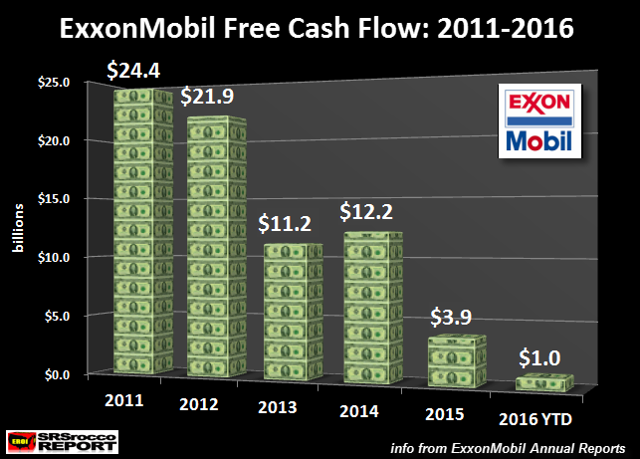
To understand the real profitability of a company, we have to look at its cash flow, or what is known as free cash flow. Free cash flow is calculated by deducting capital expenditures ((capex)) from the company’s cash from operations. Exxon Mobil’s free cash flow declined from $24.4 billion in 2011 to $1 billion for the first nine months of 2016:
So, here we can see that Exxon’s free cash flow of $1 billion (2016 YTD) is down 95% from $24.4 billion in 2011. The reason for the rapidly falling free cash flow is due to skyrocketing capital expenditures and falling oil prices. But this is only part of the picture.
If we include dividend payouts, Exxon’s financial situation drops down another notch. While free cash flow does not include dividend payouts, the money Exxon pays its shareholders must come from its available cash. By including dividend payouts, the company was $8.3 billion in the hole in 2015:
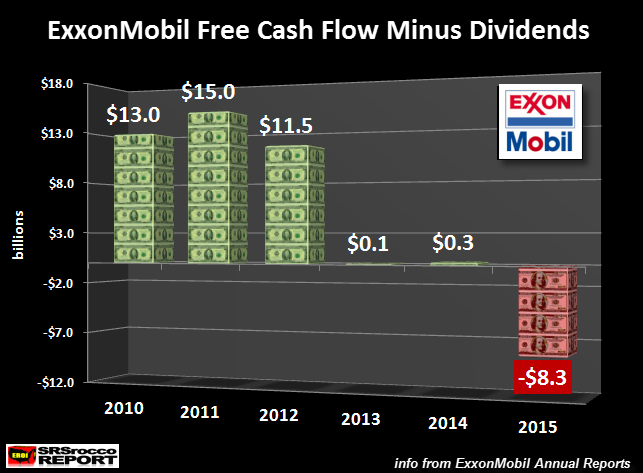
Now, even though Exxon stated a $45 billion net income for 2012, its free cash flow minus dividends was only $11.5 billion. Moreover, the company didn’t make any money in 2013 or 2014 after dividends were paid to their shareholders. Thus, deducting dividends from the equation provides a more realistic picture, especially since Exxon has been forking out serious sums of money to its shareholders.
That said, there seems to be something seriously wrong going on at Exxon when we look at the long-term chart below:
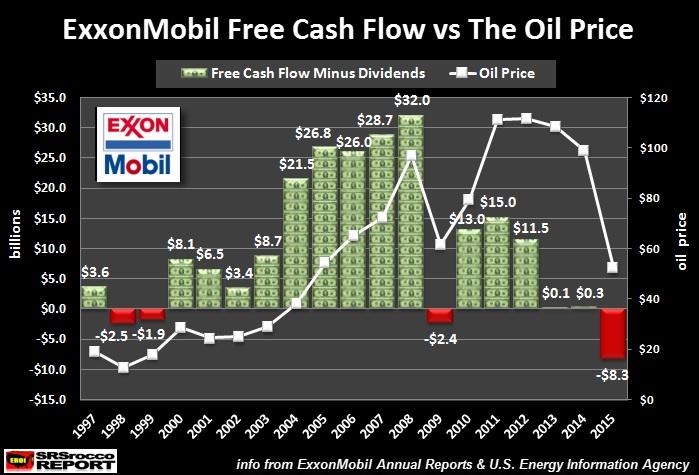
Let me start off by saying, this chart is an extension of the chart above it. Even though the title doesn’t include dividend payouts, the legend in the chart displays it. The white line represents the average annual oil price. There are several important factors shown in this chart.
- As the price of oil increased from $20 in 2002 to $97 in 2008, Exxon’s free cash flow minus dividends surged to $32 billion from $3.4 billion. Thus, the higher oil price led to larger free cash flow profits. Well, that was the good news.
- The bad news is that Exxon’s surplus cash declined significantly when the oil price was over $100 from 2011 to 2013. Even though the oil price in 2011 and 2012 was higher than it was in 2008, the company’s free cash flow including dividends was less than half. Furthermore, Exxon made no surplus cash in 2013 when the oil price was above $100.
- While Exxon enjoyed surplus cash over $20 billion from 2004 to 2007 when the price of oil was between $38 and $72, how is it that the company made no surplus cash in 2013 when the oil price was north of $100? We will get into that in a minute.
- Even though Exxon suffered negative free cash flow (including dividend payouts) in 1998 (-$2.5 billion) and 1999 (-$1.9 billion), the oil price was at a low of $13 and $18, respectively. Compare that to a cash deficit of $8.3 billion in 2015 at an average oil price of $52 — triple of what it was during 1998 and 1999.
- The reason for the huge decline in Exxon Mobil’s surplus cash, even at much higher oil prices, was due to two factors: 1) higher capital expenditures, and 2) higher dividend payouts.
While higher dividend payouts put more stress on the company’s financial situation, the real problem is the massive increase in capital expenditures
The Massive Increase of Capital Expenditures Is Causing Havoc At Exxon Mobil
Very few investors realize the devastating impact of rising capital expenditures on Exxon’s financial bottom line. This chart shows annual capital expenditures vs. the company’s oil (total liquid) production:
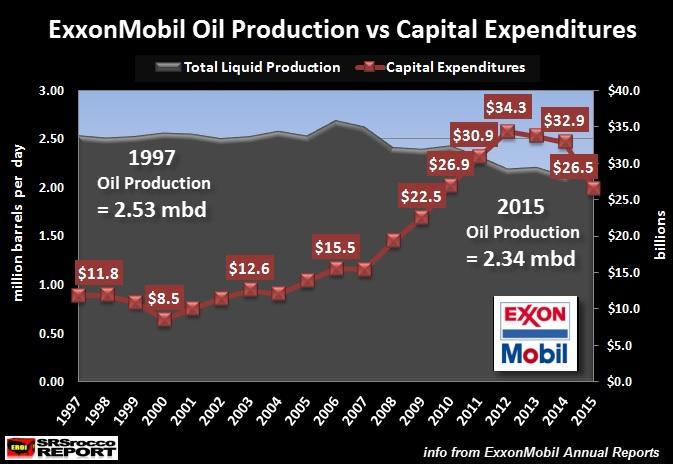
For example, in 1997, Exxon spent $11.8 billion on capital expenditures while producing 2.5 million barrels per day (mbd) of oil. However, their capital expenditures nearly tripled to $34 billion in 2012 as total liquid production fell to 2.2 mbd. Basically, Exxon spent three times more money in 2012 to produce 300,000 barrels per day less than it did in 1997.
When the company realized toward the end of 2013 that the market would not afford to pay $120 a barrel (the cost for new oil projects), Exxon started cutting back on exploration and capital expenditures. Even though total liquid production increased to 2.34 mbd in 2015, capital expenditures declined to $26.5 billion.
Unfortunately, the situation continued to deteriorate in 2016. According to Exxon’s Q3 report, capital expenditures in the first nine months of the year declined another 40% compared to the same period in 2015. Without increased capex spending, it is going to be quite difficult for the company to sustain production and to remain profitable.
So, when we consider that Exxon had to triple its capex spending to maintain production as well as increase dividend payouts to keep shareholders happy, the falling oil price is totally gutting the company from within. The evidence shown here is bad enough; I hate to be a broken record, but the situation is even far worse for Exxon when include two more negative factors.
Exxon Spent the Majority of Its Surplus Cash Buying Back Shares Rather Than Funding New Oil Projects
It seems as if Exxon realized early on that peak oil had finally arrived (privately, of course), so it decided to not waste too much money on future oil projects. Instead, the company spent a massive amount of money on stock repurchases over the past two decades, especially since 2005.
While Exxon had been repurchasing their stock for several years, I had no idea of the total amount. You see, the net total free cash flow, including dividends, for Exxon was $190 billion from 1997-2015. Looking over company’s balance sheet, I had no idea where all that money had gone. I was talking to financial expert Vic Patane a few days ago, and he said, “You should check out their stock repurchases.” So, I did — and what a surprise.
According to Exxon Mobil’s annual reports, the company spent a staggering $260 billion on stock repurchases since 1997:
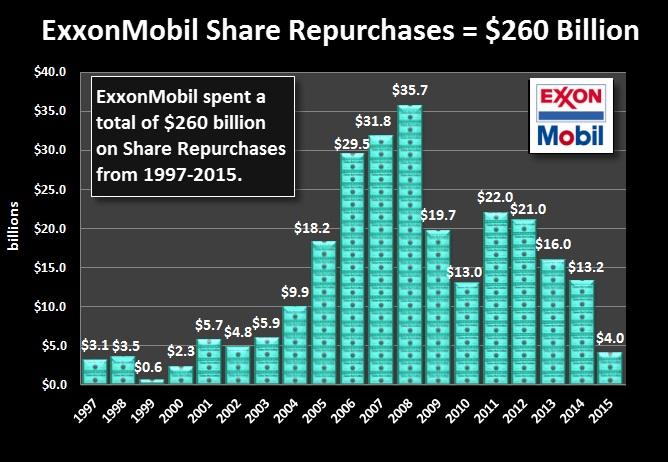
The lion’s share of their stock buybacks were between 2005 and 2014. In that 10-year period, Exxon purchased a staggering $220 billion of its own shares. Now compare that to the company’s total capex spending of $245 billion during the same time period:
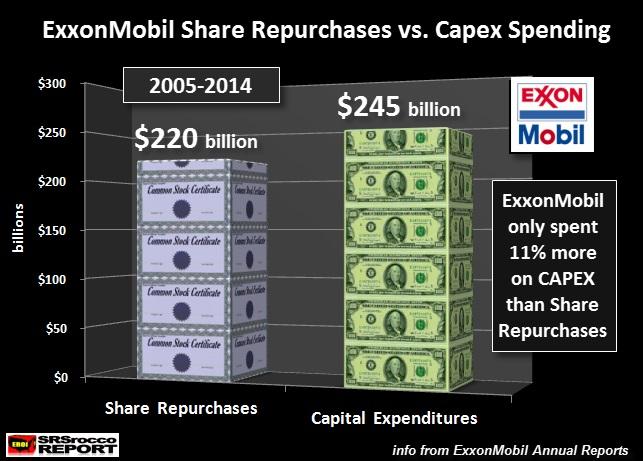
Amazingly, Exxon only spent 11% more on it total capital expenditures than it did on stock buybacks. Which means, the largest oil company in the United States decided to repurchase roughly a third of its outstanding shares (2005 to 2014), than use its surplus cash to fund new oil projects. Exxon’s outstanding shares declined from 6.1 billion in 2005 to 4.2 billion in 2014. This is certainly an interesting way for the leading U.S. oil company to use its surplus cash. For those who continue to be skeptics of the peak oil theory, you really need to look at the data.
Now that we know the lower price of oil is gutting the entire U.S. oil industry, what is it doing specifically to Exxon? Good question.
Exxon’s Long-Term Debt Surges in the Last Three Years
Before I present Exxon’s chart on its rising long-term debt, we need to look at the impact of the company’s share buybacks on its bottom line. When factoring in Exxon’s share repurchases on top of its increasing capital expenditures and dividend payouts, the company’s financial situation started to deteriorate in 2011. That’s when the oil price shot up to $110; go figure:
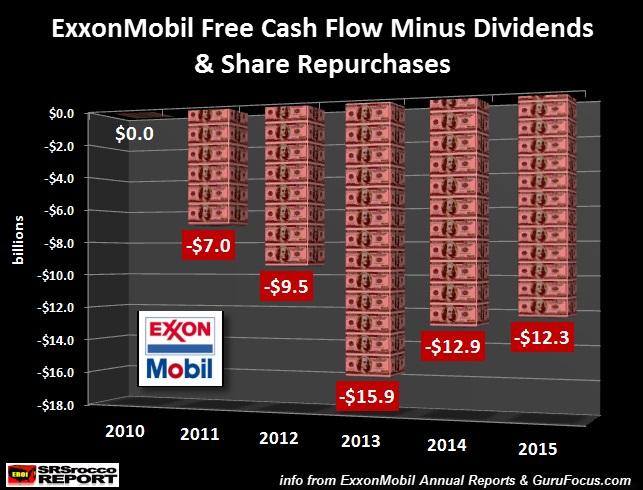
So, if we include share buybacks, capex spending and dividend payouts, Exxon basically broke even in 2010 and actually had to start tapping into cash reserves or borrow money to fund their deficits. In just five years (2011-15), the company spent $58 billion more than they received from operating cash.
This has had a profound impact on Exxon’s long-term debt, as shown below:
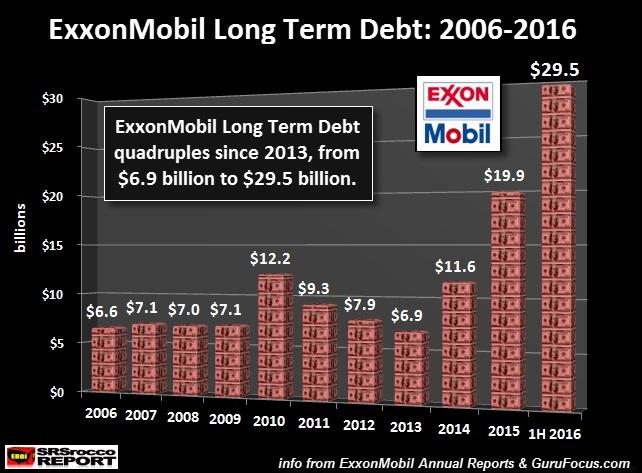
As we can see, Exxon’s long-term debt has exploded from $6.9 billion in 2013 to $29.5 billion in the first half of 2016. Basically, the company is now borrowing money to repurchase shares or pay dividends. This is not a viable long-term business model. And we are already seeing the negative ramifications of low oil prices, as Exxon only repurchased $4 billion of its shares in 2015 vs. $35.7 billion back in 2008.
Investors need to realize the situation in the U.S. major oil industry is in big trouble. If the largest oil company in the country is already suffering, what does it say for the rest of the industry? Well, let me give you just one example.
Chevron is the second-largest oil company in the United States. In 2015, Chevron spent a stunning $18.2 billion more on capital expenditures and dividend payouts than the company’s operating cash. Thus, Chevron spent $10 billion more than Exxon Mobil did last year ($8.3 billion after capex and dividends).
This paints a very gloomy picture for the sustainability of the one great U.S. major oil industry, especially when oil prices continue to decline. As was mentioned in previous articles, the Hills Group and Louis Arnoux forecast that within 10 years, 75% of U.S. gas stations will be closed and the oil industry as we know it will have disintegrated. Well, it seems as if their forecast is playing out just as they predicted, as Exxon recently announced some extremely bad news.
Exxon to Write Off 20% of Its Petroleum Reserves
I don’t know how many of you caught this little tidbit released last week when Exxon stated its Q3 report, but it was a whopper. According to the article “Exxon Warns On Reserves As It Posts Lower Profit“:
Exxon Mobil Corp. warned that it may be forced to eliminate almost 20% of its future oil and gas prospects, yielding to the sharp decline in global energy prices.
Under investigation by the U.S. Securities and Exchange Commission and New York state over its accounting practices –and the impact of future climate change regulations on its business — Exxon on Friday disclosed that some 4.6 billion barrels of oil in its reserves, primarily in Canada, may be too expensive to tap.
From what I have read, the 4.6 billion barrel reserve write-off is mostly from its oil sand projects in Canada and its onshore shale deposits in the United States. However, this amounts to more than 20% of Exxon Mobil’s oil or liquid petroleum reserves.
At the end of 2015, the company reported a total of 24.7 billion barrels of oil equivalent. That figure includes oil, liquids and natural gas. However, if we just consider their oil and liquid reserves of only 14.7 billion barrels, a 4.6 billion barrel writedown would amount to nearly one-third of their oil reserves. This is much greater than the 20% stated in the article.
When Exxon reduces its oil and liquid reserves by 4.6 billion barrels, it will only have 12 years’ worth of reserves remaining, at current production levels. But, what if the price of oil continues to decline toward the $12 maximum price suggested in The Hills Group Report by 2020? What would that do to Exxon or other U.S. oil companies’ reserves and future oil production?
The 100-plus-year era of the U.S. major oil industry is coming to an end — and fast. Unfortunately, Americans have no clue just how dire the situation has become as many probably still believe in the delusion of “U.S. Energy Independence.”
I would imagine by 2020, the U.S. will be a much different place. Regrettably, most Americans are not prepared.
Note: The opinions expressed in this guest post do not necessarily represent those of Dennis Coyne or Ron Patterson.
Seeking Alpha
13 Comments on "End Of The U.S. Major Oil Industry Era: Big Trouble At Exxon Mobil"
rockman on Thu, 10th Nov 2016 11:27 pm
“But, what if the price of oil continues to decline toward the $12 maximum price suggested in The Hills Group Report by 2020? What would that do to Exxon or other U.S. oil companies’ reserves and future oil production?”. In the case of ExxonMobil it would see a huge increase of proved producing reserves acquired at a low price that hasn’t been seen in decades. Similar to what XOM is doing today: picking up proved production for $15 to $20 per bbl. IOW acquiring reserves at a much lower price then it has been able to do for many years by drilling.
And what do the Wall Street experts think of all the data spewed out above: currently XOM stock of trading at the same price as when oil prices averaged $98/bbl as the recent high in 2013. But what does the Street know? Apparently now as much the wizards at the Hill Group.
Mr. Pockets on Fri, 11th Nov 2016 4:27 am
Doomed.
Dredd on Fri, 11th Nov 2016 6:47 am
Humble Oil-Qaeda will be part of the insurrection, so gloat on (Humble Oil-Qaeda).
Odds are that these humble aliens will defeat the Earth people.
shortonoil on Fri, 11th Nov 2016 7:23 am
This is almost the same article that Steve Angelo at the https://srsroccoreport.com/
put out more than a week ago, but the srsroccoreport did a more complete job of it.
mx on Fri, 11th Nov 2016 11:10 am
Tillerson isn’t smart enough for the job.
When everything’s find a CEO focused only on Profitability is find. But, now Russia can produce oil at $10 a barrel, and is increasing output.
Indian Oil ( in India ) is building out 2.7 Gigawatts of Solar.
The world is transitioning to solar and wind.
China making heavy commitments to EV’s.
When year-over-year growth stops Exxon’s stock will be cut in half, at a minimum. It could lose 80% of it’s value with all future growth priced out of the stock.
That’s a Heavy Risk Factor.
Alice Friedemann on Fri, 11th Nov 2016 11:40 am
No worries! Trump is thinking of appointing Harold Hamm Energy Secretary, we are going to DRILL BABY DRILL out way out of this (and if that doesn’t work, invade middle eastern countries and TAKE their oil):
House 112-176. September 13, 2012. The American energy initiative part 28: A focus on the outlook for Achieving North American energy independence within the decade. House of Representatives. 167 pages.
Mr. Harold Hamm, Chairman and CEO of Continental Resources and energy policy advisor to Governor Romney. I’m here today to talk to you about the viability of American energy independence. I am here to testify to the policies needed to insure North American Energy Independence in the next decade. There are three basic policies needed to continue the march towards North American energy independence.
Reasonable and consistent environmental regulations
Encouraging development of federal lands
Maintain tax policies that let us keep our own money to drill.
America is endowed with an estimated 139.6 billion barrels of recoverable oil-enough to replace Persian Gulf imports for the next 50 years. We also have undiscovered technically recoverable natural gas of 1445.3 trillion cubic feet.
We now have natural gas reserves of over a century.
With this extraordinary advance in technology we can now access the immobile oil
The tax provisions in place for over 50 years that let us keep our own money to reinvest in drilling are crucial to keep this energy revival going. We support comprehensive tax reform. When that process begins we should all be willing to make the case as to why provisions in the code are beneficial to all Americans. We will make the case that the repeal of these tax provisions would result in as much as a 40% decrease in drilling activity and stop this American energy renaissance.
SSome call this expensing of ordinary business expense a “subsidy”.
Sixty-Two Percent of the known Oil Resources on Federal lands Are Off-limits. Based on resource estimates, these lands contain about 62 percent of the oil on federal land (19.0 billion barrels) and 41 percent of the natural gas (94.5 trillion cubic feet).
Mr. POMPEO. Mr. Hamm, it wasn’t very long ago that there was peak oil, we are about out of the stuff. All of American energy policy really for the last 25, 30 years under both parties was premised on that notion. Any validity to the fact that you are wrong, that what we have heard from these economists today is wrong and that we do have this challenge in front of us in the near term?
Mr. HAMM. There are several believers in peak oil. I wasn’t in that group. You know, there are still some people, I guess, that maybe are talking about peak oil.But, you know, frankly it is supply and development and we are seeing so many other oil plays across the United States today that, you know, it is almost too many to quantify at this time. But the big ones that we have, of course the Bakken and Eagle Ford, and that is adding so much supply here in the United States, plus natural-gas production across the United States brings a lot of liquid with it as well.
Senate 114-17. March 19, 2015. U.S. Crude oil export policy. U.S. Senate. 150 pages.
HAROLD HAMM, CHAIRMAN AND CHIEF EXECUTIVE OFFICER, CONTINENTAL RESOURCES, INC., OKLAHOMA CITY, OK.
In October 2011 DEPA put a stake in the ground and predicted American energy independence by 2020. America’s independent oil and gas producers have unlocked the technology and resources that made this a reality, not the majors. As a result we can today mark the recent 40th anniversary of the OPEC oil embargo by ending their oil scarcity in America and along with it ending the last short sighted regulation passed during that same period.
America now counts their natural gas supplies in centuries.
Experts agree we’ll be energy independent in terms of crude oil within this decade. This phenomenon was brought about by a group of independent American producers and missed by the general consensus of the industry.
It was in complete contrast to the popular belief that the United States would be running out of oil and gas at the turn of the 21st century.
bloomberg 2014: Harold Hamm, the chairman and chief executive officer of Continental Resources who became a billionaire drilling in North Dakota, told U.S. lawmakers Jan. 30 that the country, which U.S. Energy Information Administration data show supplied 86 percent of its own energy last year, can drill its way to energy independence by 2020. Hamm is leading an effort to get Congress to allow crude exports for the first time since the 1970s.
Senate 113-355. January 30, 2014. Crude oil exports. U.S. Senate.
HAROLD HAMM, CHAIRMAN & CEO CONTINENTAL RESOURCES, INC.
America now counts their natural gas supplies in centuries.
Experts agree we’ll be energy independent in terms of crude oil within this decade.
It was in complete contrast to the popular belief that the United States would be running out of oil and gas at the turn of the 21st century.
rockman on Fri, 11th Nov 2016 1:23 pm
“America now counts their natural gas supplies in centuries. Experts agree we’ll be energy independent in terms of crude oil within this decade. It was in complete contrast to the popular belief that the United States would be running out of oil and gas at the turn of the 21st century.”
Well, that certainly settles it: the Rockman certainly isn’t an expert. LOL. Yes indeed: the US will be producing a lot of NG for many decades. And will also continue importing NG for decades just as we do now since we are a NET NG IMPORTER. Just the result of consuming more NG then we produce. And now that the Marcellus has cooled off our NG imports have started to increase after decreasing for 9 consecutive years.
Independent of oil imports in a decade? Certainly possible if the US goes into a severe derpression and consumption is driven down. Which may be more likely then a significant increase in domestic oil production since the EIA show a consistently declining production rate over the last 12 months of the current reporting period. Given stagnant oil prices and a rig count still almost 70% below the peak that led to increased production and the fact that depletion, like rust, never sleeps, it looks like that declining trend could persist for a while.
shortonoil on Fri, 11th Nov 2016 1:33 pm
“But, now Russia can produce oil at $10 a barrel, and is increasing output.”
$10 per barrel are EBITDA figures, not full life cycle production costs. They aren’t even close to the same number.
Hubbert on Fri, 11th Nov 2016 2:36 pm
Average American Idiot is not ready for this.
Truth Has A Liberal Bias on Fri, 11th Nov 2016 9:32 pm
THG Report is fucking retarded. Anyone who believes that crap obviously never took a high school physics class. Boat can’t even do grade 10 math. Most of you other retards ain’t much smarter.
SRSrocco on Sat, 12th Nov 2016 12:13 am
Truth has a Liberal Bias,
Why don’t you behave and put your crayons away. Leave the troll comments to the professionals.
Northwest Resident on Sat, 12th Nov 2016 1:26 am
As an unbiased and astute observer, it is apparent to me that THALB is all that he is accusing others of being, and then some.
Kenz300 on Sat, 12th Nov 2016 11:39 am
Climate Change is real….. we will all be impacted by it
Exxon’s Climate Change Cover-Up Is ‘Unparalleled Evil,’ Says Activist
http://www.huffingtonpost.com/entry/exxon-evil-bill-mckibben_561e7362e4b028dd7ea5f45f?utm_hp_ref=green&ir=Green§ion=green