


Eagle Ford output is difficult to estimate as there are 20-25 separate fields that need to be followed to get a full picture. To save time, I have used Enno Peters’ data for horizontal wells from Districts 1 to 5 in Texas from his website shaleprofile.com, he has data through June. Enno’s data is combined with the RRC data for statewide C+C output to find the percentage of Texas C+C from the Eagle Ford. This percentage is multiplied by Dean’s estimate for Texas C+C output to get the following estimate, which is compared with Enno Peters’ data. EF-EP is Enno Peter’s collection of data from the RRC, EF-DC is my estimate using the method described. Based on a May 2016 Eagle Ford estimate, I subtract 70 kb/d from the EF-DC estimate to account for non-Eagle Ford horizontal well output in Districts 1 to 5
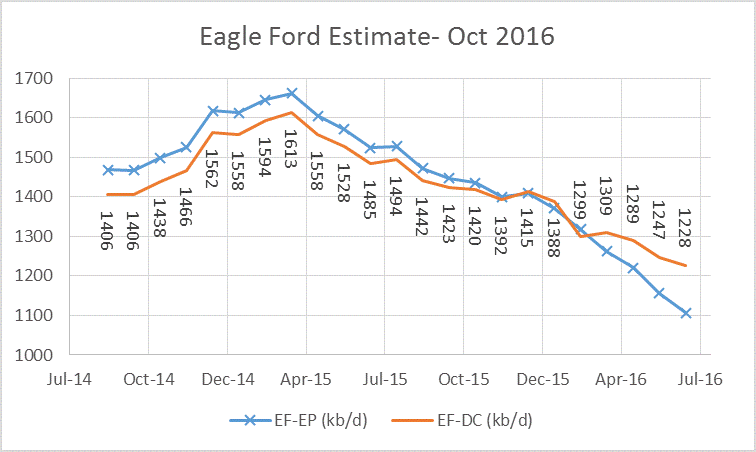
The data labels in the chart above are for the EF-DC estimate.
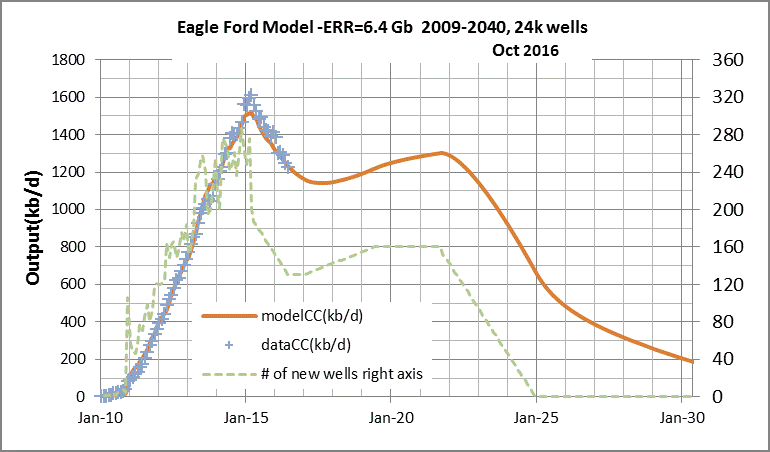
I used these updated output estimates for the Eagle Ford and David Hughes estimate (from Drilling Deeper ) of 7.8 Gb of liquids output from 36,000 total wells drilled to develop a future output scenario for the Eagle Ford. Hughes’ estimate includes both oil and gas wells and through September 2016 about two thirds of wells completed have been oil wells, so I will assume 24,000 total oil wells drilled. As of Sept 1, 2016, 11,600 oil wells had been completed in the Eagle Ford according to the RRC. Hughes estimates about 290 kb for the EUR of the average Eagle Ford well, my estimate (including condensate from the average gas well) is 270 Kb of C+C for the average Eagle Ford well with 216 kb of crude only (excluding condensate from gas wells). I assume new oil wells added will be 131/month from July 2016 to Dec 2016 and then the number will increase by one well each month from Jan 2017 to June 2019 when 160 new wells per month are added. The new wells added remain at 160 per month until Sept 2021 and then begin to decrease. There is a secondary peak in 2021 at about 1300 kb/d with total output from Jan 2010 to Dec 2040 of 6.4 Gb, output declines sharply from 2022 to 2026, falling to 200 kb/d by Jan 2030.
Truth Has A Liberal Bias on Tue, 4th Oct 2016 3:04 pm
Oh no charts! Here comes Mak to say it’s propaganda bullshit lol what a fucking retard! Mak just can’t read charts. He failed math. Lol dumbass butch.
Joe D on Tue, 4th Oct 2016 4:37 pm
I stopped reading Peak Oil Barrel when Dennis Coyne and Fernando took over. Which was pretty much just after Ron created the site after theoildrum closed. I always enjoyed Ron’s articles and comments on both theoildrum and peakoilbarrel.
rockman on Tue, 4th Oct 2016 4:48 pm
Some clarifications which really aren’t critism of this effort. There are not “20 to 25” diffent EFS “fields”. When one submits completion paperwork to the TRRC one must put something into the blank marked “Field”.The EFS is a “trend”…neither a field nor a collection of fields. The “fields” are just diffent geographic areas. The A Field might share a common lease line with the B Field. Complicating it further the companies don’t report production by the well but by the lease. IOW the big Smith lease might have produced 1.5 million bbls from 5 wells. Which doesn’t mean each well recovered 300,000 bbls. One well might have done 1 million, one did 300,00) bbls and the others 3 did about 70,000 bbls each. The only one with those details each operator.
Same problem with “field production”. That number is just the cumulative production of those leases assigned to each “Field”.
And the future? Over the next 14 hears no one knows what the price of oil will be, how many EFS wells will be drilled or how oil each will produced so everyone is free to draw their chart however they like. And if they want me to believe them just show me the ACCURATE chart they drew 14 years ago. LOL. Or
makati1 on Tue, 4th Oct 2016 11:22 pm
And the drip goes on….
http://countercurrentnews.com/2016/10/185000-u-s-oil-pipelines-leak-every-single-day/#
“There are 185,000 miles of liquid oil pipelines alone.”
Davy on Wed, 5th Oct 2016 4:54 am
“Alaska Oil Known Reserves May Have Just Grown 80% on Discovery”
http://tinyurl.com/jfyfx9x
“The light-oil reserves were found in the company’s Smith Bay leases between Prudhoe Bay and Barrow along the Arctic shore, according to a statement from Caelus. As much as 2.4 billion barrels is estimated as recoverable, according to a release issued by the company. That compares with the state’s proved reserves of 2.86 billion barrels in 2014, almost 8 percent of the U.S. total, Energy Department data show.”
“Caelus said its newly discovered field could produce as much as 200,000 barrels a day. That compares with 483,000 barrels a day pumped in Alaska last year, Energy Department data show. The Eagle Ford shale region, the largest U.S. field, yielded 238,000 barrels a day in 2013.”
“A driller on the North Slope needs oil at about $40 a barrel on average to be profitable, Sarah Erkmann, external affairs manager at the Alaska Oil and Gas Association, said in a phone interview. Oil traded at about $49 a barrel today in New York.”