
Peak Oil is You

Donate Bitcoins ;-) or Paypal :-)


Page added on August 25, 2016

Heinberg: Is the Oil Industry Dying?
The ‘peak oil’ controversy is staging a come-back as the industry confronts higher costs—and low prices
Talking about “peak oil” can feel very last decade. In fact, the question is still current. Petroleum markets are so glutted and prices are so low that most industry commenters think any worry about future oil supplies is pointless. However, the glut and price dip are hardly indications of a healthy industry; instead, they are symptoms of an increasing inability to match production cost, supply, and demand in a way that’s profitable for producers but affordable for society. Is this what peak oil looks like?
When prices are high enough to generate profits (which is very high indeed these days), they are also high enough to destroy demand.
Aside from forecasts regarding the timing of the inevitable moment when petroleum production would max out (yes, many of those forecasts proved premature), the peak oil discussion more importantly highlighted three key insights, all of them as valid now as ever:
1. Oil is essential to the modern world. Energy is what enables us to do anything and everything, and oil is currently the world’s primary energy source. But oil’s role in society is even more crucial than that sentence might suggest. Nearly 95 percent of global transport is oil-powered, and if trucks, trains, and ships were to stop running the global economy would grind to a halt almost instantly. Even electricity (which is the other main energy pillar of commerce and daily life) depends on oil: coal mining, transport, and processing depend on oil; much the same is true for natural gas, uranium, and the components of solar panels and wind turbines.
2. Oil is hard to substitute. A colleague, the energy analyst David Fridley, and I recently finished a year-long inquiry into details of the necessary and inevitable transition from fossil fuels to renewable sources of energy. While lots of sunshine and wind are available, not all the ways we use energy will be easy to adapt to renewable electricity. Some of the biggest challenges we identified are in the transport sector. Electric cars are certainly feasible (more are on the road every year), but batteries alone can’t power heavy trucks, container ships, and large airplanes.
There are other possibilities (including biofuels and hydrogen-based fuels made using electricity), but these are likely to be much more expensive and will require large energy inputs for their ongoing production. Moreover, transitioning to them will take major investment and infrastructure build-out occurring over two or more decades.
3. Depletion of oil (and of other non-renewable resources) tends to follow the low-hanging fruit principle. Humanity has been extracting oil on an industrial scale for 150 years now. At first, all it took was identifying places where petroleum was seeping to the ground surface, then digging a shallow well. Today, globally, millions of old conventional oil wells lie depleted and abandoned. The primary remaining prospects for production include heavy oil (which requires expensive processing); bitumen (which must be mined or steam-extracted); tight oil (produced from low-permeability source rocks, which requires hydrofracturing and horizontal drilling, with typical wells showing a rapid decline in output); deepwater oil (which entails high drilling and infrastructure costs); or arctic oil (which has so far mostly proven cost-prohibitive). All of these options entail rapidly growing environmental costs and risks.
It’s that third point that helps explain the disturbing recent evolution of the petroleum world. Most industry analysts focus on oil prices, and it’s clear on this score that the market has gone seriously weird in recent years. In 2001, petroleum sold for about $20 a barrel, a price that sat well within a fairly narrow band of highs and lows that had bounded price for roughly 20 years following the politically generated oil shocks of the 1970s. But, by the summer of 2008, the price had ascended to the unprecedented, dizzying altitude of $147; then (following the cratering of the global economy) it plummeted to $37. Following that, prices gradually recovered to around $100, where they remained for nearly three years before sliding again, starting in mid-2014, to the high $20s, from which they have partially rebounded to today’s approximately $40.
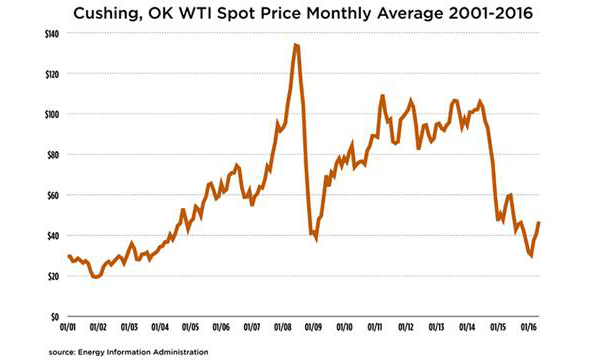
The recent highs (above $100) are incomprehensible, until we recognize that the oil industry’s costs of production have skyrocketed in the past decade. Throughout the first decade-and-a-half of the new century, demand for oil was growing rapidly in Asia. Normally, the industry would have simply ramped up its supplies of conventional crude to satisfy the needs of new car buyers in China and India. But output of conventional oil topped out in 2005; all the new supply growth since then has been from hard-to-reach or low-grade resources. Producers didn’t resort to these until demand outstripped supply, raising prices and justifying the far higher rates of investment that are required per unit of new production. But that meant that, henceforth high prices would have to continue if producers were to turn a profit.
When oil was selling for $100 per barrel, many tight oil projects in the United States were nevertheless only marginally profitable or were actually money losers; still, with interest rates at historic lows and plenty of investment capital sloshing around the financial industry, drillers had no trouble finding operating capital (David Hughes of Post Carbon Institute was one of the few analysts who questioned the durability of the “shale gale,” on the basis of meticulous well-by-well analysis). The result of cascading investment was a ferocious spate of drilling and fracking that drove levels of U.S. oil production sharply upward, overwhelming global markets. The amount of oil in storage ballooned. That’s the main reason prices collapsed in mid-2014—along with Saudi Arabia’s insistence on continuing to pump crude at maximum rates in order to help drive the upstart American shale-oil producers out of business. The Saudi gambit mostly succeeded: Small-to-medium-sized U.S. producers are now gasping for air, and, as their massive debts come due over the next few months, a wave of bankruptcies and buyouts seems fairly inevitable. Meanwhile, in the continental U.S., oil production has dropped by 800,000 barrels a day.
It might not be far from the mark to suggest that we are witnessing the early stages of the thermodynamic failure of global industrial society.
Indeed, the entire petroleum business is currently in deep trouble. Countries that rely on crude oil export revenues are facing enormous budget deficits, and in some cases are having trouble maintaining basic services to their people.
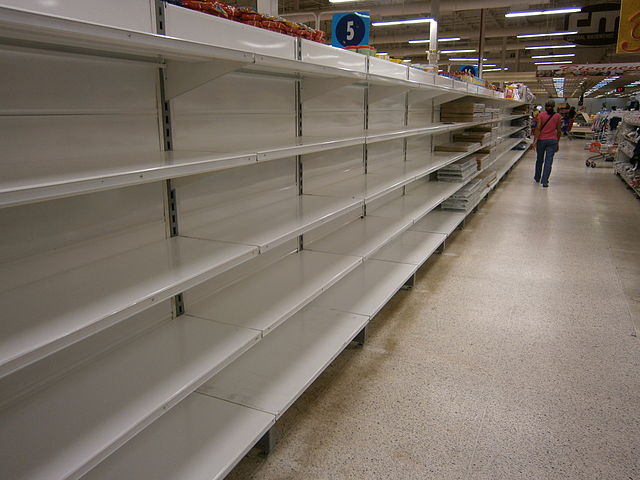
The worst instance is Venezuela, where hunger is rampant. But hard times have also fallen on Nigeria, the Middle Eastern monarchies, Russia, and even Canada to some degree. The oil majors (Exxon, Shell, Chevron, etc.) are still somewhat profitable because a significant portion of their output still comes from older, giant oilfields; but a large and increasing segment of their remaining profits now goes toward debt servicing. And their existing oil reserves are not being replaced with new discoveries.
Any way you look at it, the industry faces a grim future. Even if prices go up, there is no guarantee of recovery: Investors may be shy to rush back to oil since they have no assurance that a price rout won’t recur in months or years. After all, when prices are high enough to generate profits (which is very high indeed these days), they are also high enough to destroy demand—which is also vulnerable to recessions, the growth of the electric vehicle market, and meaningful climate policy. It’s simply unclear whether the global economy can consistently support an oil price that’s sufficiently robust to pay the industry to extract and refine the kinds of resources that remain.
Again, most oil commentators look at all of this through a purely economic lens. But it may be helpful to think more in terms of thermodynamics. Oil, after all, is primarily useful as a source of energy. And it takes energy to get energy (it takes energy to drill an oil well, for example). Energy profits from oil extraction activities were once enormous, and those energy profits got spread throughout society, wherever oil was used. Now, petroleum’s energy profitability is falling fast.
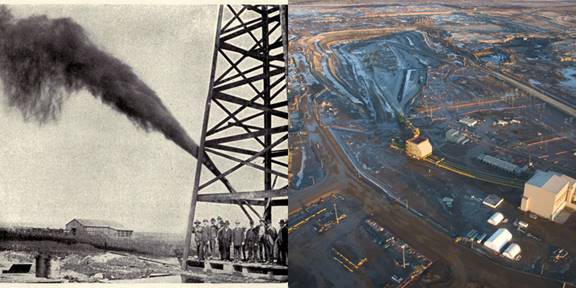
_pic.279_Trans-Mississippi_Gusher.jpg)
For example, while conventional oil wells 50 years ago often had a hundred-to-one energy payback, today’s bitumen production in Canada shows an energy-return-on-energy-invested (EROEI) ratio of between 3:1 and 5:1. This declining energy profitability is why it’s now so hard to produce oil at a financial profit, and also why—even when oil supplies are still expanding—they don’t fuel as much economic growth throughout the economy.
Since oil is the key energy source of modern civilization, the effective EROEI of society as a whole can be said to be declining. It might not be far from the mark to suggest that we are witnessing the early stages of the thermodynamic failure of global industrial society. An earlier phase of the process manifested in the financial crash of 2008; when that occurred, governments and central banks responded by deploying easy money (massive debt, low interest rates) to prop up the system, and this temporarily masked society’s dwindling EROEI. Debt can accomplish this over the short run: Money is effectively a marker for energy, and we can borrow and spend money now on costly energy with the promise that we will pay for it later (hence the massive build-up of debt in the oil industry). But if cheaper-to-produce energy and higher prices don’t emerge soon, those debts will eventually become transparently unrepayable. Hence what is inherently an energy crisis can appear to most observers to be a debt crisis.
The problem of eroding energy profitability is hard to deal with partly because the decline is happening so fast. If we had a couple of decades to prepare for falling thermodynamic efficiency, there are things we could do to soften the blow. That’s what the peak oil discussion was all about: It was an effort to warn society ahead of time. Once the dynamic of declining energy profitability really gets rolling, adaptation becomes much more difficult. Oil no longer provides as much of a stimulus to the economy, which just can’t grow as it did before, and this in turn sets in motion a self-reinforcing feedback loop of stagnating or falling labor productivity, falling wages, falling consumption, reduced ability to repay debt, failure to invest in future energy productivity, falling energy supplies, falling tax revenues, and so on. How long can debt continue to substitute for energy before the next traumatic phase of this feedback process begins in earnest? That’s anybody’s guess, but our time-window for action is likely months or years, not decades.
What could world leaders do about declining societal EROEI if they took the crisis seriously? Clearly, part of their strategy would entail building alternative energy supply infrastructure—which must be low-carbon, since we also face the existential threat of climate change. Indeed, some environmentalists say peak oil is a non-issue because whatever we do to tackle climate change will simultaneously solve our oil dilemma. I’m not so sure about that. Most proposed climate mitigation strategies start with transitioning the electricity sector to solar and wind power, and then proceed with a gradual electrification of other energy usage (electric cars, electric air-source heat pumps to heat buildings, etc.). But, as noted, much of the transport sector is hard to electrify. It’s nice to see more Nissan Leafs, Teslas, and Chevy Volts on the road, but those carry people; our real challenge is moving all the stuff we need (food, raw materials, and manufactured goods of all kinds), and that stuff outweighs passengers by an order of magnitude and currently travels mostly by ship and truck.
Efforts now underway to power trucking and shipping renewably are woefully insufficient. Peak oil demands that we focus on transport now, not later: We should supply substitute renewable fuels where absolutely needed, but we must also quickly and substantially reduce our reliance on long-distance transport through economic re-localization.
Much as I hate to think so, thermodynamic decline and economic contraction could seriously impair our chances for a robust renewable energy transition in response to the threat of climate change. Building enough solar panels and wind turbines, and adapting the ways we use energy (in building heating, in industrial processes, in transportation, in food systems, and on and on), will take time and many trillions of dollars of investment. It will also require stable international markets and supply chains, and those could be thrown into turmoil by the declining thermodynamic profitability of our society’s current primary energy source—unless we can somehow build a bridge to the future while the highway we’re on is crumbling beneath us.
The subject of peak oil has been discredited following a short-term oil supply glut and low oil prices. Even many environmentalists have filed peak oil under “Things Not to Worry About.” (One high-level climate campaigner of my acquaintance has said that peak oil is a lousy issue to organize around—as though we can afford to ignore a gargantuan problem if it offers insufficient fundraising potential). Thankfully, that small, resourceful audience has taken action anyway, in the form of community resilience-building efforts that often fly under the banner ofTransition Initiatives and similar networks.
It may be counterproductive even to use the phrase “peak oil” today, though I’ve done so in this essay. After all, we don’t know if the actual maximum in world oil output occurred last year, or will happen this year, next year, or several years from now. This lack of definitive predictive power is the Achilles’ heel of an otherwise useful term. What instead should we call the complex, interrelated set of developments described above? Should we dub it “the thermodynamic collapse of industrial civilization”? That has a nice techno-apocalyptic ring to it and is probably more accurate. But it has too many syllables and requires too much background explanation. Only geeks could ever get it.
Something is happening here, whether we have a snappy buzzword for it or not. And we can’t afford to ignore it, regardless how hard it is to explain it to economists, policymakers, and even many environmentalists. My colleagues and I keep trying to do just that. But at this point it also makes sense to batten down the hatches and build resilience close to home.
“You Can’t Handle the Truth!”
Movie buffs will recognize this title as the most memorable line from “A Few Good Men” (1992), spoken by the character Colonel Jessep, played by Jack Nicholson (“You can’t handle the truth!” is #29 in the American Film Institute’s list of 100 top movie quotes).
I hereby propose it as the subtext of the recently concluded Republican and Democratic national conventions.
At this point most people appear to know that something is terribly, terribly wrong in the United States of America. But like the proverbial blind man describing the elephant, Americans tend to characterize the problem according to their economic status, their education and interests, and the way that the problem is impacting their peer group. So we hear that the biggest crisis facing America today is:
- Corruption
- Immigration
- Economic inequality
- Climate change
- Lack of respect for law enforcement
- Institutionalized racism
- Islamic terrorism
- The greed and recklessness of Wall Street banks
- Those damned far-right Republicans
- Those damned liberal Democrats
- Political polarization
The list could easily be lengthened, but you get the drift. Pick your devil and prepare to get really, really angry at it.
In reality, these are all symptoms of an entirely foreseeable systemic crisis. The basic outlines of that crisis were traced over 40 years ago in a book titled The Limits to Growth. Today we are hitting the limits of net energy, environmental pollution, and debt, and the experience is uncomfortable for just about everyone. The solution that’s being proposed by our political leaders? Find someone to blame.
The Republicans really do seem to get the apocalyptic tenor of the moment: their convention was all about dread, doom, and rage. But they don’t have the foggiest understanding of the actual causes and dynamics of what’s making them angry, and just about everything they propose doing will make matters worse. Call them the party of fear and fury.
The Democrats are more idealistic: if we just distribute wealth more fairly, rein in the greedy banks, and respect everyone’s differences, we can all return to the 1990s when the economy was humming and there were jobs for everyone. No, we can do even better than that, with universal health care and free college tuition. Call the Democrats the party of hope.
But here’s the real deal: a few generations ago we started using fossil fuels for energy; the result was an explosion of production and consumption, which (as a byproduct) enabled enormous and rapid increase in human population. Burning all that coal, oil, and natural gas made a few people very rich and enabled a lot more people to enjoy middle-class lifestyles. But it also polluted air, water, and soil, and released so much carbon dioxide that the planet’s climate is now going haywire. Due to large-scale industrial agriculture, topsoil is disappearing at a rate of 25 billion tons a year; at the same time, expanded population and land use is driving thousands, maybe millions of species of plants and animals to extinction.
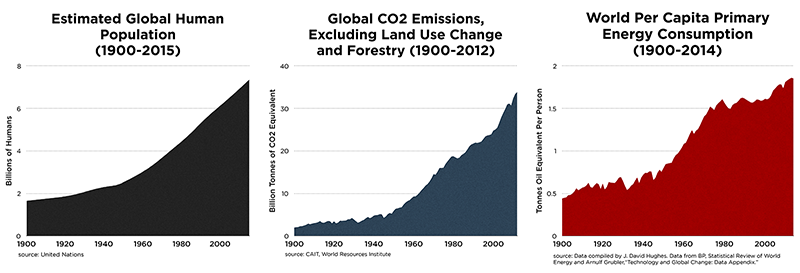
We extracted non-renewable fossil fuels using the low-hanging fruit principle, so that just about all the affordable petroleum (which is the basis for nearly all transport) has already been found and most of has already been burned. Since we can’t afford most of the oil that’s left (either in terms of the required financial investment or the energy required to extract and refine it), the petroleum industry is in the process of going bankrupt. There are alternative energy sources, but transitioning to them will require not just building an enormous number of wind turbines and solar panels, but replacing most of the world’s energy-using infrastructure.
We have overshot human population levels that are supportable long-term. Yet we have come to rely on continual expansion of population and consumption in order to generate economic growth—which we see as the solution to all problems. Our medicine is our poison.
And most recently, as a way of keeping the party roaring, we have run up history’s biggest debt bubble—and we doubled down on it in response to the 2008 global financial crisis.
All past civilizations have gone through similar patterns of over-growth and decline. But ours is the first global, fossil-fueled civilization, and its collapse will therefore correspondingly be more devastating (the bigger the boom, the bigger the bust).
All of this constitutes a fairly simple and obvious truth. But evidently our leaders believe that most people simply can’t handle this truth. Either that or our leaders are, themselves, clueless. (I’m not sure which is worse.)
Hence the political primaries generated lots of feelings (anger, hope, fear), but revealed or conveyed almost no understanding of what’s actually going on, what’s in store, or what to do about it.
Now, I’m not proposing that the two parties are equivalent. There are some substantive differences between them. And in dangerous times, hope usually yields better outcomes than fear and rage (though hope is vulnerable to disillusionment and recrimination, which in turn lead back to fear and rage). Some of the Democrats’ ideas may help as we embark on our Great Slide down the steep slope of the Seneca cliff: for example, a universal basic income (not in the Democratic Party’s platform but consistent with its ideals) could provide a temporary safety net as the economy enters its inevitable long nosedive. Democrats at least acknowledge the problem of climate change, though they have few plans to do much about it (on this issue, the Republicans almost literally reside on a different planet). Meanwhile the Republicans’ reflex toward tribalism and division has the potential to turn social relations between America’s historically dominant European descendants and the nation’s various other ethnic groupings into a seething cauldron of hatred and violence.
But Democrats’ inability to provide a credible response to the zeitgeist of imperial decline could play into electoral defeat or failure either this time around or next. Trump offers a politics of isolationism and the image of the Strong Man, which may better fit the spirit of the times. True, any intention to “Make America Great Again”—if that means restoring a global empire that always gets its way, and whose economy is always growing, offering glittery gadgets for all—is utterly futile, but at least it acknowledges what so many sense in their gut: America isn’t what it used to be, and things are unraveling fast.
Troublingly, when empires rot the result is sometimes a huge increase in violence—war and revolution. The decline of the British Empire was the backdrop for World War I, which led to an even bloodier reprise a couple of decades later. Today the foreign policy establishment in Washington appears eager to pick a fight with Russia, and Hillary Clinton has a track record of dangerous interventionism (she’s won the endorsement of neoconservative hawks—both Republican and Democrat—who pushed for the Iraq invasion of 2003). Trump, for all his rhetorical belligerence, seems perhaps a bit less bellicose internationally, though his eventual foreign policies are currently about as easy to read as a Rorschach ink blot.

Russia’s Vladimir Putin is playing a peculiar role in the current contest. Trump and Putin have publicly complimented one another (one can only speculate as to the motives on both sides), while Hillary Clinton hews closely to the neocon-formulated State Department line that Putin is a dangerous strongman who threatens his neighbors. In fact, it is the US and NATO that have surrounded Russia with advanced weapons, reneged on agreements, and instigated regime change in Ukraine.
The Western powers’ ongoing provocation and demonization of Russia ispushing the world closer perhaps to nuclear war than was the case even during some decades of the Cold War. Against this frightening backdrop Trump has proposed (perhaps jokingly) that Russia hack Clinton’s emails. For her part, Clinton gives no indication that she will ratchet down the anti-Putin rhetoric; just the opposite appears to be in store—both during the campaign and the next four crucial years, when we are likely to face another (perhaps much worse) financial crisis along with escalating international tensions.
Could “we the people” handle a bit more of the truth? One would certainly like to think so. As it is, the US and the rest of the world appear to be sleepwalking into history’s greatest shitstorm (a somewhat more geeky and less scatological way to describe it would be as the mother of all Dragon Kings). Regardless how we address the challenges of climate change, resource depletion, overpopulation, debt deflation, species extinctions, ocean death, and on and on, we’re in for one hell of a century. It’s simply too late for a soft landing.
I’d certainly prefer that we head into the grinder holding hands and singing “kumbaya” rather than with knives at each other’s throats. But better still would be avoiding the worst of the worst. Doing so would require our leaders to publicly acknowledge that a prolonged shrinkage of the economy is a done deal. From that initial recognition might follow a train of possible goals and strategies, including planned population decline, economic localization, the formation of cooperatives to replace corporations, and the abandonment of consumerism. Global efforts at resource conservation and climate mitigation could avert pointless wars.
But none of that was discussed at the conventions. No, America won’t be “Great” again, in the way Republicans are being encouraged to envision greatness. And no, we can’t have a future in which everyone is guaranteed a life that, in material respects, echoes TV situation comedies of the 1960s, regardless of race, religion, or sexual orientation.
Bernie Sanders offered the best climate policies of any of the pre-convention candidates, but even he shied away from describing what’s really at stake. The times call for a candidate more in the mold of Winston Churchill, who famously promised only “blood, toil, tears, and sweat” in enlisting his people in a great, protracted struggle in which all would be called upon to work tirelessly and set aside personal wants and expectations. The candidates we have instead bode ill for the immediate future. Given the absence of helpful leadership at the national level, our main opportunity for effective preparation and response to the wolf at our doorstep appears to lie in local community resilience building.
It’s the truth. Can you handle it?
29 Comments on "Heinberg: Is the Oil Industry Dying?"
gutpunch1 on Thu, 25th Aug 2016 6:59 am
Well stated. Please elaborate on ‘planned population decline’.
Cloggie on Thu, 25th Aug 2016 7:09 am
As long as there is demand for oil, there will be an oil industry. The days that there won’t be demand for oil are decades away, in other words the oil industry is NOT dying. What we see is a situation of overproduction. It suffices to use the economics 101 model of pork cycle to understand what is happening: too many producers fishing for too few customers. Consequence: the weaker guys will go out of business, which will lower production, which will increase prices which will lead the stronger guys to thrive again.
Finally Heinberg admits that “many foreasts were premature”, but fails to admit that his own wrong forecast had global reach, to the tune that I am now sitting in my old giant chair overlooking my garden-turned-vegetable garden, which probably hadn’t happened without “The Party Is Over”.lol
Can you handle that truth, Richard?
https://en.wikipedia.org/wiki/Pork_cycle
paulo1 on Thu, 25th Aug 2016 7:22 am
I read most of this article some time ago. Perhaps it was part of an earlier compilation?
Very well stated article. To me, it rings with truth. Investors will come back to high-priced oil projects, but how many times will people be willing to lose their money? Or, other people’s money? 🙂
In the background noise of today’s somewhat low oil prices and all the election BS, I often forget about looming decline. This article is a sobering reminder…at least a reminder to be mindful. I think there are a few facts to deal with in our daily lives that exist across lines. We do have fewer opportunities these days. Regular ‘folks’ are making do with less, right now. Plus, further decline seems to be baked in despite brash electioneering. Add in some Global Warming effects and we are looking at some profound adaption challenges.
regards
onlooker on Thu, 25th Aug 2016 8:09 am
This is a repeat article. As for this statement by Cloggie “As long as there is demand for oil, there will be an oil industry. ” Totally bogus. At some point the Oil Industry will implode as an economically unfeasible enterprise. Remember the basis of economic activity is energy including attaining and accessing that energy. Thus a society with critically low energy levels will not have the funds to continue economic activity and such society could not afford to try and continue to exploit an energy source that requires more energy to attain than is derived from it
i1 on Thu, 25th Aug 2016 8:29 am
I’m thinking a boat is the way to go. With a .50 cal tripod and radar alert. Beats the hell out of bolthole siege or the highway to hell. Transition town lol.
brough on Thu, 25th Aug 2016 8:30 am
I also read this article some time ago.
After which I analysised each and every statement and came to the conclusion that it is probably 90% true.
joe on Thu, 25th Aug 2016 8:38 am
Opec nations and tight oil both have the same problem from opposite sides. Conventional peak oil happened, gloop that delivers single digit profits is not what i mean. Theres lots of gloop out there, it needs refining, but when prices go up that stuff is gold. Only problem is that Opec is wise to that game so it has to keep gloop off the market, and Iran (because thats what god wants).
Cloggie on Thu, 25th Aug 2016 8:43 am
“At some point the Oil Industry will implode as an economically unfeasible enterprise”
You are saying exactly the same thing as I do: oil industry will implode when there are no longer sufficient customers, a situation aka “economically unfeasible enterprise”.
That situation will occur when oil prices will increase to say 300-400$. By that time everybody will have started a wind-turbine or solar panel factory and those people could be the last customers of 300-400$ oil.
PracticalMaina on Thu, 25th Aug 2016 8:47 am
http://www.ecowatch.com/massive-fracking-explosion-in-new-mexico-1919567359.html
rockman on Thu, 25th Aug 2016 9:14 am
Looker – And once more the unusual situation where we view the situation differently. Individual companies will come and go but the “oil industry” will not only survive for many decades but will also experience great prosperity from time to time. Ver simply we control a commodity all economies desparately need. A commodity that’s depleting with no viable alternative yet that can completely complete with it.
There will be less oil production in the future and fewer companies. But those remaining will still have you by the balls and will occassionally squeeze them tight enough to make you cry. LOL
Sissyfuss on Thu, 25th Aug 2016 9:35 am
This is a cogent and concise description of our predicament which is unsolvable with our present and waning technologies.Doom is real and fast approaching whether in the form of 500 yr floods or civil wars. Like Erlich the problem of prognostication is rooted in timing and not denouement.
shortonoil on Thu, 25th Aug 2016 9:56 am
“That situation will occur when oil prices will increase to say 300-400$. By that time everybody will have started a wind-turbine or solar panel factory and those people could be the last customers of 300-400$ oil. “
$300 – 400! Right? We will file that under unicorns, and magic pixie dust!
Here is what has been happening with consumption growth and price:
https://oilprice.com/images/tinymce/2016/Berman2208O.jpg
Hang that graph on your wall, and go pencil in that $300 to 400 someplace in your basement.
Boat on Thu, 25th Aug 2016 9:58 am
Clog,
“That situation will occur when oil prices will increase to say 300-400$. By that time everybody will have started a wind-turbine or solar panel factory and those people could be the last customers of 300-400$ oil.”
That is one view, here is another. That 22 million growth in vehicle growth will increasingly be replaced by hybrid, electric, nat gas etc. There is plenty of oil at say $65 to last till 2030–2035 causing the last peak oil. After that demand will drop with ample oil still available. Oil producers then will fight in a below $65 price scenario. Of course this assumes stable geopolitics.
PracticalMaina on Thu, 25th Aug 2016 11:22 am
Boat, you need the renewables to replace the ICE. I do not see decades of prosperity for oil producers like Rockman, everyone will slowly realize that the climate is being destroyed and it is our happy motoring that is doing it. A heavy sin tax would be an important first step.
Don Stewart on Thu, 25th Aug 2016 11:36 am
shortonoil; Heinberg; John Michael Greer
This will be ‘numbers lite’ rumination on what has happened to ERoEI over the last century. I will loosely refer to Shortonoil’s work, John Michael Greer’s new book Dark Age America, and a century old oil boom/ ghost town, Three Sands, Oklahoma. I grew up a dozen miles or so from Three Sands, but it was long past its prime by that time.
On page 105, Greer says: ‘One of the factors that makes it difficult to think through the economic consequences of the end of the industrial age is that we’ve all grown up in a world where every form of economic activity has been channeled through certain familiar forms for so long that very few people remember that things could be any other way….We’re going to have to confront them, because one of the core features of the decline and fall of civilizations is that most of the habits of everyday life that are standard practice when civilizations are at zenith get chucked into the recycle bin as decline picks up speed….Every exchange you make, whether it’s selling your labor or buying goods and services with the proceeds, takes place within a system that has been subjected to the process of intermediation…When you go to exchange money for goods and services, the same principle applies; how much of the value of your labor you get to keep for your own purposes varies from case to case, but it’s always less than the whole sum, and sometimes a great deal less….market economies inevitably load them with as many intermediaries as the overall complexity of their economies can support.’
I’d like to refer you to a brief video which shows the town of Three Sands now and during its prime, a century ago. I’d particularly call your attention to how different life looked back then to the people who worked in the oil field. For example, notice the rows of industrial housing almost directly below the oil rigs. Notice that most people are walking. And if you read the article, you will find that as the sweet spot moved, so did the town. Notice the gasoline plants right on the spot.
https://www.youtube.com/watch?v=OpikOA1Ih94
http://www.gazmuth.com/region/ghost-towns/three-sands.html
It doesn’t take too much deep thought to see that Three Sands didn’t really have a lot of intermediation a century ago. This area is active again, due to the fracking boom, and my home town recorded an earthquake a few days ago. But nobody is building any houses or places of business at Three Sands. The intermediation that Greer talks about has increased enormously over the last century, and the workers need Ford to make F150s and the frackers need pipelines and expensive refineries which are far away. The Three Sands school probably didn’t employ a single counselor, and one of the students was probably assigned to sweep up at the end of the day.
When people in the oil business begin to talk about efficiency, and how things have improved, they are generally referring to ‘more intermediation’. Some engineering company came and redesigned a production process to make it faster or better or cheaper. Some safety engineer came and redesigned things so that there are fewer industrial accidents. In the school, all the people who work there, who do not actually teach, can quote chapter and verse about the horrible things which will happen if they are fired.
I draw three conclusions:
*Greer is correct that societies with a surplus of energy will tend to expand the number of intermediaries.
*Shrinkage is complicated and unpleasant because the intermediaries now have enormous political and economic power. For example, I am sure that many politicians in Washington would describe their ‘constituency’ as working on K Street.
*The boundary conditions are extremely important when looking at oil and survival. If the capitalist economy has been functioning as Greer says it has, there is very little fat in the system. Slight shrinkages can shift the benefit to cost ratio into the negative. If we look very narrowly at drilling wells, then we are likely to miss the real action in the intermediaries.
Don Stewart
oracle on Thu, 25th Aug 2016 12:12 pm
We’re going to run out of oil companies long before we run out of oil.
onlooker on Thu, 25th Aug 2016 12:23 pm
Haha, I do not equate scavenging for oil ala Mad Max akin to the Oil Industry
Boat on Thu, 25th Aug 2016 12:36 pm
PracticalMaina on Thu, 25th Aug 2016 11:22 am
” A heavy sin tax would be an important first step.”
For that to happen the world would have to agree. But as climate change becomes more costly political will grow.
ghung on Thu, 25th Aug 2016 2:30 pm
Another great post, Don. Thanks. You quoted Greer:
…..how much of the value of your labor you get to keep for your own purposes varies from case to case, but it’s always less than the whole sum, and sometimes a great deal less….market economies inevitably load them with as many intermediaries as the overall complexity of their economies can support.’”
I figured out early on that this is where I could do myself the most good. Sweat equity; began with doing my own learning and planning; built my own house; harvest my own energy; utilize my own water sources; account for (as much as possible) my own waste streams…. reduces the number of intermediaries which I often found to be grossly inefficient in the scheme of things. It’s not that I begrudge them making a “living”, so to speak; it’s just that, at some point, I figured out that I, and society in general, can’t afford them. Requires too much surplus in terms of energy and other real capital.
I agree that it will very likely be a wild ride back down the irreparable ladder of complexity. One’s best bet, IMO, is to get about the not-so-hard process (in my experience) of decomplexifying ones own affairs. As Greer also says, collapse now and avoid the rush. Problem is, it appears that most folks (and society in general) are addicted to complexity.
Surrender can be voluntary or forced, but it’s up to each of us to choose; those of us who actually have choices. Too bad those who have the most capacity for change have the fewest incentives to do so.
Apneaman on Thu, 25th Aug 2016 3:17 pm
The Luxury Cruise to the End of the World
“Sorry, you missed it. But if you had known about it — I don’t know why you didn’t get the memo — and if you had $120,000 lying around ($22,000 for steerage) you could have joined 1,000-plus passengers served by 700 crew on the first luxury cruise from Seward, Alaska to New York City via the Northwest Passage through the Arctic Ocean. Once solid ice, the Northwest Passage became navigable in theory in 2007 because of climate change.”
http://www.dailyimpact.net/2016/08/24/the-luxury-cruise-to-the-end-of-the-world/
https://www.youtube.com/watch?v=ZHh0V7UjVXI
Apneaman on Thu, 25th Aug 2016 3:26 pm
Mass Extinction: The Early Years
A quick rundown of the ecocidal empires that came before us.
https://blog.longreads.com/2016/08/04/mass-extinction-the-early-years/
shortonoil on Thu, 25th Aug 2016 3:37 pm
” then we are likely to miss the real action in the intermediaries. “
Hi Don,
If you buy a $500 refrigerator with a credit card someone hands the credit card company $15 to $30 for performing a process that literally cost them a fraction of a cent. One would, at first glance, think that with profitability of that size that there would be hundreds of credit card companies. There are four that dominate 99.95%of the market world wide.
Greer is correct about the intermediaries, they proliferate like lice at a sheep ranch. Some of them grow to monstrous size. They become embedded in their victims like giant heart worms. They become so entrenched that removing them would almost certainly kill the victim.
In the conclusion to “Depletion: A determination for the world’s petroleum reserve” we state:
“In the United States – federal, state and local governments, along with some private organizations annually invest $2.1 trillion to protect, manage and regulate the flow of petroleum. This includes not only the servicing of its millions of miles of highways, and a vast military infrastructure that is needed to protect the nation’s oil supply, trade routes and harbors, but also a myriad of agencies and groups. The MMS, OSHA, EPA, DOT, and an almost endless, and immensely expensive number of regulatory services are involved in the process. As petroleum losses its relevance the unwinding of this labyrinth of colossal enterprises in an orderly and non-chaotic fashion will represent one of the major challenges of the next two decades.”
Can these giant life sucking parasites be removed without killing the victim? If they die from energy starvation will the entire civilization cease to function. Is their ending the beginning of the road to Mad Max? Not only have we built a civilization that has become too complex to manage, but it is likely to have become too complex to shut down.
Brent on Thu, 25th Aug 2016 5:26 pm
Nobody has ever explained to me that if we have a power grid that is barely functioning right now from years of neglect. How are we going to somehow just switch right over to electric cars when they will dive electricity demand through the roof. Solar panels and wind turbines great idea heirs the thing I am broke along with most of this country. No we are going to try to not look at the problem until it is here and biting us in the ass.
onlooker on Thu, 25th Aug 2016 5:44 pm
Yes Brent, we literally put all our apples into one cart. In this case fossil fuels. All our important infrastructure runs with FF. So we are stuck with FF whether we like it or not. Or at least what is left of FF or realistically obtainable
jjhman on Thu, 25th Aug 2016 8:38 pm
Brent:
I charge my electric car at night when the grid is way under loaded. I suspect that it can handle a whole lot of electric cars before it is running at anywhre near the peak.
Brent on Fri, 26th Aug 2016 4:30 am
jjhman:
Not everyone will want to only charge their cars at night. Americans want power right now what happens when someone needs to run to the store right now and the car is not charged? I think most people will want to plug in their car right after they gt home from work.
Davy on Fri, 26th Aug 2016 7:38 am
Let us hope attitudes and lifestyles will change so people understand the importance of charging EV’s at night when the grid has surplus power in many cases. This is also true of the variability of alternative sources like wind and solar where they have a significant local effect. This is something the authorities can push and the markets adapt to. I suspect when a visible crisis hits that is around the corner these positive attitudes and lifestyles will be embraced. I called the crisis visible because we are in a crisis now but we are ignoring it and maintaining a delusional social narrative of normal. We are anything but normal and soon will be in destructive and visible change. Discretionary and non-essential activities will be cut significantly in a visible crisis. I have seen studies that show something like a 10% reduction in liquid transport fuels equate to a 50% reduction in discretionary driving because of the importance of the emergency services and essential transport. I don’t have the exact numbers but you get the point of leverage. Attitudes and lifestyle will change but will they change fast enough to make this dive into collapse less jagged and destructive.
onlooker on Fri, 26th Aug 2016 8:31 am
Can enough recharging stations be built to accommodate long distance driving? But the central point is how to scale reliance on electrical transportation given already evident limitations of the electrical grid and the cumbersome and energy/economically intensive transition to less energy dense renewable energy. The obstacles are formidable and intransigent.
shortonoil on Fri, 26th Aug 2016 2:23 pm
“Attitudes and lifestyle will change but will they change fast enough to make this dive into collapse less jagged and destructive.”
That will depend on how long the petroleum industry can continue to operate on any kind of a global basis. We know that the industry is extracting 32 Gb more each year than it is replacing. At the present price of $47/ barrel that is $1.5 trillion per year that the value of the extractive portion of the industry is contracting. Using the energy equations of the Model it comes out to $2.3 trillion per year. The Model also projects that those loses will be growing as time progresses.
The question, then simply becomes, how long can the industry continue to function with that magnitude of loses? Once the global petroleum industry is gone all bets are off with any type of world wide transition to other sources, or life styles. The monetary financial, and economic system that would make transition possible will be also be gone. There is also the very good possibility that a failing, but not yet failed, petroleum industry will bring down the financial, economic system before it, itself, completely fails.
Taking everything that we know into consideration any attempts at transition should be taking place on a regional, or local level. Continued dependance on a global system will undoubtedly prove to be futile. The means to accomplish any type of transition will be gone long before any transition can be performed.