
Peak Oil is You
Donate Bitcoins ;-) or Paypal :-)


Page added on July 20, 2016

The Shopping Mall Death Spiral
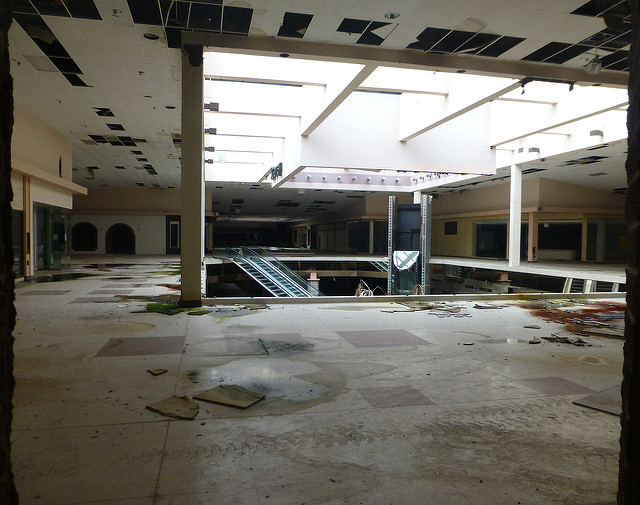
Did the people who built this think it would fail in less than a generation? The answer might surprise you.
The shopping mall is the epitome of America’s Suburban Experiment. From a local government standpoint, it was the golden chalice of development, a winner-take-all prize in our race to the bottom. Whoever got the mall was able to steal from their neighbors that fraction of a sliver of retail taxes that local governments receive. When consolidated in one place, that could add up to a significant amount of money, at least for a while.
The losers with their crumbling downtowns…..well, they could eat cake.
Until now. As kind of an indicator species in this great auto-oriented paradigm we’ve created, the shopping mall is in what one industry insider calls, “a death spiral.” This dinosaur of another age is finding it hard to exist amid an ecosystem that has more nimble, adaptable competition:
“We are extremely over-retailed,” said Christopher Zahas, a real estate economist and urban planner in Portland, Ore. “Filling a million square feet is a tall order.”
That’s what happens when we have a one-size-fits-all tax system mashed together with a winner-takes-all development pattern; we end up with too much of the easiest thing to generate quick cash with.
In the Curbside Chat presentation, I show two similarly-sized pieces of property. One is the highly-coveted big box store with an auto-dealership and gas station on the edge of town. The other is the run down, neglected downtown with all of its vacancies and burned-down buildings that are now parking lots. The headline from the comparison is that the downtown — despite being old and not having a real competitive set of offerings — is worth 78% more than the big box complex. It dominates in the enduring wealth category.

Even if this were not the case — although the Urban 3 folks let us know that it pretty much always is — the Strong Towns subtext of the comparison is what matters most.
When that big box store closes — and it will someday — what happens then? What replaces it? These buildings, their parking lots and loading docks aren’t designed to last more than a couple of decades. When the site is no longer viable for the scale of retail that it was built for, what is its next life?
There are all kinds of brilliant people working on “sprawl repair”, as if cities will have the capital, not to mention the desire, to convert their malls and big box stores way on the edge of town into walkable urban villages. Why not just fix your existing walkable urban village (or move to one that is being restored)?
There are also many example of these buildings receiving a second life as churches, Salvation Army depots and public buildings. That’s charming, but where’s the tax base? These buildings require millions of dollars of pipes, streets, sidewalks and curbs to function. When they were originally built, loose money from the Fed along with a myriad of federal, state and local tax incentives made it easy for the Wal-Marts and Bass Pro’s of the world to absorb these costs. Now the cost of maintenance is the city’s, i.e. the local taxpayer.
Walking away from these really bad investments would be easy if it weren’t for the fact that most cities use these “investments” to juice horizontal growth in other, less-accessible areas. So you can ignore that pipe that needs replacing, but then you have to deal with the plethora of housing subdivisions, low-value retail and storage sheds upstream.
Contrast this with the traditional development pattern of the downtown. When one of those businesses close, what happens? We all know: something else takes it place. In our nasty downtown here I’ve seen — in my short life — one storefront be home for dozens of different things, from a pizza restaurant to office space to retail establishment. Downtown, we may not be able to get 48 different kinds of mustard in the same store where I can buy car tires and flannel underwear, but we’re also not going to go broke as a community.
After the malls, the big box stores will be the next species to falter and go on the endangered list. Strip malls and drive-through restaurants may hang around longer and may, in some places, find ways to adapt, but their general model is going to die as well. Cities that tethered their future to this experiment are going to struggle while those that still have a pulse in their core neighborhoods will have a chance at renewed prosperity.
The time to adopt a Strong Towns approach is now.
11 Comments on "The Shopping Mall Death Spiral"
pennzoilbill on Wed, 20th Jul 2016 10:41 am
As a floridan I can say, sprawl sucks, now I live in and urban core neighborhood and everything I need, including industrial needs are within 10 miles of my location
joe on Wed, 20th Jul 2016 11:05 am
Cars, cars, cars. It all hangs in the balance. We live in a zoo of buildings. Malls have a purpose and are best served in areas of low density and high income. Lets go one place 1-2 times a week and get everything. Urbanised areas are a different animal. The tale will be told in how or if we use transport as we do now. The next generation will buy even more online than today. Food delievery is the big one. People go out to buy food and clothes, socialising is coincidencidental. If my food and clothes are all done on line, going for a hair cut and a coffee can be done locally. If online really beats real retailers then kiss the services sector goodbye. Then, that could be all in the plan.
Outcast_Searcher on Wed, 20th Jul 2016 3:09 pm
A business model fails (or at least deeply retrenches) because a better one (internet shopping, with all the easy online search comparison shopping capability) came along.
So what? In my town, malls are being replaced with more viable businesses. Like more medical complexes to serve the aging population.
That’s what happens as the world changes, just as buggy whip makers had a bad time when the car largely replaced the horse.
The world changes. It doesn’t always mean doom, except to perma-doomers.
ghung on Wed, 20th Jul 2016 4:07 pm
pennzoilbill said; “…now I live in and urban core neighborhood and everything I need, including industrial needs are within 10 miles of my location….”
….with 10,000 mile long supply chains. Sucks, doesn’t it?
Apneaman on Wed, 20th Jul 2016 6:42 pm
There is a bigger death spiral to start soon.
First Half of 2016 Blows Away Temperature Records
Heat drops after El Niño but remains at record global highs
http://www.scientificamerican.com/article/first-half-of-2016-blows-away-temperature-records/
jjhman on Wed, 20th Jul 2016 6:50 pm
This article made me think about Europe. I don’t know what’s happening there but in spite of perennial wars some cities, Heidelburg comes to mind, have had the same downtown format for centuries.
What is is about tech society that makes everything impermanent? Obviously some stability is good. This process of gutting the heart out of cities is obviously bad. Why is it accepted?
Apneaman on Wed, 20th Jul 2016 7:01 pm
Not as cool as dead shopping malls, but still awesome considering there is enough methane and CO2 in the far northern tundra to turn earth into venus. Oh and only a fraction needs to come out to crush the puny humans. Oh and it can’t be stopped now. Positive self reinforcing feedback loop they call it.
Trembling tundra – the latest weird phenomenon in Siberia’s land of craters
Earth is moving as ‘leaking methane gas due to global warming causes surface to bubble’ in a new phenomenon.
http://siberiantimes.com/ecology/others/news/n0679-trembling-tundra-the-latest-weird-phenomenon-in-siberias-land-of-craters/
Kenz300 on Thu, 21st Jul 2016 8:33 am
Electric vehicles, walking, bicycles and mass transit are all part of making cities livable……….
Ride to work…….ride to school……….ride for fun………………..
Riding a bike is good exercise and will keep you healthy and fit………….
Cities need to do more to encourage safe bicycle use……….employers need to support bicycle use by proving places to lock and store bicycles…….speak up and encourage your elected officials to support bike and walking paths that connect homes, schools and businesses. Children need to start riding at an early age. Riding a bike to school is better than being dropped off in a car.
Save money….ride a bicycle……….
Save the environment……reduce pollution……ride a bicycle
Apneaman on Thu, 21st Jul 2016 6:56 pm
Water-borne diseases will increase as energy declines
“Drinking water and sewage treatment plants are the main reason lifespans nearly doubled. Not medicine. Read Laurie Garrett’s “Betrayal of Trust: The Collapse of Global Public Health” for details.
As energy declines, the ability of towns and cities to treat water and sewage (haul garbage, clean up superfund toxic waste sites, etc)., will decline, as this is both expensive in terms of money and energy. Currently, the vast majority of water delivery systems are falling apart and not being maintained or replaced despite energy abundance.
For decades I’ve been frustrated that the media rarely reports on infrastructure. It takes a disaster to put a spotlight on the issue, but even then, the problem is seen as being local to where the disaster occurred, i.e. Flint Michigan, despite many, if not most, water systems in the nation at risk. So consider putting clean water at the top of your surviving peak oil to-do list. It seems likely that at some point, the larger the city, the more unhealthy it will become to live there…”
http://energyskeptic.com/2016/water-borne-diseases-will-increase-as-energy-declines/
Apneaman on Thu, 21st Jul 2016 7:23 pm
El Nino is Basically Over — But this Global Coral Bleaching Event Just Won’t End
https://robertscribbler.com/2016/07/21/el-nino-is-basically-over-but-this-global-coral-bleaching-event-just-wont-end/
Kenz300 on Fri, 22nd Jul 2016 7:57 am
Cities need to be redeveloped with more opportunities for walking, biking and mass transit being used to connect schools, work, homes and apartments…..
There once was a time when every major city had a trolley car running thru it for mass transit……..
It is time to reduce reliance on the automobile and make cities more livable by providing more safe walking and biking paths.
Children need to ride bikes to school rather than being dropped off by their parents in a car.
There is an obesity epidemic……leading to increases in heart disease, high blood pressure and cancer.
Buy a bicycle for your son, daughter, niece, nephew or grandchild. It will change their life….