
Peak Oil is You
Donate Bitcoins ;-) or Paypal :-)


Page added on June 15, 2016

First New U.S. Nuclear Reactor in Almost Two Decades Set to Begin Operating
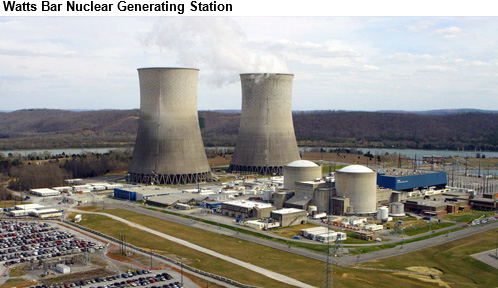
Source: Republished with permission from the Tennessee Valley Authority
The Tennessee Valley Authority’s (TVA) Watts Bar Unit 2 was connected to the power grid on June 3, becoming the first nuclear power plant to come online since 1996, when Watts Bar Unit 1 started operations. Watts Bar Unit 2 is undergoing final testing, producing electricity at incremental levels of power, as TVA prepares to start commercial operation later this summer. The new reactor is designed to add 1,150 megawatts (MW) of electricity generating capacity to southeastern Tennessee.
Watts Bar Unit 2 is the first nuclear plant in the United States to meet new regulations from the U.S. Nuclear Regulatory Commission (NRC) that were established after the 2011 earthquake and tsunami that damaged the Fukushima Daiichi Nuclear Plant in Japan. After the NRC issued an operating license for the unit in October 2015, 193 new fuel assemblies were loaded into the reactor vessel the following month. TVA announced at the end of May that the reactor achieved its first sustained nuclear fission reaction.
Construction on Watts Bar Unit 2 originally began in 1973, but construction was halted in 1985 after the NRC identified weaknesses in TVA’s nuclear program. In August 2007, the TVA board of directors authorized the completion of Watts Bar Unit 2, and construction started in October 2007. At that time, a study found Unit 2 to be effectively 60% complete with $1.7 billion invested. The study said the plant could be finished in five years at an additional cost of $2.5 billion. However, both the timeline and cost estimate developed in 2007 proved to be overly optimistic, as construction was not completed until 2015, and costs ultimately totaled $4.7 billion.
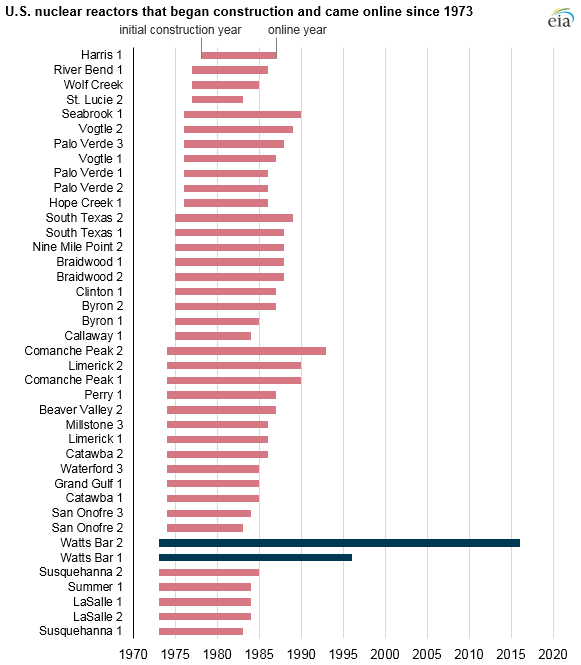
Source: U.S. Energy Information Administration, based on the International Atomic Energy Agency’s Power Reactor Information System
Although Watts Bar 2 is the first new U.S. nuclear generator to come online in 20 years, four other reactors are currently under construction and are expected to join the nuclear fleet within the next four years. Vogtle Electric Generating Plant Units 3 and 4 in Georgia and Virgil C. Summer Nuclear Generating Station Units 2 and 3 in South Carolina are scheduled to become operational in 2019–20, adding 4,540 MW of generation capacity.
39 Comments on "First New U.S. Nuclear Reactor in Almost Two Decades Set to Begin Operating"
Bob Owens on Wed, 15th Jun 2016 1:01 pm
This nuke plant took 40 years to construct with huge cost over-runs. Compare this to a wind/solar plant that can be completed in 3 years with no cost over-runs and no fuel costs, no water cooling, no radiation, no insurance problems, quiet and robust, easy to maintain, upgrade. Which one do you want to build? Solar, even with battery/salt storage, would be cheap at twice the price. Wake up America!
Go Speed Racer on Wed, 15th Jun 2016 1:08 pm
Big reactor, will be big meltdown. Buy iodine pills.
penury on Wed, 15th Jun 2016 1:47 pm
With all the evidence of the danger to life on the planet from “Nuclear” humans continue to demand “moar”. We will never be satisfied, never. However, each little “accident” draws the end stage closer. And we (the humans) will not be saved by sun or wind or water or the arrival of the aliens. It matters not if you believe in one of the thirty five only gods or not humans are going away.
ghung on Wed, 15th Jun 2016 1:54 pm
Right, Bob. Nothing “new” about this reactor. The only new reactors in the US will be the two AP1000 units being constructed at Plant Vogtle in Georgia, currently seriously over budget and behind schedule. Imagine that. Glad I’m not a gridweenie.
PracticalMaina on Wed, 15th Jun 2016 1:59 pm
Only 40 years getting to the point on a return on investment. Wooo!
PracticalMaina on Wed, 15th Jun 2016 2:03 pm
and by point of return i mean see a cent of the billions laid out
Plantagenet on Wed, 15th Jun 2016 2:23 pm
Hopefully this will be last nuke built in the US.
On to solar and wind!
Cheers!
yellowcanoe on Wed, 15th Jun 2016 2:43 pm
The high cost of building or refurbishing nuclear plants is offset by the fact that they produce a large amount of power 24/7 and have lower fuel costs than fossil fuel powered plants. Despite an investment of billions in refurbishing reactors at the Bruce and Pickering sites in Ontario, nuclear continues to be cheaper than power from solar, wind or natural gas. Use of coal generation in Ontario was phased out two years ago and that was largely due to putting some reactors back into service. Ontario Power Generation are about to start a refurbishment of the four reactors at Darlington. This is major project that has been years in the making with an estimated cost of $10 billion US. Preparations for the refurbishment included the construction of a full size mock up of a reactor so all procedures can be tested before the actual refurbishment begins. The project will extend the life of this 3600MW facility for another 30 years.
shortonoil on Wed, 15th Jun 2016 2:49 pm
1,150 MW per year is equal to 24.36 mb, or $193/barrel. Since 85% of all life time operational costs of a nuke are up front cost, over the 40 year life time of the plant, that averages out to $4.10/ barrel. What this does not include is the decommissioning costs of the plant after its 40 year service life. If this turns out like Fukishima, at an estimated $5 trillion, that turns out to be $5,131 per barrel.
What a deal! Bet they sold this to Washington along with a few more $27,000 toilet seats.
jjhman on Wed, 15th Jun 2016 3:29 pm
This plant is a 1960s design PWR. I think it is the same design used on 3 mile island.
An interesting note at the Wiki article: the govt has piggy backed on the electric generation the generation of tritium for use in nuclear weapons.
This is the way the world ends
This is the way the world ends
This is the way the world ends
Not with a bang but a whimper
Davy on Wed, 15th Jun 2016 3:41 pm
No use crying over spilled milk let’s put it to work. It represent a huge built out fixed cost in resources along with CO2. We are going to get poor quick so anything that can mitigate that decline is an asset.
Jim Hopf on Wed, 15th Jun 2016 4:13 pm
What a mindboggling set of comments.
Even with the cost overruns, this plant will deliver power at a lower price than either solar or wind (esp. given that the wind resource is poor in that region). With storage, for renewables, it’s not even close. Only gas is cheaper than nuclear (in retrospect).
“All the evidence” is that nuclear represents a negligible “danger to life on the planet”. Fukushima, the only significant release of pollution in non-Soviet nuclear’s entire 50-year history, caused no deaths and is projected to have no measurable public health impacts. By contrast, fossil power generation causes global warming and several hundred thousand *annual* deaths.
Nuclear plant decommissioning (and waste management) costs only add a fraction of a cent to the per kW-hr price. They are a negligible fraction of overall cost. The nuclear vs. oil analysis was interesting, until the utterly comical $5 trillion assumed cost of Fukushima (the cost is ~$100 billion), along with the analysis effectively assuming that Watts Bar WILL meltdown (100% chance, for every reactor).
Almost no experts believe that getting 100% of our power from solar and wind will occur within the foreseeable future. They also agree that the main impact of less nuclear will be more fossil fuels. Therefore, having no more new reactors built is very much NOT something to hope for. Fossil fuels are thousands of times worse.
I’ll close by asking all these commenters what the reason is for their extreme nuclear hatred, and their relative LACK of concern about fossil fuels, despite the fact that fossil generation is thousands of times worse in terms of both public health risk and environmental impact.
shortonoil on Wed, 15th Jun 2016 4:26 pm
“It represent a huge built out fixed cost in resources along with CO2. We are going to get poor quick so anything that can mitigate that decline is an asset. “
The problem is that we have no way of estimating what the full life cycle cost of a disaster like Fukishima will be. This may eventually result in the complete collapse of Japan as a culture as the effects of radiation display themselves over time. It is also possible that the Northern Pacific will become a dead zone for the next few thousand years. If this winds up as bad as is possible the risk of using those assets would far exceed their value.
Simply put, this boils down to the biggest game of Russian Roulette that humanity has ever played since it began building nuclear weapons. You would think that spinning that cylinder one more time would make the average person a little nervous. Of course, the average person got invited to the game, but it was never explained to them exactly what the game entailed.
jjhman on Wed, 15th Jun 2016 4:53 pm
Jim Hopf:
” Fukushima, the only significant release of pollution in non-Soviet nuclear’s entire 50-year history, caused no deaths and is projected to have no measurable public health impacts.”
I don’t think it is clear at all what the health ramifications of the Fukushima disaster is:
http://www.reuters.com/article/us-fukushima-workers-specialreport-idUSBRE99O04320131025
Davy on Wed, 15th Jun 2016 4:53 pm
I agree short and I don’t want to see any more NUK plants built because we can’t handle what we have but we should finish what we started. My point is disaster awaits us anyhow so let’s try to lessen the crash landing. Built out NUK plants offer cheap power if you disregard decommissioning and the unknowns of disasters. The world will be closer to collapse if we shut all the NUK plants down because we don’t have that luxury anymore. We should end any new plants on the drawing board and close ones that are unsafe. All this is part of the same old catch 22 trap of modern man. Damned two times doing and dont-ing.
shortonoil on Wed, 15th Jun 2016 5:18 pm
” I don’t think it is clear at all what the health ramifications of the Fukushima disaster is: “
NASA uses it, the American Cancer Society uses it, almost every scientist in the world involved with radioactive substances uses it. The probability of developing cancer from exposure to radiation is directly proportional to the “accumulated life time dosage”.
Eastern Japan got dosed — in spades.
Does that make it a little clearer?
Anonymous on Wed, 15th Jun 2016 5:36 pm
JH believes, “Even with the cost overruns, this plant will deliver power at a lower price than either solar or wind.”
ROFL. Nookle-ar power is heavily subsidized. And nukes are so expensive its common practice in the empire to pre-bill rate-payers for electricity they haven’t even used yet, or possibly, never will in some cases. Nuke power is not ‘cheap’, it never was, never will be. Wind and Solar have virtually no externalities to speak of, and are cost-competitive-now. Nuclear, otoh, is nothing but a subsidy sink and externality farm.
http://www.indystar.com/story/news/2014/02/01/nuclear-power-project-financing-option-sticks-ratepayers-with-tab-/5092887/
Thirty years ago — the last time this question came up in Indiana — the answer was clear: The utility would swallow the cost. And it did. Public Service Indiana nearly went bankrupt in 1984 when construction costs soared to $2.5 billion at its Marble Hill Nuclear Power Station in southern Indiana. The distressed company pulled the plug. The half-built plant was later dismantled and sold for parts.
Around the country, including in Indiana, a move is growing to shift up-front costs of potential nuclear power projects from utilities to ratepayers.
In states from Florida to South Carolina, utilities can bill customers billions of dollars for engineering and construction costs — usually years before a single kilowatt hour of electricity is generated, and sometimes even if the plant is never built.
So when construction costs soar, as they often do, it’s not the utility, but homeowners, shops and steel mills that keep paying the tab.
The idea was floated here earlier this month by state Sen. James Merritt, powerful chairman of the Senate Utilities Committee.
Merritt introduced a bill that would allow utilities to build a nuclear power plant, or a new, smaller generation of nuclear generators called small modular reactors, and pass along the engineering and construction costs to customers years before the plant goes into operation.
makati1 on Wed, 15th Jun 2016 6:11 pm
A Nuclear spent fuel fire at Peach Bottom in Pennsylvania could force 18 million people to evacuate.
“[If electric power were out 12 to 31 days (depending on how hot the stored fuel was), the fuel from the reactor core cooling down in a nearby nuclear spent fuel pool could catch on fire and cause millions of flee from thousands of square miles of contaminated land, because these pools aren’t in a containment vessel.”
http://energyskeptic.com/2016/spent-fuel-fire-on-u-s-soil-could-dwarf-impact-of-fukushima/
“A major fire “could dwarf the horrific consequences of the Fukushima accident,” says Edwin Lyman, a physicist at the Union of Concerned Scientists, a nonprofit in Washington, D.C. “We’re talking about trillion-dollar consequences,” says Frank von Hippel, a nuclear security expert at Princeton University, who teamed with Princeton’s Michael Schoeppner on the modeling exercise.”
Closest Nuke to me is about 400 miles and downwind (China). I am glad I no longer live near Three Mile Island or Peach Bottom.
dave thompson on Wed, 15th Jun 2016 6:21 pm
What is the cost of spent nuke fuel storage foe tens, no hundreds of thousands of years?
shortonoil on Wed, 15th Jun 2016 6:32 pm
” What is the cost of spent nuke fuel storage foe tens, no hundreds of thousands of years? “
That is a question which has three answers:
1) I don’t know,
2) I can’t know,
3) Even if I did know, it wouldn’t make any difference.
Boat on Wed, 15th Jun 2016 7:02 pm
mak,
A Nuclear spent fuel fire at Peach Bottom in Pennsylvania could force 18 million people to evacuate.
18 million is chump change. 7 billion + carbon sinks running around. Your a doomer, think much bigger.
Go Speed Racer on Wed, 15th Jun 2016 7:03 pm
Fukushima caused no deaths? LOL.
People died of nuclear sun tan, same day. Get real. Put away the hash pipe.
Boat on Wed, 15th Jun 2016 8:50 pm
mak,
Let’s celebrate.
The U.S. wind energy industry celebrated the 10th annual Global Wind Day Wednesday by highlighting a 66% drop in the cost of wind-generated electricity in just six years.
“From the corn fields of Iowa to the windswept plains of Texas, by improving our technology and lowering wind power’s costs we’re saving you money,”
“With costs 66% cheaper than they were six years ago, wind power is on sale in the U.S. It’s a credit to American ingenuity and manufacturing. We’re celebrating Global Wind Day by sharing this good news far and wide.”
God bless American ingenuity and manufacturing.
Northwest Resident on Wed, 15th Jun 2016 9:35 pm
No worries, guys. Once we are firmly into collapse and no environmentalists are around to raise hell, they’ll simply dump whatever nuclear waste they don’t want into the Mariana Trench.
That new nuclear power plant, along with a number of others in Tennessee and surrounding states, where numerous major military bases just happen to also be located, could end up becoming the new seat of the Federal government. Sea rise is predicted to flood the current White House location one of these days, and probably not that far into the future. Anyway, once collapse gets under way, the Federal government or whatever shape that central government takes will not want to be dependent on coal or natural gas powered electricity in the Washington D.C. area. No way! The Federal government is going to bail out of D.C. and leave those suckers to fend for themselves. They’ll set up in the general location of a big cluster of nuclear reactors, hooked up to the new one no doubt, with plenty of military assets nearby. Now that this new and best-of-tech nuclear reactor is going into service, we may find out that the reason TPTB have been buying time all along is just to make sure they’ve got a long-term guaranteed source of power before the lights go out everywhere else. Pure speculation, of course.
DMyers on Wed, 15th Jun 2016 10:04 pm
It would be a safe bet that over a long course of time, the damage wrought by Fukushima will be horrific. We know the nature of the beast that escaped from F-ima. It is going to cause great harm, as any rational mind would discern.
We have to stop watching ourselves drive over a cliff and explode at the bottom while insisting that we’re probably going to be okay. [see “Groundhog Day” drive over cliff scene]
Nuclear is by far the best overall option for electrifying at current scale.
Unfortunately, due to the long time lag between a nuclear release (e.g. Fukushima) and its ultimate/total affect on the life on this planet, we go forward blindly, believing all is well. Maybe they’ll come up with a vaccine that guarantees coverage against every danger in our lives. They might even be able to raise the safe levels to where almost any level is considered safe. It will take several generations before the worst begins to emerge.
Nuclear has the most apt qualities to serve as a perfect replica for the metaphorical Pandora’s Box.
Just to throw in, there might be some concern about the placement of this plant in relation to the New Madrid fault. The NM holds a huge potential for destruction. This nuke plant exists somewhere in eastern TN. A frequent traveler of I40 from the TN border East to Nashville, I report there is a hell of a hard rock base throughout that area that will transport quake waves like copper carries electricity.
All I can say is I have the impression that a big snap on the NM fault would take this sucker down with a solid rock tsunami. That’s a “not if but when” type situation.
makati1 on Wed, 15th Jun 2016 10:58 pm
You might find this map of interest:
https://search.yahoo.com/search?fr=mcafee&type=C111US0D20151022&p=new+madrid+seismic+zone
Or this one:
https://search.yahoo.com/search?fr=mcafee&type=C111US0D20151022&p=new+madrid+seismic+zone
Anything that can make the Mississippi run backwards is not to be ignored.
simonr on Thu, 16th Jun 2016 7:09 am
There seems to be a lot of assertions on the cheapness of NUK power.
Could someone provide links to the cost per Mwh, to back this up ?
I found 60(ish) USD per Mwh. This is way higher than Gas or Coal or Wind or Hydro or Solar
makati1 on Thu, 16th Jun 2016 9:03 am
Ask the Japanese how much it costs. They are going to be paying for a long time to clean up Fukushima. Decades, if ever.
Kenz300 on Thu, 16th Jun 2016 9:12 am
Nuclear energy is toxic to people and the planet…..
7 Top NRC Experts Break Ranks to Warn of Critical Danger at Aging Nuke Plants
http://ecowatch.com/2016/03/09/nrc-experts-warn-dangers-nuclear/
Nuclear energy is too costly and too dangerous…..
How much will it cost to store nuclear waste FOREVER and who will pay for it
Kenz300 on Thu, 16th Jun 2016 9:13 am
Nuclear energy is poisoning the planet…………
5 Years After Fukushima, ‘No End in Sight’ to Ecological Fallout
http://ecowatch.com/2016/03/05/5-years-after-fukushima/
PracticalMaina on Thu, 16th Jun 2016 10:07 am
TEPCO doesn’t mind, they are probably billing Japan and grid users for the juice they are wasting trying to freeze a wall of ice in the face of radioactively heated runoff water, and salt water as well.
JuanP on Thu, 16th Jun 2016 11:36 am
Boat, If you still believe that American ingenuity and manufacturing will make any difference then you haven’t learned much in the time you’ve been here. I hope your comment was meant to be sarcastic!
Babtized on Thu, 16th Jun 2016 11:36 am
Went over Watts Bar damn last week, terrible wreck on interstate I-40 both ways closed. Anyway carrying my sport bike to the mountains to ride and get out of record braking temps. There is 36 dams in the mountains and 6-10 very large dams upstream from Watts Bar. My point is I have been riding in this area for 30+ years and have watched the lakes fill up with silt and water vegetation,(think kudzu)and the people population explode by at least 20 times, because of cheap labor. And the way dwellings have been built, you will die without air conditioning. Don’t want to be a doomer, but I felt uneasy going across that dam-nuclear plant.
JuanP on Thu, 16th Jun 2016 11:41 am
Building nuclear power plants is insane!
steveo on Thu, 16th Jun 2016 12:45 pm
The US stopped development of nuclear power technology in the 1970s, even before the Three Mile Island melt down. Had we used those 40 years to develop reactor technology that isn’t water moderated, we could have had systems operating at one atmosphere that burn 90% of the actinides instead of being pressure cooker bombs that leave 90% of their fuel in the waste stream.
The fact that we haven’t had more TMIs and Fukushimas is a testimony to how good our grandfathers with their slide rules were.
peakyeast on Thu, 16th Jun 2016 5:18 pm
When the economy gets really tough – where are the nuke people going to save money?
Maintenance and safety inspections.
Just like in Japan…
frankthetank on Thu, 16th Jun 2016 5:37 pm
Capt Ron says “We’re gonna fucking die”
Kenz300 on Fri, 17th Jun 2016 8:00 am
Wind and solar are safer, cleaner and cheaper forms of energy…………..
Solar Added More New Capacity Than Coal, Natural Gas and Nuclear Combined
http://ecowatch.com/2016/06/09/solar-new-capacity/
makati1 on Fri, 17th Jun 2016 8:09 am
Kenz, when wind and solar power more than 30% of the world, get back to me…