
Peak Oil is You

Donate Bitcoins ;-) or Paypal :-)


Page added on June 14, 2016

Peak Oil: The Next Steps Pt 3
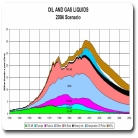
A moment’s pause to consider the practical realities of billions of others looking to improve their lifestyles on any scale by which we measure our own progress and achievements should realize immediately that a finite set of ever-more-challenging-to-acquire energy supplies needed to power those advances can only be spread so thin.
I’m fairly certain that one thing has not changed since my last post: finite resources are still finite, and that means they remain subject to the same laws regarding the consequences of depletion as was true last week.
Much of the opposition to the concept of a peak in the rate of production is based upon vague but impressive-sounding claims regarding the “potential” for one increase in production or another, usually based on the possibility of gains if certain other pieces fall into place. [If anyone is interested in more on this topic, please review any of the large number of posts from the “Peak Oil Denial” Category in the sidebar.] Making statements backed by almost no substantive discussion or explanation of mitigating factors [e.g, comments suggesting that trillions of barrels remain to be produced sounds great as long as no one explains what that would involve and thus how all but impossible it will be for any amounts anywhere close to such production totals to ever be achieved].
ADDRESSING THE FACTS
If the attempts to dispute the facts are not placed in the real-world context of increasing demand, depleting oil fields, harder-to-find-and-produce newer resources (meaning more energy being used to produce lesser amounts of inferior quality supplies), and the often-overlooked factor that many oil-exporting nations are now keeping for their own use more of their production totals, then the “potentials” lose much of their luster. So there is a reason why details tend to be omitted, apparently on the hope that pleasant-sounding generalities will suffice, as they sadly do.
Just keeping up with depletion rates still represents a net loss in production if worldwide demand increases and exports from oil-producing nations are being curtailed. And let’s also remember that all of these “new,” more expensive, energy-intensive and time-consuming efforts are taking place because there’s no place else to go. Because these enhanced efforts are more costly, energy prices have to remain high for producers to justify the time, expense, investments (financial, manpower, asset-acquisition), and efforts needed to extract these often inferior oil resources.
Important factors such as these need to be part of the information base released to the public. The failure to do so may serve the interests of some—at least in the short term, but none of those beneficiaries will include the public.
We’ll need to change those dynamics if we’re going to develop effective plans and preparations, and we’re going to need to develop effective plans and preparations. That result is much likelier if we engage that process before we have no choices left.
8 Comments on "Peak Oil: The Next Steps Pt 3"
makati1 on Tue, 14th Jun 2016 7:36 pm
Equal distribution would make a huge difference.
The US imported about 2,700,000,000 bbls of oil in 2015. (It is NOT energy independent!)
If that oil were used in the amounts the Philippines consumes per capita, it would provide an equal energy source for ~2,000,000,000 more people, or 6 times that of the US population. That does not count the oil produced in the 50 states. Just imports.
Dustin Hoffman on Tue, 14th Jun 2016 8:01 pm
Perhaps we should consider this new research
http://m.phys.org/news/2016-06-student-stunning-oil.html
The results appear to show that while production of conventional oil may slowly start to go down over the next decade, ‘unconventional’ forms (tight oil and sand oil, which are mined rather than drilled) may last until the 2040s, and shale oil until the 2070s. If more reserves of these are discovered, then oil supplies could even last beyond 2100.
Levchenko says, “When I started, I originally wanted to discuss whether an oil crisis is inevitable and to survey other potential sources of energy. This was really just a small half-semester project, and I didn’t think the work was anything special while I was doing it. I was stunned to discover that the critical moment may not arrive until 2070 at the very earliest, which would give the world much more time to develop the alternatives.”
Boat on Tue, 14th Jun 2016 11:08 pm
Dustin,
Way before the 2040s an ever increasing electric economy will have caused peak oil and will significantly eat away at oils market share of btu’s.
Shale and tar sands may not be needed in that environment since they are a higher cost producer in a shrinking market.
meld on Wed, 15th Jun 2016 4:16 am
@ Dustin
What you have just pointed out Dustin is called Peak oil. If unconventional oil may last to 2070 then that pretty much guarantees we are at peak right now. Peak oil is not running out of oil, it’s the moment the supply begins to drop exponentially and as such our economies that rely 100% on growth can no longer continue to grow. This causes mass civil unrest, systems break down and collapse. You’re watching it happen right now all around the world every day.
Davy on Wed, 15th Jun 2016 6:48 am
“Why Billions in Proven Shale Oil Reserves Suddenly Became Unproven”
http://www.bloomberg.com/news/articles/2016-06-15/shale-drillers-paper-wells-draw-sec-scrutiny-before-vanishing
“Ultra Petroleum Corp. was a shale success story. A former penny stock that made the big leagues, it was worth almost $15 billion at its 2012 peak. Then came the bust. Almost half of Ultra’s reserves were erased from its books this year. The company filed for bankruptcy on April 29 owing $3.9 billion.”
“Ultra’s rise and fall isn’t unique. Proven reserves — gas and oil resources that are among the best measures of a company’s ability to reward its shareholders and repay its debts — are disappearing across the shale patch. This year, 59 U.S. oil and gas companies deleted the equivalent of 9.2 billion barrels, more than 20 percent of their inventories, according to data compiled by Bloomberg. It’s by far the largest amount since 2009, when the Securities and Exchange Commission tweaked a rule to make it easier for producers to claim wells that wouldn’t be drilled for years.”
“There are two ways to increase reserves: buy more or find more. Fracking made it easier to do the latter, and the industry lobbied the SEC to count more undeveloped acreage as proved reserves, arguing that shale prospects are predictable across wide expanses. The SEC agreed, with two key limits. First, the wells must be profitable to drill at a price set by an SEC formula. The companies got a temporary reprieve for 2014 because the SEC number was about $95 a barrel even though crude had plummeted to less than $50 by the time results were reported in early 2015.”
Dustin Hoffman on Wed, 15th Jun 2016 8:20 am
Dear Over the Hill Gang
Please, just posted that article as an example of the misunderstanding we face regarding depletion.
Thanks for the replies…it was mostly outta fun..
A student writes a summer research paper makes a startling discovery…too much!
LOL
rockman on Wed, 15th Jun 2016 9:48 am
Dustin – To put a sharper edge to meld’s point: PO has nothing to do with either the amount of reserves left to produce or how long they might be produced. And no: a company’s proved reserves have little bearing on it’s value. I’ve bought companies off and on for more then 4 decades and the price was never based upon its reserves but on its cash flow. IOW on its PDP reserves: Proved Developed Producing reserves. And even that price doesn’t include all the PDP reserves but only those produced in the next 7 or 8 years. That’s because we use the NPV to calculater a company’s value. Using the Net Present Value (which factors in time) essentially assigns ZERO VALUE to any reserves that would be produced more then 8 years or so in the future.
But that’s how the oil patch professionals calculate value and not stock investors who base their expectations on bullish*t fed to them by the brokers…and folks like Bloomberg. LOL.
rockman on Wed, 15th Jun 2016 11:58 am
Mak – Oil is equally distrtubuted. It’s just that some of US are more equal then others. LOL.