
Peak Oil is You
Donate Bitcoins ;-) or Paypal :-)


Page added on May 20, 2016

The Other Fire: Fort McMurray’s Slow Burn
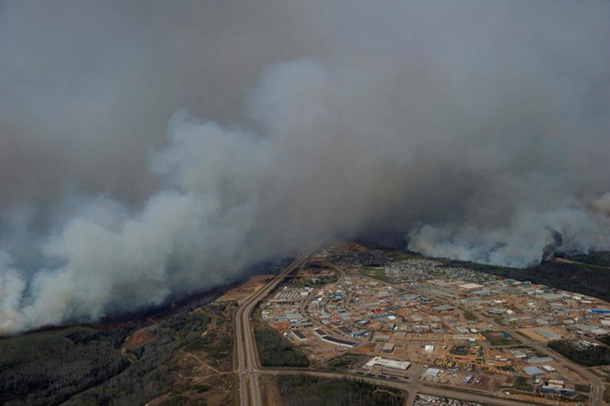
At the end of the day the $10-billion wildfire that consumed 2400 homes and buildings in Fort McMurray may be the least of the region’s problems.
Although the chaotic evacuation of 80,000 people through walls of flame will likely haunt its brave participants for years, a slow global economic burn has already taken a nasty toll on the region’s workers.
That fire began last year when global oil prices crashed by 40 percent and evaporated billions of investment capital in the tarsands.
As the project’s most hight cost producers started to bleed cash, corporations laid off 40,000 engineers, labourers, cleaners, welders, mechanics and trades people with little fanfare and even less thanks.
Many of these human “stranded assets” endured home foreclosures and lineups at the food bank.
Worker flights to Red Deer and Kelowna got cancelled and traffic at the city’s new airport declined by 16 per cent. Unemployment in Canada’s so-called economic engine soared to nearly nine percent.
Despite the high cost of the oil price crash, most residents of Fort McMurray, along with Canada’s politicians, think that oil prices will rebound and things will turn around sooner or later. They’ve seen it all before, they say.
But a number of economic trends and analyses suggest that bitumen’s glory days may be over.
Oil demand is slowing
What resembles a string of bad luck may actually be the unfortunate consequence of rapidly developing a high risk and volatile resource with no real safety net.
The first undeniable factor is weakening demand for oil, the engine of global economic growth. China’s economy, the world’s largest oil importer, is faltering as its industrial revolution peaks and fades.
Europe, Japan and the United States are also using less oil, and their economies are stagnating too.
The global economy has become so stuck in neutral that famous financial power brokers such as Larry Summers now write depressing articles entitled “The Age of Secular Stagnation,” in Foreign Affairs no less.
In such a world, little if any bitumen will be needed in the international market place. In fact economists now trace about 50 per cent of the oil price collapse to evaporating demand.
Investors fear getting burned
But there are many other potent signs and they have already covered the economic landscape with smoke.
Murray Edwards, the billionaire tycoon behind Canadian Natural Resources, one of the largest bitumen extractors, has decamped from Alberta to London, England.
Edwards and company slashed $2.4-billion from CNRL’s budget in 2015.
Since the oil price crash, by some accounts, Murray’s company has lost 50 per cent of its market value.
(Cenovus, another oilsands player, got cursed with junk bond status.)
Edwards likely has read the tea leaves and understands that bitumen might not play a significant role in the secular age of stagnation.
In fact bitumen has lost so much of its global investment lustre that, even before the Fort Mac blaze, Bloomberg reported that no new supplies of low-grade bitumen will enter the market in 2018.
This would mark the first time in more than a decade that the rate of bitumen extraction, now at 2.4 million barrels a day, will not increase.
In addition Carbon Tracker, a market friendly group, now informs investors that low oil prices will favor existing production from low carbon and low cost conventional sources.
That’s a terrible forecast for Alberta’s oilsands and its product which is neither low cost to produce nor low carbon to refine.
Sold cheap, pricey to refine
Unfortunately, there’s more reason to expect Fort McMurray’s and the oil patch to get burnt by global economic realities.
Consider the Alberta government data on the dive bombing value it places on bitumen.
The junk low-grade heavy oil or what the Koch brothers accurately call “garbage” (the right-wing billionaires remain the largest buyers of raw bitumen at their Pine Bend facility in Minnesota) is such a complicated and low-grade resource that it requires a complex methodology to grade its market value.
Bitumen might be the world’s most expensive hydrocarbon to extract out of the ground, but it remains the world’s cheapest refinery feedstock. Due to its low quality it has always sold at a discount to West Texas Intermediate.
About half of all oilsands exports — 1.2 million barrels — are raw unrefined bitumen. Unlike the Alberta government, which has rarely thought about adding value to bitumen, the Koch brothers saw an opportunity years ago.
Since the 1980s Koch Industries has been buying Canada’s bitumen crude and turning it into high value jet fuel and gasoline at their Pine Bend refinery. In fact Koch Industries now gobbles up 300,000 barrels of bitumen a day and remains the single largest buyer of Canada’s dirtiest crude. To the Kochs it’s a no brainer: bitumen offers some of the most attractive refinery margins in the world.
Up in smoke? Even before the Fort Mac blaze, Bloomberg reported that no new supplies of low-grade bitumen will enter the market in 2018. Photo of wildfires near Fort McMurray neighborhoods, May 5, 2016, Courtesy CF Operations/Handout.
With the oil price collapse the Kochs keep on making more money, while Alberta gets poorer.
In February the Alberta government set a minimum value for bitumen at $10 per cubic metre. That equates to a value of about $1.50 per barrel of bitumen.
But in 2014 the government’s monthly report valued bitumen at $421 per cubic metre. The data suggests that bitumen has lost 97 per cent of its value during the price collapse. In other words companies once worth billions are now worth millions.
Could that be why Edwards sailed to England?
A slow fire has victims, too
Last but not least comes a pithy analysis by Jeff Rubin, CIBC’s former chief economist. Rubin warns that contraction is the only future for the oilsands unless Canada wishes its economy to become “obsolete and non-competitive.”
He correctly notes that 80 per cent of the increase in new global oil did not come from OPEC but from high cost bitumen mines and fracked U.S. shale deposits.
North American corporations, in other words, engineered the global oil glut.
Encouraged by easy credit, Big Oil flooded the market with difficult and largely uneconomic hydrocarbons.
The Saudis, the world’s number one and cheapest producers, refused to scale back production or give up market share. Instead they precipitated a price free-fall.
When oil prices stood at $100, rash bitumen development made some sense. But when prices fell below $45 the gamble turned into Russian roulette.
Unlike Saudi oil, most bitumen projects require prices of at least $60 to $70 a barrel to survive.
And so most tarsands extractors (except those who own refineries) are now bleeding cash; many banks have developed nervous twitches; and thousands of workers have found themselves unemployed.
The overproduction of bitumen explains why, says Rubin, “the oilsands morphed from an engine of economic growth into the epicenter of a made-in-Canada recession.”
Canadian politicians and the media, adds Rubin, still treat the market downturn as “a largely self-correcting” oil price cycle and assume that happy days will return again.
But Rubin doubts that. As the world economy stagnates and begins to cut carbon emissions, demand for oil and its most carbon intensive products from the tarsands, Canada’s single largest source of carbon pollution, will likely shrink.
The wise course of action for Alberta and Canada, therefore, rather than being caught by surprise, would be to plan for an orderly transition that protects communities and oilsands workers, and rewards them for the economic contributions they’ve made by providing funds for retraining and industry diversification.
As Rubin argues, the tarsands can downsize today and avoid more economic pain. Or it could ignore all the smoke and global trends and wait for “massive write downs tomorrow.”
No one who has survived a horrific fire wants to hear that sort of truth. But there are nasty and dirty fires burning in the economic woods and they are now stalking a project that industry and government carelessly allowed to grow too fast and too big.
Most Albertans and most Fort McMurray residents never wanted reckless growth. In a heartbeat they would have voted to slow down the tarsands years ago with higher royalties and better regulations, but their political masters refused to put on the brakes.
Ironically enough, only a wildfire has been able to do that.
17 Comments on "The Other Fire: Fort McMurray’s Slow Burn"
penury on Fri, 20th May 2016 1:55 pm
It is possible that this is the signal that people have been waiting for: growth is over, prepare for the unwind.
yellowcanoe on Fri, 20th May 2016 2:52 pm
Companies were walking away from the tar sands prior to the sharp drop in oil prices. Costs were rising at a fairly steep rate and some companies correctly concluded that there was too much risk associated with doing a tar sands project. Even when oil prices recover, I think oil companies will still be reluctant to invest there.
Apneaman on Fri, 20th May 2016 4:29 pm
We need to burn more fossil carbon for as long as we can and it will ensure, without any doubt, to solve every human problem that ever existed. No human will ever feel pain or suffering again. Go cancer go.
Wet Bulb Near 35 C — Heatwave Mass Casualties Strike India Amidst Never-Before-Seen High Temperatures
“And it is in this newly dangerous climate context that temperatures near 125 degrees Fahrenheit settled in over India’s border region with Pakistan yesterday. A blistering wave of crippling heat hitting never-before-seen readings over that highly-populated nation. In Phalodi, India, the mercury rocketed to 123.8 degrees Fahrenheit (51 degrees Celsius). This reading exceeded India’s previous all-time record high for any location which stood at 123.1 degrees Fahrenheit (50.6 degrees Celsius) set on May 25, 1886. Across the border in Pakistan, temperatures crossed “critical” thresholds this week, hitting 124.7 degrees Fahrenheit (51.5 degrees Celsius) Thursday in the city of Jacobabad as officials in that state issued health warnings to the public.”
“340 Heat Deaths in Dehli
Across India, the story of heat casualties was much the same. Though no official national estimate of heat related injuries or deaths has yet been given, the current heatwave and related drought is far worse than that experienced during 2015 when 2500 people lost their lives in the excessive heat. But it’s reasonable to assume that heat injuries across India now number in the tens of thousands with tragic heat deaths likely now numbering in the hundreds to thousands.”
more
https://robertscribbler.com/2016/05/20/wet-bulb-near-35-c-heatwave-mass-casualties-strike-india-amidst-never-before-seen-high-temperatures/
Apneaman on Fri, 20th May 2016 6:16 pm
The environmental damage of the Fort McMurray fire
“The Fort McMurray fire has released millions of tons of carbon into the atmosphere and destroyed natural habitats. Scientists fear it may have caused long-term damage to the surrounding boreal ecosystem ”
“We have very preliminary estimates of around 80 million tons of CO2 released,’ Werner Kurz, a forest carbon scientist at Natural Resources Canada, tells Geographical. ‘To put this into perspective, it’s equivalent to about 10 per cent of the annual emissions from all other sectors in Canada.”
“While wildfires are part of the natural cycle of boreal forests and return to one area every 80 to 200 years, it is the sheer size and heat of the Fort McMurray fire that is so damaging. ‘It’s a huge fire – it covered an area nearly twice the size of Dorset or Luxembourg,’ says John Innes, Dean at the University of British Columbia Faculty of Forestry. The blaze, nicknamed ‘the beast’, has been burning so hot that damage may have extended under the ground. ‘We saw similar scenarios with the Tasmania fires last January, which were so hot the soil burnt too,’ says Innes. If the peaty soil around Fort McMurray has burned, not only will that release more sequestered carbon, ‘it could be destroying the forest’s seed bank and tree roots, preventing regrowth.’”
more
http://geographical.co.uk/places/forests/item/1692-the-environmental-damage-of-the-fort-mcmurray-fire
Anonymous on Fri, 20th May 2016 8:51 pm
If you thought the uS controlled tar-sands were an economic black hole BEFORE this fire, what is it now? The revenue generated from the tar-mines prior to this were insufficient to pay to remediate the damage done by the tar-sand mining. And that was even when oil was @$100 a barrel. So, if the short and long term damage done by the tar-sanders cant be recouped through royalties, taxes, fees, or even economic spin-offs, how can the tar-sands be justified now? When all the extra billions in property and other losses get tallied up, one can’t help but ask;
Who is going to pay for all this?
makati1 on Fri, 20th May 2016 9:09 pm
The taxpayer… as usual.
Davy on Fri, 20th May 2016 9:20 pm
You have any better sources Anonymous for your claim that tar sands are American?
Key Companies Active in Alberta Oil Sands
http://www.iberglobal.com/files/alberta_oil_companies.pdf
Suncor Energy is a Canadian integrated energy company based in Calgary, Alberta. It specializes in production of synthetic crude from oil sands. Suncor ranks number 134 in the Forbes Global 2000 list.
Imperial Oil Limited is a Canadian petroleum company. It is Canada’s second-biggest integrated oil company. Exxon Mobil Corp. had a 69.6 percent ownership stake in the company as of December 31, 2012.
Husky Energy is an integrated energy and energy-related company that ranks among Canada’s largest petroleum companies in terms of production
Cenovus is a Canadian oil company with oil sands operations in northern Alberta
Canadian Natural Resources Limited, or CNRL or Canadian Natural, is an oil and gas exploration, development and production company with its corporate head office in Calgary, Alberta.
Encana Corporation produces, transports and markets natural gas, oil and natural gas liquids. It was formed in 2002 and descends from the 19th century Canadian Pacific Railway and ‘Canadian Pacific Oil and Gas’ in the 20th century, respectively.
Talisman Energy Inc. was a Canadian multinational oil and gas exploration and production company headquartered in Calgary, Alberta. It was one of Canada’s largest independent oil and gas companies, and was formerly known as BP Canada Ltd.
Nexen-CNOOC Ltd. Nexen is a wholly-owned subsidiary of a Chinese CNOOC Limited.
Harvest Operations Corp. is a wholly-owned subsidiary of Korea National Oil Corporation (KNOC).
Canadian Oil Sands Limited is a Canadian company with headquarters in Calgary, Alberta.
eugene on Fri, 20th May 2016 9:45 pm
I figure, in the end, we’ll burn it all. There’ll be lots of chatter but it’s all endless BS as we haven’t a clue what the future brings. With world population increasing by 1.5 million a week, how long will demand stay down. We have come to depend on our lifestyle to fill emotional needs. As my neighbor says “if I can’t keep what I’ve worked for, life has been worthless”. Making a living has come to mean nothing, it’s what I have that gives life meaning.
So we can rant about whatever and that’s what comments on blogs are, rants about really nothing. Stagnation means ever increasing millions jobless and hungry. How long does anyone think that will work? It’s an endless treadmill of ever more to fill our meaningless lives. This is not going to end well regardless.
Anonymous on Fri, 20th May 2016 10:22 pm
http://business.financialpost.com/news/majority-of-oil-sands-ownership-and-profits-are-foreign-says-analysis
“Some notably Canadian oil companies, such as Suncor, Canadian Oil Sands and Husky, are predominantly owned by non-Canadians,” said the report. “The data also shows us that more than half of Canada’s oil and gas revenue goes to foreign entities.”
Keep trying, maybe one day you’ll know what the fook yer talk’n bout there yankee.
Apneaman on Fri, 20th May 2016 10:50 pm
eugene, yabut ranting brings great meaning to my life and makes me feel all warm N fuzzy inside. I luvs me a good rant and sometimes I even mean it…..sort of.
I agree with meaningless lives for the most part – still have family and friends and that matters, but the society were trapped in is the biggest, phoniest piece of shit in the history of civilization regardless of how soft it is physically and all the cool toys. It sucks the soul out of humans. Take America as the worst basket case scenario. Take all the people that are self medicating with alcohol, crack, meth, heroin, pot, bath salts, ketamine, gambling, over eating, compulsive shopping, etc, then add in all the people who are corporate medicated with anti depressants, anti anxiety’s, anti psychotics, and 80% of the worlds prescription narcotics – what percent of the population is that? Whatever it is it’s a shit load of unhappy people with meaningless lives. This is the byproduct of our neo liberal religion. Not all that different where I live or in Britain or everywhere they worship this sick inhumane arrangement. The corporate state is our dealer. We’re nothing but externalities.
One of my favorite Americans (I love Americans btw) Sheldon Solomon said:
“America is a petri dish of psychopathology”
If you’re not familiar with him check him out. He’s an original and a great thinker IMO.
Afraid of the Dark: Humanity at the Crossroads | Sheldon Solomon
https://www.youtube.com/watch?v=wuJhD5TkX-0
makati1 on Fri, 20th May 2016 11:00 pm
We have what we carry with us. Our memories, skills and education. We have what ever our body’s condition is at the moment. Some of us also volunteer to carry the baggage of bullshit we are fed daily all of our lives by TPTB. THAT is all we truly own and then only until death takes it all.
If you cannot walk away from everything else, you are a slave. If it takes externalities to make you happy or feel safe, you are a slave. Most Westerners are slaves and most do not even know it. That is the best kind of slavery as far as the powers that be are concerned. Self slavery.
Apneaman on Sat, 21st May 2016 1:08 am
Canada wildfire raging in Alberta has spread from Fort McMurray into Saskatchewan
http://www.telegraph.co.uk/news/2016/05/20/canada-wildfire-raging-in-alberta-has-spread-from-fort-mcmurray/
Davy on Sat, 21st May 2016 5:50 am
Anonymous, you didn’t answer the fookin question dumbass. WhoTF are the predominate owners? How is this an American thAng? We know Exon owns some of Imperial but the rest have a variety of owners including the Asians. Try to be accurate if you are going to be anti-American. It makes you look sloppy.
http://business.financialpost.com/news/majority-of-oil-sands-ownership-and-profits-are-foreign-says-analysis
http://www.iberglobal.com/files/alberta_oil_companies.pdf
Trevor on Sat, 21st May 2016 5:50 am
“The Saudis, the world’s number one and cheapest producers, refused to scale back production or give up market share. Instead they precipitated a price free-fall.”
Wrong. The US and Canada precipitated the free fall by dramatically increasing production. In any market, if there is too much production and prices fall it is the more expensive production that scales back. It is not up to the low cost producers to bale out the high cost producers.
Davy on Sat, 21st May 2016 6:05 am
If we look at the numbers of Americans on drugs, alcohol, and psychiatric drug use we see the numbers are not as horrible as the anti-Americans want to paint. Is there a substance use issue, absolutely, is it as bad as the anti-Americans say, no. There is 10% of Americans with an alcohol problem. There is a 9.4% with a drug problem. There are 20% who are on psychiatric drugs. The anti-Americans want to always show the nasty numbers but there is another side to the US and that side is normal.
Most Americans Drink Less Alcohol Than You Think
According to statistics from the National Epidemiological Survey on Alcohol and Related Conditions (NESARC), 30% of American adults don’t consume alcohol. Of those that do drink, the median number of drinks per week is three. The mean average is misleading because the actual data is very lopsided: the top 10% of Americans drink on average 74 alcoholic drinks per week–over 10 a day. This means that many Americans drink little or nothing, but those folks on the high end of the spectrum often binge drink and hit the bottle–or can–hard. In 2013, 43.6% of Americans over age 18 reported drinking no alcoholic beverages in the past month, according to NESARC data. Furthermore, 29.3% drank no alcohol in the past year.
http://www.healthyplace.com/blogs/debunkingaddiction/2015/04/many-americans-dont-drink-alcohol/
Illicit Drug Use*
Illicit drug use in the United States has been increasing. In 2013, an estimated 24.6 million Americans aged 12 or older—9.4 percent of the population—had used an illicit drug in the past month. This number is up from 8.3 percent in 2002. The increase mostly reflects a recent rise in use of marijuana, the most commonly used illicit drug. Graph of past-month illicit drug use in 2013. Numbers in Millions. Illicit drugs 24.6, marijuana 19.8, Prescription drugs 6.5, cocaine 1.5, hallucinogens 1.3, inhalants 0.5, heroin 0.3
https://www.drugabuse.gov/publications/drugfacts/nationwide-trends
November 17, 2011 — A new report shows that 1 in 5 adult Americans took at least 1 psychiatric medication in 2010.
http://www.medscape.com/viewarticle/753789
Davy on Sat, 21st May 2016 9:41 am
http://planetfreewill.com/2016/05/20/portland-school-board-bans-climate-change-denying-literature/
Kenz300 on Sun, 22nd May 2016 4:44 am
High cost producers……..Canadian tar sands………if not for their deep pockets they would have been shut down long ago…………