


We owe to Kennet Boulding the concept that “Anyone who believes exponential growth can go on forever in a finite world is either a madman or an economist.” And we call the end of this impossible growth a condition of “no growth”, “zero growth” or “stable state.” Many people argue that such a condition is not only necessary because of physical reasons, but it is also a good condition to be in.
In practice, we don’t know what a true “zero-growth” society could be, simply because it has never existed in the modern Western World. The only hint we can find on how such a society could be is from history. Probably the best example of such a society, close in time and very well known, is Japan during the Edo Period, that historians place between 1603 and 1868.
We have no data about Edo Japan that we could compare to our modern concept of “Gross Domestic Product,” which is at the basis of our idea of “economic growth”. However, we have good data about the population of that time and there is no doubt that it remained nearly stable during the whole period. We also know that the extent of cultivated land in Japan didn’t vary over almost one century and a half, from 1720 to 1874 (source). The large cities, such as Edo (the modern Tokyo) grew during this period, but that can only be the result of people moving away from smaller cities or from the countryside. Overall, I think we can say that, for some two centuries, Edo Japan was as close to a “zero-growth” society as we can imagine one.
So how was life in a zero-growth society? Clearly, Edo Japan very different than our society. The large majority of the people (around 90% of the population) were peasants living in country villages. On the other side of the social spectrum, there was the elite, the warrior class who ruled the country with an iron hand and meted harsh punishment to the smallest sign of disobedience. There was no such a thing as “democracy”, to say nothing about concepts such as “personal freedom”, “human rights,” or “social security.”
But it would be wrong to dismiss Edo Japan as a harsh dictatorship of no interest for us. In between the peasants and the warriors, there were people whom we could identify as close to our concept of “middle class:” craftsmen and merchants. These people were not rich, but they seem to have been reasonably free of worries about near-term survival. And they seem to have been thriving. Basically, as long as they didn’t attempt to rebel against the ruling class, they were left in peace by the government. This sector of the Japanese society was lively and innovative. Edo Japan was a country of artists and of master craftsmen in all fields: the Japanese were very advanced in technologies from metallurgy to paper-making, and they created a culture that we still know and admire today: from poets such as Matsuo Basho to painters such as Hokusai and Hiroshige.
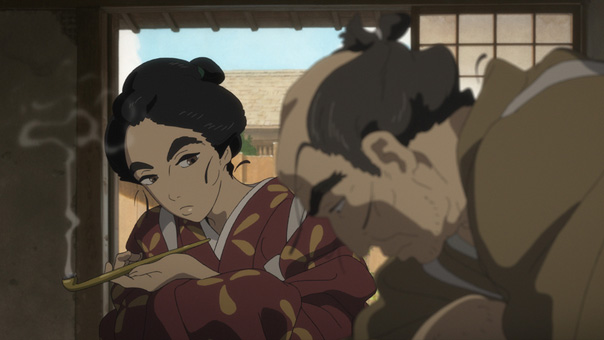
Today, we have a large number of fiction works, from Manga to Samurai movies, that try to convey something of a period that, evidently, modern Japanese still remember very well and, probably, with a certain degree of nostalgy. From all these works, we can have a visual impression of what it could have been to live in Edo Japan as a member of the craftsmen or merchant class. And the impression is that, yes, so many things were different but, maybe, not so much. Everywhere and at all times, people face the same troubles, challenges, and opportunities. So, the “middle class” of Edo Japan lived in a simple world, dressed in simple but elegant cotton kimonos, their only drink was sake, and wherever they wanted to go, they had to walk there on their own feet. But they seemed to be able to live a fulfilling life. They enjoyed nature, poetry, literature, music, and each other’s company. Not even their oppressive government could take that away from them.
The movie “Miss Hokusai” is an especially good portrait of life in Edo Japan, showing a great attention to the details of everyday life. It is a delicate and beautiful movie, centered on the life of O-Ei, the daughter of the famous painter Hokusai. It has no great dramas nor scenes of battles or fights (although it does have quite a bit of supernatural hints). But it is an unforgettable portrait of human life that transcends its historical setting and tells us something of what it means to be human anywhere in the world.
We cannot say if in the future we will be able to attain a global “zero-growth” society as Japan did during the Edo Period. Maybe empires will continue to grow and fall as they have done during the past millennia. Or, maybe, we will be able to create a worldwide stable society that might look like ancient Japan. Will it have to be a harsh dictatorship as it was then? We cannot say for sure, although is at least possible that, in order to maintain stability, it is necessary to block social mobility and to suppress every attempt of rebellion. But, in any case, nothing can stop human beings from being human. The future remains open and it will be what we will want it to be.
JuanP on Mon, 18th Apr 2016 5:13 pm
Ugo is losing it. The future will be what we want it to be? Who is we? There is no we.
Plantagenet on Mon, 18th Apr 2016 5:44 pm
Ugo has a point. Feudal Japan WAS self-sufficient, used no fossil fuels, and had a highly cultured and sophisticated society.
Some people fantasize that the world will go back to the stone age after the oil age—Ugo is saying that is wrong—the future may look more like feudal Japan.
Cheers!
Boat on Mon, 18th Apr 2016 6:01 pm
zero-negative growth
Tv, cheaper and uses less energy.
Hybrid cars, use less energy.
Zero energy homes use net less energy
Regulation for vampire energy. Much of the tech is there.
Economies wont die with no growth, just evolve.
makati1 on Mon, 18th Apr 2016 6:56 pm
JuanP, the rah-rah crowd have nowhere to go these days. So many dreamers, so little time. Perfect example: the two commenters following yours. LOL
makati1 on Mon, 18th Apr 2016 6:58 pm
As for “steady state”, that is another dream. We are sliding down the slope to a subsistence, or maybe a bare survival, level, not any form of “economy”.
sparky on Mon, 18th Apr 2016 7:11 pm
.
Prior to the 10 of January 1709 when the first blast furnace was brought on line at Coalbrookdale , using charred coal ,
all societies were “steady state”
Medieval and Renaissance Europe , the Romans , Persians and Chinese are example of this .
Any increase in “GDP” was due to population growth ,territorial expansion or some new technology .
wind mills ,the Iron plow ,better sailing ships etc etc
the introduction of new foodstuffs such as the potato made marginal farming land able to support a great increase in population leading to the local rulers of Russia or Prussia achieving greater territorial power.
There were always setback , cities were a sink for rural population surplus ,
the poors starved first and were decimated by diseases or/and famines .
On an average year , life wasn’t too bad for most ,but it always was a very conservative society , learning was restricted and the prime use of power was cheap human labor
dave thompson on Mon, 18th Apr 2016 7:17 pm
Where in the cartoon world of the anime do nukes like fukushima fit in?
Daniel in KC on Mon, 18th Apr 2016 7:54 pm
Makati1 – Do a little research, Ugo Bardi can’t exactly be called part of the ‘rah rah’ crowd.
makati1 on Mon, 18th Apr 2016 8:34 pm
Dan, been reading him for years. And I stand by my over-time observations.
thylacine on Mon, 18th Apr 2016 8:37 pm
So things weren’t too bad for the 10% who were craftsmen or merchants. Pop down in the morning to check that everything’s OK at the samurai sword workshop, then home for a bit of sushi, a cup of sake and then some light calligraphy in the afternoon? Great, where do I sign up? The real question is what was life like for the serfs/peasants. That’s where most of us would be headed ultimately in a zero growth economy. Short, hard lives, ruled by tyrants – less appealing.
Davy on Tue, 19th Apr 2016 7:24 am
Ugo is probably suffering from wishful thinking of salvation smart people get when addressing doom. He may be also appealing to his sheeple readers that have wishful thinking syndrome. We are going to have “zero-growth” but it is going to be more than that. We are going to drop to a much lower level of human activity. This drop will vary greatly over time and place but in the end it will be the end of globalism.
The degree of connection you and yours have to globalism will dictate how far you fall. If you are a 1%er in the Hamptons than you best get started on that parachute. The drop for you will be blistering. Some will prep and maybe do well but most will crash and burn bad. If you are a poor family like some that live around me here in the depressed Ozarks the fall will be less. Everyone is at risk of starvation at all levels poor and rich. There is no generalized safety. Each and every class, race, and nation is at risk.
This generalization winds down to the local and the lucky ones if you will survive. We know those locals most at risk. That is a no-brainer. If you are in one of those exposed location get the hell out and quick. You have just a few years maybe months. The longer you wait the worse it gets until it is probably best to stay put. This is much like an approaching hurricane you have an evacuation window.
We just don’t know when all this is going to shake out and we don’t know where we are going to land. There is just too many possibilities. Any efforts are a gamble. Ugo is right on the “future remains open” but his emphasis on optimism is the problem. The future is open to an abyss of uncertainty and collapse. There is no sugar coating this.
We often want to appeal to that specialness of humans but that specialness is an evolutionary dead end of being unable to resist the temptation of opening doors. Humans want to believe they can pass through doors then go back through bad doors. Guaranteed happy ending are part of a big brains ability to fantasy. This is why Hollywood was such a success. We are going to have to pay a price for what we have done. This is the natural process of our Earth ecosystem. Why should humans be any different? All species play this game we are no different.
At the micro and personal level you have some options for the remaining time you have left above ground. You have doors to open or not. Stay put or make alternative arrangements either with lifestyle and or location. Anything you do at this point is a gamble. What is certain is globalism is on a trajectory of collapse with nothing to stop it. ALL locals have been delocalized and dependent on an overextended global system. Some locals are worse than others but ALL are exposed. At every level of analysis this is plain to see we just choose to believe we can overcome yet another problem. It is over for our modern man but you can make a difference for yourself in the short time you have left as an organism in nature’s earth ecosystem.
Apneaman on Tue, 19th Apr 2016 5:06 pm
Steadily deteriorating.
The Secret Shame of Middle-Class Americans
Nearly half of Americans would have trouble finding $400 to pay for an emergency. I’m one of them.
http://www.theatlantic.com/magazine/archive/2016/05/my-secret-shame/476415/?google_editors_picks=true
Apneaman on Tue, 19th Apr 2016 5:07 pm
U.S. Senate hearing on our aging water infrastructure
“Even though conventional oil production has been on a plateau since 2005, there is no sense of alarm or urgency to try to fix infrastructure before oil is rationed and not enough exists to replace or repair it. Some day people will ask why energy was used to build skyscrapers, keep roads smooth as a babies bottom in the empty deserts of Nevada, and a million other non-essential uses, instead of fixing dams and replacing century old water delivery systems. After all, if our hydroelectric dams fall apart, there won’t be any electricity to power the elevators in Trump towers, without water delivery systems we’ll all be drinking lead, giardia and cholera laced water, grow less food as irrigation systems fall apart, be unable to transport goods on inland rivers as locks fail, be unable to cool power plants and have to shut them down, or treat and get rid of sewage wastes.”
http://energyskeptic.com/2016/aging-water-infrastructure-united-states/
makati1 on Tue, 19th Apr 2016 6:13 pm
Fukushima coming to your neighborhood …
“Thousands of gallons of radioactive waste leaked from the Hanford Nuclear Reservation Site in Washington State, as workers pumped sludge from the tank during the weekend. “This is catastrophic. This is probably the biggest event to ever happen in tank farm history. The double shell tanks were supposed to be the saviors of all saviors (to hold waste safely from people and the environment),” said former Hanford worker Mike Geffre.”
http://www.zerohedge.com/news/2016-04-19/catastrophic-thousands-gallons-radioactive-waste-leak-washington-nuclear-storage-sit
How many more are crumbling with old age? Where is the closest one to where YOU live? Up river? Up wind? Next door?
Davy on Wed, 20th Apr 2016 6:08 am
China, the middle kingdom of bubbles and bad debt.
“Swimming Naked” – Chinese Corporate Bond Market Worst Since 2003”
http://www.zerohedge.com/news/2016-04-19/swimming-naked-chinese-corporate-bond-market-worst-2003
“A week ago we highlight the “last bubble standing” was finally bursting, and as China’s corporate bond bubble deflates rapidly, it appears investors are catching on to the contagion possibilities this may involve as one analyst warns “the cost has built up in the form of corporate credit risks and bank risks for the whole economy.” As Bloomberg reports, local issuers have canceled 61.9 billion yuan ($9.6 billion) of bond sales in April alone, and Standard & Poor’s is cutting its assessment of Chinese firms at a pace unseen since 2003. Simply put, the unprecedented boom in China’s $3 trillion corporate bond market is starting to unravel.”
Davy on Wed, 20th Apr 2016 9:34 am
Systematic extremes and minimum operating levels of our financial system are prime indicators of an economic collapse process.
http://www.zerohedge.com/news/2016-04-20/how-systems-break-first-they-slow-down