
Peak Oil is You

Donate Bitcoins ;-) or Paypal :-)


Page added on March 3, 2016

Why Globalization Reaches Limits

We have been living in a world of rapid globalization, but this is not a condition that we can expect to continue indefinitely.
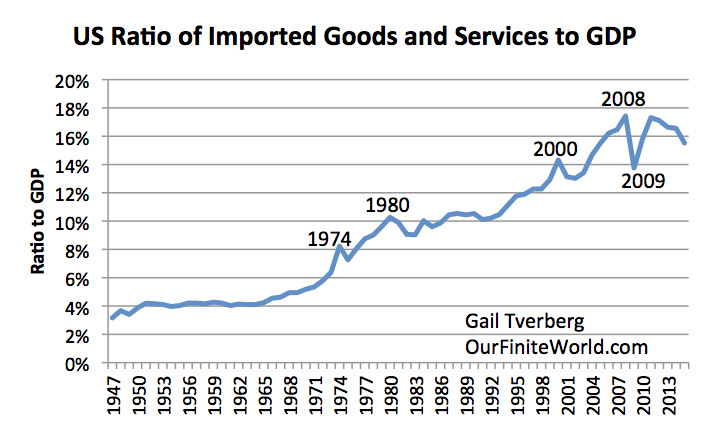
Figure 1. Ratio of Imported Goods and Services to GDP. Based in FRED data for IMPGS.
Each time imported goods and services start to surge as a percentage of GDP, these imports seem to be cut back, generally in a recession. The rising cost of the imports seems to have an adverse impact on the economy. (The imports I am showing are gross imports, rather than imports net of exports. I am using gross imports, because US exports tend to be of a different nature than US imports. US imports include many labor-intensive products, while exports tend to be goods such as agricultural goods and movie films that do not require much US labor.)
Recently, US imports seem to be down. Part of this reflects the impact of surging US oil production, and because of this, a declining need for oil imports. Figure 2 shows the impact of removing oil imports from the amounts shown on Figure 1.
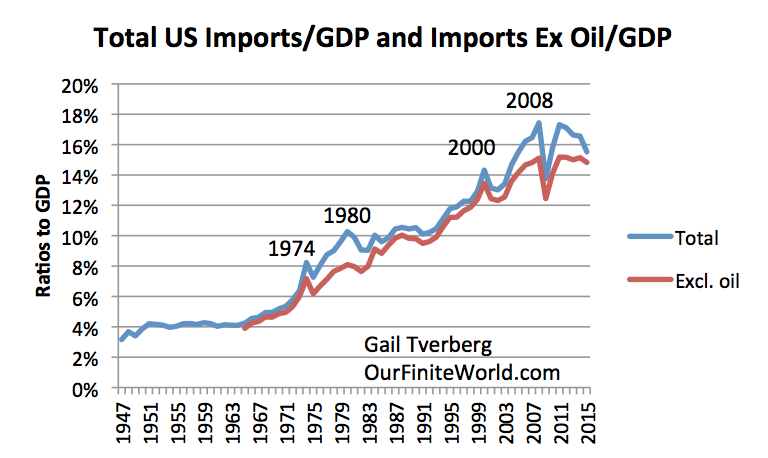
Figure 2. Total US Imports of Goods and Services, and this total excluding crude oil imports, both as a ratio to GDP. Crude oil imports from https://www.census.gov/foreign-trade/statistics/historical/petr.pdf
If we look at the years from 2008 to the present, there was clearly a big dip in imports at the time of the Great Recession. Apart from that dip, US imports have barely kept up with GDP growth since 2008.
Let’s think about the situation from the point of view of developing nations, wanting to increase the amount of goods they sell to the US. As long as US imports were growing rapidly, then the demand for the goods and services these developing nations were trying to sell would be growing rapidly. But once US imports flattened out as a percentage of GDP, then it became much harder for developing nations to “grow” their exports to the US.
I have not done an extensive analysis outside the US, but based on the recent slow economic growth patterns for Japan and Europe, I would expect that import growth for these areas to be slowing as well. In fact, data from the World Trade Organization for Japan, France, Italy, Sweden, Spain, and the United Kingdom seem to show a recent slowdown in imported goods for these countries as well.
If this lack of demand growth by a number of industrialized countries continues, it will tend to seriously slow export growth for developing countries.
Where Does Demand for Imports Come From?
Many of the goods and services we import have an adverse impact on US wages. For example, if we import clothing, toys, and furniture, these imports directly remove US jobs making similar goods here. Similarly, programming jobs and call center jobs outsourced to lower cost nations reduce the number of jobs available in the US. When US oil prices rose in the 1970s, we started importing compact cars from Japan. Substituting Japanese-made cars for American-made cars also led to a loss of US jobs.
Even if a job isn’t directly lost, the competition with low wage nations tends to hold down wages. Over time, US wages have tended to fall as a percentage of GDP.
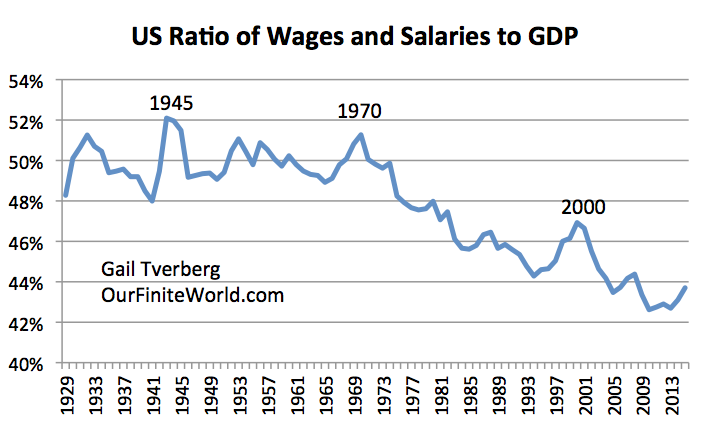
Figure 3. Ratio of US Wages and Salaries to GDP, based on information of the US Bureau of Economic Analysis.
Another phenomenon that has tended to occur is greater disparity of wages. Partly this disparity represents wage pressure on individuals doing jobs that could easily be outsourced to a lower-wage country. Also, executive salaries tend to rise, as companies become more international in scope. As a result, earnings for the top 10% have tended to increase since 1981, while wages for the bottom 90% have stagnated.
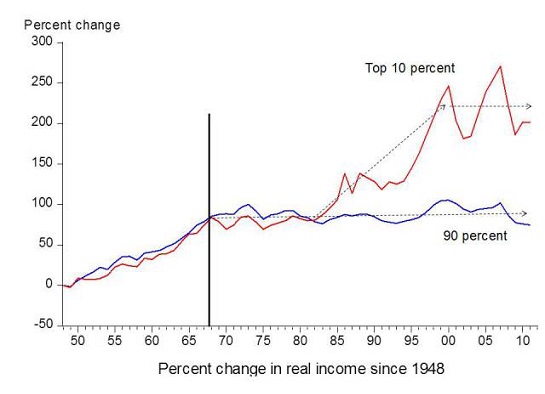
Figure 4. Chart by economist Emmanuel Saez based on an analysis of IRS data, published in Forbes. “Real income” is inflation-adjusted income.
If wages of most workers are lagging behind, how is it possible to afford increased imports? I would argue that what has happened in practice is greater and greater use of debt. If wages of American workers had been rising rapidly, perhaps these higher wages could have enabled workers to afford the increased quantity of imported goods. With wages lagging behind, growing debt has been used as a way of affording imported goods and services.
Inasmuch as the US dollar was the world’s reserve currency, this increase in debt did not have a seriously adverse impact on the economy. In fact, back when oil prices were higher than they are today, petrodollar recycling helped maintain demand for US Treasuries as the US borrowed increasing amounts of money to purchase oil and other goods. This process helped keep borrowing costs low for the US.

Figure 5. US Increase in Debt as Ratio to GDP and US imports as Ratio to GDP. Both from FRED data: TSMDO and IMPGS.
The problem, however, is that at some point it becomes impossible to raise the debt level further. The ratio of debt to GDP becomes unmanageable. Consumers, because their wages have been held down by competition with wages around the world, cannot afford to keep adding more debt. Businesses find that slow wage growth in the US holds down demand. Because of this slow growth in the demand, businesses don’t need much additional debt to expand their businesses either.
Commodity Prices Are Extremely Sensitive to Lack of Demand
Commodities, by their nature, are things we use a lot of. It is usually difficult to store very much of these commodities. As a result, it is easy for supply and demand to get out of balance. Because of this, prices swing widely.
Demand is really a measure of affordability. If wages are lagging behind, then an increase in debt (for example, to buy a new house or a new car) can substitute for a lack of savings from wages. Unfortunately, such increases in debt have not been happening recently. We saw in Figure 5, above, that recent growth in US debt is lagging behind. If very many countries find themselves with wages rising slowly, and debt is not rising much either, then it is easy for commodity demand to fall behind supply. In such a case, prices of commodities will tend to fall behind the cost of production–exactly the problem the world has been experiencing recently. The problem started as early as 2012, but has been especially bad in the past year.
The way the governments of several countries have tried to fix stagnating economic growth is through a program called Quantitative Easing (QE). This program produces very low interest rates. Unfortunately, QE doesn’t really work as intended for commodities. QE tends to increase the supply of commodities, but it does not increase the demand for commodities.
The reason QE increases the supply of commodities is because yield-starved investors are willing to pour large amounts of capital into projects, in the hope that commodity prices will rise high enough that investments will be profitable–in other words, that investments in shares of stock will be profitable and also that debt can be repaid with interest. A major example of this push for production after QE started in 2008 is the rapid growth in US “liquids” production, thanks in large part to extraction from shale formations.

Figure 6. US oil and other liquids production, based on EIA data. Available data is through November, but amount shown is estimate of full year.
As we saw in Figure 5, the ultra-low interest rates have not been successful in encouraging new debt in general. These low rates also haven’t been successful in increasing US capital expenditures (Figure 7). In fact, even with all of the recent shale investment, capital investment remains low relative to what we would expect based on past investment patterns.

Figure 7. US Fixed Investment (Factories, Equipment, Schools, Roads) Excluding Consumer Durables as Ratio to GDP, based on US Bureau of Economic Analysis data.
Instead, the low wages that result from globalization, without huge increases in debt, make it difficult to keep commodity prices up high enough. Workers, with low wages, delay starting their own households, so they have no need for a separate apartment or house. They may also be able to share a vehicle with other family members. Because of the mismatch between supply and demand, commodity prices of many kinds have been falling. Oil prices, shown on Figure 9, have been down, but prices for coal, natural gas, and LNG are also down. Oil supply is up a little on a world basis, but not by an amount that would have been difficult to absorb in the 1960s and 1970s, when prices were much lower.

Figure 9. World oil production and price. Production is based on BP, plus author’s estimate for 2016. Historical oil prices are calculated based on a higher than usual recent inflation rate, assuming Shadowstats’ view of inflation is correct.
Developing Countries Are Often Commodity Exporters
Developing countries can be greatly affected if commodity prices are low, because they are often commodity exporters. One problem is obviously the cutback in wages, if it becomes necessary to reduce commodity production. A second problem relates to the tax revenue that these exports generate. Without this revenue, it is often necessary to cut back funding for programs such as building roads and schools. This leads to even more job loss elsewhere in the economy. The combination of wage loss and tax loss may make it difficult to repay loans.
Obviously, if low commodity prices persist, this is another limit to globalization.
Conclusion
We have identified two different limits to globalization. One of them has to do with limits on the amount of goods and services that developed countries can absorb before those imports unduly disrupt local economies, either through job loss, or through more need for debt than the developed economies can handle. The other occurs because of the sensitivity of many developing nations to low commodity prices, because they are exporters of these commodities.
Of course, there are other issues as well. China has discovered that if its coal is burned in great quantity, it is very polluting and a problem for this reason. China has begun to reduce its coal consumption, partly because of pollution issues.
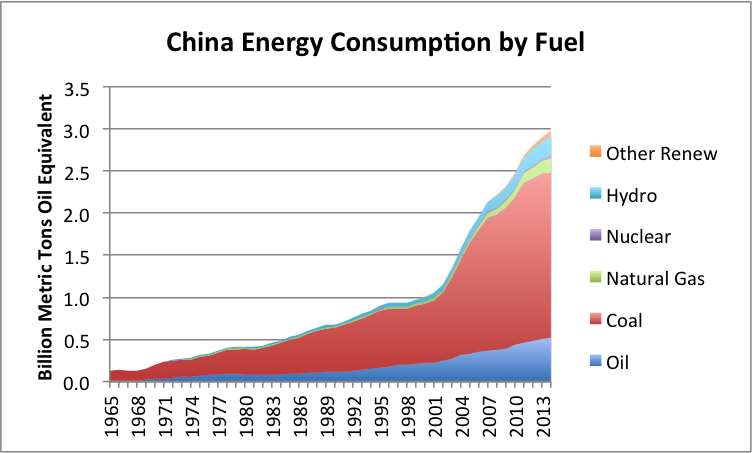
Figure 10. China’s energy consumption by fuel, based on data of BP Statistical Review of World Energy 2015.
There are many other limiting factors. Fresh water is a major problem, throughout much of the developing world. Adding more people and more industry makes the situation worse.
One problem with globalization is a long-term tendency to move manufacturing production to countries with ever-lower standards in many ways: ever-lower pollution controls, ever-lower safety standards for workers, and ever-lower wages and benefits for workers. This means that the world becomes an ever-worse place to work and live, and the workers in the system become less and less able to afford the output of the system. The lack of buyers for the output of the system makes it increasingly difficult to keep prices of commodities high enough to support their continued production.
The logical end point, even beyond globalization, is for automation and robots to perform nearly all production. Of course, if that happens, there will be no one to buy the output of the system. Won’t that be a problem?
Adequate wages are critical to making any system work. As the system has tended increasingly toward globalization, politicians have tended to focus more and more on the needs of businesses and governments, and less on the needs of workers. At some point, the lack of buyers for the output of the system will tend to bring the whole system down.
Thus, at some point, the trend toward globalization and automation must stop. We need buyers for the output from the system, and this is precisely the opposite of the direction in which the system is trending. If a way is not found to fix the system, it will ultimately collapse. At a minimum, the trend toward increasing imports will end–if it hasn’t already.
24 Comments on "Why Globalization Reaches Limits"
onlooker on Thu, 3rd Mar 2016 2:51 pm
Globalization cannot continue because it is predicated on vibrant trade and growth. Once this ends and that time is not far off, then the rationale behind globalization not to mention the resources to allow it to exist both disappear. Then people once again return to being stewards of what they have and living within boundaries of all kinds.
Practicalmaina on Thu, 3rd Mar 2016 2:57 pm
Well said onlooker, I was thinking about how inefficient globalism is the other day. In my state for example wood chip biomass is burned for some of our electricity, this is fine and dandy but the diesel required by skidders, chippers log trucks ect offsets the benefits of this renewable fuel source. If people were stewards of their own small lots and used more manpower and less diesel power using wood for fuel becomes much more ecologically beneficial.
Apneaman on Thu, 3rd Mar 2016 3:09 pm
The Fates of Nations – The Chinese Story
“…Chinese history very clearly shows the link between population growth and historical cycles: it would go through periods of rapid advancement, bump against a cultural ceiling, and then disintegrate politically, socially and economically. After a long period of stagnation and population decline (often due to incomprehensibly horrific famines), society would once again tentatively advance to the next plateau, only to experience another decline when the lands filled up again. The Chinese were among the first to recognize this pattern.”
http://hipcrime.blogspot.ca/2016/03/the-fates-of-nations-chinese-story.html
Pennsyguy on Thu, 3rd Mar 2016 3:11 pm
In short, the current global civilization will collapse because it, like all previous civilizations, is inherently unsustainable.
makati1 on Thu, 3rd Mar 2016 6:19 pm
“World Trade Falls 13.8% In Dollar Volume”
“Global Recession Roundup”
“Global Manufacturing Rolling Over: Over 70% Of Global PMIs Decline In February”
“Factory activity shrinks in US, China in February”
“Global Trade Is Collapsing—-Chinese Exports To Brazil Down 60% In January Y/Y; All Containerized Shipments To LatAm Down 50%”
“Trade Gap Widens: Exports Sink 2.9% vs. Imports Down 1.5%” (US)
http://ricefarmer.blogspot.fr/
And the beat goes on…
theedrich on Thu, 3rd Mar 2016 6:55 pm
In evolution, it is the types that cannot adjust their form, function and knowledge to the current conditions that go extinct. This “epistemological” dynamic is responsible for the origin, and death, of species, as Charles Darwin, among others, pointed out in the nineteenth century. Today the White West is being propagandized into remaining permanently frozen in its perverted Christian “mea-culpa” ideology so that it can save the exploding non-White parasites invading us.
Part of this guilty-savior mentality is used to support the economic drive toward ever more international trade. Besides the strictly economic (and often spurious) argument that such trade maximizes efficiency, much propaganda for it also proclaims that “we” (i.e., you, Whitey) are raising millions of ThirdWorlders out of poverty. As if those millions could never make it by themselves — which is true.
The reality is that the wages in White countries are lowered by such “efficiency,” while pollution and population, often accompanied by increased tyranny, expand in the Third World. The only ones benefitting are the trading companies and their managements. (As, e.g., both non-superpacked candidates — Trump and Sanders — have said, the TPP is a disaster for the U.S. And omitted here is the issue of international criminal organizations piggybacking on international trade.) What Gail is pointing out, in effect, is that diminishing returns are beginning to act as a brake on globalization and will eventually show it to be a complete failure.
But since we cannot change our assumptions of White culpability for every ill in the world, and our wish to take the easy road in history, we are headed toward extinction.
rom on Thu, 3rd Mar 2016 9:15 pm
Mak. Manufacturing needs to be 90% down cuz it is worthless.
Theefag. Importing inbred, worthless low IQ heathens is antichristian. It’s meant to destroy what’s left of Euro-Christian-patriarchy.real Christianity converts or kills the fuck out of you.
makati1 on Thu, 3rd Mar 2016 10:08 pm
rom, while I agree with your 90%, it will not stop there. Before it approaches even 50%, the whole system will revert to Lords and serfs. Zero manufacturing.
Have you considered the supply line to make a simple pair of shoes today? Or a pair of jeans? Or even toilet paper?
If you don’t know how the stuff you wipe with is made and all of the thousands of inputs from the trees to the chemicals, to the machines, etc. maybe you should read this:
http://www.madehow.com/Volume-6/Toilet-Paper.html
Then you will see how many manufacturing units/processes are necessary for even the most basic necessities. Or you could use a stick, like the Romans….lol.
marmico on Fri, 4th Mar 2016 4:26 am
Another GIGO blog post from Tverberg trying to hammer squares into circles.
Not a single mention of trade elasticity.
It is patently obvious that she is clueless when this statement is made:
Each time imported goods and services start to surge as a percentage of GDP, these imports seem to be cut back, generally in a recession. The rising cost of the imports seems to have an adverse impact on the economy.
Imports of goods (implicit price deflator)
markisha on Fri, 4th Mar 2016 4:38 am
and this is why we are screwed
https://foreignpolicy.com/2016/03/03/its-time-to-abandon-the-pursuit-for-great-leaders-clinton-trump-sanders/
Apneaman on Fri, 4th Mar 2016 4:53 am
trade elasticity? more meaningless made up econ 101 bullshit marmi.
Yup, trade elasticity gonna save da economy from crashing.
Apneaman on Fri, 4th Mar 2016 4:58 am
THE IMPLICATIONS OF PEAK ENERGY
http://circulatenews.org/2016/03/implications-of-peak-energy/
onlooker on Fri, 4th Mar 2016 5:52 am
Yeah, I suppose trade elasticity will allow us to come up with a few more Earths to exploit and trash.
Davy on Fri, 4th Mar 2016 6:28 am
The issues is not why globalism has hit its limits. This is all too clear across a broad spectrum from population to economy on to the environment. It is the all-inclusive nature of the limits that point to an inflection point. These limits are not in isolation but converging with negative reinforcement. This converging of negative reinforcement of a broad spectrum of limits is creating the beginnings of a mega event.
The issue always comes down to the searing of the frog on a hot grill or the slow boil. It appears it will be both with locals and some regions failing and other adapting and even growing but at the expense of the other dying. Eventually all will fail together.
We are in a demand and supply super cycle of destruction. This has created a glut of resources and productive capacities. This will take time to work through especially because demand is decaying for systematic reasons of debt deflation and years of poor decisions. Demand decay is freeing up supply and avoiding shortages. We have huge overcapacity still with overdevelopment that can be cannibalized.
We have corrupted our rule of law and our fundamentals of business law at all levels. Our society is degenerating into fear and apathy. Societal cognitive dissonance is apparent. Our leaders say things are wonderful but with challenges in hollow visionary statements. No leader can tell the truth to a public that can’t handle the truth. People are feeling less prosperity and feel paralyzed as a result. For globalism confidence is liquidity and liquidity keeps globalism going.
We have burned through the best resources and in the process disrupted a stable climate. Science is telling us all the nasty things ahead that most people try to forget until freak weather smacks them with a reality stick. Then there is the population issue that is still manageable but barely. It will not be long before a combination of climate, economy, and increasing population lead to famine. Famines and large scale death are very damaging to globalism.
Globalism is a fine tuned high horsepower machine. It has amazing strength with people dedicated by greed and lust who are very serious about maintaining their seat on the train. It has fatal flaws that can derail the train. Limits will decay globalism. Decay causes dysfunction. Networks that allow global trade and create confidence are fragile. Human nature is not all rational. Decay and dysfunction are not confidence builders. Famine does not make people optimistic.
This is a process with embedded events that will occur over a globalized world in some cases randomly in others systematically. It is possible this could drag on for some years if the haves manage to disenfranchise the have nots. It could start to end tomorrow by a cascade of events. It only takes a few weeks of food and fuel shortages to disrupt an economy beyond a return to the status quo. The speed at which a breakdown can occur is truly terrifying. That it has not happened should also be terrifying like the big earthquake that is long past due. We have pushed the envelope far past a soft landing possibility.
This is going to happen because we are in the process. The process is beyond prediction except in the immediate. How it will unfold is also unpredictable. We can say where the worst could be just from the obvious risk factors. Then there is fate and luck. We are either on a bumpy descent or the beginning of a rapid descent. We are no longer on the bumpy plateau. That ended in 2014 with the last of QE. Oil is now destabilized. China the last growth engine is in economic descent. It is just a matter of time.
onlooker on Fri, 4th Mar 2016 7:14 am
Wow, great summary of where we are and where we may be going Davy. The lack of predictability lies as always with how will the top tier decision makers react along with the masses. I do agree that a lack of confidence will fatally wound business as usual in some countries, while others even now are being cannibalized/exploited like Africa and the Middle East. Another wild card is military confrontations but I do not expect major ones until we are further down the road of contraction/collapse, then all bets are off. Yes as has been said by others, collapse is a multi-faceted asymmetrical process affecting different areas differently and at different time lines. What is horrific is that now we are talking about the most barbaric and primitive circumstances for some, a true survival of the fittest, fight for life. Being rich and having some environmental resiliency is good while the converse means basic necessities shortages are nearing or already present.
shortonoil on Fri, 4th Mar 2016 8:44 am
The author completely misses the point; and attempting to explain this through an ECON 101 perspective is insulting to her readership. The simple fact is that the resource base does not exist, nor has it ever existed, to support an industrialized global economy. This simple fact has been well known since the early 1970’s, and was widely discussed for several decades preceding that. The Club of Rome published an excellent presentation high lighting the constraints that must eventually appear if industrialized economies continued to be formed, and grow. They even described a time table to delineate when those constraints would begin to present themselves, and it has been highly accurate to date.
Debt, declining worker wages and falling capital investment are only manifestations of constraints that result from attempting to pursue infinite growth on a finite planet. Fiddling with GDP, interest rates, and investment numbers will only serve to continue to obfuscate the cul- de-sac the world has been traveling down for the last century. Articles of this nature only serve to hide the inevitable limits that nature has placed on the activities of man. They exemplify the religion that has evolved around humanity’s belief that it has conquered nature.
Nony on Fri, 4th Mar 2016 9:15 am
As usual Gail completely ignores technological advancements that can act against diminishing returns. Energy abundance has created massive technological advancement and now that same technological advancement can create cheap energy. It’s basically a positive feedback loop.
Nony on Fri, 4th Mar 2016 9:22 am
I didn’t post the above. It’s my ape. Maybe I should just leave.
Apneaman on Fri, 4th Mar 2016 11:19 am
Limits to growth + AGW = a real world example of the new global normal.
Tasmania battles to keep lights on with cloud-seeding and diesel generators
“What if an entire state in one of the world’s wealthiest countries was to run out of electricity?
It’s a question Tasmanians have been pondering – initially with humour, but increasingly with eyebrows arched – since late last year.”
“though you could say they didn’t properly take into account the impact of climate change.”
http://www.smh.com.au/business/energy/cloudseeding-and-diesel-generators-tasmanias-battle-to-keep-lights-on-20160302-gn8g5h.html
Apneaman on Fri, 4th Mar 2016 11:59 am
Friday Roundup — Truly Exceptional Human Bullshit
http://www.declineoftheempire.com/2016/03/friday-roundup-truly-exceptional-human-bullshit.html
Apneaman on Fri, 4th Mar 2016 1:05 pm
Cheap oil is taking shipping routes back to the 1800s
The plummeting price of oil on international markets has had many effects – one of which is that it may be cheaper for ships to travel right around Africa than go through the Suez Canal.
http://www.bbc.com/future/story/20160303-cheap-oil-is-taking-shipping-routes-back-to-the-1800s
Big polluters: one massive container ship equals 50 million cars
“Shipping is by far the biggest transport polluter in the world. There are 760 million cars in the world today emitting approx 78,599 tons of Sulphur Oxides (SOx) annually. The world’s 90,000 vessels burn approx 370 million tons of fuel per year emitting 20 million tons of Sulphur Oxides. That equates to 260 times more Sulphur Oxides being emitted by ships than the worlds entire car fleet. One large ship alone can generate approx 5,200 tonnes of sulphur oxide pollution in a year, meaning that 15 of the largest ships now emit as much SOx as the worlds 760 million cars.”
http://www.gizmag.com/shipping-pollution/11526/
Climate change: February smashes global temperature records to become the warmest month since records began
February broke the temperature record which was only set the previous month
http://www.independent.co.uk/life-style/gadgets-and-tech/news/climate-change-february-2016-warmest-month-temperature-records-a6911991.html
twocats on Fri, 4th Mar 2016 1:48 pm
The agreements made at the COP21 climate conference in Paris last year committed all parties to pursue efforts to limit the global temperature increase to 1.5 degrees above pre-industrial levels. If the current spike continues, it’s possible this limit could be briefly exceeded this year. [independent article]
The COP21 goal was “well below 2 degrees” and to pursue efforts at 1.5. Of course none of these commitments even come into effect in terms of action until 2020. That would be awesome if we firmly hit the 1.5 or even the 2 degree mark before 2020.
Why awesome? Because humans are so smug and confident in themselves, all these leaders, including the negotiators in Paris. But they’re not awesome. They are lousy. And I hope Trump bombs them all!
Aire on Fri, 4th Mar 2016 8:43 pm
The two “different user” Nony posts are only 7 min apart. That’s a weird coincidence…
Anyways, I’d say technology has helped prolong the inevitable and we most likely have been the sole reason our crash will be far more rough then previous collapses.
theedrich on Mon, 7th Mar 2016 2:20 am
Well, romfeces, your wish to obliterate manufacturing ought to begin with you. As for religions built on fraud and hypocrisy, such as Christianity and Islam, their main supporters are and have always been power-mad mass killers. Communism is likewise a spinoff of the lethal utopianism inherent in Judaism and Christianity. As for mass aggression, killing others is simply the nature of the human species, as also of other primates.
The problem with Christianity is that it advocates not so much killing others, but killing one’s own kind.