
Peak Oil is You

Donate Bitcoins ;-) or Paypal :-)


Page added on February 18, 2016

Start Preparing for the Collapse of the Saudi Kingdom
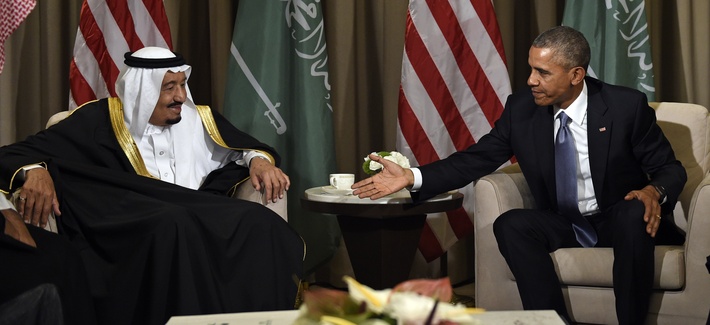
Saudi Arabia is no state at all. It’s an unstable business so corrupt to resemble a criminal organization and the U.S. should get ready for the day after.
For half a century, the Kingdom of Saudi Arabia has been the linchpin of U.S. Mideast policy. A guaranteed supply of oil has bought a guaranteed supply of security. Ignoring autocratic practices and the export of Wahhabi extremism, Washington stubbornly dubs its ally “moderate.” So tight is the trust that U.S. special operators dip into Saudi petrodollars as a counterterrorism slush fund without a second thought. In a sea of chaos, goes the refrain, the kingdom is one state that’s stable.
But is it?
In fact, Saudi Arabia is no state at all. There are two ways to describe it: as a political enterprise with a clever but ultimately unsustainable business model, or so corrupt as to resemble in its functioning a vertically and horizontally integrated criminal organization. Either way, it can’t last. It’s past time U.S. decision-makers began planning for the collapse of the Saudi kingdom.
In recent conversations with military and other government personnel, we were startled at how startled they seemed at this prospect. Here’s the analysis they should be working through.
Understood one way, the Saudi king is CEO of a family business that converts oil into payoffs that buy political loyalty. They take two forms: cash handouts or commercial concessions for the increasingly numerous scions of the royal clan, and a modicum of public goods and employment opportunities for commoners. The coercive “stick” is supplied by brutal internal security services lavishly equipped with American equipment.
The U.S. has long counted on the ruling family having bottomless coffers of cash with which to rent loyalty. Even accounting today’s low oil prices, and as Saudi officials step up arms purchases and military adventures in Yemen and elsewhere, Riyadh is hardly running out of funds.
Still, expanded oil production in the face of such low prices—until the Feb. 16 announcement of a Saudi-Russian freeze at very high January levels—may reflect an urgent need for revenue as well as other strategic imperatives. Talk of a Saudi Aramco IPO similarly suggests a need for hard currency.
A political market, moreover, functions according to demand as well as supply. What if the price of loyalty rises?
It appears that is just what’s happening. King Salman had to spend lavishly to secure the allegiance of the notables who were pledged to the late King Abdullah. Here’s what played out in two other countries when this kind of inflation hit. In South Sudan, an insatiable elite not only diverted the newly minted country’s oil money to private pockets but also kept up their outsized demands when the money ran out, sparking a descent into chaos. The Somali government enjoys generous donor support, but is priced out of a very competitive political market by a host of other buyers—with ideological, security or criminal agendas of their own.
Such comparisons may be offensive to Saudi leaders, but they are telling. If the loyalty price index keeps rising, the monarchy could face political insolvency.
Looked at another way, the Saudi ruling elite is operating something like a sophisticated criminal enterprise, when populations everywhere are making insistent demands for government accountability. With its political and business elites interwoven in a monopolistic network, quantities of unaccountable cash leaving the country for private investments and lavish purchases abroad, and state functions bent to serve these objectives, Saudi Arabia might be compared to such kleptocracies as Viktor Yanukovich’s Ukraine.
Increasingly, Saudi citizens are seeing themselves as just that: citizens, not subjects. In countries as diverse as Nigeria, Ukraine, Brazil, Moldova, and Malaysia, people are contesting criminalized government and impunity for public officials—sometimes violently. In more than half a dozen countries in 2015, populations took to the streets to protest corruption. In three of them, heads of state are either threatened or have had to resign. Elsewhere, the same grievances have contributed to the expansion of jihadi movements or criminal organizations posing as Robin Hoods. Russia and China’s external adventurism can at least partially be explained as an effort to re-channel their publics‘ dissatisfaction with the quality of governance.
Related: Defense One‘s complete coverage of Saudi Arabia
For the moment, it is largely Saudi Arabia’s Shiite minority that is voicing political demands. But the highly educated Sunni majority, with unprecedented exposure to the outside world, is unlikely to stay satisfied forever with a few favors doled out by geriatric rulers impervious to their input. And then there are the “guest workers.” Saudi officials, like those in other Gulf states, seem to think they can exploit an infinite supply of indigents grateful to work at whatever conditions. But citizens are now heavily outnumbered in their own countries by laborers who may soon begin claiming rights.
For decades, Riyadh has eased pressure by exporting its dissenters—like Osama bin Laden—fomenting extremism across the Muslim world. But that strategy can backfire: bin Laden’s critique of Saudi corruption has been taken up by others and resonates among many Arabs. And King Salman (who is 80, by the way) does not display the dexterity of his half-brother Abdullah. He’s reached for some of the familiar items in the autocrats’ toolbox: executing dissidents, embarking on foreign wars, and whipping up sectarian rivalries to discredit Saudi Shiite demands and boost nationalist fervor. Each of these has grave risks.
There are a few ways things could go, as Salman’s brittle grip on power begins cracking.
One is a factional struggle within the royal family, with the price of allegiance bid up beyond anyone’s ability to pay in cash. Another is foreign war. With Saudi Arabia and Iran already confronting each other by proxy in Yemen and Syria, escalation is too easy. U.S. decision-makers should bear that danger in mind as they keep pressing for regional solutions to regional problems. A third scenario is insurrection—either a non-violent uprising or a jihadi insurgency—a result all too predictable given episodes throughout the region in recent years.
The U.S. keeps getting caught flat-footed when purportedly solid countries came apart. At the very least, and immediately, rigorous planning exercises should be executed, in which different scenarios and different potential U.S. actions to reduce the codependence and mitigate the risks can be tested. Most likely, and most dangerous, outcomes should be identified, and an energetic red team should shoot holes in the automatic-pilot thinking that has guided Washington policy to date.
“Hope is not a policy” is a hackneyed phrase. But choosing not to consider alternatives amounts to the same thing.
27 Comments on "Start Preparing for the Collapse of the Saudi Kingdom"
HARM on Thu, 18th Feb 2016 6:21 pm
“Saudi Arabia is no state at all. It’s an unstable business so corrupt to resemble a criminal organization…”
Er… while I am certainly no fan of the KSA the same thing could easily be said of America. Of course, we don’t chop off people hands, heads and other body parts for perceived infractions against a state religion. That aside, our ruling oligarchy’s hands are hardly clean.
Plantagenet on Thu, 18th Feb 2016 6:39 pm
HARM is just telling it like it is.
Davy on Thu, 18th Feb 2016 6:42 pm
Countries that are too important to fail will likely be rescued if possible by the world community. KSA is simply too important because of oil and because of the Muslim holy cities. I am not saying KSA will not collapse but a significant effort will be made depending on the crisis to see some degree of stability there. If not the global system is doomed. It is doomed anyway just as KSA is doomed but time frame is an important consideration.
Degree, duration, and speed of the fall are all important conditions for the hurt a failed KSA would put on the global community. At some point there will be no hope of saving them but before that point it is in the global communities interest to not see a failed KSA.
Apneaman on Thu, 18th Feb 2016 7:07 pm
Risking Nuclear War for Al Qaeda?
“When President Barack Obama took questions from reporters on Tuesday, the one that needed to be asked – but wasn’t – was whether he had forbidden Turkey and Saudi Arabia to invade Syria, because on that question could hinge whether the ugly Syrian civil war could spin off into World War III and possibly a nuclear showdown.
If Turkey (with hundreds of thousands of troops massed near the Syrian border) and Saudi Arabia (with its sophisticated air force) follow through on threats and intervene militarily to save their rebel clients, who include Al Qaeda’s Nusra Front, from a powerful Russian-backed Syrian government offensive, then Russia will have to decide what to do to protect its 20,000 or so military personnel inside Syria.
President Barack Obama meets with Vice President Joe Biden and other advisors in the Oval Office. [White House photo]
President Barack Obama meets with Vice President Joe Biden and other advisers in the Oval Office on Feb. 2, 2016. [White House photo]
A source close to Russian President Vladimir Putin told me that the Russians have warned Turkish President Recep Tayyip Erdogan that Moscow is prepared to use tactical nuclear weapons if necessary to save their troops in the face of a Turkish-Saudi onslaught. Since Turkey is a member of NATO, any such conflict could quickly escalate into a full-scale nuclear confrontation.
Given Erdogan’s megalomania or mental instability and the aggressiveness and inexperience of Saudi Prince Mohammad bin Salman (defense minister and son of King Salman), the only person who probably can stop a Turkish-Saudi invasion is President Obama. But I’m told that he has been unwilling to flatly prohibit such an intervention, though he has sought to calm Erdogan down and made clear that the U.S. military would not join the invasion.”
https://consortiumnews.com/2016/02/18/risking-nuclear-war-for-al-qaeda/
shortonoil on Thu, 18th Feb 2016 7:33 pm
By our calculations it will require $39 trillion in subsides from the world’s economy to keep petroleum flowing over the next decade. Whether the world will have the political will to do that, or face the consequences of complete social breakdown is still unknown. The image that the industry has advanced of itself over the last 100 years is certainly not going to help the situation.
http://www.thehillsgroup.org/
pennsyguy on Thu, 18th Feb 2016 7:47 pm
My father rode a camel.
I drive a car.
My son will fly in an airplane.
His son will ride a camel.
KK4NQU on Thu, 18th Feb 2016 7:49 pm
Saudi citizens attacked the World Trade Center on 9-11-2001, killing thousands of American citizens in a most horrific way. This was the Saudi version of Pearl Harbor excepting civilians were the target this time and no military action was taken against the KSA as it was agsinst Japan (oil speaks).
Craig Ruchman on Thu, 18th Feb 2016 7:50 pm
“By our calculations it will require $39 trillion in subsides from the world’s economy to keep petroleum flowing over the next decade”
What will it cost for BAU in the decade starting in 2030? If we make it that far.
Truth Has A Liberal Bias on Thu, 18th Feb 2016 9:06 pm
Arras of oil production constitute a fraction of Saudis Arabians territory. Those areas will be targeted for control and exploitation while less valuable territory will be abandoned. Whether it’s the Saudi King or a Shiite militia that controls the oil production area is irrelevant. It will be prioritized for control and exploitation and the resource will be exported. KSA will experience an event that may best be described as Lebanonization or Balkanization as collapse proceeds. It will increase the cost of doing business aka controlling and exploiting the oil fields, but it will be done. The King might be hanging from a tank barrel but the oil will continue to flow.
Apneaman on Thu, 18th Feb 2016 10:57 pm
Start Preparing for the Collapse of wherever the fuck it is you live.
You won’t like downsizing
“But the electric car adds to the socio-economic complexity of our over-stressed life support system, it does not simplify it. In addition to the factory itself, an electric car needs sophisticated power hungry production systems, a living environment for its workers, housing, roads, schools and so on, as well as the Bolivian lithium mines and the socio-economic-industrial complexity needed in that country, all solely dependent on a vehicle concept that is ultimately a consumer of the hydrocarbon fuel it is promising to replace. All these systems are (hydrocarbon) energy intensive and expensive to produce. In a downsized society, that complexity will not exist, yet our focus on such dead ends as the electric car shows that humankind does not have the means to rid itself of dependence on the wheel. While the electric car might appear to be a bright shiny symbol of continuing wealth and prosperity, it is in fact a block of embodied energy, as subject to the laws of thermodynamics as any other construction. It demands constant energy input to maintain its viability, and serves no useful purpose in a downsized environment because the means to sustain will not be there. No industrialised nation can maintain its road transport system without the constant input of oil. Fossil fuelled vehicles, whether used on land, air or sea produce our food, sustain our infrastructure and maintain the cohesion of nations. And there are no alternatives.”
http://www.endofmore.com/?p=1464
onlooker on Thu, 18th Feb 2016 11:14 pm
No where is this last article by AP, more applicable than in the US where our entire society has been built is seems for the CAR. The suburbs are the greatest misallocation of resources in the history of humanity, JHK stated. And I agree. You could go further at this point and say globalization and modern civilization is the greatest misallocation of resources.
GregT on Thu, 18th Feb 2016 11:48 pm
The planet Earth is not a resource base for human exploitation onlooker. What we do to the Earth we do to ourselves. We owe our existence to the Earth, not the other way around.
onlooker on Fri, 19th Feb 2016 12:07 am
Yes, Greg, the whole human enterprise on Earth, took a fateful and drastically wrong turn with the industrial revolution and fossil fuel use. We embarked on a growth and exploitation spree that as rendered our planet in that short time as barely able to support life and all the humans on it. That is why we cannot overstate how screwed we really are. Just the growth momentum in both population and consumerism ensures that no solution exists for our predicament. We stand humbled in our folly, or at least those of us who care and understand the magnitude of the situation.
bug on Fri, 19th Feb 2016 12:21 am
Onlooker, while the industrial revolution speeded up the downfall and wrong turn,
in reality it started when our ancient ape ancestors climbed down from the trees.
Apneaman on Fri, 19th Feb 2016 12:51 am
bug, I think monkey grandpa was eating rotten fermented fruit, got hammered and fell out of the tree. All drunk brave and shit, he started yelling at a saber tooth cat and scared it away and stole it’s kill. The rest caught on quick. Drunken monkeys is what we are.
https://www.youtube.com/watch?v=pmnzIhbX2bg
GregT on Fri, 19th Feb 2016 12:51 am
“in reality it started when our ancient ape ancestors climbed down from the trees.”
In reality it started when we lost all respect for the natural world, and embraced human technologies.
HARM on Fri, 19th Feb 2016 12:52 am
@Plant, thanks. And nice to see everyone is getting along tonight. We all agree that the KSA is awful and America’s oligarchs are complicit in keeping it propped up and well supplied with dollars and weapons.
joe on Fri, 19th Feb 2016 4:37 am
The us backs saudi the way russia backs assad. As long as there is oil to make money from, then the us will keep these murderous peado-centric moon howlers drinking all the gold they can. After that there will be a huge civil war in islam when control of mecca will be up for grabs. The house of saud will skulk back to Riyad to be emirs of an empty city when Arabias capital is mecca again as it has always been.
Davy on Fri, 19th Feb 2016 5:37 am
It is less likely that Turkey would try to move on the heart of the Syrian government areas where her allies Russia, Iran, and Hezbollah are located. This would be a red line that Russia may consider Tactical NUK’s as one comment above linked. It is noteworthy that Russia would even hint to or indirectly mention Tac NUK’s. This alludes to just how overextended and vulnerable they are to Turkey. Turkey and KSA have enough planes to overwhelm Russian air defenses and their small air force. This would invite strategic retaliation from Russia with bombing of bases and possibly economic sites. This would then lead to a closing of the Bosphorus which would be very detrimental to the Russian navy. Turkey is the real power in this situation with the manpower. Russia has air lift capabilities but this would be a costly undertaking and put their military in difficult support scenario. It is unclear what NATO would do if Turkey starts a conflict. It could chose not to intervene because this is not a defensive action but offensive.
It is more likely that Turkey and KSA will gain enough of a foothold in northern Syria to maintain supply lines to the rebels. This could eventually lead to a division of Syria and possibly northern Iraq. The Kurd situation would definitely complicate with the possibility of a Kurdish civil war in the area. The Turks would surely win this scenario but at great cost. The Iraqi Kurds are definitely protected by the US and would not be a target. The US has made that clear indirectly. The US will probably have to abandon the Syrian Kurds to the Turks.
If the Syrian Government and here allies do not consolidate territory quickly it is likely this is going to drag out into a nasty asymmetric conflict with conventional forces drawing up boundaries with the asymmetric fight in the contested areas. This will surely bleed Russia of vital economic energy at a time when her economy is under stress. If Syria wins this segment of the war consolidating western Syria it will control a destroyed area. Syria will never be a dominant military and political power again. Iran and Russia will be stuck with supporting this destroyed area and weak government. The US has lost a dominant position in the Mideast and is now nothing more than a multipolar power there. Turkey is destabilized and will likely suffer economic and political crisis for years. Europe is going to be fighting an internal fight of how to deal with too many refugees. I don’t see any long term winners.
More likely Syria and her allies will cement the west and Turkey and her allies will maintain influence and support of the north and east. Iraq is then another story. If Turkey goes all in with supporting the Sunni rebels this may strengthen the Sunni position at the expense of the Shia Iraq. In this situation Shia Iraq is a loser also.
Really at this point anything could happen including a peace process for more level heads. It is not like anyone can afford a war these days. Hopefully cooler heads will prevail and this infected sore can be healed for everyone’s sake. We are very close to a global economic spiral. We are in a global descent but the speed is not dangerous yet. A war in Syria would push the global economy into a dangerous spiral.
shortonoil on Fri, 19th Feb 2016 7:38 am
“What will it cost for BAU in the decade starting in 2030? If we make it that far.”
We are an oil based civilization; when the oil age ends so does BAU. The oil age ends when the minority portion of the world’s liquid hydrocarbon supply that can power our civilization has been used. By 2030 it will be all but gone. What will replace BAU will be what evolves out of the chaos created when it ends. There is no Plan B.
http://www.thehillsgroup.org/
JuanP on Fri, 19th Feb 2016 8:03 am
Did Russia threaten Turkey with tactical nukes? http://russia-insider.com/en/politics/did-russia-just-threaten-turkey-nuclear-weapons/ri12936
JuanP on Fri, 19th Feb 2016 8:05 am
Risking nuclear war for Al-Qaeda? https://consortiumnews.com/2016/02/18/risking-nuclear-war-for-al-qaeda/
PracticalMaina on Fri, 19th Feb 2016 2:55 pm
Aw shucks, and they were so friendly and really helped the world progress in a positive manner…. HAHAHAHA
IanC on Fri, 19th Feb 2016 3:50 pm
Let’s not forget all those American soldiers, marines, airmen, and sailors who have died and lost body parts to keep the oil spigots open in the Middle East. Such a waste!
It looks like political disruptions in Syria, KSA, Turkey, and Iraq are much more likely to cause a drop off in oil production that merely slow, steady depletion from consumption. I think we’re heading for oil shocks that make the ones in the ’70s look like the lines to see Star Wars.
george on Fri, 19th Feb 2016 4:37 pm
The Vegas line on the rooskies versus the Turks in a nuclear exchange is 8 to 5 .
Socratic Dog on Fri, 19th Feb 2016 7:06 pm
All this… and no mention of the petrodollar? Without the petrodollar, US commercial collapse would seem assured (it has been collapsing economically for some time, since 2008 at a minimum). If SA as presently constructed collapses, or if the US fails to live up to its security obligations and protect SA no matter what, then the petrodollar disappears.
And that is a whole lot more important than who controls the oil, the only thing to do with an oil surplus is to sell it. Unfortunately, you have to buy it with something of tangible value. Without the petrodollar, the US doesn’t have much left to offer.
I can’t see this ending well.
JuanP on Fri, 19th Feb 2016 7:07 pm
Washington’s game in Syria, http://journal-neo.org/2016/02/17/washington-s-machiavellian-game-in-syria/