



The past few weeks have seen lots of excitement as the world reached agreement to tackle climate change in Paris. What is key to the Paris deal is a requirement that every nation (all 195 of them) take part. Ahead of the talks, governments of 186 nations put forth public plans detailing how they would cut carbon emissions over the next 10 to 15 years. However, these plans alone, should they come to fruition, will cut emissions by only half the levels required to meet the targets set out in the agreement. The plans vary significantly from country to country with some like China depending upon nuclear power as part of their plan – and others not. With no concrete plan to achieve the goals in the agreement, one thing is clear; that if there is any chance of meeting these ambitious goals, there will have to be a larger role for nuclear power.
Critics of nuclear power generally focus on two main issues: safety, mostly concern that the consequences of a possible nuclear accident are not worth the risk; and cost, with many noting that nuclear is a high cost option that just diverts funds from the real environmental options for future generation, wind and solar. This month we will talk about cost and how to ensure that nuclear is seen for what it is, a capital intensive yet highly economic option for reliable 24/7 generation. If nuclear is to play the role that it can, and must play in the future generation mix, it can only get there by being the economic option of choice.
In our last post we noted the updated version of “Project Costs of Electricity” has recently been published. This is an important report that is now in its 8th edition from the IEA and NEA looking at the costs of various forms of electricity generation.
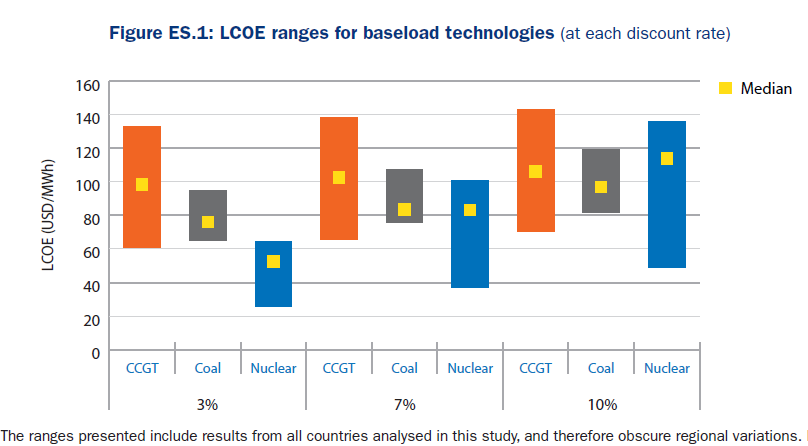
The results of this study are very clear. It shows that nuclear is a very competitive option on a Levelized Cost of Electricity (LCOE) basis.


In fact, at low discount rates (3%), it is the clear winner among both traditional fossil technologies and the cost of renewables. While the report acknowledges the huge gains made by renewables in reducing their costs, it also notes the belief that nuclear costs continue to rise is false.
What is of interest is how the results are presented. The main comparisons in the executive summary are provided varying only one parameter, discount rates, that range from 3% to 10%. This represents a three-fold increase in the discount rate over the range. It is therefore not surprising that the technologies that are capital intensive, i.e. nuclear and renewables show the greatest sensitivity to this one parameter. This is one way to look at the comparative economics. On the other hand, generating stations powered by fuels like coal and gas are much more sensitive to fuel price. This sensitivity is only shown later on in the report in a sensitivity section.
Figure 7.12: LCOE as a function of fuel cost

So for example, while gas plants (CCGT) vary little with discount rates due to their relatively low capital costs and higher fuel costs, their LCOE is very sensitive to fuel prices. In the chart above, the sensitivity only varies fuel prices by up to 50%; rather small in comparison to the three-fold change in discount rates in the earlier chart. Yet we all know that today’s very low gas prices in North America are easily less than half as much as they were only a few years ago. Doubling gas prices or more would have a huge impact on electricity costs.
As would be expected, the economics also vary by region. It is no accident that China is building the most nuclear plants in the world. Even though they are also building many more coal plants to meet their ever increasing hunger for energy, nuclear plants provide clean reliable energy at about half the cost of coal in China making it an easy decision to move forward with new nuclear plants as quickly as they can. On the other hand, this past month we have once again heard about nuclear plants in the United States that are likely going to close prematurely due to poor economics. This results mostly from very low gas prices that impact the economics in those parts of the country that have open competitive markets. The units that are most impacted are the older smaller single unit stations that are requiring capital investment at this stage of their life cycle. Without any acknowledgement of the low carbon characteristics of nuclear, or the reliability of fuel supply (gas plants generally are fed by pipelines that are at risk in cold winter months), these units are struggling. Yet the industry in the USA is not standing still. As reported in the December 10 Nucleonics Week, the US industry is targeting to reduce its costs for the existing fleet by 30%. Once achieved, this will ensure that once again nuclear will be the lowest cost generation on the system.
However, this is only the first step. Being a low carbon generator is only sufficient to ensure that nuclear remains an option. The key to long term success is the ability to reduce the capital costs of constructing the plant; producing low cost energy is what will really drive a strong new build program. This can be seen in countries such as China and Korea, where capital costs are relatively low, making nuclear by far the most economic option available. Lessons learned in these markets must be shared and implemented globally to bring down capital costs in other markets as well. China and Korea are showing the way. If the rest of the world follows, abundant nuclear power will play a large role in tackling climate change as the electrical grid workhorse of reliable low-carbon and mostly, economic generation, for decades to come.
potterpaul on Sat, 19th Dec 2015 12:52 pm
Economic until you have to clean up a few meltdown incidents. Or deal with the waste that lasts thousands of years. Oh yeah, that.
Pennsyguy on Sat, 19th Dec 2015 1:36 pm
Right Potterpaul. There also so economical that none has ever been built without a subsidy.
Bob Owens on Sat, 19th Dec 2015 2:11 pm
When you can install wind farms and have them producing in 3 years or less, why would you go nuclear? With its long build time, extreme expense, cost over-runs, vulnerable to terror attacks, can melt down destroying the State it is located in for hundreds of years, I ask again: Why would you go nuclear? Just look at the meltdowns in Japan if you want proof.
Go Speed Racer on Sat, 19th Dec 2015 2:30 pm
The pressurized water reactor is 2% efficient. The other 98% is that mountain of nuclear waste they want to bury.
A pebble bed reactor is 30% efficient and cannot melt down.
A liquid fuel Thorium reactor would approach 100% fuel efficiency, just we have to design it, but that is not allowed.
So what happen? The USA people are so fat, the fat plugged their brain cells and there is only ‘Nuclear’, they cannot comprehend there is more than one type. Sort of like at church, there is only ‘God’, the 2% efficient rods & water reactor. Dont. ask if there are multiple possibilities.
simonr on Sat, 19th Dec 2015 2:54 pm
Speed Racer
Aren’t you assuming no one in the world except the USA has the relevant Know-How ….
Or, there is a massive world wide conspiracy to keep this technology suppressed, with only a few brave souls (such as yourself) willing to speak out.
A third option could be that the physics of high pressure fluids as pertaining to Water is easily understood, whereas others (Salt) are not so, linear, and thus not so economical, ask Areva
I prefer option 2
simon
shortonoil on Sat, 19th Dec 2015 3:00 pm
As far as scruples, integrity, ethics, and compassion for other life forms on the planet, the nuclear power industry makes the petroleum industry look like Mother Theresa. If Lucifer made his debut he would be dressed as a GE BWR.
simonr on Sat, 19th Dec 2015 3:10 pm
Hi Speed
Sorry for the outburst its late here !
I actually asked someone very close and very qualified, this question myself, a while ago, the answer is, the predictability (and thus economics) of high pressure/temperature fluids and the economics thereof are better understood with water than any other medium.
once again, sorry for the outburst
Simon
onlooker on Sat, 19th Dec 2015 3:22 pm
“As far as scruples, integrity, ethics, and compassion for other life forms on the planet, the nuclear power industry makes the petroleum industry look like Mother Theresa. If Lucifer made his debut he would be dressed as a GE BWR.” Yes the legacy of nuclear will be with humans probably just as long as global warming effects.
simonr on Sat, 19th Dec 2015 3:25 pm
Uranium 235 has a half life of 700 million years (give or take), so wayyyy longer than AGW
onlooker on Sat, 19th Dec 2015 3:49 pm
Yes it beats in length of time the recovery of life from the greatest extinction event on Earth, “The Great Dying”. I think it took 10 million years for life to recover from that episode. Once you talk millions of years your talking a long time.
simonr on Sat, 19th Dec 2015 3:59 pm
Good point, from out point of view, its forever.
https://www.youtube.com/watch?v=g4p7zUEK67M
into eternity, a film about nuclear waste, really interesting
simonr on Sat, 19th Dec 2015 4:06 pm
Mjch better link
https://www.youtube.com/watch?v=6j2t6nXqUi4
Davy on Sat, 19th Dec 2015 4:30 pm
The reality of NUK power should be a serious effort to stabilize waste in insecure pools around the globe. Talk about extend and pretend. It is one thing to extend and pretend bad debt but quite another to pretend NUK waste will be safe in these pools. They just keep packing those rods in there ever tighter thinking someday the money will appear to put them into longer term storage.
shortonoil on Sat, 19th Dec 2015 4:42 pm
“Yes the legacy of nuclear will be with humans probably just as long as global warming effects.”
The nuclear power legacy will beat out global warming by about the half life of plutonium 232. Which, if I remember, is 3.2 million years. Mother Nature will clean up the human mess in about a 1000 years. About the life span of Hover Dam.
Plantagenet on Sat, 19th Dec 2015 4:43 pm
If want to avoid a climate disaster we need to shift to carbon-free sources of energy. Nuclear doesn’t produce CO2, i.e. we should shift to nuclear. Yes, nuclear waste is a bad thing—but so is destroying the entire planet by buying hydrocarbons.
Anonymous on Sat, 19th Dec 2015 5:01 pm
Nuclear Greenwashing.
eugene on Sat, 19th Dec 2015 5:45 pm
According to Plant, shifting things to future generations is better than dealing with the problem ourselves. Course those future generations will have a different opinion but then we don’t have to face them. Hypocrisy is such a wonderful thing. My opinion is nuclear is just a gutless way out.
dissident on Sat, 19th Dec 2015 6:04 pm
Plantagenet is right. But he got the “waste” detail wrong. There is no nuclear waste it is all burnable fuel for fast neutron breeder reactors and allows a 50 fold increase in the energy extracted from a kg of Uranium. So all the talk about burdening future generations is a load of BS a mile high. The usual distortion from anti-nuclear hysterics.
It is time to retire all water cooled nuclear reactors. They are unsafe and stupid designs that produce “waste” and are the source of all the accidents. Unpressurized molten metal (sodium or lead) vat breeder designs are vastly superior. With lead it is not even possible to have a meltdown since it boils at 1740 Celsius. The passive heat loss from the vat is large enough to prevent this temperature from ever being reached.
dubya on Sat, 19th Dec 2015 6:12 pm
Coal & Nuclear certainly are in the lead for passing our problems to future humans. I have a hard time justifying running this PC by producing CO2 or nuclear waste – using solar & hydro seems slightly less psychotic.
The pre-contact Australians had a policy of avoiding the area around Kakadu – apparently they had determined it was a poor place to live or hunt & gather; but I doubt they ever had an understanding of why.
Now imagine if the ancient Greeks had left a similar legacy – I can’t imagine we would be happy about having areas that are mysteriously dangerous & cost money & lives as a leftover for some trivial purpose thousands of years ago.
Of course humans will always understand how to build & use a radiation detector, such enduring information is so simple that I have a schematic on a 5 1/4″ floppy disk right here.
dubya on Sat, 19th Dec 2015 6:17 pm
sorry about the double post; but I have to ask dissident a serious question – if all these new & improved nuclear reactors are so sensible why don’t you gather a consortium of experts and build one? That is how America became great, not by waiting for someone else to do it.
I think it is a great idea but I personally don’t have the knowledge of nuclear physics, business, construction, management, insurance & etc; and I’m a bit old & too far away to initiate this myself.
shortonoil on Sat, 19th Dec 2015 6:20 pm
“Unpressurized molten metal (sodium or lead) vat breeder designs are vastly superior.”
You may have up to 15 years to start delivering them. After that we may not have retained enough technology to build a light bulb; so there isn’t going to be much use for the reactors? Civilization, and its offspring, technology, is the art of getting a whole bunch of people to do the right thing at the right time. Once people start getting worried about what is going to be in their stomachs it has a tendency to stop working.
peakyeast on Sat, 19th Dec 2015 6:25 pm
From what I have read about molten salt reactors come with their very own collection of problems.
As soon as they applied for real we shall all see what those problems are.
Pete Bauer on Sat, 19th Dec 2015 7:07 pm
Russia has achieved a major feat in nuclear power by connecting BN800 Fast reactor to the grid. Fast reactors produce 50 times as much energy from a given fuel compared to regular reactors. It also produces fuel for other reactors while burning the fuel.
http://www.world-nuclear-news.org/NN-Russia-connects-BN800-fast-reactor-to-grid-11121501.html
Meanwhile China has standardized a reactor Hualong-1 after gaining considerable experience and now they are building many units of that reactor. Nuclear power is needed not only to cut the power generated by fossil fuels, but also to power the electric vehicles of the future.
In the last 5 years, 1 million electric vehicles were added. It will take only 2 years to hit the 2 million mark and probably 1 1/2 years to hit the 3 million mark.
JuanP on Sat, 19th Dec 2015 7:50 pm
Pete, my country, Uruguay, has around three million people. It is a tiny, insignificant corner of the world. Have you ever heard the name or do you know where it is? Three million cars is nothing in today’s world. That is a small fraction of a percent of the world’s automobile fleet, way less than the margin of error. We will never have a significant number of electric vehicles other than, maybe, and that is a BIG maybe, bicycles.
makati1 on Sat, 19th Dec 2015 8:09 pm
Changing the topic for a moment. If you are interested in your countries place in the healthy world, you might want to check out this site.
http://www.worldlifeexpectancy.com/
It’s stuffed full of easy to understand facts and comparisons in colored maps and charts.
Now back to the regular scheduled topic.
I could tag any number of negative articles about nuclear energy but the real reason nuclear is even here is that it was a way to get YOU to pay for making the fuel for nuclear bombs. Not cheap energy, which it never was nor ever will be. They never told you about the hundreds of years of special care required for the spent fuel or radiated materials left when the plant is closed. LOL
Apneaman on Sat, 19th Dec 2015 8:23 pm
short, what is it with you engineer types and the clinging to milankovitch cycles? 1000 years is wishful thinking at this point. The permian mass extinction was triggered by CO2 from the siberian traps and the recovery was at least 30 million years. The warming from CO2 triggered all sorts of positive feedbacks just like we have. Mostly independent of AGW we have started the current (6th) mass extinction and we caused major changes even before the industrial revolution happened. Don’t even need global warming or radiation. AGW is a driver for sure, but not the main one. Destruction of habitat is. 7.4 billion cancer monkeys and their farms, mines, suburbs, roads, malls, etc. This time we are Meteor and volcanic traps.
Recovery from Extinctions
“The “Big Five” mass extinctions are numbered. The shaded bands show the “recovery interval” — the interval from the highest extinction rate (the peak on the middle graph, at the left edge of each shaded band) until the rate at which new groups were originating peaked again (the peak on the bottom graph, at the right edge of each shaded band). These recovery intervals average about 10 million years.”
http://www.pbs.org/wgbh/evolution/library/03/2/l_032_03.html
Recovering From A Mass Extinction
“The full recovery of ecological systems, following the most devastating extinction event of all time, took at least 30 million years, according to new research from the University of Bristol”
http://www.sciencedaily.com/releases/2008/01/080118101922.htm
makati1 on Sat, 19th Dec 2015 8:25 pm
If any, more efficient, safer, nuclear reactor was profitable, they would have replaced the old ones by now. Since that has not happened, apparently ALL nuclear reactors require government/taxpayer money to exist AND to be retired.
Since we know that ALL of the governments sponsoring nuclear plants, are deep in debt and cannot even repair their infrastructure, we can see our species’ future clearly. There is none. Cancers will go up and soon exceed heart disease as the main cause of death. That is, IF there are no other faster use of nuclear materials before then.
jjhman on Sat, 19th Dec 2015 10:05 pm
Any nuclear enthusiast would be happy to tell you that the major expense of building nuclear reactors is government interference by way of unnecessary, burdensome regulations.
Given the power of the free market reactors would be providing unlimited free energy.
Of course if there were any big problems the companies would just file bankruptcy and dump the whole mess on the taxpayers. But, hey, that’s the free market.
snarc off (I spent 8 years working in the nuclear industry. I wouldn’t trust the managenemt with a plug nickel)
Plantagenet on Sat, 19th Dec 2015 11:04 pm
@Eugnene
If you’re going to lie about what someone said in their post, try to wait until a few other people have posted before you post your lie.
You look like a dope in addition to being a liar when you post your nonsense right after the post you are misrepresenting.
Cheers!
Apneaman on Sat, 19th Dec 2015 11:40 pm
They better start breaking ground – like yesterday if they want to cut the ribbon before the apes go bye bye.
Why It Took 36 Years to Build America’s Newest Nuclear Power Plant
http://www.greentechmedia.com/articles/read/why-it-took-36-years-to-build-americas-newest-nuclear-power-plant
Go Speed Racer on Sun, 20th Dec 2015 1:31 am
Hi Simon R, just got back from wringing out the Mach 5, driving a long route on some winding mountain roads. Pops changed the springs and this time he got it just right.
Glad to hear from you about atomic waste, I will be sure to look at the movie link you provided.
The thing is, if the nuclear fuel is burned fully in the reactor, instead of just partially, it’s not nearly a waste so much as it is more like isotopes of lead.
The problem with water is its a ‘neutron moderator’ that slows down neutrons. Water in a reactor equals slow neutrons. And then it can’t break up all the nuclear waste. Just as Trixie, she’s been reading all about it.
The pebble bed reactor is well understood, the Chinese are building them. So it depends on what you want… did you want 2% energy and 98% waste? Or did you want 30% energy and 70% waste?
Or better than that? The LFTR (liquid fluoride and thorium reactor) would produce mostly energy, and little waste. Also there is lots of Thorium, you can get it from beach sand.
Well, back to the open highways! See you at the burger stand Simon R !
GregT on Sun, 20th Dec 2015 2:12 am
Pinter-Plantagenet said,
“You look like a dope in addition to being a liar when you post your nonsense right after the post you are misrepresenting.”
https://www.youtube.com/watch?v=07Fncn-DjgM
makati1 on Sun, 20th Dec 2015 3:08 am
Go Speed, not going to happen. It is NOT profitable and doesn’t produce fuel for bombs. Nuff said.
adamc18 on Sun, 20th Dec 2015 3:23 am
The UK is in an interesting situation with nuclear,having signed up with the the Communist People’s Republic of China to build an initial nuke at Hinkley Point using French technology. After that the Chinese will be building more reactors in the UK themselves. The UK government is guaranteeing them an electricity price which is double today’s price.
At the same time the UK govt is going ahead with renewing its fleet of 4 Trident nuclear submarines at a cost of around £100 billion. No doubt the primary targeting for the missiles will be Russia, but after that where? Almost certainly China. But of course the Chinese won’t need to have any missiles aimed at the UK when it has a number of nuclear ‘installations’ already in the country.
Some great wit said that “Military Intelligence” is a contradictory use of words – how very true!
Go Speed Racer on Sun, 20th Dec 2015 4:21 am
You win that one easily Makita. If the reactor actually produces energy instead of nuclear waste, it will be made illegal by our bomb-loving govermint.
makati1 on Sun, 20th Dec 2015 5:41 am
adamc18, any nuclear exchange with Russia will not leave any of the UK livable. No need for China. There will not be a Europe or US either. None are more than 30 minutes away from Russia and the UK is only about 5. The new Russian missiles travel at about 14,000 mph.
Kenz300 on Sun, 20th Dec 2015 7:43 am
So how much will it cost to clean up Fukishima and store the nuclear waste FOREVER?
A 40 year clean up plan that admits the technology to do the job does not exist yet………..
Nuclear energy is too costly and too dangerous.
Wind and solar are safer, cleaner and cheaper……
peakyeast on Sun, 20th Dec 2015 8:28 am
@jj: They already do that since nuclear power plants are not insured by ordinary means in private insurance companies but through the government.
That is the same as saying: When it goes well we take the profits – when it goes bad everybody must pay for the disaster .
Rodster on Sun, 20th Dec 2015 9:59 am
”
potterpaul on Sat, 19th Dec 2015 12:52 pm
Economic until you have to clean up a few meltdown incidents. Or deal with the waste that lasts thousands of years. Oh yeah, that.”
^^^ This !
Mike616 on Sun, 20th Dec 2015 10:51 am
Nuclear has a big Decommission cost. It’s actually just as expensive to un-build one as to build one.
That’s never mentioned.
It’s almost as if it’s just not profitable, with the only people pushing these a nuclear engineers who need jobs.
jjhman on Sun, 20th Dec 2015 12:08 pm
I’ve found some interesting reading on liquid sodium reactors. If you read the positive stuff about reducing waste and “inherent” safety features it sounds pretty good.
http://thorconpower.com/
My first reaction, however was to wonder about corrosion. Sure enough if you look deep enough even tho they’ve come up with a new version of Hastelloy they can’t stop the corrosion or, it turns out, plating out of nasty substances on relatively cool surfaces. You don’t see any concern about that in the promotional literature.
https://whatisnuclear.com/reactors/msr.html#problems
So I have to conclude pretty much what I concluded 35 years ago when I left the industry: Yes, it’s very clever but it almost certainly is a technology that you shouldn’t trust feeble humans with. Ralph Nader once said that 93 million miles, the distance to the sun, is about as close to a nuclear reactor as you want to get. OK, so Ralph’s a jerk. But he got that right.
Anonymous on Mon, 21st Dec 2015 12:06 am
The one thing about pro-nuke advocates, no matter if they are paid or doing it for free, consistently make statements that are 100% opposite to the reality of nuclear energy.
IE,Nuclear,abundant and economical!
(Its neither)
Fusion boosters do the same thing. With them, its:
Fusion! Unlimited!, clean!, safe!
(Its none of those things either)
But their totally inverted-to-reality-messaging, is consistent, if nothing else.
simonr on Mon, 21st Dec 2015 5:04 am
Cost per MwH
Uk’s new station 150Eur
Frances Solar 300Mw Station 110Eur
CCGT/Coal/Hydro Mix 48Eur
Hmmmmmm
Davy on Mon, 21st Dec 2015 6:41 am
Costs are still relative if you step out of the status quo. Many power sources will be stranded in a decaying grid. Others have adaptability per their engineering. I have to step back to a comment by Short mentioning a localized oil production arrangement as a dynamics applicable to many resources and power sources.
The key to this retrofit is the speed of decay of the status quo. Decay will affect the people skills and the physical needs. Those needs are maintenance and spare parts. There is also economies of scale. What good is 3 Gorges hydro if it cannot be localized, not much.
The immediate future of status quo descent belongs to a built in decentralized adaptability. This is not important to the status quo and as long as the status quo is dominant it is not even economic per the numbers. This is the paradox of descent with value that are obscured in a jutaposition. The hidden value of people, places, and things is near at hand.
simonr on Mon, 21st Dec 2015 6:50 am
Hi Dave
Good point, as the UK nuclear is more expensive than paying subsidies for local solar/wind, however local solutions stop us being dependant on the state.
Simon