
Peak Oil is You

Donate Bitcoins ;-) or Paypal :-)


Page added on December 7, 2015

Why we still don’t understand civilization collapse
Imagine a team of archaeologists living three thousand years in the future. They work at digging out the remains of an ancient civilization on the Eastern shore of the Mediterranean Sea, a region that its ancient inhabitants called “Syria.” The archaeologists find clear evidence that the Syrian civilization collapsed in correspondence of a series of disasters: a severe drought, a civil war, the destruction of cities by fire, foreign invaders, a reduction in population, and more. The evidence for these event is clear, but what exactly caused them? Our future archaeologists are baffled; they suspect that there is a single reason for this coalescence of disasters, but they can’t find proof of what it could have been. Some of them propose that the collapse originated from the depletion of a mineral resource, since they found that these ancient Syrians were extracting something from underground and using it as a source of energy. But, without reliable data on the production trends, they cannot prove that depletion was the basic cause of the collapse.
Something similar is happening today to the archaeologists who try to understand the reasons of the collapse of the Mediterranean civilization of the end of the second millennium BCE; the end of the Bronze Age. We have archaeological evidence of a brilliant and thriving civilization: palaces, works of art, commerce, metallurgy, and more. But we have also evidence that this civilization met a violent end: there are traces of fires destroying palaces and cities, there is evidence of droughts and famine, and some of the people living in the region, the Hittites for instance, disappeared forever from history. But what caused the collapse? That’s a very difficult question.
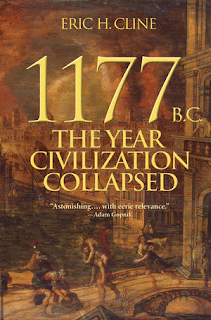
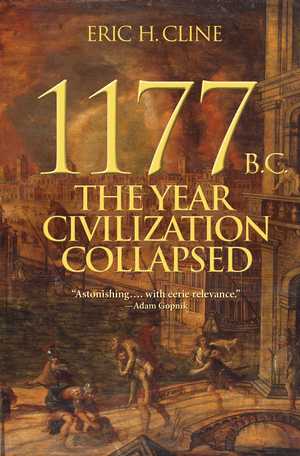
Eric Cline’s book, titled “1177 BC” shines some light on the history of the Bronze Age civilization and its demise. As a book, it is well done and it summarizes very well the result of nearly two hundred years of archaeological studies. It is a fascinating story of a historical time that strikes our imagination as a refined and sophisticated world; not an empire, but a loose federation of peoples. Sometimes they were engaged at warring with each other, but more often in commerce and in cultural exchanges. We can’t imagine that such a sophisticated civilization would collapse so fast; possibly in just a few decades. And yet, it did.
So, what caused the collapse? Cline’s book is good evidence of how difficult it is to understand these phenomena. A whole chapter, the last one, is dedicated to explore the reasons for the collapse, but it doesn’t arrive to any definitive conclusion. As it is almost always the case when discussing societal collapse, we see different proposed reasons piling up: some experts favor external causes: invasions, droughts, earthquakes, volcanoes, or similar. Others seek for internal causes: rebellions, institutional decline, political struggle, and more. And some, including Cline himself, favor a combination of several causes. He writes:
“There probably was not a single driving force or trigger, but rather a number of different stressors, each of which forced the people to react in different ways to accommodate the changing situation(s)…. a series of stressors rather than a single driver is therefore advantageous in explaining the collapse at the end of the Late Bronze Age.”
Unfortunately, this is not satisfactory. Suppose that I were to tell you “I am suffering of a number of different stressors, including fever, throat ache, sneezing, coughing, pain at the joints, and more.” Then, you would look at me, perplexed, and say,”you mean you have a flu, right?” Yes, of course, all these different “stressors” result from a single cause: a viral infection. Just like a flu is a common illness in humans, collapse is such a common feature in human societies that we can hardly imagine that it could be caused by a fortuitous combinations of stressors, all acting in the same direction.
In examining this issue, a basic point is that societies are complex systems, and need to be understood as such. Unfortunately, the knowledge about complex system has not yet permeated the study of societal collapse, as it is amply demonstrated by the discussion in the last chapter of Cline’s book. Several authors have apparently tried to explain the collapse of the Bronze Age society in terms of what they call “complexity theory”. But I am afraid they didn’t understand very well what a complex system is. Just as an example, in the book we read a sentence taken from the work of Ken Dark who says “”The more complex a system is, the more liable it is to collapse.” Now, this is simply wrong if it is applied to the kind of complex systems that have to do with human organizations; companies, or civilization. And you don’t need to be an expert in complex system to note that large and complex systems tend to be very resilient and long lasting. Compare, for instance, IBM with the large number of small upstart companies in information technologies that appear and quickly disappear. So, you just can’t invoke “complexity” as a mumbo-jumbo to explain everything, as Cline correctly notes in the book.
A lot of confusion in this area has arisen from the variability of the definition of a “complex system;” there is not just one kind of complex system, there are several (and that is something you would expect since they are, indeed, complex!). One kind of complex system that has had a lot of success in the popular imagination is the “sandpile”, proposed by Bak, Tang, and Wissental, a model that shows a series of small and large collapses. The problem is that the sandpile model is valid for some systems, but not for others. It works nicely for those systems which have only simple, short term interactions: the financial system, for instance. But it doesn’t work at all for systems which base their complexity on stabilizing feedbacks: civilizations, for instance. The difference should be clear: the financial system was never built with the idea that it should be stable. The opposite is true for a civilization or a large company, both have plenty of feedbacks designed to keep them stable or, if you prefer “resilient”. Large organizations are often more resilient than small ones, simply because they can afford more kinds of stabilization feedbacks.
Then, what can bring down a feedback-stabilized complex system? The answer is “a forcing that is strong enough.” The term “forcing” is used in the study of system dynamics and it has the same meaning of the “stressor” employed by Cline in his discussion. A forcing is an external factor that affects the system and forces it to adapt by changing some of its parameters. If the forcing is really strong, the adaptation can take the shape of a fast and disastrous reduction in complexity; it is what we call “collapse”. So, it is starting to appear clear that civilizations tend to collapse because they lose access to the resources that created them and allowed them to exist; often as the result of overexploitation. Over and over, civilizations have been brought down by soil erosion and the loss of agricultural productivity. Then, some civilizations have collapsed because of the depletion of the mineral resources that had created them, an example is the collapse of the modern Syrian state that I was describing at the beginning of this post. Another example is the collapse of the Roman Empire, It showed a lot of symptoms that we could call “stressors:” rebellions, corruption, wars, invasions, depopulation, and more. But they all originated from a single cause: the depletion of the gold mines of Spain which deprived the Imperial government of its fundamental control system: gold and silver coinage.
At this point, we can conclude that, most likely, there never were a combination of parallel stressors that brought down the Bronze Age Civilization. Rather, there was some basic factor that generated the various catastrophes that we observe today in the archaeological record. The problem is that we don’t know what this forcing was. There are elements showing that climatic change played a role, but we lack sufficient evidence to be sure that it was “the” cause of the collapse. So, perhaps it was mineral depletion that brought down this civilization? Maybe, and we can note how the defining term for this age is “bronze” and in order to have bronze you need to alloy copper with tin. And we know that there was plenty of copper available from mines in the Mediterranean region, but no tin; it had to be transported from a long and probably precarious supply route from the region we call Serbia today, or maybe from the Caucasus. If the people of the Bronze Age used bronze as currency, then their commercial network would have been badly disrupted by an interruption of the supply of tin. So, they might have been destroyed by the equivalent of a financial crisis.
Even though we cannot arrive to a definitive conclusion, the story of the Bronze Age civilization is part of the fascination we feel for the subject of civilization collapse. It is a fascination that derives from the fact that we may be seeing our “Western” civilization starting right now its final phase of collapse, after having badly depleted its sources of energy and generated the disastrous disruption of the ecosystem that we call “climate change.” In our case, unlike for civilizations lost long ago, we have all the data we need to understand what happening. But we still don’t understand collapse.
Cassandra’s legacy by Ugo Bardi
13 Comments on "Why we still don’t understand civilization collapse"
onlooker on Mon, 7th Dec 2015 5:12 pm
“It is a fascination that derives from the fact that we may be seeing our “Western” civilization starting right now its final phase of collapse, after having badly depleted its sources of energy and generated the disastrous disruption of the ecosystem that we call “climate change.” In our case, unlike for civilizations lost long ago, we have all the data we need to understand what happening. But we still don’t understand collapse.” Good article and this final paragraph explains well the direct stressors or forcings that are now acting to bring upon the collapse of our world civilization. I would add that environmental degradation and overpopulation are also playing significant roles.
dave thompson on Mon, 7th Dec 2015 6:38 pm
This is a good overview of what is being denied in real time, collapse of industrial civilization.
Davy on Mon, 7th Dec 2015 7:05 pm
I see complexity as the issue today. I agree complexity in and of itself is not necessarily a cause of collapse. The problem arises with the social narrative. We as a global people feel an exceptionalism through our technologies, knowledge, and development. Complexity is at the center of that exceptionalism not moral and ethical imparatives.
Our social narrative has chosen greater complexity over voluntary simplicity in a relationship with our ecosystem. We chose human knowledge over natural connection. We are unable to say no to our human knowledge.
With each step we make in that direction we become further estranged from our ecosystem. Now it is too late with no turning back. Now it is about how can we avoid extinction. The social narrative is still looking to knowledge, technology, and development to solve problems this behavior created.
It would be best to acknowledge and accept failure and face a rebalance of consumption and population. Complexity allows control and those who control need this complexity so it becomes a vicious circle. It will end when complexity ends. Then maybe we will have learned something about ourselves.
makati1 on Mon, 7th Dec 2015 7:55 pm
“…the knowledge about complex system has not yet permeated …”
The knowledge of ‘complex systems’ has not permeated many of today’s techie and economy gurus either. Nor the unicorn huggers or there would not be so many stupid comments this site.
BTW: The Med Basin was a small area in the Bronze age and a small percentage of the world’s human population then. Unlike today when ‘collapse’ will mean the whole world to some extent, but again, not so much in the 3rd world as the 1st. Only total extinction will be felt by all and that is now a pretty sure thing.
Pennsyguy on Mon, 7th Dec 2015 8:14 pm
Reading Dr. Bardi is a must for anyone who wants to understand our predicament.
Apneaman on Mon, 7th Dec 2015 8:16 pm
Soil loss: an unfolding global disaster – Grantham Centre briefing note
“At the moment, intensive agriculture is unsustainable – under the intensive farming system current crop yields are maintained through the heavy use of fertilizers, which require high energy inputs to supply inorganic nitrogen via the industrial Haber-Bosch process. This consumes five per cent of the world’s natural gas production and two per cent of the world’s annual energy supply.”
http://grantham.sheffield.ac.uk/soil-loss-an-unfolding-global-disaster/
makati1 on Tue, 8th Dec 2015 1:22 am
Pennsyguy, I agree.
Yes, Ap, I think some radical changes will be in store for the ‘food self-sufficient’ countries of today when the chemicals disappear and all that is left is dead dirt. Permaculture may work in some areas not too far gone, but you would need to start now.
joe on Tue, 8th Dec 2015 3:31 am
These terms ‘stone’ ‘copper’ ‘bronze’ ‘iron’, which then give way to better written history for which we have invented other catch all terms mean nothing. The collapses of these societies didn’t give way to nothing, humans didn’t freeze in place and wait for a new epoch to begin. These systemic changes happen and society moves on. The end celtic-grecco Europe gave way to grecco-roman which in turn gave us judeo-romano-christian which gave us islamo-christian, what’s really going on is that societies create politics and slowly over time we create and recreate the idiom of our existence, that process doesn’t stop or pause, circumstances and environmental issues affect how we relate to the world and each other in our minds but the truth is that when cities burn we usually make a choice to adapt to and accept the new world and go on, or we fight it and try to reinstate the old way in the old world, both are valid and both can succeed, the perfect example is attempts by modern western European Muslims and trying to build a their idea of a society that had at most a few thousand members 1400 years ago which it elf lasted not more than a few decades before itself changing, but failing to update it’s core thesis for its society.
theedrich on Tue, 8th Dec 2015 3:51 am
The 1177 Collapse also begot Judaism. Dovetailing perfectly with Cline’s book is the excellent study by a foremost archeologist, Pennsylvania State University’s Ann E. Killebrew, Biblical Peoples And Ethnicity: An Archaeological Study of Egyptians, Canaanites, Philistines, And Early Israel 1300-1100 B.C.E (Atlanta, GA: Society of Biblical Literature, 2005), which I have mentioned before on this site. In the fiction of a mass of Israelite slaves escaping from Egypt under the leadership of Moses, there is virtually nothing that can be confirmed by modern scholarship. In fact, rather than Israelites leaving Egypt, the historical evidence reveals the reverse: a process of imperial Egypt leaving Canaan in consequence of the civilizational collapse described by Cline. In the late Bronze Age (roughly 1300 — 1100 BC), Levantine empires were slowly weakening under various pressures, as he explains. But until that time, Egypt had dominated and enslaved much of Canaan’s population. Many slaves, naturally, did their best to escape. Indeed, Egyptian records themselves talk of runaway slaves.
Then in the latter half of the 12th century, the declining Egyptian hegemon retreated from Canaan, leaving the locals to fill in the power vacuum and form their own societies. As Killebrew explains in her work, archeology shows the beginnings of ancient Israel (the ethnogenesis of the Hebrews) appearing in the Cisjordan and Transjordan hill country in the eleventh century. In addition, scholars have found a correlation between the description of the boundaries of the much-ballyhooed “promised” land (as described in Numbers 34:1-15, Josh. 15.1-12; Ezek 47.13-20) and the Levantine territory under Egyptian control at the end of the 13th century. (Cf. Adele Berlin and Marc Zvi Brettler, edd., The Jewish Study Bible, Oxford, England: Oxford Univ. Press, 2004, p. 341.)
Hundreds of years later, the collective memories — of the Egyptian occupation, of the enslavement of Canaanites, and of ongoing escapes of slaves — were “layered” atop one another and fictionalized or “telescoped” (so Killebrew) into a fable of Israelites escaping en masse (again, ca. 2 million of them, plus livestock) from Egypt through a miraculously parted sea which subsequently closed over and drowned pursuing pharaonic forces. As this huge number supposedly wandered around in a desert for 40 years (vide Numbers, chapter 33), the hordes were divinely supplied with manna (ch. 11) to keep them and their animals alive.
In reality, after the end of the Egyptian domination (after 1177, in the period 1150-1100 B.C.), a portion of the thitherto subjugated population that had long been native to Canaan developed a powerful religio-political ideology centered on the worship of Yahweh. This self-organizing polity quickly filled the vacuum left by the retreat of imperial forces.
There are, of course, many other myths, distortions, frauds and fakeries in the “Holy” Bible (both Old and New Testaments), but there is no room to go into them here. I do not doubt, however, that, because I have presented the above facts, some of the politically so very correct readers of this site will, as is usual, direct some of their projectile vomiting at me.
Davy on Tue, 8th Dec 2015 5:02 am
Thee, most here do not take the Bible and Hollywood literally. How can you and trust science? The above comment is an excellent short comment on an important early history complete with support. Good work.
Lawfish1964 on Tue, 8th Dec 2015 7:29 am
Interesting stuff, Theedrich. I always enjoy comparisons of actual history with Biblical myths. That one was particularly enlightening.
Dredd on Tue, 8th Dec 2015 8:29 am
Some of the “why” is based upon the rise and fall of popular historians.
Before he fell into disfavor for criticizing human civilization, the at-one-time most quoted historian, Toynbee, wrote:
“In other words, a society does not ever die ‘from natural causes’, but always dies from suicide or murder — and nearly always from the former, as this chapter has shown.” – A Study of History, by Arnold J. Toynbee
apneaman on Tue, 8th Dec 2015 3:43 pm
If all you have to feed your kids is grass, does that qualify as collapse?
In Drought-Hit Uttar Pradesh, The Poor Are Eating Rotis Made Of Grass
http://www.ndtv.com/india-news/in-drought-hit-uttar-pradesh-the-poor-are-eating-rotis-made-of-grass-1252317