
Peak Oil is You

Donate Bitcoins ;-) or Paypal :-)


Page added on November 22, 2015

The “Syrian Sickness”: What Crude Oil Gives, Crude Oil Can Take Back.

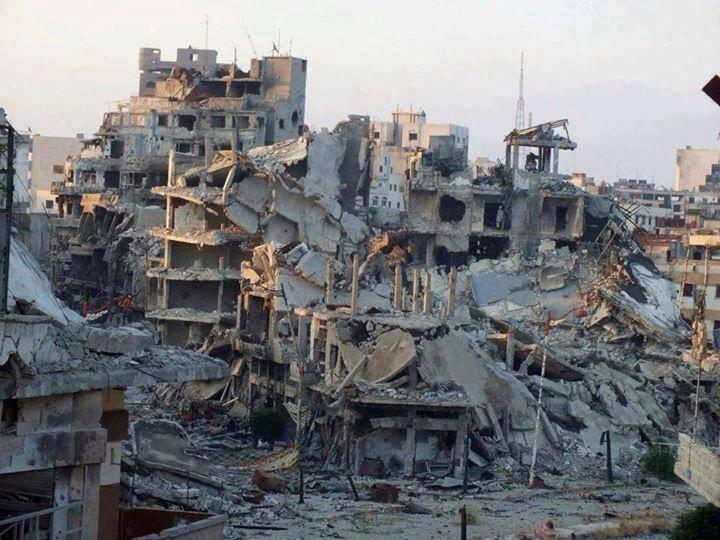
Crude oil is a great source of wealth for the countries that possess it. But it is also a wealth that comes as a cycle. Normally, the cycle spans several decades, even more than a century, so that those who live through it may completely miss the fact that they are heading to the end of their wealth. The cycle is especially visible in those areas where the amount of oil is modest; then, the cycle goes faster; wealth and misery appear one after the other in a dramatic series of events.
One of these rapid cycles of growth and decline is that of Syria. It is a country that never became a major world producer, less than 1% of the world’s total production when it peaked, around 1995. (graph below, from Gail Tverberg’s blog). For the small Syrian economy, however, even this limited amount was important
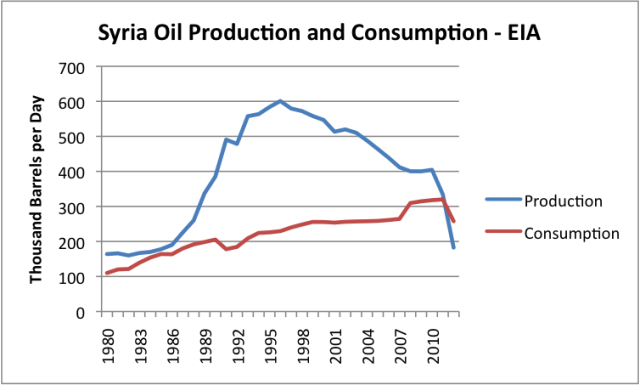
The Syruan oil production went through its unavoidable cycle over a span of little more than three decade. Depletion generated progressively higher production costs and that led to a scarcity of capital investments to keep production increasing. The result was the “bell shaped” production curve that is often called the “Hubbert curve”. Eventually, around 2011, the internal consumption curve crossed the production curve and that transformed the country from an oil exporter to an oil importer. The cross-over point corresponded to the start of the civil war.
The IMF data show that the Syrian government’s budget was still 25% dependent on oil in 2010. Data on what it was earlier on are hard to find, but it is clear that, at the time of the peak, it must have been much larger; surely, at that time, most of the government’s revenues came from oil. Seen in this light, it is not surprising that the complete loss of these revenues generated a big turmoil.
So, we can build up a narrative of what happened in Syria after the peak. With progressively lower oil revenues, the government was less and less able to afford the bureaucracy and the social services it used to provide. Gradually, it became unable to afford an efficient police force and a functioning army. The middle class, that had been strongly dependent on the government’s handouts, was badly hit. The most educated and wealthy ones left the country or, at least, moved their financial assets abroad. Those who were forced to remain saw their assets destroyed by hyperinflation and became an impoverished urban proletariat. At the same time, the countryside also went through an economic disaster, enhanced by the droughts created by climate. At this point, a large number of young men, unemployed and without hope for the future, become easy prey for religious fanatics or for local warlords, often paid by foreign powers interested in carving out the country in pieces to be distributed among themselves. The destruction of whatever was left was also helped by economic sanction and aerial bombardments. The final result is what we see: the “Syrian Sickness.” A nearly terminal form of social sickness; it is hard to imagine when and how Syria will be able to recover even a shade of its former wealth and stability.
The factors that led to the Syrian disaster are by no means limited to Syria alone. Yemen, went through a nearly identical cycle; peaking its oil production in 2002 at levels smaller than those of Syria, but probably even more important for the local economy. The cross-over point of the production and consumption curves took place in 2013 and, like Syria, the country is at present being destroyed by civil war and aerial bombardments. (image from “crudeoilpeak“)

There are several other examples of minor oil producers that went through similar cycles. Egypt, for instance, experienced the cross-over of production and consumption in 2010, experiencing a phase of dramatic civil unrest. Egypt, however, did not collapse; most likely because the importance of oil in its economy was not as large as it was for Syria (naturalresourcegovernance). Other examples of countries that experienced the cross-over are Malaysia and Indonesia, also undergoing internal troubles, but no generalized collapse. No country is completely immune to the Syrian sickness, but some are less sensitive to it.
At this point, the question is obvious: given the known cases of Syrian Sickness, given that depletion is unavoidable, which country is the next in line?
There are several candidates for an upcoming crossover of production and consumption, but none seems to be very close to it. Venezuela, Iran, and Mexico may be the closest candidates; but the critical moment may still be several years away in the future. The most interesting, and worrisome, case is that of Saudi Arabia (data from Mazamascience). Most producers of the Arabian peninsula (with the exception of Yemen) show a similar pattern.

You see that, despite the rapid increase in internal consumption, Saudi Arabia is still able to export about two thirds of its production. How about the future? Of course, extrapolations are always dangerous, but it doesn’t seem that the production and consumption curves are destined to cross each other very soon. Hence, the country might still have a couple of decades of substantial oil export revenues. The problem is that the Saudi economy is heavily dependent on oil: 90% of the government revenues. So, Saudi Arabia may not need to go through the cross-over point to start experiencing troubles; consider that it is nearly completely dependent on imports for the food its population consumes, and that the trend is worsening because of the depletion of local aquifers. You can imagine what the problem could become in case of a substantial loss of financial resources coming from crude oil. If Saudi Arabia starts suffering of the Syrian Sickness, the result disaster may make the Syrian collapse pale in comparison.
Can a country recover from the Syrian Sickness? Maybe, but only if it can manage a substantial supply of financial capital to rebuild its oil industry. It is something that, for instance, Russia did after the fall of the Soviet Union, reversing what had seemed to be an irreversible decline and returning to country to the status of oil exporters. The US also did something similar by investing in the exploitation of its resources of tight (or “shale”) oil. The US didn’t become again an oil exporting country (and probably never will) but it strongly reduced its dependency on imports.
However, these are just stopgap measures. Depletion is an irreversible process; the Syrian Sickness can be postponed, not avoided. A country can only prepare for it by building an alternative energy infrastructure while it still has the financial resources for doing that. Unfortunately, when Syria went through its production peak, renewable energy was not yet as cheap and efficient as it is today. Instead, renewables are nowadays a concrete option for energy production for countries like Saudi Arabia, which have the financial resources for massive investments in that sector. Unfortunately, it doesn’t appear that these investments are being made, with the Saudi government preferring to engage in expensive military power games. That’s a bad idea not only for Saudi Arabia, but for the whole world: with more than 10% of the world’s oil consumption provided by producers in the Arabian Peninsula, you can imagine what might happen if the region falls victim of the Syrian Sickness.
Crude oil has given a lot to Saudi Arabia, crude oil can take back a lot from it. But crude oil cannot provide the wisdom necessary to manage it well and wisdom really seems to be the resource we are lacking most.
Cassandra’s legacy by Ugo Bardi
28 Comments on "The “Syrian Sickness”: What Crude Oil Gives, Crude Oil Can Take Back."
adamc18 on Sun, 22nd Nov 2015 9:29 am
An excellent article.
There are a number of studies which highlight the effect of Syria’s 2006 -2010 drought on rural areas where up to 80% of livestock died, not to mention the effect on food prices. Also, as Ugo says, urban poverty and unemployment were a recipe for unrest among young men.
What is fascinating is that the links between resource depletion, climate change and mass migration are completely overlooked by policy- makers.
paulo1 on Sun, 22nd Nov 2015 10:03 am
Just sent this one on to some friends. Very good article and comment. It is so enjoyable to read a comment, Adam, that is not flippant or designed to attack others. Nice tone you have set to this topic.
bs on Sun, 22nd Nov 2015 11:43 am
The US imports about 7 mbbl/d, 60% of our daily usage. Yet the capital markets are forcing reduction in US production by reduction in exploration and production.
Where is the US policy response to the Syria sickness?
The time horizon is simply too short for the markets. Government policy must provide the longer term solutions.
Fat Lady on Sun, 22nd Nov 2015 1:12 pm
Who were the sickos that bombed Syria ?
apneaman on Sun, 22nd Nov 2015 1:33 pm
Now the truth emerges: how the US fuelled the rise of Isis in Syria and Iraq
http://www.theguardian.com/commentisfree/2015/jun/03/us-isis-syria-iraq?utm_content=buffer917ae&utm_medium=social&utm_source=twitter.com&utm_campaign=buffer
Anonymous on Sun, 22nd Nov 2015 1:39 pm
Actually, Syria has a severe case of Al-CIA-da sickness. AkA ‘ISIS’ these days. Syria didn’t start to come apart because of alleged Syrian oil depletion. It fell apart because of a concerted effort by the US, Israel, and its GCC lackeys(with ‘Nato ally’ Turkey along for the ride to overthrow the Assad gov’t. Multiple goals of course-to destroy an ally of Russia and Iran, to ensure Israel never had to give back the Golan Heights-ever, and as part of a much larger economic energy war against Russia. A lot of the anglo-sphere was there too. Britain, Canada, Australia and others have been complicit while pretending to want to take destroy ‘ISIS’.
This entire article premise is flat out wrong, at least in this specific case. Cleary Prof. Bardi subscribes to the western narrative that the so-called ‘Syrian Civil War’ was a purely internal and spontaneous reaction to the ‘Evil’ Assad gov’t. This article attempts to put a slightly different spin on that false narrative and attribute it to, oil depletion. The fact is, Syria still has (or had) plenty of hydrocarbon resources in what (used) to be its territory. Unfortunately, the US controlled ‘ISIS’ is currently squatting on large portions of Syria atm. Russia and Iran are currently cleaning house though, so there is hope of course.
The idea that Syria had a particularly large segment of unemployed, restless and jihadist tilting young men who all suddenly acquired German, and TOW missile anti-tank systems,and fleets of color matched Hilux pickup trucks to take on the Govt with(all due to oil depletion), is just an assertion, for which no evidence exists or is presented. There are plenty of un, or under-employed young men in North America, the EU, Aus, Britain, too yet they haven’t suffered a oil depletion melt-down. Why not? Because us ‘whiteys’ are ‘civilized’ and young Syrian men are not?
Prof. Bardi is much smarter than this, which makes this article all the more puzzling. I would never dispute that a generalized energy crash IS coming(for all of us), yet there is little or no evidence in this article that ANY of Syria’s current problems are anything other than the direct result of American efforts to topple the Syrian Gov’t and redrawn the map to further American-Zionist ends.
shortonoil on Sun, 22nd Nov 2015 2:31 pm
“There are several candidates for an upcoming crossover of production and consumption, but none seems to be very close to it. Venezuela, Iran, and Mexico may be the closest candidates; but the critical moment may still be several years away in the future.”
How does one miss the very obvious fact that oil is now $41/ barrel; and that oil producers can not make money at $41. They can only keep operating by amassing debt, depreciating out capital stock, pumping down reserves, and liquidating assets. The entire world has now reached the crossover point. The point where it can no longer afford the oil that it is consuming.
http://www.thehillsgroup.org/
Boat on Sun, 22nd Nov 2015 4:36 pm
short,
Wrong, plenty of oil out there that makes money at $40. Some of that oil has been reported to have been developed and is producing for $10. Where do you get your information.
The entire world has now reached the crossover point. The point where it can no longer afford the oil that it is consuming.
Wrong again. The world continued to grow consumption of oil for the 6 years the prices were high. Consumption will continue to grow while prices are low.
apneaman on Sun, 22nd Nov 2015 4:53 pm
boat, which companies are making money? I don’t see a link. Where do you get your information?
Oil, Gas Sector Job Losses Continue To Mount
“Waning commodity prices, which closed Nov. 17 down again at $40.67/bbl (WTI), continue to hit the coffers of oil and gas companies, pushing up the sector’s job losses higher.
Hundreds of thousands of positions have already been cut and unfortunately the reductions keep coming.”
“If data from the quarterly report are accurate, the number of job losses in Texas would be greater than that previously indicated. Regardless, the number of job losses is astonishing.”
“When the upstream oil and gas economy in Texas entered into the current contraction, we estimated jobs lost over the length of the downturn could total 40,000-50,000 jobs,” Ingham said. “We now appear to be well beyond that estimate, and the end is not is sight.”
http://www.epmag.com/blog/oil-gas-sector-job-losses-continue-mount-828001#p=full
apneaman on Sun, 22nd Nov 2015 5:08 pm
Boat, I want to feel happy and hopey tell me some more stories about how awesome the global economy is doing……you and the PTP are the only ones left.
Abandon ship: Baltic Dry index hits record low
A leading indicator of world economic growth, the Baltic Dry, has plunged to its lowest ever level
http://www.telegraph.co.uk/finance/markets/12005765/Abandon-ship-Baltic-Dry-index-hits-record-low.html
METALS-Zinc, lead hit multi-year lows, copper near 6-year low
http://www.reuters.com/article/2015/11/11/global-metals-idUSL8N13639H20151111
As stock buybacks reach historic levels, signs that corporate America is undermining itself
http://www.reuters.com/investigates/special-report/usa-buybacks-cannibalized/
New York Fed: Household debt at highest level since 2010
http://www.cnbc.com/2015/11/19/new-york-fed-household-debt-at-highest-level-since-2010.html
shortonoil on Sun, 22nd Nov 2015 5:17 pm
“short,
Wrong, plenty of oil out there that makes money at $40. Some of that oil has been reported to have been developed and is producing for $10. Where do you get your information.”
There was 4 Gb discovered in 2013; 12% of what the world consumed. Now who exactly did you mention that had replaced their reserves in 2015. If a producers is not replacing their reserves they are consuming their assets, and that is not making money. Get your facts straight!
shortonoil on Sun, 22nd Nov 2015 5:26 pm
By the way, those reserves (assets) are now worth 40% of what they were worth 2 years ago. Just because they have not yet been written off the holders books, doesn’t make them worth anymore than they are.
makati1 on Sun, 22nd Nov 2015 7:04 pm
“What Crude Oil Gives, Crude Oil Can Take Back.”
And is doing so to all oily countries including the US. All of the party favors are broken or trashed and the punch bowl is about empty. It’s 3 Am and there’s a sub-zero blizzard outside. No one who came to the party in the Spring are dressed for the trip home. Most will not make it. Why? The last sentence answers that question.
“… wisdom really seems to be the resource we are lacking most.”
Excellent article as usual.
makati1 on Sun, 22nd Nov 2015 7:19 pm
Shortonoil, I am still a bit confused about cheap oil and profit. If an oil worker in the US makes, say $25/hr on average, and an oil worker in say, Venezuela, makes the equivalent of $5/hr. Doesn’t that affect the price at which the company can make a profit?
For instance, Russia’s oil workers are paid in rubles, not dollars. And the ruble was devalued by a significant percent over the last year. They are still paid the same amount of rubles per hour. That surely affects the point where a country can break even?
I know that the entire monetary system is so convoluted that it would be difficult to compare apples to apples and not the apples to bananas we see today. Why don’t we have news sources that explain the difference when they proclaim a country is in trouble?
I know this is a long question, but how much is wages involved in the cost of producing a barrel of oil? 1% 10% 20% More? Less than 1%? Please educate me. This has been on my mind since the oil plunge last year.
rockman on Sun, 22nd Nov 2015 8:18 pm
I won’t go into detail but most are confusing the conversation again by loose terminology. First “making money” and “making a profit” aren’t very useful metrics. And “producing oil” (and “making money” by doing such) is still being used to refer to two very different dynamics: the cost (and profit) from producing an existing well and the cost (and profit) of drilling new wells. And “companies” aren’t making profits or losing money. That happens with individual companies. But even that distinction needs clarification: are they losing/making money producing existing wells? Lots of companies with very poor rates of return (even those with net negative ROR) are making very nice cash flows at the current price. IOW they are profitably producing wells from which they’ll never recover 100% of their investment. And there were more then a few companies that had negative ROR’s when oil was selling for $100/bbl. And today the Rockman and a some other companies are drilling profitable 17,000′ vertical wells in the Smackover formation in Mississippi at current prices.
It’s very easy to make generalized statements about anything. But that’s typically because those statements really don’t add much to the discussion other then someone countering with another general statement.
twocats on Sun, 22nd Nov 2015 8:47 pm
I really like this article, it’s a great parallel to the factor of climate change as adding stress to these systems. It was mentioned that it was really the US/CIA factor and the active attempt to undercut Assad, and not peak oil. I don’t know as Bardi would disagree, but he would stress that these maneuvers by proxies would NOT HAVE BEEN AS EFFECTIVE if Assad had been able to maintain his spending power. I don’t know enough about Syria either way, but his argument vis-à-vis Yemen, Egypt, Syria passes at least the sniff-test. It’s not a ridiculous thesis. (Didn’t Egypt peak right around its revolution(s)? And don’t forget Egypt is like #1 receiver of US aid in the world, or some such thing.)
I was a little disappointed in his “likely candidates” scenario. I mean, I know Saudi Arabia is extravagant in terms of expenditures and has few other industries / agriculture, but we are talking about Saudi Arabia – top three largest producer, top three largest exporter (right?). He lost me there. If he had said like Vietnam or Trinidad Tobago (just examplee! Don’t get all worked up.), or some other country and shown how production was about to cross consumption and how it had such & such underlying industrial or agricultural base, then it would have been an extremely good article. As such, it’s more of an introduction to a discussion.
Boat on Sun, 22nd Nov 2015 10:27 pm
apeman.
You know how to read. If you want to know any companies financial history it is available.
GregT on Sun, 22nd Nov 2015 11:04 pm
@Boat,
You obviously don’t know how to read, because if you did, you wouldn’t continuously be spewing such complete and utter nonsense.
theedrich on Mon, 23rd Nov 2015 1:29 am
¿Syrian sickness? What about Ø’s murder of Syria? It is a simple fact that the U.S. government (White House, CIA, Pentagon, &c.) generated the “civil war” in that country. The usual mendacity about how evil a country’s ruler is — often “proven” by false-flag ops — allegedly gives America the right to regime-change that ruler by subversion. An electorate so twisted as to choose a creature from the abyss for its president can not possibly understand that its new Dark Lord must do as Israel and other stringpullers say. Nor does it care that this is not 1941, when an American president could ensnare another country into launching a “surprise” attack (covertly planned by the selfsame prez) on it.
Yet in listening to all of the “experts” pontificate on the Syrian and ISIL situation, with nauseating regularity one hears references to World War II and the nasty Nazis, and how brave G.I. Joe won that war single-handedly, etc., etc. (Korea and Vietnam have been stuffed down the memory hole.) And constantly, the arguments used to justify American aggression and mass murder are couched in moralistic terms — again, with frequent references to WW II. Given that America is the most religious (= Christian) of all the Western nations, such cloying moralism sells well. And it is so nice that we have airplanes that can bomb Syria, thereby killing without being killed. So how long will it be before some righteous Judeo-Christian in the Pentagon decides to call for nuking Damascus? Without question, Yahweh will approve of it.
Davy on Mon, 23rd Nov 2015 2:46 am
Thee said “It is a simple fact that the U.S. government (White House, CIA, Pentagon, &c.) generated the “civil war” in that country.”I don’t buy it Thee. The Syrian tragedy is an osmosis of problems. This tragedy is a multifaceted evolution of problems and issues that resulted in a Syria we see today.
The starting point is a brutal regime supported by the Soviets then Russians for decades. You have Assad’s power plays in Lebanon and with Israel. You have Assad’s support of Hezbollah and its battles with Israel. These power plays made enemies. We have the religious issues ethnicities in strife that brewed above ground with lack of opportunities for the Sunni majority and under the surface with Sunni repression by minority rulers. We have mass killings during Sunni uprisings from the past. There is the issue of population growth and the resulting pressures with the corresponding decline in oil revenues and the drought. All these issues provided a breeding ground for various powers to meddle and stir the soup of discord.
Yes, the enemies of Assad took advantage of that. The US was a part of that. The US did not generate a civil war it evolved from multiple factors. The US and a few others added the catalyst that allowed this to blow up. This is realpolitik not kumbya camp. Assad focked up and Assad made enemies. He got what was coming to him. The Syrian people were sacrificed by all sides in this deadly serious political game. Your statement is like the many on this board that are agenda based. It is not that you are wrong it is you are misleading with your emphasis and intended message.
shortonoil on Mon, 23rd Nov 2015 7:41 am
“Shortonoil, I am still a bit confused about cheap oil and profit.”
If a company “only” has 100 widgets, and the market value of a widget is $1 the company has $100 in assets. If the market value of widgets falls to 40 cents the asset base of the company is now $40. If the company made $10 selling widgets that year its P&L will show a loss of $50 for the year; that is, if they are keeping an honest set of books. Replace widgets with barrels of oil, and the same thing occurs. With oil falling from $100 to $40 these companies should be writing off their declining asset values as an expense. Unless the price of oil increases, they will probably never replace the lost value to their asset base, which is primarily their reserves. If they carry their losses forward, that is they amortize them, most of them will probably never again show a profit before their fields are depleted out. When oil prices fell from $100 to $40 a huge piece of the world’s capital stock was destroyed, and the chances are it will never be retrieved:
http://www.thehillsgroup.org/depletion2_022.htm
What we are saying is that because of the effects of depletion the actual value of a barrel of oil has fallen. That is derived from an energy analysis of the world’s Petroleum Production System. Of course, the bookkeepers of the world will be trying to hide that fact for as long as possible. Their paychecks depend on it being otherwise!
http://www.thehillsgroup.org/
bug on Mon, 23rd Nov 2015 7:46 am
Short, but don’t accounting firms that work for the banks that are lending money to the oil firms have something to say about this, as to protect banks?
Davy on Mon, 23rd Nov 2015 8:18 am
Short, Makster is trying to get you to buy into his agenda of the west is screwed because of higher operating costs and the developing world will do better because of lower costs. He is setting a trap for you which of course you avoided above. This issue of oil production economics is not about labor costs as much as the whole economics of the oil complex. Labor is not the most significant portion of bringing oil to market. Makster is always looking for an edge with his agenda. You got to hand it to the guy he is tenacious in his hatred and resentment of the west.
shortonoil on Mon, 23rd Nov 2015 8:27 am
“Short, but don’t accounting firms that work for the banks that are lending money to the oil firms have something to say about this, as to protect banks?”
If shale is any indication of what will happen, the banks will try to keep these outfits in business for as long as possible. They definitely don’t want to own, and have to operate an oil company. They don’t know how, and they know that they don’t. Also, these firms aren’t doing anything illegal (as of yet). The IRS allows them to carry losses forward for seven years. They don’t have to write them off immediately. The world is still hoping, and praying that prices will go back up; we are saying that they can’t go up enough to bail out the industry. This is charms, amulets against evil, and spells vs physics. We have found that the spells usually don’t work very well!
http://www.thehillsgroup.org/
Dredd on Mon, 23rd Nov 2015 9:34 am
“What Crude Oil Gives, Crude Oil Can Take Back”
Nope.
When your planet is dead you’re also dead.
Poisoners gotta poison.
yellowcanoe on Mon, 23rd Nov 2015 11:15 am
The author believes that Egypt avoided a collapse when its domestic oil consumption and production lines crossed because it has a more diversified economy. My impression though is that it is money from Saudi Arabia and other Gulf states that is keeping the Egyptian government afloat. Given the impact that low oil prices are having on Saudi Arabia I have to wonder how much longer they can keep propping up Egypt?
makati1 on Mon, 23rd Nov 2015 11:55 pm
yellowcanoe, don’t forget the US:
Question: What is the breakdown of U.S. aid to Egypt? What money has been paid out and what is left?
Answer: The Egypt bilateral foreign assistance budget for FY2014 is approximately $1.5 billion and includes $1.3 billion in Foreign Military Financing (FMF) – $200 million in Economic Support Funds; and over $7 million for other security assistance programs, including International Military Education and Training, International Narcotics Control and Law Enforcement, and Nonproliferation, Antiterrorism, Demining and Related Programs.
http://www.state.gov/r/pa/prs/ps/2014/04/225147.htm
The Egyptian National Budget is about $100 billion.
https://www.cia.gov/library/publications/the-world-factbook/geos/eg.html
And that does not count the ‘under the table’ contributions of weapons, etc.
theedrich on Tue, 24th Nov 2015 3:23 am
Davy, by the U.S. government’s “taking advantage” of the Syrian problems, it gravely exacerbated that gruesome situation. I have an son-in-law, an ex-Special-Ops man recently retired from the Army and back home with severe PTSD, who told us several years ago that northern Lebanon was awash in money and materiel meant to regime-change Syria. In addition, every country in MENA is trying to undermine the government of every other country there. Given the ancient tribal nature of the Mohammedans with their “high culture,” only dictators like Saddam Hussein can keep any semblance of order in such lands. The idiot savants in the White House, CIA, State Department and Pentagon, let alone in the Council on Foreign Relations, are unable to understand this. They fantasize that they can turn such primitives into nicey-nice, democracy-loving peaceniks licking U.S. boots if they just treat them to enough shock and awe. (Israel’s complicity in driving our intervention can also not be overlooked.) Of course, none of these “experts” believe in evolution and the different evolutionary levels of human races. Even to mention that in their hothouses would be to have them cast out into the outer darkness without employment. No, the U.S. is an incompetent interloper in the Middle East. And this, at a time when we are clearly headed for bankruptcy ourselves.