
Peak Oil is You

Donate Bitcoins ;-) or Paypal :-)


Page added on October 20, 2015

A Pessimistic View On Big Oil
Summary
A macroeconomic view on the future of Big Oil in my lifetime.
Declining reserves of economically viable oil create a pessimistic view for Big Oil companies.
Political initiatives to cut reliance on oil for energy security.
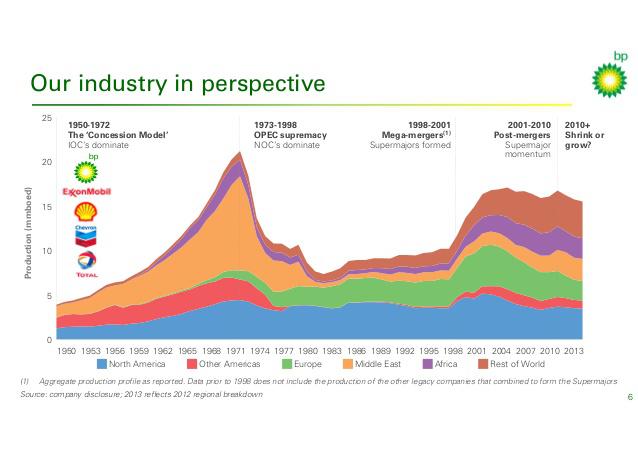
‘Big Oil’ is described as the Supermajors of the oil companies that operate around the world. This list includes: Exxon Mobil XOM, BP, Royal Dutch Shell RDS.A, Chevron CVX, Total TOT, Saudi Aramco, Eni and sometimes ConocoPhillips COP. This article will provide a pessimistic outlook for the macroeconomic conditions that are becoming evident for the future of Big Oil as exploitable reserves decrease and global pressures push for a shift to a greater use of renewable energy to secure energy security.
According to a study by BP, total proved oil reserved totaled 1700.1b barrels at the end of 2014. Although this might seem like a huge amount, this only equates to 52.5 years of global production. This figure is of course subject to a number of variables in the future such as: future investment in exploration and development, future global oil demand and the extent to which renewable energy usage plays a part of global consumption.
It should also be noted that global energy consumption is decreasing. Bob Dudley (CEO of BP) stated in 2015,
Global primary energy consumption increased by just 0.9% in 2014, its slowest rate of growth since the 1990s, other than immediately after the financial crisis.
Effects of declining reserves
To focus on the effects on Supermajors in an area of declining production, look no further than what is happening in the North Sea. The North Sea was once one of the most prominent oil producing areas in the world. Production started in the 1970s, producing several millions of barrels of oil per day to reach its peak in 1999, from where it has declined ever since. This has declined down to 1.42 barrels being produced per day in 2014, a decline of approximately 70% from the 1999 peak. This is shown from the graph below.
(click to enlarge)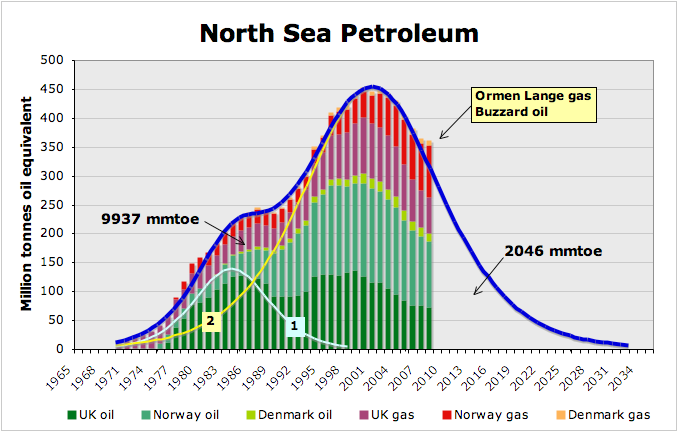
Although it has been exemplified by the lower price of oil, investment in the North Sea has declined dramatically, and this is set to continue. Capital investments in the North Sea this year were £14.8b and are set to fall by £2-4b over the next four years.
In addition to this, as the oil fields have been maturing further, Supermajors have been selling off assets to smaller niche firms that have special technical expertise to exploit reserves that are harder and more expensive to reach. Instead, Supermajors are being offered licenses for exploration and production in ‘frontier’ areas of the UK, where harsher conditions and deeper waters require higher financial capabilities. The frontier areas also carry higher risk and costs as less proven reserves have been discovered and little infrastructure exists to support the transportation of hydrocarbons.
This format is expected to be followed in other maturing provinces around the world as some argue that we may be seeing ‘peak global oil’ with proven reserves having only increased 0.4% from 2013-2014. This is expected to fall even further this year as investments in further production has decreased dramatically as the price of oil has plummeted from $100+ per barrel to under $50.
These factors are expected to create a harsh long term outlook for the Supermajors as their ability to create enough cash flow to cover costs and dividend payments with declining global production is diminishing.
The Arctic
The Arctic is seen to be the next major source of hydrocarbons over the next few decades. According to the U.S Geological Survey (USGS), the estimated total amount of undiscovered hydrocarbon resources in the Arctic is 413b boe (about 22% of global undiscovered conventional oil and gas resources). These estimates equate to the Arctic’s share of non-OPEC supply is increasing from a rise of 16% in 2010 to 31% by 2050.
Although this large amount of undiscovered reserves may seem a huge positive for oil majors, it comes with many qualifications.
Firstly, there is no international treaty on the Arctic at present as what is considered ‘the Arctic’ can be disputed as it is not a single land mass such as Antarctica. This creates many uncertainties in determining which countries can drill where. As oil majors are very reluctant to invest heavily when their legal positions are very much in doubt, progress in further production may be very slow.
Secondly, the Arctic has some of the most technically challenging conditions to explore and produce hydrocarbons. While the oil price remains low, it is not commercially viable to exploit the reserves when there is plentiful supply from cheaper middle eastern countries.
Evidence of the Arctic’s problems has been recently proven by Shell’s retraction from exploring and drilling this month after allegedly only finding traces that were not commercially viable.
In addition to this, the US has pulled the plug on exploring and developing hydrocarbons in the foreseeable future. It has cancelled plans to sell more drilling leases in the Alaskan regions and has refused to extend leases given to Shell and Statoil.
The above reasons should result in a lowered global guidance of oil and gas production.
Political Pressures to increase percentage of energy consumption to renewable energy
As climate change becomes an ever increasing issue that needs attention, countries around the globe are creating new regulations to combat green house gas emissions and move towards higher consumption of renewable energy.
An example of this come from the European Union. In 2007, the European Council agreed to adopt an overall binding target of 20% renewable energy consumption within total energy consumption in the EU by 2020. This was implemented in the Directive 2009/28/EC. These targets are expected to increase beyond 2020. The overall effect of this will be increased spending initiatives on renewable energy projects and a reduced reliance on oil and gas for energy security.
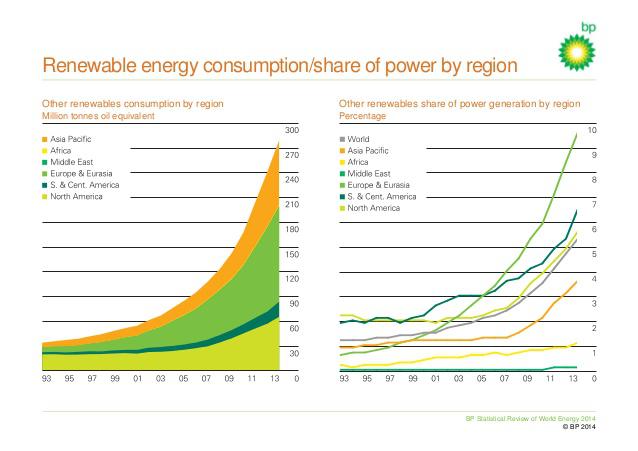
Similar regulations are being put in place across the globe, which is having the effect of a rapid increase in renewable energy consumption as a percentage of total energy consumption.
For the long term investor
For these reasons, I think it would be prudent for very long term investors to realise how energy consumption is changing in this century and should realise that holding dividend aristocrats such as Exxon and Chevron, with an exemplary history of increasing dividends might not be able to continue this over the next few decades.
Conclusion
The playing field is changing in the oil and gas sector. Many more reserves in the world are maturing leading to production being taken over by smaller niche oil and gas production companies rather than Supermajors. In addition, the low oil price and global regulatory reform on climate change is hampering the outlook for Supermajors to invest in commercially viable projects to increase production. The only way for Supermajors to secure financial security for shareholders over the next few decades is for both the oil price to increase over time and to increase their share of revenues from non green house gas emitting hydrocarbons.
8 Comments on "A Pessimistic View On Big Oil"
BobInget on Tue, 20th Oct 2015 5:07 pm
http://militaryedge.org/articles/state-department-approves-11-25-billion-sale-multi-mission-warships-saudi-arabia/
State Department Approves $11.25 Billion Sale of Multi-Mission Warships to Saudi Arabia
makati1 on Tue, 20th Oct 2015 7:46 pm
Alpha is still seeking unicorns and suckers…
BC on Tue, 20th Oct 2015 8:12 pm
https://research.stlouisfed.org/fred2/graph/fredgraph.png?g=2cri
https://research.stlouisfed.org/fred2/graph/fredgraph.png?g=2cqs
https://research.stlouisfed.org/fred2/graph/fredgraph.png?g=2cr8
https://www.cbo.gov/sites/default/files/114th-congress-2015-2016/reports/50878-MBR.pdf
Private final sales (FS) per capita have stalled and the deficit/FS is set to increase.
Prepare for a “stimulating” 2016-17 (to 2018-20?), a deficit/FS of ~15-16% (SAAR) at some point, and the Fed’s balance sheet at, or near, 40% of FS and approaching ~100% of bank loans less inter-bank loans, charge-offs, and delinquencies, i.e., effectively no fractional reserve lending at that point.
Ready, gents?
Jerry McManus on Wed, 21st Oct 2015 1:52 pm
God only knows, financial security for shareholders is way, WAY more important than a functional biosphere.
GregT on Wed, 21st Oct 2015 1:57 pm
Yah, what do we need the Earth for anyways? With enough money we could colonize the Moon.
ghung on Wed, 21st Oct 2015 2:02 pm
“…we could colonize the Moon.”
Yeah, send all the fat people up there so they won’t need hip and knee replacements at 40.
GregT on Wed, 21st Oct 2015 2:47 pm
“Yeah, send all the fat people up there so they won’t need hip and knee replacements at 40.”
And with all the money that we save, the rest of us could colonize Mars. A win win.
apneaman on Wed, 21st Oct 2015 3:21 pm
ghung, like I mentioned yesterday. A society based solely on increasing profit that externalizes everyone and everything makes for sick people. Sedentary lab rats in the most mental system ever devised.
Why It Was Easier to Be Skinny in the 1980s
A new study finds that people today who eat and exercise the same amount as people 20 years ago are still fatter.
http://www.theatlantic.com/health/archive/2015/09/why-it-was-easier-to-be-skinny-in-the-1980s/407974/
Food cravings engineered by industry
How Big Food keeps us eating through a combination of science and marketing
The New York Times investigative reporter spent four years prying open the secrets of the food industry’s scientists.
“This was like a detective story for me, getting inside the companies with thousands of pages of inside documents and getting their scientists and executives to reveal to me the secrets of how they go at this,” he said. What he found became the title of his new book, Salt, Sugar Fat: How the food giants hooked us.
“I was totally surprised,” he said. “I spent time with the top scientists at the largest companies in this country and it’s amazing how much math and science and regression analysis and energy they put into finding the very perfect amount of salt, sugar and fat in their products that will send us over the moon, and will send their products flying off the shelves and have us buy more, eat more and …make more money for them.”
http://www.cbc.ca/news/health/food-cravings-engineered-by-industry-1.1395225
The Youngest Case Of Type 2 Diabetes Ever Recorded Highlights An ‘Emerging Epidemic’
http://thinkprogress.org/health/2015/09/23/3704715/young-girl-diabetes-diet-change/
Hey, it’s all about personal choice. Like depression, it’s in your head and just a matter of personal weakness and low character. Don’t worry folks, in addition to the knee and hip replacements, we can sell you a shitload of stuff to help you make the right choice or at least not feel anything – diabetic meds, oxygen tanks, allergy meds, liposuction, scooter chairs, gastric bypass surgery, anti everything meds and now Abilify. Also on offer is a few hundred billion dollar a year diet, supplement and exercise industry (permanent weight loss at a whopping 2% success rate) and a shit load of self help books to help you make the right personal choices and build character – get the audio version and listen on your 2hr daily commute and helicopter parenting trips. Of course you will have to do most of this in what remains of your free time. Now get back to your cubicle, get in that chair and get to work.
Parents investigated for neglect after letting kids walk home alone
“It was a one-mile walk home from a Silver Spring park on Georgia Avenue on a Saturday afternoon. But what the parents saw as a moment of independence for their 10-year-old son and 6-year-old daughter, they say authorities viewed much differently.
Danielle and Alexander Meitiv say they are being investigated for neglect for the Dec. 20 trek — in a case they say reflects a clash of ideas about how safe the world is and whether parents are free to make their own choices about raising their children.
“We wouldn’t have let them do it if we didn’t think they were ready for it,” Danielle said.”
https://www.washingtonpost.com/local/education/maryland-couple-want-free-range-kids-but-not-all-do/2015/01/14/d406c0be-9c0f-11e4-bcfb-059ec7a93ddc_story.html
And remember kids to always listen to teacher
Iowa teacher takes his ‘McDonald’s diet’ for losing weight to schools, irks critics
http://economictimes.indiatimes.com/magazines/panache/iowa-teacher-takes-his-mcdonalds-diet-for-losing-weight-to-schools-irks-critics/articleshow/49373648.cms
There will be plenty of weight loss in the future when the twisted demented techno industrial society that created these unfortunates collapses under it’s own weight.