
Peak Oil is You

Donate Bitcoins ;-) or Paypal :-)


Page added on October 15, 2015

Research Shows Promise for Economical Deepwater Production

When it comes to offshore advancements, Australia is on the cutting edge of developing technology aimed at lowering the costs of deepwater production.
One of those advancements is mobile mudmats, or offshore foundations that gently slide along the seabed rather than remaining in place – much like a skyscraper slightly bends with the wind.
During the mudmats’ first experimental tests, which began in late 2013 in the geotechnical centrifuge at the Centre for Offshore Foundation Systems (COFS) at the University of Western Australia, the new technology showed excellent performance, indicating that it can contribute to economically producing hydrocarbons from remote locations or from deepwater fields, said Susan Gourvenec, a professor of offshore geomechanics at COFS, to Rigzone.
COFS is renowned for offshore technology advancements and boasts the largest number of geotechnical researchers in the world, said Mark Randolph, Fugro Chair of Geotechnics and founding director of COFS, to Rigzone.

Australia’s many hard-to-reach gas fields coupled with the country’s complex seabed composition have driven the success of COFS, which is funded by industry and the government.
“We continually strive to be at the leading edge of offshore developments, including mobile foundation technology,” Randolph said, adding that the technology spotlight has been thrown on Australia as Royal Dutch Shell plc plans to introduce the world’s first floating liquefied national gas facility off the country’s northwest coast.
Moving Mudmats
In relatively shallow waters with relatively simple seabed compositions, fixed foundations can work well because they are often small enough to be installed on the seafloor by the same vessel that lays the subsea pipelines – saving operators money, Gourvenec explained.
When in place, the mudmat foundations support the pipeline infrastructure that connects individual wells to manifolds and carries the hydrocarbons across the seabed to a fixed or floating facility, Gourvenec said.

As the industry moves into deeper waters, the soils of the seabed become softer and more precarious, requiring larger and more substantial foundation systems. The traditional design requirement that a foundation should remain fixed leads to a size and weight of mudmat that must be installed by a specialized vessel, which can quickly escalate project costs, Gourvenec explained.
Allowing the foundation to tolerably slide in response to pipeline thermal expansion loads enables foundation footprints to be reduced. Ultimately, reduced footprint size enables the mobile mudmats to be fabricated and installed more cost-effectively, Gourvenec said.
Once installed, mobile mudmats are designed to slide along the seabed in tandem with the thermal expansion and contraction of the attached pipelines.
Gourvenec explained that as hot gas or oil flows through the pipes, the pipes expand. As they expand, the mobile mudmats slowly slide in response to the expansion force, and may move a meter or more in each direction. When the pipeline is turned off and subsequently cools and contracts, the mudmats slide back.
Testing Phases
While field records of mobile mudmat behavior through a full working life do not yet exist, simulations of their whole-life behavior have been completed in COFS’ Geotechnical Centrifuge Centre – home to the busiest geotechnical centrifuge in the world. There, the technology has been tested on a small-scale level at accelerated gravity levels. These tests allow field-scale soil stresses to be replicated correctly and field-scale time-dependent processes to be accelerated.
“Our experimental setup allows 50 years of subsea operations to be simulated in 48 hours while the centrifuge runs continuously. This allows us to quantify the progressive sliding of the foundation, as well as any accumulated settlement and tilt,” Gourvenec said. “From what we have seen so far, it appears that mobile foundations work well in realistic field conditions, and our work is allowing us to optimize the shape of the foundations and develop prediction tools for their performance.”
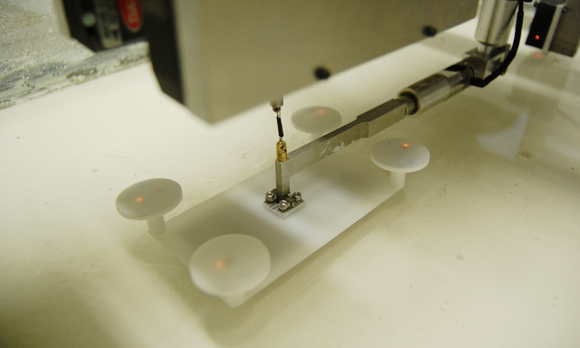
The team is currently developing a theoretically-based framework to describe the response of the seabed during the operating life of a mobile mudmat. This will provide a tool to allow designers to make reliable predictions of mobile foundations’ response.
The end goal is to develop a generalized design tool for commercial use.
Industry Calls
Calling mobile mudmats the next “logical” step in geotechnical advancements, Gourvenec said that the offshore industry has been navigating in the direction of tolerably mobility by allowing pipelines and other infrastructure to move – albeit in a controlled manner – to relieve unwanted loads, whether caused during installation or operation.
Bespoke commercial design work for mobile mudmats has been spearheaded by COFS’ close industry partner, Fugro Advanced Geomechanics (Fugro AG), which sponsors Randolph’s Fugro Chair in Geomechanics. The company developed designs for mobile mudmats that are being used for major oil and gas projects offshore northwest Australia, drawing on centrifuge modeling results from COFS. Its work has resulted in this technology being deployed for the first time offshore Australia, unlocking more efficient field architecture.
COFS’ and Fugro AG’s research work has been published to wide industry acclaim. It is leading toward a generalized design framework for tolerably mobile foundations, validated by field experience that will enable this technology to be deployed more routinely, and more cost-effectively.
Driven by the industry’s needs for less costly deepwater production, COFS’ research on mobile mudmats for commercial use is currently being supported by a 3-year grant from the Australian Research Council, Gourvenec said.
Mobile mudmats are one of a handful of new technologies being researched at COFS to facilitate deepwater developments. Others include efficient systems for fatigue design of steel catenary risers; higher performance drag or plate anchors; taut-wire mooring systems; prediction tools to support the design of subsea pipelines with lateral buckling to relieve internal loads; and new tools to characterize the properties of the seabed in situ.
“These types of technologies can be used as more economical ways to appraise and produce hydrocarbons that would otherwise remain stranded,” Gourvenec said.
Now, in particular, the industry is working to move forward despite the decline in oil and gas prices, Randolph said. Developments such as mobile mudmats are an effort to help lower the costs of production in areas that don’t typically contain the low-hanging fruit on the hydrocarbon tree.
5 Comments on "Research Shows Promise for Economical Deepwater Production"
makati1 on Thu, 15th Oct 2015 7:48 pm
Hype or hope? My bet is on hype or plain bullshit. Gotta keep the suckers on board.
ghung on Thu, 15th Oct 2015 10:15 pm
How clever. Burn it. Burn it all!
rockman on Fri, 16th Oct 2015 7:18 am
I assume they are just referring to offshore Aussieland since there’s been “economica Deepwater production” in the Gulf of Mexico for the last 36 years. Not an engineer but while it sounds neat I doubt it will turn an uneconomical Aussi discovery into one that can be justified.
penury on Fri, 16th Oct 2015 11:02 am
All you need to know. FF are getting more difficult to supply and the expense will reflect that. People are broke and getting poorer by the day. The oil age is ending, and the age of gas is not far behind. Debt jubilee? or bankruptcy apparently are the only choices for most nations.
shortonoil on Sat, 17th Oct 2015 7:27 am
It costs $X dollars to lift Y barrels of oil, and Z barrels of water L feet.
When they get their anti-gravity machine perfected, hope they let us know?