
Peak Oil is You

Donate Bitcoins ;-) or Paypal :-)


Page added on October 1, 2015

The Exxons of Agriculture

It goes without saying that oil and coal companies should not have a seat at the policy table for decisions on climate change. Their profits depend on business-as-usual and they’ll do everything in their power to undermine meaningful action.
But what about fertiliser companies? They are essentially the oil companies of the food world: the products they get farmers to pump into the soil are the largest source of emissions from farming.1 They, too, have their fortunes wrapped in agribusiness-as-usual and the expanded development of cheap sources of energy, like shale gas.*
Exxon and BP must envy the ease their fertiliser counterparts have had in infiltrating the climate change policy arena. World leaders are about to converge for the 21st Conference of the Parties (COP21) in Paris in December, but there is only one major intergovernmental initiative that has emerged to deal with climate change and agriculture – and it is controlled by the world’s largest fertiliser companies.
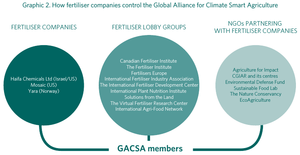
The Global Alliance for Climate Smart Agriculture, launched last year at the United Nations (UN) Summit on Climate Change in New York, is the culmination of several years of efforts by the fertiliser lobby to block meaningful action on agriculture and climate change. Of the Alliance’s 29 non-governmental founding members, there are three fertiliser industry lobby groups, two of the world’s largest fertiliser companies (Yara of Norway and Mosaic of the US), and a handful of organisations working directly with fertiliser companies on climate change programmes. Today, 60% of the private sector members of the Alliance still come from the fertiliser industry.2
Corporate smart agriculture
One possible explanation for the fertiliser industry’s successful policy coup is that its role in climate change is poorly understood and severely underestimated. People associate Shell, not Yara, with fracking. But it is Yara that coordinates the corporate lobby for shale gas development in Europe, and it is Yara and other fertiliser companies that suck up most of the natural gas produced by the fracking boom in the US.3
Fertilisers, especially nitrogen fertilisers, require an enormous amount of energy to produce. Estimates are that fertiliser production accounts for 1-2% of total global energy consumption and produces about the same share of global greenhouse gas (GHG) emissions.4 This production gets bigger every year. Supplies of nitrogen fertiliser, which is produced almost entirely from natural gas, are expected to grow nearly 4% per year over the next decade.5 And this production will increasingly rely on natural gas from fracked wells, which leak 40 to 60 percent more methane than conventional natural gas wells. (Methane is 25 times more potent than CO2 as a greenhouse gas.)6
Production, however, accounts for only a small fraction of the GHG emissions generated by chemical fertilisers. Most emissions occur once they are applied to the soil.
The International Panel on Climate Change (IPCC) estimates that for every 100 kg of nitrogen fertiliser applied to the soil, one kg ends up in the atmosphere as nitrous oxide (N2O), a gas that is 300 times more potent than CO2 as a greenhouse gas and is the world’s most significant ozone-depleting substance. In 2014, this was equivalent to the average annual emissions of 72 million cars driven in the US – about a third of the US fleet of cars and trucks.7
New research, however, shows that these alarming numbers are at least three to five times too low. The use of chemical fertilisers this year will likely generate more GHG emissions than the total emissions from all of the cars and trucks driven in the US! (See box: The fertiliser footprint)
The fertiliser industry has long known that their chemicals are cooking the planet and there is a growing body of evidence that shows that their products are not needed to feed the world. Farmers can stop using chemical fertilisers without reducing yields by adopting agroecological practices.8 This was the conclusion supported by the 2008 International Assessment of Agricultural Knowledge, Science and Technology for Development (IAASTD) – a three-year intergovernmental process involving over 400 scientists that was sponsored by the World Bank and all of the relevant UN agencies.9
Faced with this dilemma, the fertiliser companies have moved aggressively to control the international debate on agriculture and climate change, and to position themselves as a necessary part of the solution.
Fronting for fertilisers
“There have been several organisations advocating at the international level for sustainable agriculture to be interpreted as synonymous with agro-ecology. However, agro-ecology has unfortunately come to represent principles which reject the use of farming inputs. Therefore, initiatives such as the Global Alliance for Climate Smart Agriculture are important to ensure the UN system adopts decisions that are reflective of modern agriculture.”
– Canadian Federation of Agriculture10
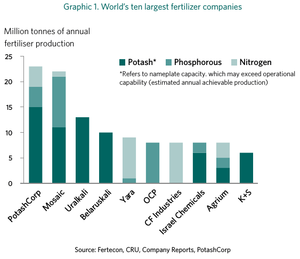
The global fertiliser industry is dominated by a handful of corporations. Yara, which is over 40% owned by the Norwegian government and its state pension fund, dominates the global market for nitrogen fertiliser, while US-based Mosaic and a few companies in Canada, Israel and the former Soviet Union operate cartels that control the global potash supply. Mosaic is also the leading producer of phosphates.
These companies are collectively represented by a number of lobby groups. The main ones at the global level are The Fertiliser Institute, the International Fertiliser Industry Association and the International Plant Nutrition Institute. Fertiliser companies are also represented by energy consumer lobby groups such as the International Federation of Industrial Energy Consumers. Yara chairs its Gas Working Party, which, in collaboration with Fertilisers Europe, is lobbying heavily for shale gas development in the European Union (EU).11
The fertiliser companies and their front groups play an active role in various alliances that they have formed with other corporations from the food and agriculture sectors to define and protect their collective interests on policies related to the environment and climate change.12
In North America, for instance, Yara and other fertiliser companies and lobby groups co-founded the Alliance for Sustainable Agriculture (“Field To Market”) alongside other major food and agribusiness companies like Walmart, Kellogg’s and Monsanto. Also active in this alliance are big US environmental non-governmental organisations (NGOs) such as the Environmental Defense Fund (EDF) and the The Nature Conservancy (TNC). These NGOs work directly with Yara, Mosaic and other fertiliser companies on “climate smart” fertiliser efficiency programmes that Walmart, PepsiCo, Campbell’s and other major food companies and retailers are using as a basis for their internal GHG emissions reduction plans (See box: Pollution as the solution).
The same NGOs and fertiliser front groups are behind Solutions from the Land, a US alliance of agribusiness corporations and corporate farmers established to defend industrial agriculture from environmental regulations, initially dealing with the destructive impacts on waterways from chemical fertiliser run-off and now focusing on climate change.
“We’re scared to death we’ll get hijacked by some groups that oppose technology,” explains Solution from the Land’s Fred Yoder, speaking in Abu Dhabi in March 2015 at an agribusiness forum on climate change.13
In early 2015, Solutions from the Land changed its name to the North American Alliance for Climate Smart Agriculture and now acts as the regional coordination for the Global Alliance for Climate Smart Agriculture.

This cosy relationship between the fertiliser industry and other multinationals of the food and agribusiness sector reaches beyond the US and Europe. Yara is particularly active within the World Economic Forum (WEF) where it co-chairs the development of its New Vision for Agriculture with Walmart. Yara also chairs the WEF’s Climate Smart Agriculture working group, through which it coordinates the implementation of “climate smart” fertiliser programmes with Nestlé, PepsiCo, Syngenta and other companies in Asia and Africa.
Fertiliser companies also have a long-standing relationship with the international research centres of the Consultative Group for International Agricultural Research (CGIAR). Today, the fertiliser industry collaborates with these centres on various climate smart initiatives in the South (see box: Pollution as the solution). The relationship extends to the Bill Gates-funded Alliance for a Green Revolution in Africa (AGRA) which has several areas of cooperation with the CGIAR and the fertiliser industry, such as the African Green Revolution Forum that was established by Yara and AGRA in 2010.
The main vehicle for the promotion of fertilisers in the South, however, is the International Fertiliser Development Center (IFDC), which was established in the US in the 1970s and is funded by several fertiliser companies, including Yara. IFDC lobbies governments for policies that increase fertiliser use and promotes different fertiliser application techniques, such as integrated soil management that AGRA, the World Bank and other funding agencies have embraced as “climate smart”.
All of these various corporations, agencies, front groups and alliances have converged behind a common effort to promote “climate smart agriculture” as the official response to climate change. It builds upon previous, equally abstract terms promoted by the fertiliser industry to cast chemical fertilisers as part of the solution to climate change, such as “climate compatible agricultural growth” and “sustainable intensification”.14
“I believe 2015 and 2016 will be the years where we move from building a global movement to action on the ground. And the key words are climate smart agriculture, an area where Yara has products and knowledge,” says Sean de Cleene, Vice President Global Initiatives, Strategy and Business Development in Yara.15
The UN’s Food and Agriculture Organisation (FAO) first coined the term “climate smart agriculture” in 2010 as a means to attract climate finance to its agricultural programmes in Africa. The term only became significant in international policy circles in 2012 after the second Global Conference on Agriculture, Food Security and Climate Change, organised in Hanoi by the World Bank and FAO and hosted by the Government of Vietnam.
The choice of Vietnam was no accident. Yara and other food and agribusiness multinationals of the WEF had recently launched a major public-private partnership with the Vietnamese government under which these corporations were given exclusive responsibility over the “value chains” of the country’s main export commodities. Yara was put in charge of coffee and vegetables, and the programmes in Vietnam were adopted as the WEF’s first pilot project for climate smart agriculture, which Yara was tasked with overseeing.16
The programme of the Second Global Conference was dominated by Yara and the other corporations collaborating with the Vietnamese government. Civil society organisations were marginalised from the discussions, and their vocal rejection of the “climate smart agriculture” concept was ignored.17 While the previous conference had called for a “paradigm shift at all levels”, this time the conference ended with a call for “a paradigm shift in the role of the private sector” to “institutionalise and scale-up” private sector involvement and “move from public-private to private-public partnerships.”18
By the time of the next Global Conference in South Africa a year later, the fertiliser lobby and its allies had produced a plan for the creation of an Alliance for Climate Smart Agriculture to be formally presented at the UN Climate Summit in September 2014 as the international community’s main platform for action on climate change and agriculture.
The US State Department then took the lead in moving the plan forward. At the Alliance’s “Partner Meeting” in The Hague in July 2014, where the final details were hammered out, the US sent five government officials, four representatives of US agribusiness lobby groups and four corporate representatives – a number equal to the entire number of delegates from developing countries.19
“The international discussions were hijacked by agribusiness companies, the World Bank, the US and other climate smart agriculture-friendly governments,” says World Food Prize winner Hans Herren. “They have the money and the lobby groups. Those of us defending agroecology, local food systems and small-scale farming as the holistic and truly climate friendly solution were simply pushed out of the process.”20
Today the Global Alliance for Climate Smart Agriculture is stacked with fertiliser companies, fertiliser front groups and NGOs and companies that work directly with them (Graph 1). Its steering committee includes Yara, Mosaic, EDF and TNC, as well as their home governments of Norway and the US.21
Back to a paradigm shift
Food and agriculture are low hanging fruits for action on climate change. Dramatic and rapid reductions in GHG emissions can be achieved in our food systems without major economic consequences. The elimination of chemical fertilisers is one of the easiest and most effective places to start.
Cutting out chemical fertilisers could reduce annual global greenhouse emissions by as much as 10% (See box: The fertiliser footprint). Additionally, the shift from chemical fertilisers to agroecological practices would allow farmers to rebuild organic matter in the world’s soils, and thus capture a possible two- thirds of the current excess CO2 in the atmosphere within 50 years.22 There are also the added benefits of improved livelihoods for farmers, more nutritious foods, protection of the ozone layer and safe water systems.
No technical hurdles stand in the way. Fertiliser companies may claim that if we stopped using their products we would have to plough up the earth’s remaining forests in order to meet global food needs, but there are plenty of studies showing that farmers using simple agroecological practices can produce as much food without chemical fertilisers on the same amount of land.
When it comes to global food security, we should be much more worried about our dependence on the cartels that the fertiliser companies operate. During the 2007 food price crisis, as a billion people starved because they could no longer afford food, the fertiliser companies jacked up their prices and held governments and farmers at ransom. They pointed to rising costs for raw materials (natural gas) but the profits of Yara and Mosaic jumped a staggering 100% that year.23
Kicking the fertiliser habit is really a matter of politics. No meaningful action can occur until the fertiliser industry’s grip on policy makers is loosened. Let’s start making this happen by shutting down the Global Alliance for Climate Smart Agriculture and booting the fertiliser companies out of the COP21 in Paris.
19 Comments on "The Exxons of Agriculture"
apneaman on Thu, 1st Oct 2015 6:55 pm
Fossil Fuel is well represented at COPout21 and apes and their ape babies are a fucking evolutionary dead end. Cancerous dopamine whores with no mechanism to regulate growth, but plenty of higher reasoning for rationalizing why they can’t stop and pretending that “it won’t be that bad” and “they’ll think of something”. Dead apes walking. Why not just gorge yourself in a last inning dopamine orgy? That’s what every other ape on the planet is doing as much as they possibly can.
COP21 sponsors are not so climate friendly!
http://corporateeurope.org/pressreleases/2015/05/cop21-sponsors-are-not-so-climate-friendly
Sponsors
http://www.cop21paris.org/sponsors-and-partners/sponsors
France defends ‘imperfect’ fossil fuel sponsors for Paris climate summit
French climate official says sponsorship of UN climate conference by EDF, Air France, and other big carbon emitters was needed for financial reasons
http://www.theguardian.com/environment/2015/may/29/paris-climate-summit-sponsors-include-fossil-fuel-firms-and-big-carbon-emitters
makati1 on Thu, 1st Oct 2015 8:17 pm
Suicide is the modern Western man’s goal.
Most Western farms are dirt* that grow a crop only with huge chemical/oil input. Soil** is history in most places these days as we are about to find out.
*dirt – noun A substance, such as mud or dust, that soils someone or something…
**soil – noun The top layer of the earth’s surface in which plants can grow, consisting of rock and mineral particles mixed with decayed organic matter…
apneaman on Thu, 1st Oct 2015 8:40 pm
mak, what’s China’s goal? 40% of their soil is toxic – you can’t even touch it without risking your health. All done in only 40 years. What did the west twist their arm? Do you know how many times Chinese civilizations have suffered self inflicted environmental disasters over millennia? More than I could list. They are just as much cancer monkeys as anyone. Read Jared Diamond’s, Guns, Germs and Steel if you want to know why we ended up being the ones to industrialize first and dominate. It has more to do with domesticated animals and bountiful crops because of happy geography than anything. Would America have become a superpower if all that oil was not under the land? Rapicious apes with the pedal to the floor to the bitter end.
makati1 on Thu, 1st Oct 2015 10:39 pm
Ap, have you had your soil tested for things like lead, and toxic chemicals? I doubt it. If it is near any paved road, it has lead from decades of gas fumes. It has toxic chemicals from the air we breath that is washed into it by every rain. It was more obvious when the acid rain was killing eastern forests years ago, but it is still there. It is impossible to avoid toxic chemicals these days. They are in everything we eat, drink, breath and touch. Everything.
As for Asia, and China in particular, yes, they have the same problems, but they have been living on the same farm land for thousands of years. They are still fertile without huge chemical inputs. You cannot say the same about most US farms that have been farmed for a few centuries at most.
The rice terraces of the Philippines are over 2,000 years old and still producing. How is that? Because they know how to farm. There are no real farmers left in the West, just plunderers for money to pay the bank and consume ‘stuff’.
I don’t have to read someone else’ opinion of why something happened, other than to gain perspective. Have you ever read any Asian history by Asians? You might get a whole new perspective on things. I have. Western dominance had more to do with the desire to plunder from day one, than any farm advantage. The farms of Europe were dying by the time they ‘discovered’ the new world. Then they started to kill the ones there and have now succeeded. When oil ends, so will most Western farms.
We will just have to agree to disagree, I guess. Have a great day!
ghung on Thu, 1st Oct 2015 11:10 pm
Mak: “The rice terraces of the Philippines are over 2,000 years old and still producing. How is that? Because they know how to farm. There are no real farmers left in the West, just plunderers for money to pay the bank and consume ‘stuff’. “
http://www.worldwatch.org/node/534 :
“But Filipinos are also part of the push to industrialize agriculture. “This is not an idea only coming from the West,” says Dr. Abe Agulto, president of the Philippine Society for the Protection of Animals, “but also coming from us.” Meat equals wealth in much of the world and many Filipino businesspeople have taken up largescale livestock production to supply the growing demand for meat. But small farmers don’t get much financial support in the Philippines. It’s not farms like Bobby Inocencio’s that are likely to get government assistance, but the big production facilities that can crank out thousands of eggs, chicks, or piglets a year….
….Some of the same effects can now be seen in the Philippines. Not far from Teresa Farms sits another, very different, farm that produces the most frequently eaten meat product in the world. Foremost Farms is the largest piggery, or pig farm, in all of Asia. An estimated 100,000 pigs are produced there every year.”
Face it Mak, Overshoot is going to fuck us all.
BC on Thu, 1st Oct 2015 11:38 pm
https://atlas.media.mit.edu/en/profile/country/phl/
The Filipinos need to industrialize agriculture to grow cheap, fat chickens and pigs to export to hungry pork-eating China. Diversify away from US, Japanese, and Korean firms’ “exports” intra-Asia of electronic components and intermediate assemblies.
Less chips, more chicks and pigs!
🙁
James Tipper on Fri, 2nd Oct 2015 12:05 am
It’s all fun and games until we also reach peak phosphorus as 90% of phosphorus production comes from 5 countries. China, the U.S., Morocco, Russia, and Tunisia are all showing signs that peak phosphorus is imminent. The vast majority of farmland on Earth needs this chemical pumped into it year after year. Good luck, Earth!
MrNoItAll on Fri, 2nd Oct 2015 1:23 am
“Good luck, Earth!”
I think you maybe meant to say, “Good luck, human beings!” In the long run, planet earth will do just fine, having been around for a few billion years or so. Humanity, with its comparatively insignificant timeline, is infinitely more challenged. If humans could just learn to live within nature’s limits… Combine vast stores of energy in accessible hydrocarbons and mankind’s tendency toward greed and pig-like consumption, and things don’t look so good for planet Earth. But all of that is about to change.
makati1 on Fri, 2nd Oct 2015 8:22 am
BC, no, the last thing the Filipinos need is industrial ag. The Chinese will get their chickens/pigs from other countries or their own. The advantage of the Ps is that it has nothing of real value to make it a target except to keep it from becoming a US military base again. It is well under the 1,000 mile Chinese missile umbrella.
There is an anti-American running for the office of President next year and he seems to be gaining ground. Should be interesting. If he wins, the US will lose their edge here. I hope so.
BTW: Nice ref. Thanks.
Truth Has A Liberal Bias on Fri, 2nd Oct 2015 9:21 am
You losers are fucking retarded. Phosphorus, nitrogen and potassium are essential elements to growing crops. Oooooooo evil chemicals. Idiots. Perhaps you’d prefer to starve.
penury on Fri, 2nd Oct 2015 9:28 am
My question for the posters who think the Philippines needs to modernize their agriculture, is” have you ever been to the Philippines? Granted it has been a few years since I was there, however the farms were small, people grew a lot of their own food and in the outlying barrios there was a lot of self sufficiency. The areas surrounding the major cities had a population problem,which is worldwide, But personally during the coming storm I would bet on the survival of third worlders over first worlders,
BobInget on Fri, 2nd Oct 2015 9:58 am
Truth Has a Liberal Bias stole my post.
You will be hearing from my lawyers, Mr Truth…
(if that’s your real name)
Kenz300 on Fri, 2nd Oct 2015 10:10 am
Climate Change is real….. we need to deal with the cause (fossil fuels)
Listen Up: Pope Calls for the Replacement of Fossil Fuels, Renewable Energy and Solar Subsidies – Renewable Energy World
http://www.renewableenergyworld.com/articles/2015/07/listen-up-pope-calls-for-the-replacement-of-fossil-fuels-renewable-energy-and-solar-subsidies.html
Davy on Fri, 2nd Oct 2015 10:42 am
Come on Pen, you have sustainability in the P’s that will be overrun by desperate masses in a collapse. Even in a long emergency the sustainability of these locations you mention in the P’s will be under significant pressure.
The P’s are already near the bottom of the ecological list of countries. The P’s are in the cross hairs of climate change. The P’s forests and fisheries are collapsing. Fish is a major source of protein in the P’s. Pen, I have not been there but please, the data is clear and numbers don’t lie. The P’s have 100MIL people in an area the size of Arizona that indicates alone the P’s will be under significant pressure from multiple directions. This is little different than the US will face in a generalized way.
You can’t listen to dog paw. He claims the P’s are a club med, a collapse refuge, and without social and ethnic tensions. Does that sound too good to be true? Yes. Dog paw is constantly talking up the third world and down the first world. I take the more balance approach that both worlds will have comparative advantages and disadvantages. In this respect it is hard to compare the two. It is especially difficult to try to generalize about a continent sized areas like the US and Europe. They are a mixed bag. The problem with the anti-Americans is they want winners and looser. They want blood and refuse prisoners. They want to compare large diverse areas as if they were small homogeneous countries.
penury on Fri, 2nd Oct 2015 4:38 pm
You are correct Davy in the respect that any industrialized nation or any nation which imports a preponderance of the necessities of life are hosed. The people that I am talking about are the people who have never travel further than ten miles from home,make their own clothes )out of cast offs that they receive) probably have one light bulb in the house, and a hole in the floor. They know nothing of the type of life you live and really would be happier the way that live now. Caribo carts, bicycle drawn carts and person power can do wonders if you do not expect more. Americans expect more. Always more. They cannot get enough. The throw away society. What we throw away would keep these types of societies going for decades. ” The problem with the anti-Americans is they want winners and looser.” No the problem is that Americans have been the winners for two hundred years and the losers are going to find the winners sinking to their level. And in the final analysis all areas will be small and homogeneous or they will not survive.
makati1 on Fri, 2nd Oct 2015 8:44 pm
Penury, your memories of the Ps is still correct. Many of those city dwellers have family farms to go back to when the SHTF. Self reliance is still the norm here. Even in the city.
And your assessment of the anti-Americans is also correct. Maybe it’s time the winners have that “one light bulb and the hole in the floor”. After all, the us is only about 60 years from outhouses and kerosene lamps. They were common in my childhood.
BC on Fri, 2nd Oct 2015 10:02 pm
https://www.youtube.com/watch?v=121wUrSHQz0
makati1 on Sat, 3rd Oct 2015 7:34 am
Penury, this will likely be pushed below the line before you read it, but I would like to tell you about one such self sufficient person I met here. I call him my ‘paper boy’ as he sells newspapers on the sidewalk where I pass going to the mall for supplies.
I met him almost 7 years ago and he is still there. He is in his late 50s, I think, and lost an arm long ago in some accident. He sits there about 12 to 14 hours a day, seven days a week, rain or shine, selling newspapers, ‘penny candy’ and single cigarettes to passers by. He may have some small government income, but not enough to live on and government healthcare is also basic. He has a wife and teenage son who occasionally relieves him so he can eat or use the rest room. If they are not there, the security guard watches his little stand while he is away.
He cannot make a lot, but he is always clean and the clothes are not rags, just not new. What I like most about him is that he is a great businessman. He remembers me and always gets the paper I like before I get to his stand. Always greets me with a big smile and thanks me for my small, 2 Peso tip, the change from the P20 bill I give him.
That is typical of the people here. They are always smiling and happy. The kids can make a game with a small balloon and entertain their friends for hours. Yes, there is poverty as there is in every country, but here the street people don’t have to worry about freezing like they do in Philly, where I observed many in the years before I came to the Ps. No one is going to steal their stuff. They are treated with dignity, not derision, by their fellow citizens.
That is my reason for being here. The people. The culture. The independence.
Davy on Sat, 3rd Oct 2015 8:21 am
Overpopulation will make dog paws wonderful example of a sustainable person null and void in a collapse in that country. The P’s has 100MIL people in a location the size of Arizona with forest and fisheries in collapse. The P’s is increasing integrated into the global system economically relying on food imports. It rice harvest is exposed to fossil fuel scarcity. I could go on and on but it should be clear wonderful places like the P’s have been made death traps by overpopulation. We can go to each and every country in the world and find sustainable people. What we can’t find is nations that are resilient and sustainable. All countries are in overshoot per overpopulation, overconsumption dependence, and or both. All people who are resilient and sustainable are at risk for those who are not. There is nowhere to hide. It will be the lucky ones, the strong ones, and the connected ones who survive. That is the harsh reality of life. Quaint stories are great but will not matter in a collapse.