
Peak Oil is You

Donate Bitcoins ;-) or Paypal :-)


Page added on June 14, 2015

The Shale-Oil Boom is Over
It comes now from the US Energy Information Agency, and is headlined by Bloomberg Business, so yes, it’s official. As Bloomberg put it, “US Shale Boom Grinds to a Halt.” Which, actually, is overstating the case by a good bit, there isn’t going to be a “halt.” Nevertheless, as sane people everywhere have been insisting for years, the shale boom is, as it always was going to be, a bust.
This — now official — assessment is in the form of a set of projections by the EIA, which, we should remember, has pretty consistently been overly optimistic in its assessment of the oil business. Remember, they were the folks who estimated that the Monterey Shale in California held 14 billion barrels of recoverable reserves — two-third of America’s total oil wealth — until they ran the numbers again and re-estimated the Monterey at 96% lower.
So they might not be great statisticians, but they are the ones we have, and upon whom the world relies for US oil numbers. And they now say that shale oil production in the US — which for five years has been on a rocket-launch trajectory that should have punched through six million barrels per day by now — will fall to 5.58 million bpd this month and to 5.49 million bpd next month and ever faster thereafter. The trajectory of a rocket when the engine quits.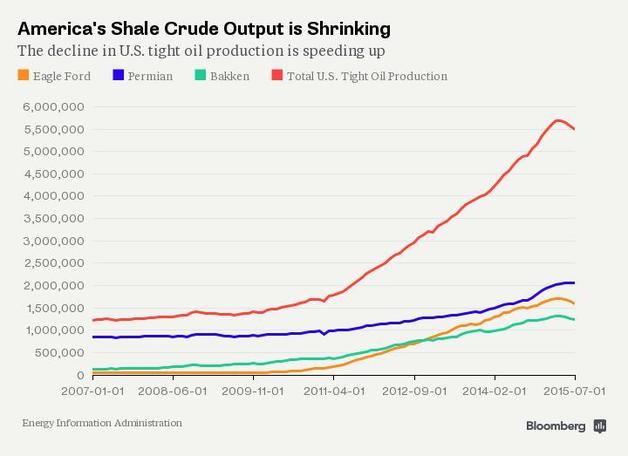
EIA’s forecasts are based on the number of rigs at work and their estimated productivity. The rig count has been dropping for 26 straight weeks, since shortly after the world price for crude oil cratered late last year. 67% of US rigs have been taken out of service. So it’s a bit of a mystery how production has been maintained this long, especially by firms that went into this crisis deeply in debt and hemorrhaging cash.
One explanation is that the rigs taken down were the least productive and the ones remaining the most fruitful. But that does not explain how insolvent companies continue to sell their product at a loss. I suggested the most likely rationale last week [Oil Money: Too Dumb to Fail]: that whacked-out investors with too much money for their own good were betting that oil will rise again (just like the South) and that all will soon be well. On that flimsy basis they have been shovelling money at some of the worst balance sheets in the history of accounting.
The popular press — including, I am sorry to see, Bloomberg — has been ascribing these events to a complex global game of market-manipulation chess being played by Saudi Arabia and the other OPEC countries. Curses! they say, Foiled again by those crafty devils! Reality check number one: those crafty devils are simply not that smart. Reality check number two: everything that is happening to the shale patch now would have happened if the price of oil had stayed above $100 a barrel. Because our crafty fracking devils aren’t that bright either.
[Rule Number One here at the Daily Impact: when an event can be explained as the result of either conspiracy or stupidity, go with stupidity. If you want to be proved right.]
Remember the talk, just a year ago, of “energy independence?” Of how we were going to be “Number one in the world in oil and gas production?” Of how we would start exporting the stuff and thus bend the rest of the world to our will? All gone now, as the EIA has just confirmed.
Reality is back. The fracking boom will be a bump on the long slide to no oil at all, and as the other, last-ditch sources of the last few drops play out, the industrial world has less and less time to execute a very hard landing, or to do nothing and, as the pilots say, augur in.
And that’s official.
36 Comments on "The Shale-Oil Boom is Over"
Nony on Sun, 14th Jun 2015 1:14 pm
We are 10 years past the peak oil predictions of Deffeyes. That is much more than a bump in the road. For that matter, shale is down not from exhaustion but from the price crash.
Plantagenet on Sun, 14th Jun 2015 1:30 pm
If the drop in TOS oil production continues, we may see the current oil glut end by the beginning of 2016. Of course that means the 2016 election campaign would hit its stride just as gasoline prices start to jack up again.
Perk Earl on Sun, 14th Jun 2015 2:10 pm
“I suggested the most likely rationale last week [Oil Money: Too Dumb to Fail]: that whacked-out investors with too much money for their own good were betting that oil will rise again (just like the South) and that all will soon be well. On that flimsy basis they have been shovelling money at some of the worst balance sheets in the history of accounting.”
Two types of risk investors; small and big. These are big risk investors jumping in at this late point in the game, thinking the world needs oil at any price, not realizing all producers have gone in full tilt in a market share war because they realize that more than any other factor, consumer affordability determines price.
So it doesn’t make sense for swing producers to supply short a market that cannot afford a much higher price. In this scenario, investing in frack oil (particularly at this point in time) will be a big loser, but the hard lesson has to be learned by big risk investors, with fewer in the future willing to take the plunge.
Nony on Sun, 14th Jun 2015 2:17 pm
The “glut” is 90% over. Prices have risen from 45 to 60. Contango has decreased from 12/year down to 3/year. And storage prices have normalized. Current futures spread approximates a Hotelling curve.
60+ is the new 100+. The glut is over, we are back at quasi-equilibrium.
Apneaman on Sun, 14th Jun 2015 2:26 pm
Should auld acquaintance be forgot,
And never brought to mind?
Should auld acquaintance be forgot,
And auld lang syne.
penury on Sun, 14th Jun 2015 4:55 pm
L feel the same for these announcements as I do for Fusion and Lithium as the energy of the future. Keep me informed if anything real happens.
rockman on Sun, 14th Jun 2015 5:26 pm
“One explanation is that the rigs taken down were the least productive…” So the logic is that the 67% of the rigs that were adding so much to the shale production were profitable at the higher oil price but those prospects aren’t commercial at the current price. So 2 out of 3 the prospects being drilled must not have been contributing much to the record rate. IOW 2/3 of those tens of $billions invested have now turned to money losers.
So to estimate how much oil the remaining 1/3 of the rigs will generate all we need to do is estimate what those 2/3 of the rigs were adding to the total and subtract that from all the amount of new oil brought on last year.
So let’s hear what that NUMBER is from our local shale experts and not some bullsh*t non-quantifiable “the remaining rigs will yield better wells”. The remaining wells are going to yield same oil that was coming from those better prospects drilled before the collapse…not more oil.
And one side note: they mention how much oil won’t be added by the lower rig count but I don’t notice an estimate of how much production will decline from the EXISTING WELLS drilled before the rig drop. Those wells that will suffer the established high decline rates in their first 12 months.
Nony on Sun, 14th Jun 2015 5:59 pm
It’s the 80-20 principle, Rock. 🙂
Nony on Sun, 14th Jun 2015 6:02 pm
Those were crappy wells, Rock. Sour grapes I say. 😉
Nony on Sun, 14th Jun 2015 6:09 pm
Figure for the Bakken, that we were slated to add about 200M to the 1.1MM of tge year end. With`
Nony on Sun, 14th Jun 2015 6:22 pm
Figure for the Bakken, that we were slated to add about 200M to the 1.1MM bpd of the year end 2014, using 180 rigs.
With no rigs at all, figure about 35% decline. So, we’re down ~0.4MM.
So the 180 rigs made up for 0.4MM decline and added .2MM to give 0.6MM bod impact.
Now figure we lose 60% of the rigs and assume some sort of Pareto distribution. Not so extreme as 80-20, but certainly affecting outlying drilling more, affecting weaker crewsand equipment more. So you won’t lose 60% of yh 0.6MM. For simplicity, assume we lose about half of that…so 30% impact. Note this is LESS extreme than 80-20. More like 66-33. [But that’s rational, since some of the distribution is just chance, not discernible differences in prospects.]
So, 30% of 0.6MM is .18MM. And that actually causes production to end up at ~1.12 MMbpd at year end. Basically flat. So much less than the dramatic fall off that you might worry about if you just thought of production and rig count as linearly related.
you can play with the assumptions, but it won’t really change much. I was teasing earlier about the sour grapes. But there really is a dynamic going on here, that people have a hard time understanding. And it helps to keep production from not cratering.
Nony on Sun, 14th Jun 2015 6:24 pm
from cratering (sorry had a double negative).
Nony on Sun, 14th Jun 2015 6:37 pm
Note, that this is a serious mathematical insight. It shows why naïve comments about number of wells needed to keep production flat (DC, RP, etc.) in the Bakken are likely to be biased high. In reality, we can’t expect only bad wells to be stopped and good wells started, but we CAN expect some sort of skew. It won’t be random. Preferentially, the worse projects will be stopped and the better ones kept. So the total number of wells needed is not a simple ratio based on the average of recent wells. Some anticipaton of high-grading must be expected. and this is just math. It doesn’t rely on technical improvements, completion backlog or the like.
rockman on Sun, 14th Jun 2015 7:45 pm
Nony – Mucho thanks for the response. But for simplicity just tell the folks how much new production will we see from the current low number of rigs drilling during the balance of 2015. I’ll be surprised to see much change in the rig count (in either direction)for the rest of 2015. We’ve about caught up from the lagged production from the wells drilled and frac’d before the rig drop so we can start tracking new production from here forward. By next December we should have a good measure of the accuracy of your estimate.
Nony on Sun, 14th Jun 2015 8:30 pm
Rock, it’s just a guess but I think in the Bakken that the ~75 rigs will not quite cover the inherent decline. So ND Bakken was 1.16 MM bpd in DEC14. I figure DEC15 will be ~1.1 MM bpd. Could be a little less or a little more. But about that.
Apneaman on Mon, 15th Jun 2015 2:12 am
Here is another BOOM
Massive blaze in Texas following reported pipeline rupture (PHOTOS, VIDEO)
http://rt.com/usa/267163-texas-cuero-explosion-fire/
Beery on Mon, 15th Jun 2015 5:06 am
I see Nony and Planty are both still on-message, despite the fact that it’s now clear that the history of their pronouncements have now been shown to be utterly wrong.
Davy on Mon, 15th Jun 2015 6:36 am
http://www.zerohedge.com/news/2015-06-14/low-energy-prices-and-conflict-drive-shell-out-ukrainian-shale
Kenz300 on Mon, 15th Jun 2015 9:15 am
If Shale is dying …. how are tar sands in Canada still kicking?
Enno on Mon, 15th Jun 2015 12:41 pm
Nony, that seems pretty logical, and was also my thought. Still, several posters at POB, including myself, came to an estimate of about 120 wells/month in ND to keep things flat. Helms had the same estimate. It assumed no major change from older wells.
However, so far we are proven incorrect. Since 6 months ago something changed. Each recent month had about >= 150 new wells, and production has been dropping since November. After checking the data, my preliminary conclusion is that older wells have been dropping a bit faster than before. There may be several reasons for this: operators producing a bit fewer days a month, less stuff to increase output of older wells(eg refracking). So instead of a too high estimate, it turns out so far that all our estimates were too low.
Nony on Mon, 15th Jun 2015 12:57 pm
Enno, I think there has been some choking going on and some days offline going on. Also some futzing around with inventories.
I don’t think the inherent new wells will get worse. For the reasons above, I think they will get better than average. (This is sort of the other side of the coin. I criticize cornies who say efficiency is improving when it is just exploitation of the Pareto distribution. But the same also applies in reverse to peakers who assume no change in the average well.)
I would be cautious about reading too much into things over recent months given the extreme contango we had in early 2015. People all over the industry were playing the storage game…not just something to read about, but I saw it. In little onsite storage tanks, even pipelines(!) etc. In addition, there were many reports by companies (EOG, CLR) of delays in completions and I basically am inclined to believe them. Some indications that it really did occur (and you can understand why…contracts for drilling had more penalty clauses than completion…completion in the winter is a pain in the ass anyways…more so than drilling.) It was not purely the contango game, but also waiting for rates to drop, the structure of the penalty clauses, and some option value.
I trust your number crunching way more than mine (I am really lazy about hard calcs), but check out page 10 of
https://www.dmr.nd.gov/oilgas/presentations/APIMinot050715.pdf
Apneaman on Mon, 15th Jun 2015 1:03 pm
Peak Oil Review – 15 Jun 2015
http://peak-oil.org/peak-oil-review-15-jun-2015/
shallow sand on Mon, 15th Jun 2015 1:23 pm
One thing I have wondered about is the undeveloped acreage. Does anyone know what is happening to all of that in the shale plays? If companies are moving to the “sweet spots”, I assume most of the current drilling in on HBP land. Are companies paying to extend primary terms or is the trend to let undeveloped acreage go?
If we look at Continental, Whiting and most of the other shale companies, their 2014 10K show large amounts of undeveloped acreage, usually more than has been developed. A large percentage of the undeveloped acreage expires in 2015, 2016 or 2017.
Would any of the PUD reserves booked by these companies be on the undeveloped acreage? How does that work exactly?
Also, as has been brought up before, won’t a good chunk of reserves vanish as a result of continued low oil and natural gas prices? In their 10K, Continental stated that if oil prices average $59 WTI for the year and gas prices average $3.35 for the year, BOE reserves fall 10% and PV10 drops from $22.8 billion to $9 billion.
There is plenty of happy talk to go around about efficiency and service cost reductions. Looking at earnings estimates for all non-integrated oil producers tells me they are not going to make much or lose money in 2015. Therefore, while efficiency, high grading and service reductions help, they are not enough to get anyone cash flow positive, apparently.
Unfortunately, gasoline prices are close to or at $3 per gallon, and appear to be headed higher. So Marm and Nony, although in better shape than last year, are not getting as big of a break at the pump as they should be.
Should be a great time to own a refinery, I guess.
Enno on Mon, 15th Jun 2015 1:32 pm
Thanks for the link Nony. Given the contango we saw, the strategy you describe definitely makes sense, and I am sure many used it in all kinds of creative ways.
I agree that so far there is not sufficient indication yet of worsening wells.
However, interestingly the slide you refer to goes until end of Jan. Since then, every month we have seen fewer well spuds than wells being brought online. So the number has surely dropped since then (by 200-300 I estimate). There is still a significant inventory, which I estimate will take most of the year before its run down. After that, we need to see a much higher rig number, or the decline will steepen. And there is a lag time of 4-5 months or so on average between spudding and coming online, at least historically.
Nony on Mon, 15th Jun 2015 1:48 pm
My sympathies are to the consumer. I want upstream to be successful in finding volumes of product because it lowers prices. When they ache for OPEC cover or the like, I have no sympathy.
SS, I have not done the math, but I have to imagine that companies built for 100/bbl are going to struggle at 60/bbl. I don’t care. I prefer 60 to 100. If some of the investors take a loss, big deal. If some companies go BK big deal. If some people (execs or workers) lose jobs, big deal. The economy overall benefits more from cheap feedstocks. If I could make it 30, I would!
P.s. And some acreage will still get produced at 60. Yeah, only the better stuff, but so what. Some will still work. And it doesn’t matter if it changes hands a bit. Good projects will get done and bad ones cut. And at 60, there are a lot positive projects than at 100. That’s the way of the world. That’s life at the marginal barrel of production.
P.s.s. I wouldn’t worry about the PUD and all that. It’s an accounting game and reporting game for the general public. Any bank loaning money will insist on valuing the prospects at current futures strip prices. And savvy investors, the same.
GregT on Mon, 15th Jun 2015 1:57 pm
“My sympathies are to the consumer.”
This is exactly the mindset that is responsible for humanities’ greatest problems. As long as the econospeak is allowed to continue to pervade our societies, the worse our situation will become.
We can’t have our cake, and eat it too Nony.
Nony on Mon, 15th Jun 2015 2:12 pm
It’s not about dividing the cake, but about growing the pie, Greg. God put us on the Earth to make progress.
http://upload.wikimedia.org/wikipedia/commons/1/12/American_progress.JPG
😉
Northwest Resident on Mon, 15th Jun 2015 2:35 pm
“God put us on the Earth to make progress.”
Define progress. Exploiting all of earth’s resources to the point of self-destruction? Wiping out entire species, ravaging biosphere, creating mountains of throw-away garbage, poisoning the air? Is that your definition of progress?
Maybe the definition of “progress” includes learning from our past mistakes and taking action to create a new reality where humans live in harmony and sustainability with whatever is left of God’s gift?
I realize that’s a tough concept for some people.
Apneaman on Mon, 15th Jun 2015 2:46 pm
I am not an animal! I’m a consumer being!
GregT on Mon, 15th Jun 2015 2:51 pm
The pie grows by itself Nony, and it produces everything that we ever really needed. If we don’t take care of the pie, we all die.
We can’t have the pie, and eat it too.
Your attitude is part of our problem Nony, not part of the solution.
Apneaman on Mon, 15th Jun 2015 3:04 pm
Nony, ya but the Pope is God’s emissary on earth and he says otherwise. Over a billion people believe he is, so by your popularity = right logic, it must be so.
Davy on Mon, 15th Jun 2015 3:37 pm
NOo, it is pretty obvious pie is shrinking especially considering population growth. NOo, Get a heart and soul and quit being a machine.
Nony on Mon, 15th Jun 2015 4:23 pm
Apnea: Encyclicals are not infallible and are not official doctrine of the Church. There are only a few papal statements of infallibility and they have to do with matters of religion (for instance aspects of Mary), not current politics.
http://www.stanthonymessenger.org/AskAFranciscan/Question.aspx?Question=176
GregT on Mon, 15th Jun 2015 4:41 pm
And then Nony, there are some things that should just be common sense. Like shitting in ones own bed is generally not a bright idea.
Apneaman on Mon, 15th Jun 2015 4:53 pm
Nony-marm, well, I don’t believe in any of it, but over a billion folks do consider themselves Catholic, so have fun with your new opponents. BTW, sacred church doctrine, like your country’s scared constitution can be changed. Just words on paper. Get a pen scratch out an amendment – happens all the time. Also, I never mentioned the Encyclical what I said is the Pope is infallible.
“Papal infallibility is a dogma of the Catholic Church that states that, in virtue of the promise of Jesus to Peter, the Pope is preserved from the possibility of error “When, in the exercise of his office as shepherd and teacher of all Christians, in virtue of his supreme apostolic authority, he defines a doctrine concerning faith or morals to be held by the whole Church.”
It’s in the last sentence “….he defines a doctrine concerning faith or morals to be held by the whole Church.”
You can bitch, argue, whine and moan, but it won’t change the fact that many of the faithful will heed Big Pappy’s words. Go Popa! Go Popa! Go Popa!
Apneaman on Mon, 15th Jun 2015 5:02 pm
Pope Francis’ Climate Change Encyclical Just Leaked. Here’s What It Says.
Humans are causing climate change, and there will be “grave consequences” if we don’t act fast, warns the pope.
http://www.motherjones.com/environment/2015/06/pope-francis-climate-change-encyclical