
Peak Oil is You
Donate Bitcoins ;-) or Paypal :-)


Page added on June 5, 2015

The Future History of Political Economy
Ecological Economics and its corollary, Steady State Economic thinking, represent a step forward for the discipline of economics and also a return to how it was practiced in the past. In the nineteenth century, economics was a part of a larger enterprise: political economy, the integrated treatment of morals and economics, ultimate ends and efficient means. Late in that century economics calved off from political economy, leaving behind political science and political philosophy as the residuum. It did this in service to the ideal of becoming rigorously scientific.
It’s odd, then, that alone among disciplines with any pretense to analytic rigor, economics has steadfastly resisted the thermodynamic revolution that swept physical and life sciences in the nineteenth and early twentieth centuries. Physics, biology, chemistry, geology, even the study of history were transformed, but not economics.
I think we can blame this on bad timing, willful ignorance, and oil.
Bad timing
In the late nineteenth century the archetypal science was physics and physics was Newtonian mechanism. Ignorant of what a young thermodynamic theorist named Albert Einstein would soon do to the Newtonian paradigm they emulated, Stanley Jevons and other economic “scientists” set about mathematically modeling the economy as sets and subsets of self-contained, equal-and-opposite actions and reactions, happily (and explicitly) assuming that all economic activity consists of ahistorical, which is to say completely reversible, processes. No one who has a nodding acquaintance with the law of entropy could have countenanced this. Entropy is Time’s Arrow, the law of irreversibility; it describes the one-way flow of energy use. A purely mechanical process can be run forward or backwards, but we’ll never invent a machine that can suck in exhaust gases, heat and motion and transform them into gasoline. The entropy law can tell you why. Newton couldn’t.
Just as a consumer might choose to keep a recently purchased appliance even though a newer, better model has been brought onto the market, neoclassical economists weren’t about to re-tool their brand-new thinking to reflect changes in the underlying metaphysics they had been so keen to adopt. It didn’t seem to them that there was any reason to.
“Seem” is the operative word here. Because the entropy process is time’s arrow, and because Ecological Economics places the entropy process at the center of its analysis, it’s entirely appropriate for Ecological Economics to understand its subject matter and itself as a discipline in historical terms. Like other paradigm-defining insights, this one seems obvious once it has been stated: elements of the neoclassical model that could pass for true on a large and forgiving planet a hundred years ago are obviously not true today, when the planet’s source-and-sink services are severely taxed, when natural capital is the limiting factor in production, when there are seven billion of us and our economic wants, capacities and expectations have been amplified by our access to the ancient sunshine of fossil fuels.
Willful ignorance
By modeling the economy as a closed and circular system, neoclassical economists have encouraged themselves to operate in a methodologically enforced state of denial about the physical roots and ecological consequences of our wealth-creating activities. And yet economics has experienced no paradigm-shaking crisis as a result. Neither climate change nor any of the other source-and-sink catastrophes facing civilization have been laid at the feet of bad economic theory. One reason: Neoclassical economists succeed in treating environmental costs as “externalities.” How could environmental degradation be the result of economic activity if it’s external to the economy?
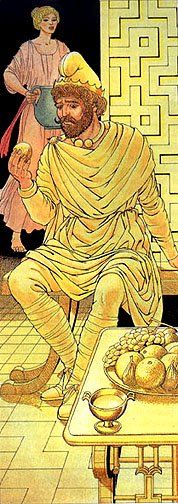
The power to create wealth gave Midas an unsustainable life as a complete solipsist. Oil’s power to create wealth has had a similar effect on Neoclassical economics. Illustration by Giovanni Caselli from The Age of Fable.
In its self-confirming isolation of the economy from nature and theory from reality, neoclassical economics amounts to a highly principled practice of solipsism. When this pathology is manifest in an individual it produces unpleasant consequences that might eventually prompt some reflection and personal growth. Not so with the collective delusion of mainstream economists. Evidence of our ongoing ecological catastrophe falls far from their purview—not just disciplinarily but geographically, as the wealthier nations (wherein the vast majority of economists reside) export their ecological footprint to the impoverished nations of the world. And for several generations (at least since Reagan defeated Carter, removed Carter’s solar panels from the White House and ushered in an era of GDP growth through de-regulation of the social and ecological consequences of economic activity), there has been a strong self-selection among students of economics. Undergraduates with any kind of deep personal connection to natural systems tend to find the study of standard economics unattractive, displeasing, even soul-deadening. This leaves the field to those most willing to bracket off as irrelevant to their professional purpose any question about the moral and ethical consequences of economic activity, any question about the health and maintenance of nature, any question about the economy’s relation to the larger social and natural systems within which it operates.
Oil
Even so, you might expect that a discipline with such a demonstrably deficient view of its subject matter would fail of its object—would fail to offer wise counsel about the collective project of augmenting the stock of wealth that humans can enjoy. But economics has had much apparent success. Despite regular downturns and financial crises, the wealth produced by our economies has grown and grown and grown. I think there’s a ready explanation that becomes visible through the conceptual lens of Ecological Economics, which tells us that energy isn’t a commodity like any other but a fundamental factor of production (part of a trio: matter, energy and human design intelligence). When your economy operates on an energy source that cranks out wealth-making value in a ratio of 100 to 1 or better—the estimated Energy Return on Energy Invested that petroleum offered us in the early 20th Century—you can believe any damn thing you want about how economies operate and your economy will still generate a great deal of wealth.
Which is to say, high-EROI oil granted the new science of economics immunity from being proven false by events. But falsifiability of principles and propositions is one solid measure of a science. (Non-falsifiable beliefs are called faiths.)
In effect the discipline of economics has a free rider problem—it’s been given a free pass by the enormous power of oil to misunderstand itself and its subject matter. You could also call it a Midas Problem, after the legendary king whose touch turned everything he touched into gold, including his dinner and his daughter. The power of wealth-generation that oil granted to our economy made it impossible for the discipline of economics to connect in any fundamental way with otherness, including the otherness of the planet and its role in the very processes that economics presumes to model.
20 Comments on "The Future History of Political Economy"
Davy on Fri, 5th Jun 2015 7:47 am
Damn, I can’t add much to that mojo! Excellent hammer job for the Econ 101 numb nuts on this board.
If we had a chance to save our lives as we know them we would have to outlaw the religion of economics. We would have to have forced population reduction policies. This would naturally reduce consumption.
There is no other choice but population and consumption rebalance. That folks is not possible with today’s global economy. It will lead to collapse. There is no reforming, degrowthing, and or trading in on a new system. This is it and our fate sealed.
It is the religion of economic and the ever growing population that ensures a train wreck. It does not matter what we do a train wreck is ahead. It is a matter of momentum with forces great than our human world.
What does matter is billions of people are going to suffer and die quickly or sooner. This will be ugly. There is no sugar coating a global tragedy. Where it matters is we can make this less painful. We can give meaning and direction even with the pain and suffering.
In any tragedy is it not our human nature to reach out and help people. We see people digging through the rubble to find trapped people. That is what we need to be doing now in a sense. We need to be rescuing people. This rescuing people is the highest of human spirit. This can happen in so many ways but it needs to happen with the understanding that the life we know now will be no more and what is ahead is a dangerous and painful world. This is true for rich and poor people and nations. No one will escape this death of an era. Kings will be just as crushed as peasants.
Nony on Fri, 5th Jun 2015 8:08 am
I’m sleepy.
marmico on Fri, 5th Jun 2015 9:02 am
Peak oil what? Ecological economics is an abject failure.
http://peakoilbarrel.com/wp-content/uploads/2015/06/5199911.gif
Production growth has waxed and waned around the 1.2% annual growth trend for the last 31 years.
GregT on Fri, 5th Jun 2015 11:05 am
Excellent article!
Exactly why we are headed for societal collapse, ecological destruction, and quite possibly, global mass extinction.
nubs on Fri, 5th Jun 2015 11:26 am
Thirty one years is a blink of an eye, even for a newbie species like us.
nubs on Fri, 5th Jun 2015 11:37 am
“I’m sleepy”- Nony, at least you sometimes provide a chuckle.
nubs on Fri, 5th Jun 2015 1:15 pm
“…we are headed for societal collapse, ecological destruction, and quite possibly, global mass extinction.”
We’re already several centuries into the sixth known global mass extinction event (http://www.scientificamerican.com/article/fact-or-fiction-the-sixth-mass-extinction-can-be-stopped/). Moral judgements aside, this is clearly an exceedingly rare event in the history of planet earth with consequences that remain largely unknown. It boggles my mind that so little attention is paid to it in mainstream thinking.
Davy on Fri, 5th Jun 2015 2:07 pm
Nubs, my thoughts exactly! I am not sure the human mind is capable of collapse contemplation other than in abstraction at the same time that mind is thinking it won’t happen to me.
It is well know throughout history there is a fiddle while Rome burns syndrome associated with all collapsing societies. This is usually from among the elites who are the last to crash and burn. Unfortunately it is those same elites who could effect change if they desired.
GregT on Fri, 5th Jun 2015 2:39 pm
Actually nubs,
From the article that you linked:
Fact or Fiction?: The Sixth Mass Extinction Can Be Stopped
The sixth mass extinction may now be beginning—and the apocalypse this time is us.
Hubbert on Fri, 5th Jun 2015 3:42 pm
Economics is the biggest fraud of the 20th centry. Pure magic at it’s best.
Hubbert on Fri, 5th Jun 2015 3:46 pm
The way the Chinese are hording ivory, Elephants may not even exist 20 years from now… there are plenty of reports
on youtube.
GregT on Fri, 5th Jun 2015 4:03 pm
Economics is more than just a fraud Hubbert.
It is a parasitical infection that is driving our entire species, and most life on the planet Earth, to death and destruction. It is pure evil.
Apneaman on Fri, 5th Jun 2015 5:20 pm
FIRST PRINCIPLE: “Economics” is an intellectual Trojan Horse with political agendas hidden within known-false assumptions.
The political conclusions follow logically from the assumptions, so if you accept those known-false assumptions,
then you also accept those hidden political agendas.
http://jayhanson.us/e.htm
HARM on Fri, 5th Jun 2015 7:43 pm
Economics is merely an intellectual construct used by the elites to describe and –critically– to defend the status quo as “natural”. The tendency toward unchecked greed, megalomania, consumption and procreation is, unfortunately, hard-wired into our species.
One of the best treatments I ever read on the subject was over at TheOilDrum (before it closed down): “Are human beings smarter than yeast?” As you might expect, the answer was (at a collective/macro level) “no”.
HARM on Fri, 5th Jun 2015 7:44 pm
test
HARM on Fri, 5th Jun 2015 7:47 pm
Odd, my last post went immediately into moderation without so much as a shred of profanity laced tirades or trolling.
HARM on Fri, 5th Jun 2015 7:48 pm
Economics is merely an intellectual construct used by the elites to describe and to defend the status quo as “natural”. The tendency toward unchecked greed, megalomania, consumption and procreation is, unfortunately, hard-wired into our species.
One of the best treatments I ever read on the subject was over at The Oil Drum (before it closed down): “Are human beings smarter than yeast?” As you might expect, the answer was (at a collective/macro level) “no”.
Makati1 on Fri, 5th Jun 2015 8:02 pm
Harm, that sometimes happens to me also. No reason for ‘moderation’ that I can see when I reread my comment. Must be a glitch in the program? But the computerization of the world is becoming more and more unstable as the quality of everything declines. Another collapse, eventually.
GregT on Fri, 5th Jun 2015 8:15 pm
Happens to me sometimes too Harm. A word of advice? Copy your comments before you post them, especially if you’ve spent any time on them. Occasionally they completely disappear into the ether.
Davy on Fri, 5th Jun 2015 8:29 pm
It happens to me routinely. I believe it is the amount of posting you do. As you all are well aware I have longish doom salad rants.