
Peak Oil is You

Donate Bitcoins ;-) or Paypal :-)


Page added on May 7, 2015

Why We Have an Oversupply of Almost Everything

The Wall Street Journal recently ran an article called, Glut of Capital and Labor Challenge Policy Makers: Global oversupply extends beyond commodities, elevating deflation risk. To me, this is a very serious issue, quite likely signaling that we are reaching what has been called Limits to Growth, a situation modeled in 1972 in a book by that name.
What happens is that economic growth eventually runs into limits. Many people have assumed that these limits would be marked by high prices and excessive demand for goods. In my view, the issue is precisely the opposite one: Limits to growth are instead marked by low prices and inadequate demand. Common workers can no longer afford to buy the goods and services that the economy produces, because of inadequate wage growth. The price of all commodities drops, because of lower demand by workers. Furthermore, investors can no longer find investments that provide an adequate return on capital, because prices for finished goods are pulled down by the low demand of workers with inadequate wages.
Evidence Regarding the Connection Between Energy Consumption and GDP Growth
We can see the close connection between world energy consumption and world GDP using historical data.

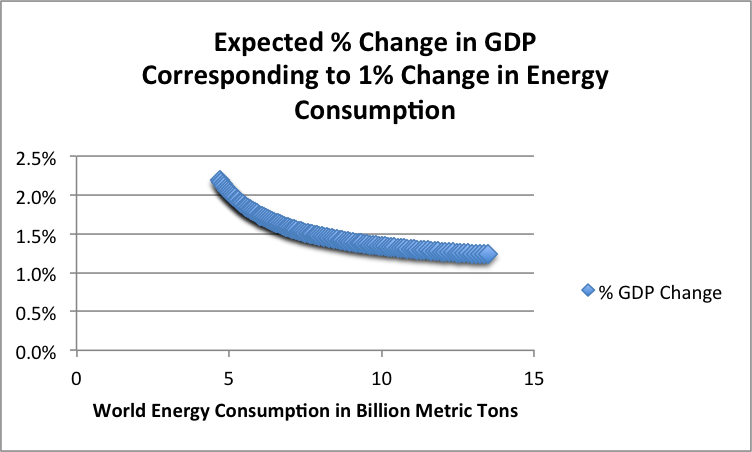
This chart gives a clue regarding what is wrong with the economy. The slope of the line implies that adding one percentage point of growth in energy usage tends to add less and less GDP growth over time, as I have shown in Figure 2. This means that if we want to have, for example, a constant 4% growth in world GDP for the period 1969 to 2013, we would need to gradually increase the rate of growth in energy consumption from about 1.8% = (4.0% – 2.2%) growth in energy consumption in 1969 to 2.8% = (4.0% – 1.2%) growth in energy consumption in 2013. This need for more and more growth in energy use to produce the same amount of economic growth is taking place despite all of our efforts toward efficiency, and despite all of our efforts toward becoming more of a “service” economy, using less energy products!
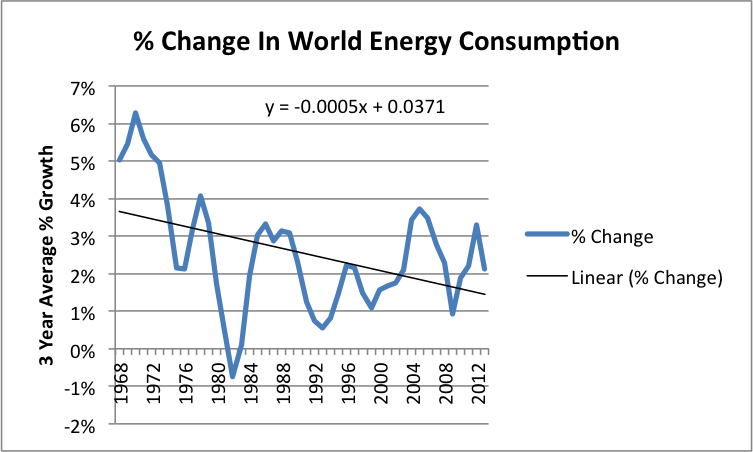
To make matters worse, growth in world energy supply is generally trending downward as well. (This is not just oil supply whose growth is trending downward; this is oil plus everything else, including “renewables”.)
There would be no problem, if economic growth were something that we could simply walk away from with no harmful consequences. Unfortunately, we live in a world where there are only two options–win or lose. We can win in our contest against other species (especially microbes), or we can lose. Winning looks like economic growth; losing looks like financial collapse with huge loss of human population, perhaps to epidemics, because we cannot maintain our current economic system.
The symptoms of losing the game are the symptoms we are seeing today–low commodity prices (temporarily higher, but nowhere nearly high enough to maintain production), not enough good paying jobs for common workers, and lack of investment opportunities, because workers cannot afford the high prices of goods that would be required to provide adequate return on investment.
How We Have Won in Our Contest with Other Species–Early Efforts
The “secret formula” humans have had for winning in our competition against other species has been the use of supplemental energy, adding to the energy we get from food. There is a physics reason why this approach works: total population by all species is limited by available energy supply. Providing our own external energy supply was (and still is) a great work-around for this limitation. Even in the days of hunter-gatherers, humans used three times as much energy as could be obtained through food alone (Figure 1).

Earliest supplementation of food energy came by burning sticks and other biomass, starting one million years ago. Using this approach, humans were able to gain an advantage over other species in several ways:
- We were able to cook some of our food. This made a wider range of plants and animals suitable for food and made the nutrients from these foods more easily available to our bodies.
- Because less energy was needed for chewing and digesting, our bodies could put energy into growing a larger brain, thus giving us an advantage over other animals.
- The use of cooked food freed up time for such activities as hunting and making clothes, because less time was needed for chewing.
- Heat from burning plant material could be used to keep warm in cold areas, thereby extending our range and increasing total human population that could be supported.
- Fire could be used to chase off predatory animals and hunt prey animals.
Our bodies are now adapted to the need for supplemental energy. Our teeth our smaller, and our jaws and digestive apparatus have shrunk in size, as our brain has grown. The large population of humans that are alive today could not survive without supplemental energy for many purposes, such as cooking food, heating homes, and fighting illnesses that spread when humans are in as close proximity as they are today.
Our Modern Formula For Winning the Battle Against Other Species
In my view, the formula that has allowed humans to keep winning the battle against other species is the following:
- Use increasing amounts of inexpensive supplemental energy to leverage human energy so that finished goods and services produced per worker rises each year.
- Pay for this system with debt, because (if supplemental energy costs are cheap enough), it is possible to repay the debt, plus the interest on the debt, with the additional goods and services made possible by the cheap additional energy.
- This system gradually becomes more complex to deal with problems that come with rising population and growing use of resources. However, if the output of goods per worker is growing rapidly enough, it should be possible to pay for the costs associated with this increased complexity, in addition to interest costs.
- The whole system “works” as long as the total quantity of finished goods and services rises rapidly enough that it can fund all of the following: (a) a rising standard of living for common workers so that they can afford increasing amounts of debt to buy more goods, (b) debt repayment, and interest on the debt of the system, and (c) and an increasing amount of “overhead” in the form of government services, medical care, educational services, and salaries of high paid officials (in business as well as government). This overhead is needed to deal with the increasing complexity that comes with growth.
The formula for a growing economy is now failing. The rate of economic growth is falling, partly because energy supply is slowing (Figure 3), and partly because we need more and more growth of energy supply to produce a given amount of economic growth (Figure 2). With this lowered world economic growth, the amount of goods and services being produced is not rising fast enough to support all of the functions that it needs to cover: interest payments, growing wages of common workers, and growing “overhead” of a more complex society.
Some Reasons the Economic Growth Cycle is Now Failing
Let’s look at a few areas where we are reaching obstacles to this continued growth in final goods and services. An overarching problem is diminishing returns, which is reflected in increasingly higher prices of production.
1. Energy supplies are becoming more expensive to extract.
We extract the easiest to extract energy supplies first, and as these deplete, need to use the more expensive to extract energy supplies. We hear much about “growing efficiency” but, in fact, we are becoming less efficient in the production of energy supplies.
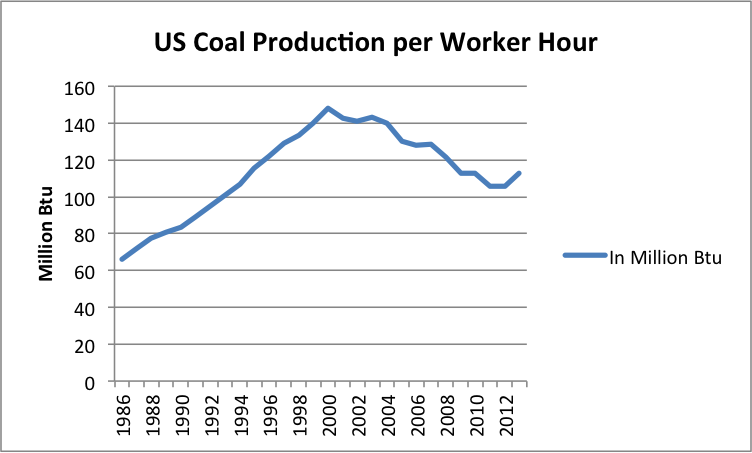
In the US, EIA data shows that we are becoming less efficient at coal production, in terms of coal production per worker hour (Figure 5).
With oil, growing inefficiency is shown by the steeply rising cost of oil exploration and production since 1999 (Figure 6).
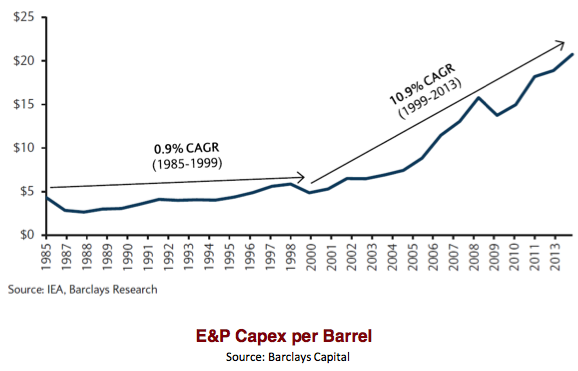
Thus, it is for a fairly recent period, namely the period since about 2000, that we have been encountering rising costs both for US coal and for worldwide oil extraction.
The extra workers and extra costs required for producing the same amount of energy counteract the tendency toward growth in the rest of the economy. This occurs because the rest of the economy must produce finished products with fewer workers and less resources as a result of the extra demands on these resources by the energy sector.
2. Other materials, besides energy products, are experiencing diminishing returns.
Other resources, such as metals and other minerals and fresh water, are also becoming increasingly expensive to extract. The issue with mineral ores is similar to that with fossil fuels. We start with a fixed amount of ores in good locations and with high mineral percentages. As we move to less desirable ores, both human labor and more energy products are required, making the extraction process less efficient.
With fresh water, the issue is likely to be a need for desalination or long distance transport, to satisfy the needs of a growing population. Workarounds again involve more human labor and more resource use, making the production of fresh water less efficient.
In both of these cases, growing inefficiency leaves the rest of the economy with less human energy and less energy products to produce the finished goods and services that the economy needs.
3. Growing pollution is taking its toll.
Instead of just producing end products, we are increasingly finding ourselves fighting pollution. While this is a benefit to society, it really is only offsetting what would otherwise be a negative. Thus, it acts like overhead, rather than producing economic growth.
From the point of view of workers having to pay for higher cost energy in order to fight pollution (say, substitution of a higher cost energy source, or paying for more pollution controls), the additional cost acts like a tax. Workers need to cut back on other expenditures to afford the pollution control workarounds. The effect is thus recessionary.
4. The amount of “overhead” to the world economy has been growing rapidly in recent years, for a number of reasons:
- The amount of overhead is growing because we are reaching natural barriers. For example, population per acre of arable land is growing, so we need more intensity of development to produce food for a rising population.
- With greater population density and increased bacterial antibiotic resistance, disease transmission becomes a more of a problem.
- Increasing education is being encouraged, whether or not there are jobs available that will make use of that education. Education that cannot be used in a productive way to produce more goods and services can be considered overhead for the economy. Educational expenses are frequently financed by debt. Repayment of this debt leads to a decrease in demand for other goods, such as new homes and vehicles.
- We have more elderly to whom we have promised benefits, because with the benefit of better nutrition and medical care, more people are living longer.
5. We are reaching debt limits.
As economic growth has slowed, we have been adding more and more debt, to try to mitigate the problem. This additional debt becomes a problem in many ways: (a) without cheap energy to leverage human labor, there are not many productive investments that can be made; (b) the addition of more debt leads to a need for more interest payments; and (c) at some point debt ratios become overwhelmingly high.
At least part of the slowdown in economic growth that we are seeing today is coming from a slowdown in the growth of debt. Without debt growth, it is hard to keep commodity prices high enough. Investment in new manufacturing plants is also affected by low growth in debt.
Reasons for Confusion in Understanding Our Current Predicament
1. Not understanding that all of the symptoms we are seeing today are manifestations of the same underlying “illness”.
Most analysts think that the economy has stubbed its toe and has a headache, rather than recognizing that it has a serious underlying illness.
2. Academia is focused way too narrowly, and tied too closely to what has been written before.
Academics, because of their need to write papers, focus on what previous papers have said. Unfortunately, previous papers have not understood the nature of our problem. Academics have developed models based on our situation when we were away from limits. The issues we are facing cover such diverse subjects as physics, geology, and finance. It is hard for academics to become knowledgeable in many areas at once.
3. Models that seemed to work before are no longer appropriate.
We take models like the familiar supply and demand model of economists and assume that they represent everlasting truths.
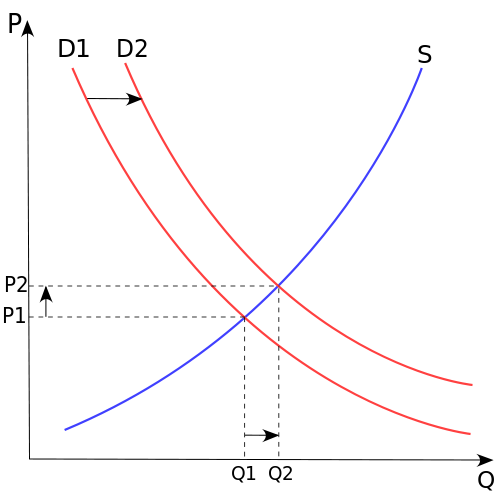
Unfortunately, as we get close to limits, things change. Both wage levels and debt levels have an impact on demand; the quantity goods available is also affected by diminishing returns. The model that worked in the past may be totally inappropriate now.
Even a complex model like the climate change model being used by the IPCC is likely to be affected by financial limits. If near-term financial limits are to be expected, IPCC’s estimate of future carbon from fuels is likely to be too high. At a minimum, the findings of the IPCC need to be framed differently: climate change may be one of a number of problems facing those people who manage to survive a financial crash.
4. Too much wishful thinking.
Everyone would like to present a positive result, especially when grants are being given for academic research will support some favorable finding.
A favorite form of wishful thinking is believing that higher costs of energy products will not be a problem. Higher cost energy products, whether they are renewable or not, are a problem for many reasons:
- They represent growing inefficiency in the economy. With growing inefficiency, we produce fewer finished goods and services per worker, not more.
- Countries using more of the higher cost types of energy become less competitive in the world market, and because of this, may develop financial problems. The countries most affected by the Great Recession were countries using a high percentage of oil in their energy mix.
- The amount workers have available to spend is limited. If a worker has $100 to spend on energy supply, he can buy 100 times as much in energy supplies priced at $1 as he can energy supplies priced at $100. This same principle works even if the cost difference is much lower–say $3.50 gallon vs. $3.00 gallon.
5. Too much faith in, “We pay each other’s wages.”
There is a common belief that growing inefficiency is OK; the wages we pay for unneeded education will work its way through the system as more wages for other workers.
Unfortunately, the real secret to economic growth is not paying each other’s wages; it is growing output of finished products per worker through increased use of cheap energy (and perhaps technology, to make this cheap energy useful).
Increased overhead for the system is not helpful.
6. An “upside down” peak oil story.
Most people in the peak oil community believe what economists say about supply and demand–namely, that oil prices will rise if there is a supply problem. They have not realized that in a networked economy, wages and prices are tightly linked. The way limits apply is not necessarily the way we expect. Limits may come through a lack of good paying jobs, and because of this lack of jobs, inability to purchase products containing oil.
The connection between energy and jobs is clear. Good jobs require the use of energy, such as electricity and oil; lack of good-paying jobs is likely to be a manifestation of an inadequate supply of cheap energy. Also, high paying jobs are what allow rising buying power, and thus keep demand high. Thus, oil limits may appear as a demand problem, with low oil prices, rather than as a high oil price problem.
In my opinion, what we are seeing now is a manifestation of peak oil. It is just happening in an upside down way relative to what most were expecting.
Conclusion
One way of viewing our problem today is as a crisis of affordability. Young people cannot afford to start families or buy new homes because of a combination of the high cost of higher education (leading to debt), the high cost of fuel-efficient new cars (again leading to debt), the high cost of resale homes, and the relatively low wages paid to young workers. Even older workers often have an affordability problem. Many have found their wages stagnating or falling at the same time that the cost of healthcare, cars, electricity, and (until recently) oil rises. A recent Gallop Survey showed an increasing share of workers categorize themselves as “working class” rather than “middle class.”
It is this affordability crisis that is bringing the system down. Without adequate wages, the amount of debt that can be added to the system lags as well. It becomes impossible to keep prices of commodities up at a high enough level to encourage production of these commodities. Return on investment tends to be low for the same reason. Most researchers have not recognized these problems, because they are narrowly focused and assume that models that worked in the past will continue to work today.
22 Comments on "Why We Have an Oversupply of Almost Everything"
John Kintree on Thu, 7th May 2015 7:56 pm
In Elon Musk’s announcement of Tesla Energy, and the 10 kWh battery they have designed for use in buildings, he talked in terms of producing billions of such batteries, and that the Gigafactory they are constructing now can be considered a machine that can be replicated so that many Gigafactories could be operating.
He made it sound very doable. I have my doubts. It requires an immense amount of raw materials, and energy to extract and process those materials, along with accompanying pollution. Maybe, maybe not.
Davy on Thu, 7th May 2015 9:00 pm
We can look at Gail’s post from the point of view of huge mal-investment. BAU has become the definition of mal-investment. Look at the US with its consumer culture, strip malls, car culture, Mc Mansions, corporate glass offices, and energy intensive leisure of all kinds. Much of this is a sunk cost that does not produce anything. It is in fact a liability we struggle to maintain with nothing to show for. What should have been invested in is resilience, sustainability, and alternative lifestyles. You can then take Asia and Europe and we find the same situation in different shades of grey.
We basically have a bottleneck on the horizon with a built out infrastructure, dumbed down population, and a destroyed ecosystem. If we have excess supply of everything per WSJ well that is what happens when the numb nut’s on Wall street are left to their own devices. The psychopaths pursue private profit at the publics expense. This has reached a critical stage of wealth transfer, corruption, market manipulation, and legalized theft. This is a normal cycle we have seen in previous civilizations as the reach their peak and then begin the collapse.
This time it is different because it is global with a population far in excess of carrying capacity. It is the same because we also have the same social dysfunctions of previous ages most notably the aristocracy in Europe around the French revolution.
This is it. BAU cannot degrowth. We are a train wreck in motion with a fate that is sealed. The predicaments and problems are beyond mitigation to maintain BAU. The mitigation and adjustment needs to be to a collapse of BAU to a much lower level of economic activity with a corresponding population rebalance.
If you spend your money unwisely in your personal life you pay the price. Why should it be different at the level of BAU? It is phenomenal the useless and needless production at the same time we allowed our population to explode. What an evolutionary dead end species we are. Congratulations Humans for being top dog on the planet the equivalent of a blink of the eye.
Chris Hill on Thu, 7th May 2015 9:15 pm
Maybe this is the real answer to Fermi’s paradox.
You hear how back in hunter gatherer days, tribes would use infanticide or other means to make sure they didn’t go beyond their carrying capacity. If this is true, was it just the surplus that lulled us into a belief of invincibility?
forbin on Fri, 8th May 2015 4:48 am
ofcourse for another view point is that the middle classes have had their wages cut both in the USA and Europe
The middle classes pay the majority of the taxes whilst the supa-riche in aggregate do not , infact they don’t want to , afterall they pay enough dont they ?
Well the poor being poor means they have little to take away
the riche can move offshore and do
middle claseses are stuffed (!)
perhaps the riche understand this and as resources dry up they will push us all back to the middle ages serfdom
This sorta thing happened apparently the Romans left Briton, the upper classes just walked away with the cake , the ensuing dark ages were pretty bad
and as we are extended now with the use of fossil fuels the next Dark Age will be a doozy , eh?
Forbin
Rodster on Fri, 8th May 2015 5:11 am
“and as we are extended now with the use of fossil fuels the next Dark Age will be a doozy , eh?
Forbin”
The way we are purposely destroying this planet environment, who knows if there will be another dark age. 😉
yoananda on Fri, 8th May 2015 5:54 am
Elon Mush’s batteries prices twice as much as the classic solar batteries …
What’s the point of is giga factory ?
Davy on Fri, 8th May 2015 6:38 am
Yo, I read somewhere that they are not even the best fit for solar applications. I know enough with the guts of solar to be dangerous IOW maybe someone like the G-man can give us insight.
Elon the Musk is just another BAUtopian high priest preaching hopium of man’s exceptionalism through technology and progress. He is not so much a false prophet as just another deluded BAU spokesman. The deluded prophets are from politics, MSM, and the worst economist.
joe on Fri, 8th May 2015 7:10 am
Musks batteries and cars have massive tax cuts associated with them. If that economic model is to be followed (ie a car that uses no petrol) then ex tobacco and without massive sales taxes then most developed economies are screwed anyway because they have to raise taxes somehow. UK for example reduces tax on supply and taxes consumption, it spends on health education and through careful money supply it can even support an army. So called green solutions are the same type of entity, a supplier. But they supply at much lower eroei therefore the costs must be higher and with the cost to society. Green is pie in the sky, not because it doesn’t work but because it’s very hard to scale up. Super batteries and the like would only work if government paid for it, and to do that as well as transition away from oil would be the moon landing of our time and next generations time.
steve on Fri, 8th May 2015 8:08 am
Musk’s obsession with space travel is enough to classify him as a nut. I know I have been critical in the past of Gail but it is nice to see some female understanding of Peak Oil. Where are all the women at when it comes to this subject? Are they all just so programmed to consume?
paulo1 on Fri, 8th May 2015 8:09 am
Tesla Powerwall is simply another stock hype. They are as universal as his cars sarc/ and will likely stay that way, production scale be damned.
Davy on Fri, 8th May 2015 8:09 am
Exactly Joe, typical high technological expectations with much less practical applications and cost effective scaling.
There is this blind belief that at the top money can be created from nothing. The default in society is government will pay for it. This was fine in an earlier time.
Currently government are contemplating or actively finding stealth ways to take the public’s money. Soon it will be open confiscation in the name of crisis management.
Tell me how all these various projects of progress and technology will be paid for in this environment of debt ridden government? Add to that a looming bond crisis.
The greenies and AltE wonks are delusion and under BAU’s spell. I am a greenies and AltE wonk but realistic and sober. There is much we can do but let’s keep expectation subdued.
Currently the public is BAUspellbound that all will work out. There are tough times ahead but the lights will go on, food in the frig, and gas at the pumps. It is going to be a rude awakening when all 3 basics are insecure and variable.
Elon the Musk is a priest of fantasy and dellusion. We listen to him like the Sirens of Jason and the Argonauts and at our peril.
steve on Fri, 8th May 2015 8:12 am
Talk about fantasy and delusion; I invite you to type in CNBC and then go to Zero Hedge….two totally different stories going on….
Davy on Fri, 8th May 2015 8:12 am
Steve, the women of the world are going to take PO dynamics the worst. They should be the most involved. It is fossil fuels that gave females freedom and rights. To be fair it also allowed mass exploitation and destructive lifestyles.
JuanP on Fri, 8th May 2015 9:52 am
I have to dmit that I basically stopped reading Gail’s articles around the time she started her blog. I’ve read a few, but I mostly skip them. I liked her TOD articles better. I think Gail is stuck in a rut and her mind has been running around in circles for a while. She is too wordy and not interesting enough for me to invest the time to read all that. Must be my ADHD.
JMG is wordy and stuck in the same way and I also skip some of his articles, too, but I like him better, particularly when he is not writing about religion.
American Idiot on Fri, 8th May 2015 10:45 am
These Wall St. Idiots reminds me of Baghdad Bob, “Everything is A O.K.”
justeunperdant on Fri, 8th May 2015 10:52 am
She has been saying since the beginning of her blog that we reach the limits of debt. I see no such evidence of that. Once social chaos will start to spread, the gouvement will come up with a guarantee minimum income for the poor to calm the situation down. It will no work for long but it could be the easiest way to bail out the oil industry and the manufacturing supply chain. Of course there is always the possibility that mass migration out of California and Las Vegas create uncontrollable social chaos and shortages.
penury on Fri, 8th May 2015 11:04 am
I have one small quibble with “justeunperdant” This statement :Once social chaos will start to spread, the gouvement will come up with a guarantee minimum income for the poor to calm the situation down.” Please understand I agree with the aim, but where do you think Gov will get the money for the program? The magic money tree has been picked clean of fruit and the bill is coming due. There is more truth in Gail’s writing than you can see. But, the deluge is coming.
justeunperdant on Fri, 8th May 2015 11:36 am
There is 93,194,000 Americans not in the labour force. How come there is no revolution in the streets ? Because there is already an some sort minimum income programs in place.
There is already an minimum guarantee income program in place since 2008. It is called easier access for older people to lifetime disability payments, easier access for poor people to student loan, easier auto loans for people with low credit score. The minimum guarantee program is already there. It has been put in place the greedy capitalism system itself.
The next minimum gurantee program will be put in place the government and officially formalized. Debt is just a number on a computer and this concept have been invented by humans. The definitions of debt can be changed anytime.
ghung on Fri, 8th May 2015 12:16 pm
Davy: “Yo, I read somewhere that they are not even the best fit for solar applications.”
According to the Tesla site these batteries are being configured for 350-450 volts, much higher than any residential grid-tied or off-grid inverter/charger that I know of. Sunny Boy offers a 700 volt (max) inverter line but AFAIK it doesn’t charge batteries. 450 volts DC is serious voltage requiring specialised balance-of-system equipment ($$). I haven’t seen any indication that Tesla plans on marketing lower voltage versions of their batteries. More likely they are planning to offer their own higher voltage inverter/grid interconnect system ($$).
penury on Fri, 8th May 2015 12:38 pm
Not a large area of disagreement “Justeunperdant” the programs which you mention are part of the reason why the budget deficit is growing, and also part of the reason why it will fail. The old saying “what can not continue will not” certainly applies to deficit spendng. While it is true that this situation can continue for a long time, when all of the CBs in the world are following the same path (QE)the piper will expect to get paid. The only other recourse is every country becomes Greece and war is NOT a viable option. Maybe not this year and maybe not for many years but, the party is over for the fiat economies. You shortly will not have Momma Fed’s teat to suck on anymore.
shortonoil on Sat, 9th May 2015 1:30 pm
Gail’s appraisal is essential correct. The oil age will end when producers can no longer make a profit producing oil. The recent price decline is an indication that it is already happening. The problem with her evaluation is that it is based on economic considerations, and that precludes the development of a time line for the decline event. Whether this will happen over the next 5, 50 or hundred years is, of course, very significant. Economics gives the analyst the latitude to be optimistic; often times to the extreme.
http://www.thehillsgroup.org
Oakley on Sat, 9th May 2015 11:03 pm
shortonoil,
I think Gail is reading your work.