
Peak Oil is You
Donate Bitcoins ;-) or Paypal :-)


Page added on April 3, 2015

The Competitive Exclusion Principle
Evolution is all about a struggle for survival and reproduction. For predators it becomes an arms race. For hundreds of millions of years predatory animals have honed their offensive weapons while prey animals have evolved ever more effective defensive adaptations. Each animal, predator or prey, carved out their particular niche and occupied that niche until they were driven out, to another niche, or went extinct, or still occupy it today.
And that’s the way it went for hundreds of millions of years. Every species multiplying its numbers to the limit its niche or habit would support. Species waxed and waned, predator and prey maintaining a balance. When the prey numbers would expand the predator numbers would expand and when too many predators reduced prey numbers, then the predator numbers would also wane.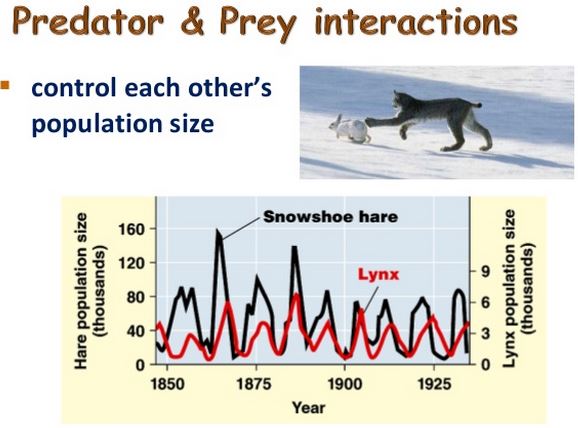
For millions of years nature kept every species in check. Population explosions of any species was soon met by either an corresponding explosion of predatory animals, or in cases were there were not enough predator animals, like rat or mice plagues, starvation would ultimately reduce their numbers to what the territory would support.
Sometimes of course there would be conflicts between different species of either predatory animals of prey animals. They can of course develop a symbiotic relationship like zebras and wildebeests, zebras eat the tall tough grass and wildebeests eat the shorter tender grass. But if this doesn’t happen, one species must adapt to another niche or go extinct.
This is not a fast process, sometimes taking many thousands of years to play out, depending on the size of the territory and the lifespan of the animals involved. And over many millions of years the balance was always maintained. Every species lived in and defended its niche and life went on. Only a universal disaster, like massive volcanism poisoning the air and seas could really disrupt this balance.
Every animal had adaptations that allowed it to survive in the wild. But no animal had a “super adaptation”, that is no animal evolved an adaptation that gave it ultimate control over other animals. There was no colossus in the animal world. No matter what the adaption, no animal could be that strong.
But the first hint of such an adaptation evolved about 5 million years ago. Somewhere in Africa a species of great ape evolved that had all the other survival adaptations of other great apes plus one more, that ape was just a wee bit smarter than other apes. And among these smarter apes, some were smarter than others. These smarter apes had a slightly higher survival and reproductive rate than the ones in their own group who were not so smart. But even these “smarter” apes were not really all that smart.
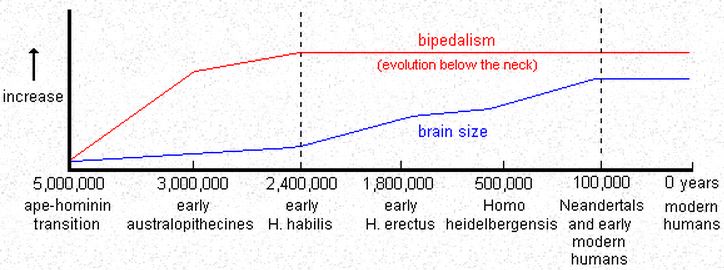 Brain size, which is correlated with intelligence, increased very slowly over two and one half million years. But the ultimate competitive weapon, the weapon that would give this one great ape a huge survival weapon over all other species had begun to evolve. From this point on the fate of the earth, the fate of all other species, was set. The ultimate weapon had begun to evolve. And about 100,000 years ago modern humans appeared.
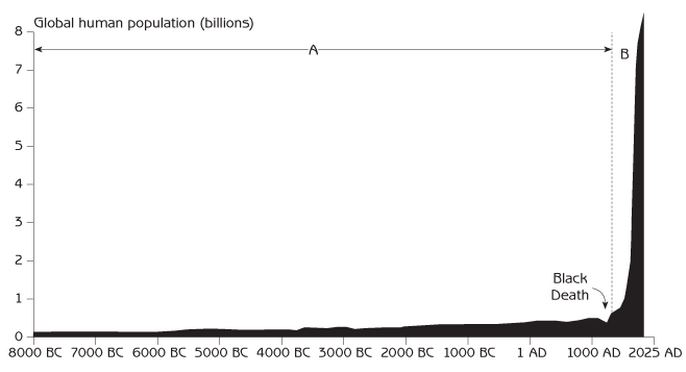 Until about 10,000 years ago, give or take, humans depended entirely on the natural world for its substance. Killing animals that they could find and gathering what fruits, roots and tubers than nature provided them. Then slowly the Neolithic Revolution started to happen. People began to plant seeds and domesticate animals. However Homo colossus had not yet appeared.
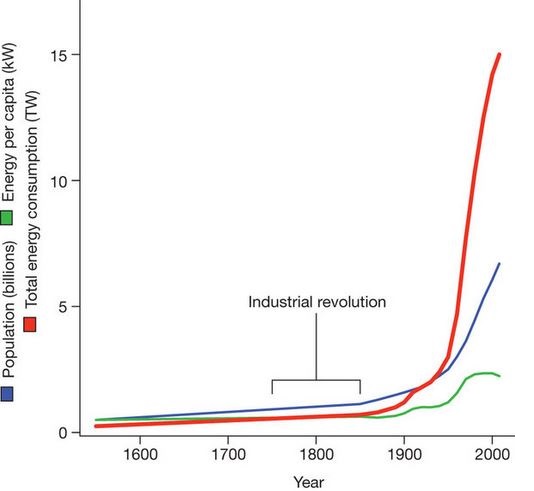
Homo colossus appeared about 250 years ago. That was when man began to spend nature’s non renewable carbon deposits as if they were income.
William Catton: When the earth’s deposits of fossil fuels and mineral resources were being laid down, Homo sapiens had not yet been prepared by evolution to take advantage of them. As soon as technology made it possible for mankind to do so, people eagerly (and without foreseeing the ultimate consequences) shifted to a high-energy way of life. Man became, in effect, a detritovore, Homo colossus. Our species bloomed, and now we must expect crash (of some sort) as the natural sequel.
However we need to get back to the subject of this post, the competitive exclusion principle.
Wiki: The competitive exclusion principle, sometimes referred to as Gause’s Law, is a proposition that states that two species competing for the same resource cannot coexist at constant population values, if other ecological factors remain constant. When one species has even the slightest advantage or edge over another then the one with the advantage will dominate in the long term. One of the two competitors will always overcome the other, leading to either the extinction of this competitor or an evolutionary or behavioral shift toward a different ecological niche. The principle has been paraphrased into the maxim “complete competitors cannot coexist“.
The competitive exclusion principle usually describes the competition of animals for a particular niche. But humans are animals also. We have been in the competition for territory and resources for thousands of years. And we have been winning that battle for thousands of years. But it is only in the last few hundred years that our complete dominance in this battle has become overwhelming. We are winning big time, we are quite literally wiping them off the face of the globe.
The below chart was created by Paul Chefurka.
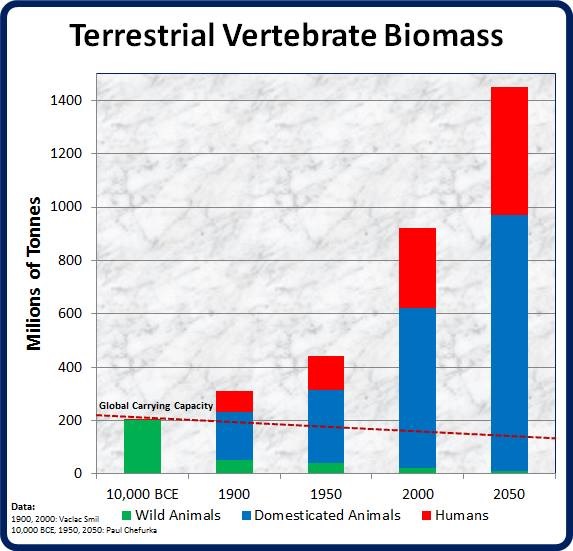
Three very important things can be derived from the above graph. One, we are wiping out all the wild species. 10,000 years ago humans were about .1 percent of all the land vertebrate biomass of the planet. In 2000 we were about 97 percent of the land vertebrate biomass. Today it is closer to 97.5 percent. And we continue to wipe them out. The Earth has lost half its wildlife in the last 40 years.
The second thing that is revealed in the above graph is the dramatic increase in biomass carrying capacity that has been made possible by fossil energy. Mechanical farming with tractors, combines and other farm equipment has made it possible for one farmer to cultivate hundreds of times the acreage he could just a little over a century or so ago. But that is only half the story. Fully half the people in the world are alive today because of synthetic fertilizer created from fossil fuel by the Haber-Bosch process.
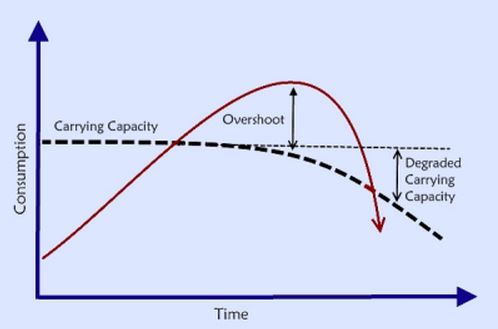
The third thing suggested by the graph is that the carrying capacity of the earth is being degraded by our massive overshoot in population.
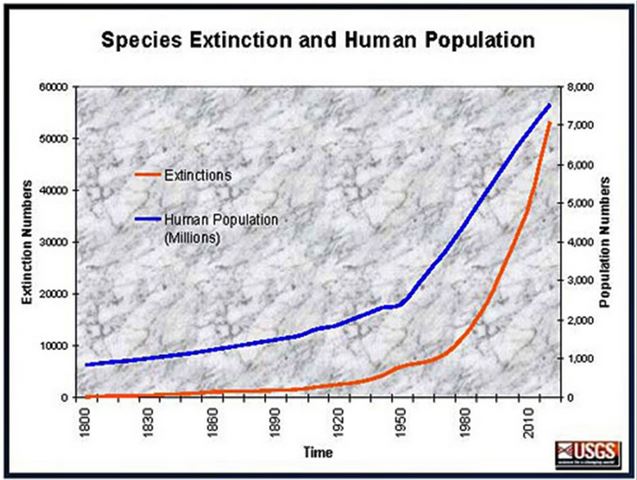
What no one ever talks about is the fact that the animal population is declining just as fast as our population is increasing. This means also that species extinctions are increasing as our population is increasing.
And here is the really, really bad news. Gause’s Law was never repealed. The competitive exclusion principle always applies. And instead of slowing down, the destruction of animal habitat is increasing. The wild animal population is declining at an alarming rate. Species extinction continues. And species extinction will continue until every animal that cannot coexist with man will become extinct.
Of course some animals will survive because their numbers are so great and their niche is so diverse. The rabbit and the dingo will survive in Australia and rabbits in other parts of the world will likely survive also. There is no doubt that rats and mice will survive and hopefully animals that feed on them, like the some owls and hawks will survive also.
Every large animal in Africa, the lion, the giraffe, the rhino, every great ape in Africa, will all disappear. Every large species in Asia will go also, the tiger, the elephant the orangutan, the panda and even the bears of northern Europe, Asia and North America will all become extinct. They all occupy territory and take resources that can be taken by Homo colossus and Homo colossus will take that territory because it is simply in his nature to do so.
We will kill them all.
It would eventually have happened even if not one lump of coal, one drop of oil or one whiff of natural gas had ever been discovered… but it would have taken a few thousand years longer. Our weapon, our intelligence, would have given us such a great advantage over other species that eventually the competitive exclusion principle would have prevaled and wiped them all out. Fossil fuels only enabled us to explode our own population and therefore wipe out the rest of the earth’s megafauna a lot sooner.
All this would happen even if we never have economic collapse. But when economic collapse does happen, every creature that is made out of meat will become a source of food. Economic collapse will just greatly accelerate the decline of the all that is wild.
Peak Oil Barrel by Ron Patterson
12 Comments on "The Competitive Exclusion Principle"
JuanP on Fri, 3rd Apr 2015 8:22 pm
What an awesome article! “And instead of slowing down, the destruction of animal habitat is increasing. The wild animal population is declining at an alarming rate. Species extinction continues. And species extinction will continue until every animal that cannot coexist with man will become extinct.”
I couldn’t agree more! I witness regularly the local environmental degradation. His observation that we would have done this without fossil fuels, but it would have taken longer is spot on, too.
Vietnam Vet on Fri, 3rd Apr 2015 9:58 pm
Hunger knows no morality. To the extent possible, all will be consumed by humans until overshoot and collapse.
This has already happened many times in the past on a local scale, this time it will be on a planetary scale.
Perk Earl on Fri, 3rd Apr 2015 10:12 pm
“10,000 years ago humans were about .1 percent of all the land vertebrate biomass of the planet. In 2000 we were about 97 percent of the land vertebrate biomass. Today it is closer to 97.5 percent. And we continue to wipe them out. The Earth has lost half its wildlife in the last 40 years.”
If 10,000 years ago we just .1% of vertebrates and today are 97.5%, then over the past 10k years we have eradicated 97.4% of all other vertibrates. That’s a staggering statistic!
Eventually there will be no wild animals. Controlled in zoos only (because we just can’t have things doing whatever out there – we need to control them) and if that space needs to be used for a multi-plex or highrise apartment, then we’ll just have to put down (murder) the animals and start excavating for the foundations.
All things continuing as is (if that was possible with sufficient cheap energy available, which it won’t be for long) all wild species would end up catalogued and preserved as DNA specimens only. Hopefully we won’t kill off the whole shebang before the other vertibrates get a chance to multiply.
I saw a documentary on this recent cave discovered in France, with cave art from 28,000 years ago. There were quite good paintings of lions, rhino, bears, wolves, horses and all sorts of other wild animals that were in France at the time. Yeah, that’s hard to imagine now.
Apneaman on Fri, 3rd Apr 2015 10:28 pm
What is staggering is that we have knocked off half of the vertebrates in the last 40-50 years while at the same time more than doubled our population and released millions of years worth of stored CO2. We were warned thousands of times by hundreds of very well meaning and intelligent people. Professor Al Bartlett anyone?
How about Walter Cronkite on Climate Change 1980
https://www.youtube.com/watch?v=MU9s0XyEctI#t=31
Dave T. on Fri, 3rd Apr 2015 11:05 pm
How easy it is to forget the bottom of the food chain when you are at the top.
Makati1 on Sat, 4th Apr 2015 1:07 am
Dave T., only until you run out of food…
Perk Earl on Sat, 4th Apr 2015 3:03 am
Hey, I just realized something. Once collapse begins then at some point will be ‘peak collapse’. Maybe at that crescendo we’ll know what it was like to be all the other species whose numbers we caused to dwindle.
sunweb on Sat, 4th Apr 2015 7:23 am
It has definitely happened in the past, now it is global.
One of the early Church Fathers, Tertullian (c. A.D. 160 – 240), commented on the effects of human enterprise on the earth: “Farms have replaced wastelands, cultivated land has subdued the forests, cattle have put to flight the wild beast, barren lands have become fertile, rocks have become soil, swamps have been drained, and the number of cities exceeds the number of poor huts found in former times . . . Everywhere there are people, communities – everywhere there is human life!” To such a point that “the world is full. The elements scarcely suffice us. Our needs press . . . Pestilence, famine, wars, [earthquakes] are intended, indeed, as remedies, as prunings, against the growth of the human race.” (Gies, Frances and Gies, Joseph. 1994. Cathederal, Forge, and Waterwheel. Harper Collins. N.Y. p. 6.)
Davy on Sat, 4th Apr 2015 7:58 am
At our human level we like to look at ourselves dualistically with nature hence an article like this. IMA a very thought provoking article. In reality all is natural on planet earth IMHO. So this Anthropocene is just a normal extinction event like the so many previous ones over life’s history on earth. The natural ecosystem will go through her cycles as she always has.
I see a coming bottleneck for man. I have do not know the time but I would say likely within 20 years but more likely 10. At least the end of the beginning will be 10. We are now likely on a bumpy descent of systematic reasons related to depletion of our foundational commodity oil and our human global system reaching diminishing returns and limits of growth. This at a time of what is likely a peaking population in overshoot per a depleting foundational commodity oil.
AGW will be the icing on the cake as the modern era ends and a huge population in overshoot enter the locust phase then the petri dish yeast phase. How fast and how hard this transition is a critical factor in survivability. If we are lucky and cooperate to some degree at least in multiple locals we may see a human population stabilize at between 500MIL and 1BIL. The possibilities of a much lower population do to runaway AGW and its feedbacks is very real. Extinction is not out of the question.
I do feel that we will very soon start an uneven process of excess deaths over birth because of systematic, food, and fuel insecurities. Research I have read shows best case scenarios of 200MIL over a generations starting anytime. This will render the worst human locations for survivability in jeopardy.
Mega urban areas and regions that import much of their food and fuel and have destroyed their ecosystem will drop quickly. Asia is a prime example. Consumption overshoot in the west will render an unprepared population dangerously exposed. Western mega population areas especially in the cold regions or dry regions will depopulate. Third world locations will follow similar issues. Even the third world areas with good survivability with subsistence cultures will be at risk for the mega populations in the vicinity that will depopulate into those areas that otherwise could survive.
This will truly be an event like no other for man. Unfortunately many more animal world extinctions will follow this process. Many critical ecosystems will be further destroyed. We want to express sadness and horror at this process but Nature does not operate ate the human level. This process is natural and as such at a level of natural connectivity we should behave differently. It is understandable having a large brain feeling exceptional we should feel guilt and culpability but that is just our large brain dualistic delusions. Nature operates at her own level with her own acquiescence. We are completely a part of this so all the whining and moaning about what is ahead is just a human nature but not Nature.
Nony on Sat, 4th Apr 2015 9:06 am
I don’t think much of the article. Some guy opining on ecology who has probably never taken college bio. Who is at a Wikipedia level of knowledge. And it contains a lot of the doomer mindset.
gdubya on Sat, 4th Apr 2015 9:29 am
Sadly, Nony, I suspect all it takes is a college level of knowledge of species interactions to realize that the biosphere is a zero sum situation. 7 billion of us means the direct competitors – wolves, sharks, orcas are directly eliminated and the rest are ‘naturally’ replaced by cattle.
Nony on Sat, 4th Apr 2015 10:21 am
http://imgs.xkcd.com/comics/land_mammals.png