
Peak Oil is You

Donate Bitcoins ;-) or Paypal :-)


Page added on March 9, 2015

Is a Chinese Shale Revolution in the Offing?


Countries across the globe like to talk a big game about developing their domestic shale oil and gas resources and sometimes utter lofty expectations of energy independence. Progress, however, has been very slow.
The following map by the World Resources Institute (WRI) illustrates locations of the 20 countries with the largest shale gas and tight oil resources, while incorporating WRI analysis of the level of water stress across every play in each country. Notably, the potential of shale across the globe depends in no small measure on water supply.

Source: World Resources Institute (WRI)
For shale gas, the WRI found that “plays in 40 percent of those countries face high water stress or arid conditions: China, Algeria, Mexico, South Africa, Libya, Pakistan, Egypt, and India.
Moreover, it may come as a surprise that – according to the EIA – only four countries in the world – the US, Canada, China, and Argentina – actually produce commercial volumes of either natural gas from low-permeability shale formations (shale gas) or crude oil from tight formations (tight oil). No surprise, however, is that the US is “by far the dominant producer of both shale gas and tight oil” thereby in a sense monopolizing the required hydraulic fracturing technology and operational expertise needed to extract these resources. No country has the extensive equipment inventory – rigs, well completion tools, etc. – found in the US.
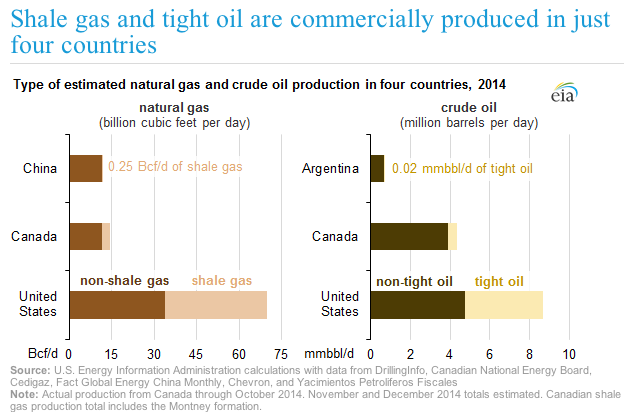 Source: EIA
According to the EIA, Sinopec and PetroChina reported “combined shale gas output of a [mere] 0.163 Bcf/d, or 1.5% of total natural gas production,” from fields in the Sichuan Basin. Faouzi Aloulou of the EIA also elaborates on why China and other countries lag behind in commercial shale development of the type demonstrated in the US. Factors to consider include the “ability to rapidly drill and complete a large number of wells in a single productive geologic formation,” accompanying logistics as well as infrastructure including “the drilling and completion processes, the manufacturing of drilling equipment, and the distribution of the final product to market.” Additionally, other so-called “above the ground factors such as ownership of mineral rights, taxation regimes, and social acceptance” also play significant roles in the success of US shale development.
The American Enterprise Institute (AEI) concurs and hails the resilience of the US political-economic system, noting the US possesses the ‘complete package’ or – in AEI’s words from its latest report “Too Much Energy? Asia at 2030,” – “the best possible combination for innovation in energy [comprising the necessary] natural resources, well-defined property rights, an open and competitive industrial structure, and deep capital markets.” Conversely, while China possesses abundant shale reserves it lacks most of the determining factors that seem indispensable for a successful shale revolution in China.

Source: AEI, Infographic by Olivier Ballou.
In sum, given that “61 percent of shale resources [in China] face high water stress or arid conditions” (for that, read WRI analysis here), water stress may turn out to be in China’s case the decisive constraining factor explaining why a full-blown US-type shale revolution in China is not in the offing. Besides, large shale reserves happen to be situated in the vast Sichuan Basin, an area of high earthquake risk.
The Sichuan Basin (China)

Source: California Institute of Technology (Caltech), Tectonics Observatory
In this context, it may also be instructive for Chinese energy regulators to monitor any developments about frequent earthquakes surrounding the Dutch Groningen gas fields – the largest in Europe – and to take the right lessons from it if there is a political will to do so. As reported by Reuters, the Dutch Safety Board found that the operators and the Dutch government ignored the “danger of earthquakes caused by gas extraction” for decades. Anthony Deutsch of Reuters writes that operations have “resulted in increasingly strong earth tremors, some measuring as much as 3.6 on the Richter scale.”
8 Comments on "Is a Chinese Shale Revolution in the Offing?"
rockman on Mon, 9th Mar 2015 6:50 am
Several points to make:
“EIA also elaborates on why China and other countries lag behind in commercial shale development of the type demonstrated in the US.” They provide a good list EXCEPT they leave out the most important factor: viable shale reservoirs to develop. In the US the vast volume of shale formations have been proven with thousands of wells to contain an insignificant amount of hydrocarbon potential. Which is why 80%+ of US oil production shale comes from just two formations: the Bakken and Eagle Ford. In the case of the EFS, which is typically 200’ thick there are shale with an aggregate thickness of 10,000’+ immediately above and below the EFS that are yielding very little oil. And NG production is dominated by a single formation…the Marcellus.
And China does not have a huge shale RESERVE base. That’s why they use the term RESOURCE. Resource is just a term to use when they have no idea as to how much commercial reserves exist. IMHO it’s an even more deception spin then the “technically recoverable” bullsh*t some like to toss out.
And of course they have to touch on the fear of frac’ng by pointing out the Dutch earth quakes despite the fact that those tremors are coming from the compaction of a conventional NG field where there has never been a single frac well. BTW just to put the Dutch tremors into perspective the USGS estimates there are about 100,000+ earth quakes around 3.6 RS in the US every year. The same number that were occurring before the frac’ng boom. It wasn’t a terrible article until they tried such cheap and potentially inflammatory spin IMHO.
BTW the typical damage caused by those Dutch earth quakes”: cracks in brick walls. Not one brick wall which had any potential to collapse.
Davy on Mon, 9th Mar 2015 6:52 am
China is too late to the game. Sorry China.
Plantagenet on Mon, 9th Mar 2015 11:09 am
Of course China will frack and develop their tight shale reserves. Any country that eats snakes and little turtles will do very well at getting oil and NG from shale.
BobInget on Mon, 9th Mar 2015 11:48 am
China’s exports surged 48.3 percent on year in February, sharply above analysts’ forecasts, potentially signaling stronger economic growth for its trade partners.
Imports fell 20.5 percent for the period, according to data from China’s customs department. A Reuters poll had forecast exports would rise 14.2 percent and imports would fall 10 percent.
For January and February combined — a common metric to help smoothe distortions from the Lunar New Year holiday period — exports rose 15 percent from a year earlier, while imports declined 20.2 percent.
“The demand from the advanced economies bodes well,” ANZ said in a note Sunday, citing data showing shipments to the U.S. and European Union rose 40.3 percent and 36.6 percent on-year respectively.
But the bank noted that the jump in exports could be due to a base effect. “The February 2014 figures were extremely low as Chinese authorities cracked down the round-tripping trade flows,” it said. “We still see strong headwinds facing China’s exports this year,” ANZ said, citing weak export order PMI data.
Davy on Mon, 9th Mar 2015 12:01 pm
Bobby, MSM fluff data based on manipulated data. Go ahead and believe it if it makes you feel better. Just check the Baltic dry data and then get back to me. No corn porn with those numbers.
BobInget on Mon, 9th Mar 2015 12:14 pm
Increased imports would naturally lead an economic recovery. China buys
More facts;
http://www.autonewschina.com/en/index.asp
(auto sales up 15%, first two months)
http://www.indexmundi.com/energy.aspx?country=cn&product=jet-fuel&graph=consumption
Jet fuel consumption. One strong economic indicator. This despite HS Rail eating into airline business.
http://qz.com/193556/chinas-high-speed-rail-is-so-popular-its-hurting-the-domestic-airline-industry/
China cannot afford to delay shale drilling domestically. Having said that:
China successfully corralled African and South American crude imports once destined for the US. China looks to be doing the same in Asia
in seas also coveted by Japan, Philippines, S. Korea, and Vietnam.. Expect friction.
US jet fuel consumption, up double digits last week.. just saying
GregT on Mon, 9th Mar 2015 3:05 pm
“VANNESS: Russia, China preparing to eliminate our reserve currency status”
“Russia and China have engaged in currency swap agreements, between themselves, to bypass the dollar in bilateral payments and both countries’ central banks have been stockpiling large gold reserves.”
“Russia and China are pushing the U.S. into a currency crisis. The massive national debt accumulated through massive U.S. borrowing is unsustainable. The growing interest on our debt will soon consume the majority of our federal budget. With the international community relying less and less on the dollar, eliminating our reserve currency status will result in higher interest rates, a rise in prices, and a greater difficulty servicing our debt.”
http://www.washingtontimes.com/news/2014/nov/18/van-ness-russia-china-preparing-eliminate-our-rese/
Davy on Mon, 9th Mar 2015 3:44 pm
China & Russia are the pot calling the kettle black. Any praise for either countries economy and or leadership is a joke!
http://www.ibtimes.com/russia-ruble-crisis-currency-continues-fall-ukraine-conflict-falling-oil-prices-blame-1780538
The Russian ruble Monday extended its decline, weakening another 1.9 percent to 62.74 against the dollar, making it the world’s worst-performing currency since Russia annexed Crimea in March. At the same time, the yield on Russia’s five-year ruble bonds rose to 16.26 percent, according to Bloomberg Businessweek.
http://davidstockmanscontracorner.com/chinas-monumental-ponzi-heres-how-it-unravels/
So in two short decades, China has erected a monumental Ponzi economy that is economically rotten to the core. It has 1.5 billion tons of steel capacity, but “sell-through” demand of less than half that amount— that is, on-going demand for sheet steel to go into cars and appliances and rebar into replacement construction once the current pyramid building binge finally expires. The same is true for its cement industry, ship-building, solar and aluminum industries—to say nothing of 70 million empty luxury apartments and vast stretches of over-built highways, fast rail, airports, shopping mails and new cities.
In short, the flip-side of the China’s giant credit bubble is the most massive malinvesment of real economic resources—-labor, raw materials and capital goods—ever known. Effectively, the country-side pig sties have been piled high with copper inventories and the urban neighborhoods with glass, cement and rebar erections that can’t possibly earn an economic return, but all of which has become “collateral” for even more “loans” under the Chinese Ponzi.