
Peak Oil is You

Donate Bitcoins ;-) or Paypal :-)


Page added on February 18, 2015

What happens if we run out of oil?

It took hundreds of millions of years to create the world’s oil reserves.
It took less than a century before oil became the commodity on which world power turned.
And it was little more than a century before fears were raised that we would run out of oil.
Fifty years further on, it’s less clear than ever how much is left. That’s because technological advance has confounded those who feared there were tight constraints on what could be drilled.
The rich rewards from oil have fuelled initiative and invention. As Professor Iain Stewart explains in his BBC series Planet Oil, this wasn’t just a passion for scientific and engineering endeavour.
It was economic, political and strategic military calculation that drove the UK and the US to find ways of becoming less dependent on supplies from the Middle East.
Having done so, they started to innovate. When the pioneers of the North Sea first found oil, they had little expectation that they could recover more than about a third of what they found.
But the rock formations that make up these fields have yielded far more than expected, maintaining the industry far longer. The next giant discovery to be developed in the North Sea – the 2-billion-barrel Johan Sverdrup field near Stavanger in Norway – has a target of 70% recovery.
With a lifespan stretching beyond the 2050s and into the third century of the oil industry, it may be possible to extract even more than that. Indeed, if past decades of technological advance are any guide, it’s very likely that more can be recovered.
That’s why the debate about Peak Oil – the point at which prices head sharply upwards because oil explorers fail to find replacement reserves – is seen as less of a threat than even ten years ago.
A look at the paranoia that surrounded the discoveries.
New techniques; new locations
Instead of needing many and mobile platforms for vertical drilling, fields can be drilled horizontally. Enhanced Oilfield Recovery is a developing technique that involves the use of chemicals to flush out more from reservoirs as they deplete.
We’re still learning how to handle the technical challenges at the new frontiers of this industry.
There are attempts to commercialise carbon capture, meaning that treated emissions could be pumped into old oil wells.
The main reason would be to remove emissions from the atmosphere, but the process could also be used to displace more oil from porous rock.
With improved drilling techniques, oil fields can be found much deeper underground than before. And with clever vessel handling and positioning, offshore exploration can go into ever deeper and wilder water.
In the UK, that’s taking the frontier west of Shetland, where the giant Laggan-Tormore gas and oil field will come on-stream later this year.
America’s leading geological institute reckons that one of the world’s ten biggest oil basins could be between Greenland and Canada. That adds icebergs and the deep freeze of winter to the dangers.
The few attempts at drilling there have not found anything significant. And at enormous cost for exploratory wells, Greenland waters are being left to the narwhals while the price remains at current lower levels.
However, the ability to operate in very cold conditions, or by putting equipment on the seabed has opened up the wider Arctic potential. It has also opened up geo-political rivalries over which countries own it.
We’re still learning how to handle the technical challenges at the new frontiers of this industry, where there are exceptionally high temperatures and pressure, and where heavy viscous oil is unusually hard to extract.
In Canada’s Alberta province, new methods are being used to extract oil from tar sands. The US boom in fracking has opened up new possibilities for extracting gas and oil from shale rock, notably in Texas and the Dakotas.
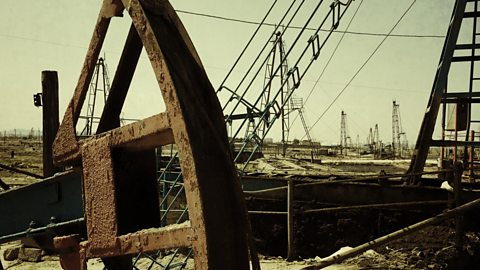
That’s not as new as it might seem, though. James ‘Paraffin’ Young pioneered the extraction of oil from shale rock in West Lothian, moving there in 1852. The ‘bings’ of mine waste are still a feature on the Forth Valley horizon.
We’re now at the early stages of seeing what energy reserves could be unlocked by re-opening coal seams for controlled burn underground, extracting coalbed methane, and by fracking shale.
Beyond America, fracking prospects look strong in China, Poland and France – if there is the political will to let the drillers get to work.
That doubt is because the industry’s methods are proving controversial. The methods used and the impact on geology and on underground water courses have provoked opposition.
Climate change and the future
And the burning of oil – as with gas and coal – has been targeted as the main source of climate change.
China and India are among those facing major problems with urban air pollution
So the future of the industry may not depend so much on how much supply can be unlocked to meet fast-growing demand from emerging economies.
It may have more to do with the political will to choke off demand and cut back emissions.
The attempts to find and implement international agreement on that have not been a notable success. From Kyoto to Copenhagen, grand government gatherings have sought to find common ground, and that circus moves on later this year to Paris.
What will be different this time? Well, the debate over whether climate change is for real, and why it might be happening, has not gone away. The doubting voices from Washington’s Capitol Hill don’t help in reaching deals.
But pushing for more action, environmental campaigners are increasing pressure on banks and moreso on investors to withdraw from oil and gas projects.
Meanwhile, the klondyke rush to grow economies in Asia and South America has slowed. And for some, the environmental cost of the new prosperity has caught up.
China and India are among those facing major problems with urban air pollution. And their city roads have become so congested that the growth in private, oil-burning transport may, literally, be choked off.
Prices and policy
Of course, price has a role to play in this demand and supply. Fracked gas has become so cheap in the US that it undercut oil and coal in the USA, and power generation has shifted to gas, as the fuel with lower emissions.
Energy-intensive industries have been attracted to the USA, even bringing back some of those which had previously offshored jobs to countries where labour was much cheaper.
Regulation has a role to play too. In the US and the European Union, governments have passed on their international obligations to cut climate change by requiring the design of more efficient cars, commercial transport and aviation.
Policy has pushed car manufacturers towards more hybrid and electric cars, and the use of biofuels.
Governments have also ensured renewable energy is subsidised by customers, to replace the retiring power stations which have long emitted CO2.
With rising pollution in big Asian cities, some similar measures are being taken by governments there. The low oil price this year gives them an opportunity to remove fuel subsidies. That ought to limit demand.
So where there used to be a strong link between economic growth and the increasing demand for oil, that link is being broken.
As countries grow their economies, service industries take a larger share than manufacturing. That, too, weakens the growth in demand for oil.
And instead of the 20th century imperative to find new, diverse sources of oil, the imperative now is to use oil more efficiently and to find new, different renewable alternatives to it.
Extraordinary achievements by innovative engineers and scientists have relaxed the constraints on the supply of oil. The upward pressure on the demand for it is also cooling.
Perhaps we won’t run out of oil, but instead learn to need it less.
16 Comments on "What happens if we run out of oil?"
Makati1 on Wed, 18th Feb 2015 6:11 am
“So where there used to be a strong link between economic growth and the increasing demand for oil, that link is being broken.”
Bullshit!
forbin on Wed, 18th Feb 2015 6:15 am
No no no
its not
“What happens if we run out of oil?”
but
“What happens when we run out of oil?”
or
” What happens if we run out cheap of oil?”
nice try on the docu. but no cigar
Forbin
Davy on Wed, 18th Feb 2015 6:32 am
The article is mostly redundancy for us here. It is interesting to see what a MSM site says about PO. IMA I follow BBC as part of my monitoring of MSM. At the bottom in the conclusions we see a fallacy in the first sentence that economic growth decouples from energy intensity. That is cat piss. In this global world of comparative advantage and disadvantage energy intensive activities have migrated but the consumption has not. One must look at the consumption to get a true picture of the economics of oil and growth. A prime example is the dirty cheap manufacturing in Asia for plastic junk the Walmart folks in the US buy. The service industries have migrated to those areas where these dirty low wage manufacturing jobs are no longer economic per globalism. The US has a strong service sector in this regards.
The second conclusion is more cat piss. Energy efficiency has hit diminishing returns. The facts are you can spend more energy to be energy intensive than you save. It is yet another example of the techies trying to use technology to fix a technological problem that is itself a problem. Einstein called that insanity. The article mentions AltE. AltE is extremely important especially the right kind with a future of a world in a bumpy descent. It will fill a resilience niche when complexity and energy intensity diminish. This AltE should be of the low cost, low tech, dispersed, and robustly reliable type not the technologically sophisticated types the greenies and techies want. AltE is not an alternative or substitution to fossil fuels. It is a fossil fuel extender. It is a life boat component all life boats should have as part of their survival inventory.
I am not against efficiency or AltE I am just saying call a black cat black not a dirty white cat. One of the biggest shams today is from the greenies, techies, and AGW folks deceiving people that AltE will be our savior if and only if we would reject FF. Nothing could be further from the truth. It is a dangerous and delusional message. There is nothing we can do to save our civilization or the environment other than reduce our population quickly to 1BIL or less. I am OK with the AltE delusions because any efficiency and AltE is useful as opposed to another baseball stadium, highway to nowhere, airport, or amusement park as a short list of a longish list.
I want to know what is currently extraordinary or innovative in the last sentence. Our age has hit diminishing returns to innovation and technology. Most what is considered innovative is just a recycling of old technology. We are deceiving ourselves about the digital. What have we really got with the digital revolution? What we have is a further disconnect with resilience and sustainability. We have become more energy intensive and more complexity dependent in a time of a paradigm shift from growth to a bumpy descent. A time where complexity and energy intensity will diminish. We have a population being dumbed down and skill deprived for what is really needed for survival. The innovations and achievements are just further moves towards bottleneck man i.e. delusion and insanity.
This article ends on a positive optimistic note. This article approaches the unsettling idea of oil running out and ends with all will be well. Technology, more complexity, efficiency, and innovation will save us exceptional critters. We humans are special and we humans will overcome. This is cat piss. We are at the cusp of collapse on multiple fronts with foundational elements with a population in overshoot. We are moving ahead further into those activities and attitudes that are part of the problem to begin with.
It is these type of articles that demonstrate little hope in time to make important mitigation and adjustment efforts at the top of society. An area that is vital for everyone. It will take a significant crisis to force efforts to change. Unfortunately it will be like aggressive cancer surgery when the cancer has spread too far. We need to write off the top as any help. You can and should prepare at the bottom. Move to a location with a future, educate yourself, do basic preparation, build community, take care of your body and change your attitudes a short list of a longish one. I could go on and on but I have done the normal Davy morning ramble so I will quit preaching.
Rodster on Wed, 18th Feb 2015 6:58 am
I’m certainly no oil expert, far from it but I always get a hearty chuckle/Mutley snicker when I hear or read that there’s no such thing as peak oil. Then I further read that in order to extract the oil they have to go thru unconventional means to get it out of the ground, which is more expensive and lower quality.
The insane amounts of clean water needed is also alarming especially when you read or hear about drought stricken areas or places where there are water shortages.
rockman on Wed, 18th Feb 2015 7:34 am
“Instead of needing many and mobile platforms for vertical drilling, fields can be drilled horizontally. Enhanced Oilfield Recovery is a developing technique that involves the use of chemicals to flush out more from reservoirs as they deplete.”
Always good for a laugh when “they” write assuming no one with tech experience will review their BS:
First, mobile platform (?) and drill rigs have been drilling non-vertical wells for more than 40 years. Second, we’ve been drilling horizontal wells into unconventional reservoirs for more than 20 years. Third, chemical EOR has been conducted in many hundreds of oil fields starting more than 50 years ago.
“Mobil platforms”…LOL. There are mobile offshore drilling rigs and fixed offshore platforms. I’ve never seen a “mobile platform”.
shortonoil on Wed, 18th Feb 2015 8:47 am
“Mobil platforms”…LOL. There are mobile offshore drilling rigs and fixed offshore platforms. I’ve never seen a “mobile platform”.
Welcome to the new age of oil. When I read that I had an image of thousands of Egyptian slaves pulling, and pushing a block of stone to a pyramid. How about thousands of Texans pulling , and pushing a drilling rig. Maybe we can get Plant a job turning the crank!
Plantagenet on Wed, 18th Feb 2015 9:08 am
Someday we will run out of oil. Right now, however, we’re in an oil glut
Plantagenet on Wed, 18th Feb 2015 9:13 am
@short
I can tell you’ve never been on an oil rig. Your fantasy about “turning a crank” is hilarious
Cheers!
Bob Owens on Wed, 18th Feb 2015 11:50 am
The title of this article is: “What happens if we run out of oil?”. The author then proceeds to tell us that we will never run out of oil due to all the miracles of tech! Every argument by peak oilers is being contested and the oil world will live forever! Gee, I feel better already. Doesn’t anyone vet these articles on this site? Too much trash is getting posted here.
J-Gav on Wed, 18th Feb 2015 12:14 pm
What happens? Euh, TSHTF!
Plantagenet on Wed, 18th Feb 2015 12:16 pm
Actually, the article doesn’t say that we will never run out of oil. It says that thanks to new technology we are probably OK on oil until past 2050.
Apneaman on Wed, 18th Feb 2015 12:29 pm
Large Explosion Prompts Fire, Police Response at Torrance ExxonMobil Refinery
http://ktla.com/2015/02/18/residents-report-hearing-explosion-feeling-ground-shake-near-torrance-exxon-mobil-refinery/
Dredd on Wed, 18th Feb 2015 1:46 pm
“What happens if we run out of oil?”
It is not “if” it is when, and it depends on who “we” are.
Civilization’s operatives ran out of sanity some time back, which is more to the point.
There is enough oil to make this true:
“Once there was no civilization, then there was, then there wasn’t (Civilization Is Now On Suicide Watch – 7).”
Sane folks know that ice is more dangerous than isis.
But the wee minded people, not the we minded people, took over to become Oil-Qaeda.
So, you will have to bullshit your way to feel good, feel gooder, and feel goodest.
Try talking about the price of a barrel of poison for starters.
hculliton on Wed, 18th Feb 2015 6:38 pm
Straight up, Davy! I’m saddened buy the amount of oil that was consumed publishing this BS.
Cullins on Tue, 24th Feb 2015 5:12 pm
We won’t un out of Oil. There is simply too much of it in the ground. That is why OPEC was formed which hyper inflated the price and the rest of the oil market followed suite! There is an insane amount of profit made in oil! People need to raise up and look at alternatives because your government is not going to support you on moving away from oil. The biggest problem we face is climate change which does need to be addressed! I suggest the best way to tackle this is by buying local food and goods as most pollution by far is done by global trade with china and food imported! Cars are not the issue, its diesel truck which travel 500,000 miles a year. Container boats and planes that casue damage.
Davy on Tue, 24th Feb 2015 6:17 pm
Cullin, too bad it isn’t so simple. There will soon not be enough oil to run BAU is the issue. AltE is a dead end but it will buy us time and should be part of a plan B. AGW is catastrophic but PO is the immediate threat. Billions will die with the end of globalization and PO will end globalization.