
Peak Oil is You

Donate Bitcoins ;-) or Paypal :-)


Page added on February 17, 2015

Peak What?

I’ve been maintaining “radio silence” for a while—mostly on account of an overflowing plate and several new new hats I wear. All the while, I have received a steady stream of e-mail thanking me for Do the Math, asking if I’m still alive, and if so: what do I make of the changing oil situation? Do I still think peak oil is a thing?
Let’s start with the big picture view.
I was wrong about everything. Oil is not a finite resource: never was and never will be. We will employ new technologies and innovate our way into essentially perpetual fossil energy. We’ve only scratched the surface in exploration: there are giant deposits (countless new Saudi-Arabia-scale fields) yet to be discovered). The shale oil tells us so—and it won’t stop there. Shale first, then slate, marble, granite: just squeeze the frack out of rocks and we’ll get oil. Meanwhile, whole new continents are being discovered, rich with resources. The most recent was hiding behind Australia. And naturally it doesn’t stop there. We have now discovered thousands of planets just a hop away, most of which are likely to contain fossil fuels of their own. So game over for the resource limits crowd, yeah?
Oh wait. I was wrong about everything in the preceding paragraph.
Wait—which is it?
Let’s not get confused, people. Earth is finite (and other planets are mostly in hostile environments and in any case rendered immaterial by unfathomable remoteness). The resources are finite. One-time consumables will peak in their use one way or another: they must do so—either by depletion or by voluntary reduction in use. Estimating timescales is the tricky part. But do I still believe in peak oil? As surely as I believe we landed on the Moon.
What about timescales: do I believe we are likely to see peak oil in the next decade or so? I do still think this is likely: a point of view based on more than stubbornness.
What’s Happening in Oil?
A good first step in anticipating the future is to understand the present and recent past. Why the dramatic price drop? In two words: shale oil. No big surprise. This is the story. The geopolitics add complexity to the tale, but essentially—as I understand it—OPEC is trying to run shale oil operations in the U.S. out of business.
Shale oil is more expensive to produce than conventional oil. Technology has its price, after all. The Saudis and friends have pledged to hold oil prices low for a good while in an attempt to destroy the market viability for U.S. shale companies to continue operation. I can’t say if this will work (the key question: how many years does it take to starve a company into liquidation of assets?). But that’s the not-so-secret word on the street.
So we need to understand something about the shale oil boom. Firstly: is it really responsible for the apparent glut? Secondly, can we expect it to last?
Recent Data
The U.S. Energy Information Agency maintains global data on oil production. Plotting the data for the world appears as follows.
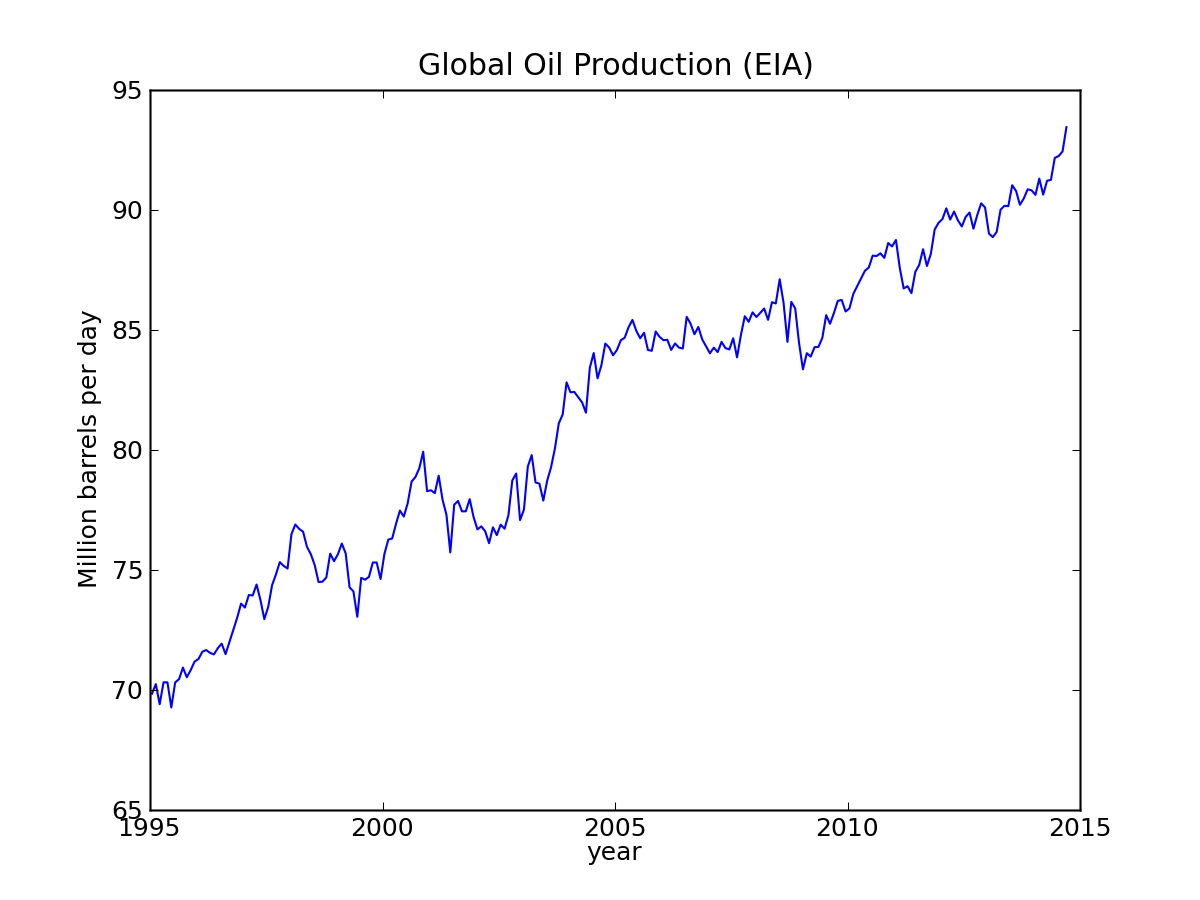
At a glance, we see an inexorable climb in oil production. No evidence for a peak here. If we cover up the right-hand side, beyond 2009, we can justify a different narrative: production hit a plateau from 2005 to 2009. During this time, oil price crept gradually from $45/barrel toward $100/barrel and then spiked in 2008 at $140/barrel. This factor-of-two price hike had no effect on production, which strongly suggested a tapped-out world: pegged production.
One can make a compelling argument that the slow price increase strained businesses in many sectors (tourism, auto manufacturers, airplane industry, etc.), and that the resulting lackluster growth popped the housing bubble—itself built on the fantasy of perpetual strong growth. When the 2008 recession hit full force, demand dropped and took the price plunging with it. Yet global production didn’t flag that much: again reinforcing the story that oil is a highly inelastic economic commodity—on account of there being no ready substitutes.
But then the plateau disappeared into the ensuing continuation of growth, making a once striking feature now difficult to discern.
Let’s flip to the U.S. production to see what influence shale oil has had.
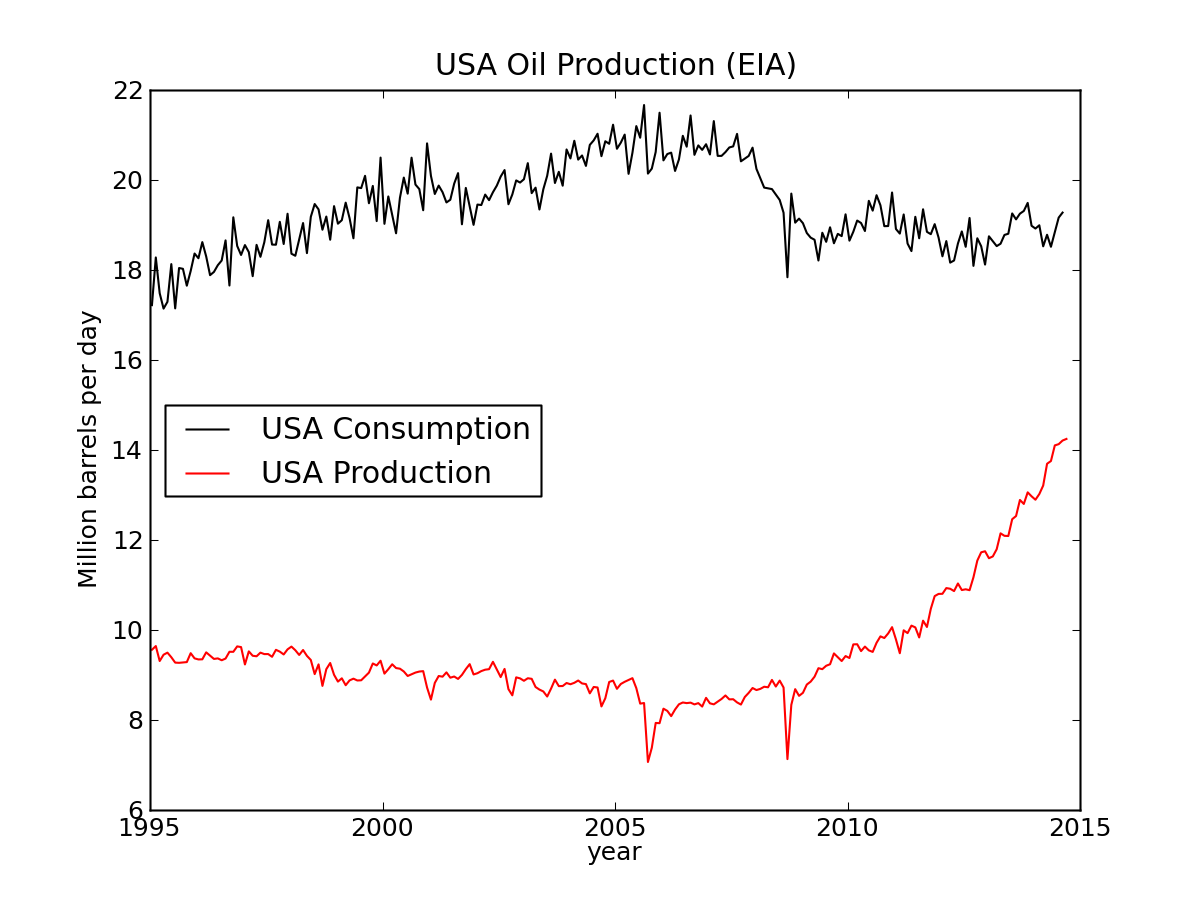
As the century odometer rolled over, we found ourselves in a slow year-by-year production decline, tucking below 9 million barrels per day (the scale of consumption in the U.S. is about 20 million bpd). Then came shale oil and what can I say: it’s a phenomenon. Around the time shale oil cranked up, consumption (black curve) was in a recession-induced decline, leading to heady predictions of energy independence in a few years’ time. Consumption has since leveled off, and we might even expect an uptick as a reaction to lower gasoline prices. Bring back the SUV! May it as that be, the red curve is climbing, and talk of energy independence for the U.S. is not to be dismissed out of hand.
That is—until OPEC has its say. The shale oil story proceeds on two fronts: the physical front and the artificial front. Physically, shale oil remains a finite resource, as any other. I have seen mixed messages about the longevity of these “plays,” probably the balance indicating that the premium spots have been exploited most rapidly, that individual drilling sites peak and collapse on few-year timescales, and that the rapid rise we have seen may represent more of a sprint than a marathon. So I would not be surprised if the juggernaut loses steam on the back of its own success, on a decade timescale. But then we have the artificial factors (highly nonlinear human meddling) that may force a downturn in shale production by economic means. Another “artificial” influence may assert itself on the environmental front, based on flammable drinking water and the like.
In any case, I am hesitant to embrace shale oil as the “new normal,” to be increasingly exploited throughout my lifetime. Certainly you can’t convince me that any of our finite resources will be with us for the long haul, but even on the timescale of 10–20 years, I think it’s unwise to extrapolate on the basis of the new kid in town (a transient, or even drifter!).
Shale Share
One final thing worth investigating: how much of the recent “post-plateau” growth in global oil production can be attributed to shale oil in the U.S.?
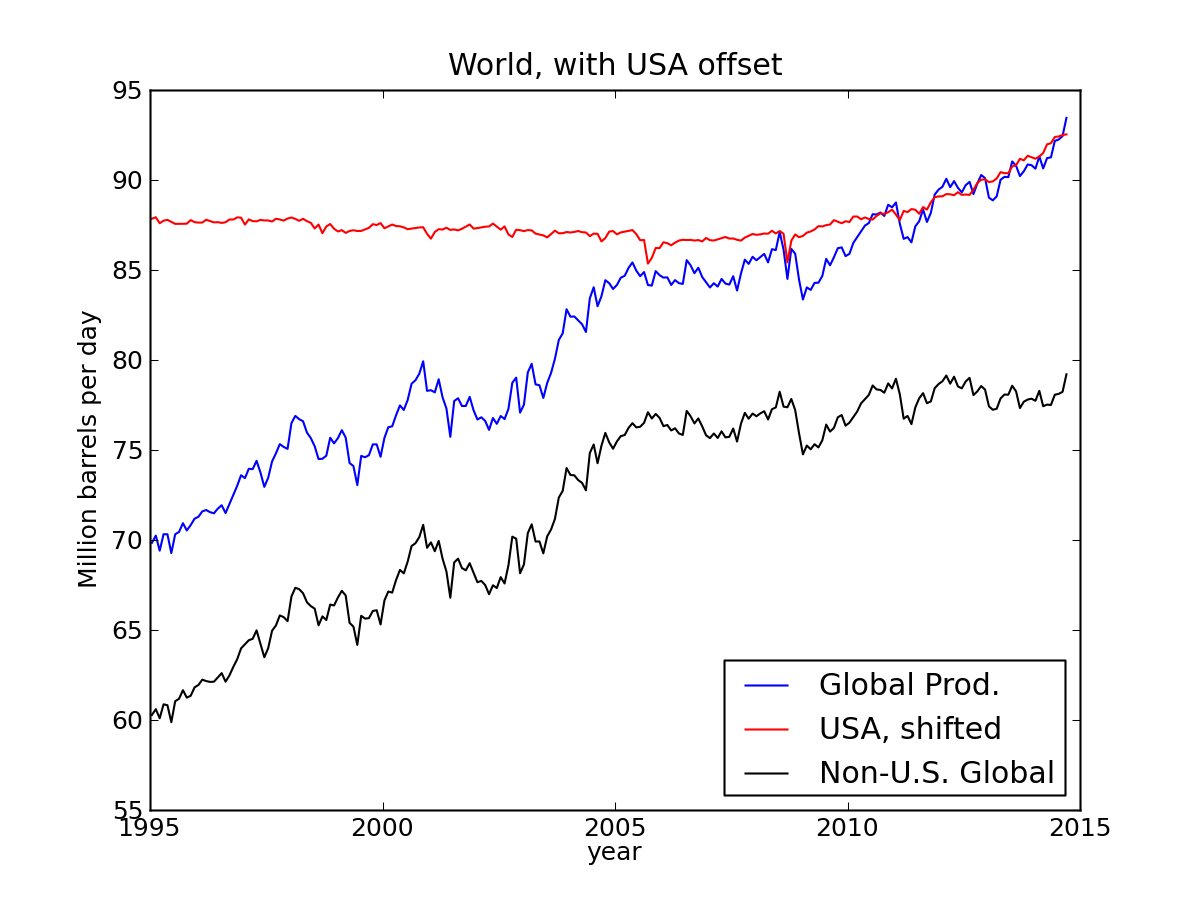
In the graph above, I have superimposed the U.S. production atop global production by adding an offset to the U.S. number so that the last few years overlap. Now the diminishing gap between the red and blue lines represents growth in the rest of the world. U.S. shale oil accounts for about 70% of the total growth since 2005. It is rather striking to behold. Global production had the characteristics of a freight train for the first ten years of this plot. Then in about 2005 it stopped abruptly (hello, plateau). The non-U.S. global production (black curve) has experienced only 20% as much growth from 2005–2015 as it did in the preceding ten-year stretch. That’s a substantial bend. Peel off the shale oil and we see that the global plateau is still very much with us—despite sustained high prices through the period.
For comparison, Saudi Arabia produced typically 9–10 million barrels per day in the 1995–2005 period, and is now edging toward 12 million bpd. While this is a commendable increase (not easy), it is not at the same scale as the U.S. increase, which now puts the U.S. back in the role of largest oil producer in the world—as it was for decades in the mid-20th Century (not a small factor in the famous prosperity of the U.S.).
Perspective
So it’s fair to say that the continued upward trend in global production post-2005 is due to the shale oil phenomenon.
What does this do to my thinking? Time. It’s added a decade or maybe two to the timescale for global peak oil. And time can be a great thing. With it, one may smartly prepare for a post-carbon world. We need time and the luxury of surplus energy to fashion a world less dependent on fossil fuels (the solution to the Energy Trap).
Some of this will happen as a matter of course. Electric cars are in a whole different place than they were ten years ago. I expect continued progress on this front—although falling short of a transformative revolution, I suspect.
But cutting against us is the sense that we have averted a crisis, so we can go back to business as usual. Investment and research into alternative energies will wane: just when we need them more than ever. Indeed, I myself do not feel the same degree of urgency that I did a few years ago, and have allowed the normal set of “distractions” to creep back in. In part, it’s just a reflection of where society at large is right now. It’s harder to draw an audience to discuss energy/resource scarcity when the headlines are in the opposite direction.
This leads to another issue on human psychology that I have been wanting to post for some time. Look for this next, when I get another break from my hat collection.
22 Comments on "Peak What?"
Plantagenet on Tue, 17th Feb 2015 6:25 pm
If fracking tight shale in the US has “added a decade” to wait for global peak oil, then more shale fracking in Europe and Asia and Australia and Africa can add still more time.
We might be able to delay peak oil for 20-30 years, assuming we’ll get past this oil glut and the price of oil goes back up so fracking becomes economic and profitable.
HARM on Tue, 17th Feb 2015 6:56 pm
If we can defer the day of reckoning another 20-30 years (or even better, 40), that’s cool by me. I may be dead or senile by then. The prospect of spending whatever cogent and reasonably healthy years I have left in a grim fight for survival thanks to post-peak collapse is very un-fun.
This may sound selfish and fatalistic, but since it does not look like 99.9% of the public is ever going to believe (much less heed) any warnings, I’d really prefer the world goes to hell after I’m gone.
Makati1 on Tue, 17th Feb 2015 7:16 pm
Dream on boys. The world economy dictates the amount of oil consumed and therefore, the price and availability. Not the amount of recoverable oil. The amount that can be recovered PROFITABLY both in money and energy (EROEI).
Look at the chart showing US consumption. That six year plateau says it all. No income, no consumption. The average American is broke. Borrowed to the hilt. Out of cash and probably unemployed or flipping burgers for minimum wage. The Saudis may be successful in trashing the fraking bubble if they hold on a year or so. It will never return, also for financial reason, not lack of oil.
At least, that is my take on the situation. Bring on $20 oil or even $2 oil. It will hurry the ending to this story and maybe allow some of the earth’s life support system to survive.
Revi on Tue, 17th Feb 2015 7:35 pm
I am thinking we are at or near the peak this year, and we will see what it causes to happen. The problem is that fracking is too expensive to make money for people, so it will go by the wayside even if oil pops back up to $75. That will leave us with only the cheap oil producers making money off of the stuff.
Davy on Tue, 17th Feb 2015 8:09 pm
I expected better out of Tom. Tom help me form my view that AltE is not a viable alternative to FF several years ago when that type of thinking was not cool. I think he needs to go back to the typewriter on this article. Short email Tom your Hill Group stuff.
James Tipper on Tue, 17th Feb 2015 8:47 pm
Remember the old adage, “The bigger they are the harder they fall,” this is extremely true for the oil situation. Imagine theoretically we could get to production of 100 million barrels a day or 110 million barrels a day? So what? All that means is that once we reach the top of peak oil the decline will be even worse and even more harsh. Just because we can increase our production for a few more years does not mean we should.
Dave Thompson on Tue, 17th Feb 2015 10:39 pm
In this age of limits, we are in the midst of a deception. Any increase in crude production only makes up for lower EROEI. There is no actual increase in usable net energy. We are now in the full fledged “red queen” state. Good luck with that.
keith on Tue, 17th Feb 2015 11:56 pm
We should call it crude extraction, Dave. So much speech today is Orwellian.
meld on Wed, 18th Feb 2015 7:02 am
What are you all worrying about. We can make oil in a lab, all we need is fusion to power the lab to make the oil, and that’s only 10 years off. Damn doomers 😉
rockman on Wed, 18th Feb 2015 8:24 am
“If we can defer the day of reckoning another 20-30 years (or even better, 40”
OK, forgive me for acting like the old spinster school teacher that delights in smacking the naughty boys across the knuckles with a ruler. But the date of PO has little effect on the lives of everyone here IMHO. Happy you say? Happy??? LOL. So we’ve delayed GPO by some years…and all it costs was the global economies transferring an EXTRA $1.2 trillion to the oil producers. Forget what you’re paying for motor fuel now: add up what you paid just for gasoline the last 4 years and compare that to what it would have cost you at current prices. That extra cost makes you happy? Worth giving you the ability to project GPO further down the road?Exactly what benefit did you get from the higher oil prices that drove the US production increases other than being able to say “Whew…thanks goodness the date of GPO is being extended X years out? LOL.
So what affects the lives of everyone here more: the date of GPO being pushed ahead X years or all the extra money it has cost the economies? IMHO the critical issue, despite arguments ad nauseam over the date of GPO, has been the POD…Peak Oil Dynamic. The POD has driven economic doldrums, booming US drilling, military adventures in the ME, etc.
shortonoil on Wed, 18th Feb 2015 9:19 am
According to EIA, and Goldman released data, between 2008, and 2013 the shale industry produce 3.21 Gboe while accumulating $960 billion in debt. That is a debt formation of $299/boe produced, or more than 3 times what the producers received for their production. Obviously, shale is not even remotely economically viable, and yet in every article there is a reference to the incredible production gains it has experienced. To believe that this can continue one would literally have to be an idiot, and yet the industry continues its mantra!
Betting on shale is like putting one’s life savings on the last horse in the last race, and expecting to win. When shale’s $trillion bet goes bad the banking system is likely to go with it.
The now collateral constrained FED is not going to be there to pull their fat out of the fire this time. It is not going to be a rerun of the 2008 housing fiasco. Just maybe, perhaps, they are beginning to figure that out!
http://www.thehillsgroup.org/
JuanP on Wed, 18th Feb 2015 10:22 am
Davy “I expected better out of Tom. Tom help me form my view that AltE is not a viable alternative to FF several years ago when that type of thinking was not cool. I think he needs to go back to the typewriter on this article.”
My thoughts, exactly! I posted a comment on his site and thought about telling him to pull it out to double check the data, but I didn’t. I ended just pointing out one mistake. I think he was done in by all the “oil, liquid fuels, crude, and whatnot” definitions. Word usage in the oil industry is a bitch.
rollin on Wed, 18th Feb 2015 12:02 pm
All those graphs look like they are not just for crude oil but for total liquid extraction (NGL’s, Condensates +crude). Just on of those tricky things when the agency started counting low molecular weight fuels as oil. So the numbers look higher.
Probably also contains synthetics like tar sands derivatives.
J-Gav on Wed, 18th Feb 2015 12:50 pm
Short – Yeah, and that last horse is looking rather scrawny and wheezy.
Craig Ruchman on Wed, 18th Feb 2015 2:23 pm
Short: Speaking of ERoEI, do you have graphs that show how what production was for a given year next to how many producing oil wells there were? It would seem that even if production goes up, but the number of wells increases faster, we have our Red Queen.
Also, you mentioned water cut as high as 95% in another post, another sign of declining ERoEI. How high can it go before they throw in the towel?
I have a hunch that 2015 or 2016 could be the year of peak oil, unless of course they grease the wheels and keep the whole thing afloat by throwing large sums of money at it. Low oil prices have been revealing on just what an unprofitable house of cards shale oil really is. If I were in business and it cost me more each year to produce my product, time is against me, and I don’t think I’ll be in the game for much longer. For me peaking production marks an inflection point, a time of change, out with the old and in with the new, rather than just a doom and gloom ending. One of the new things energy wise is PV solar, even if it’s just a hydrocarbon extender. That’s the horse I’m betting on. It could be a good run for the next ten years or so.
rockman on Wed, 18th Feb 2015 2:31 pm
Craig – Getting rid of water is just one portion of production costs. But I know operators who were making decent net incomes at 97 – 98% water cut…@ $100/b. But even then you needed a lot of those wells to make a company because you’re likely making less then 10 bopd from each well.
Dredd on Wed, 18th Feb 2015 2:35 pm
The dood that wrote this piece got old time religion I see.
“So Elijah went to Zarephath, and as he came to the town gate, he saw a widow gathering firewood. “Please bring me a drink of water,” he said to her. And as she was going to get it, he called out, “And please bring me some bread, too.”
She answered, “By the living LORD your God I swear that I don’t have any bread. All I have is a handful of flour in a bowl and a bit of live oil in a jar. I came here to gather some firewood to take back home an d prepare what little I have for my son and me. That will be our last meal, and then we will starve to death.”
“Don’t worry, “Elijah said to her. “Go on and prepare your meal. But first make a small loaf from what you have and bring it to me, and then prepare the rest for you and your son. For this is what the LORD, the God of Israel, says; ‘The bowl will not run out of flour or the jar run out of oil before the day that I, the LORD, send rain.’”
The widow went and did as Elijah had told her, and all of them had enough food for many days. As the LORD had promised through Elijah, the bowl did not run out of flour nor did the jar run out of oil.”
(Old Testament, 1 Kings 17:10-16).
The only problem is conflating oil that one can consume as food with poison.
Mental addiction is like that, thus, the answer is the same to these two questions:
“what if we run out of oil?”
“what if we don’t run out of oil?”
Apneaman on Wed, 18th Feb 2015 2:42 pm
I would be more impressed if their god conjured up a never ending ham sandwich.
Hallelujah!
Bob Tegir on Wed, 18th Feb 2015 3:10 pm
Good article but missed a few points. Even the government predicts that the shales will peak in the 2018 timeframe. Overseas, shales have been very disappointing and most countries do not have the infrastructure to support mass fracking. Africa has good potential for new conventional oil, but doing business there is not easy. Libya is likely to go totally off line. If you take out NGLs, and ‘bio-fuels’ you are already at a plateau. The only current bright spot is natural gas, but that too according to some is likely to peak in the US within 10 years or less, leaving us with tripling NG prices and likely not enough to go around.
shortonoil on Wed, 18th Feb 2015 6:01 pm
Short: Speaking of ERoEI, do you have graphs that show how what production was for a given year next to how many producing oil wells there were?
We have a graph that gives the ERoEI of the average well in the world, but we don’t know how many wells are actually producing at any point in time. There are about 48,000 fields (Robelius) and about 2+ million wells. Half of those are in North America. I would guess that the number of wells is increasing faster than production just because of the shale industry. But we do know that the ERoEI is declining, so there is no doubt that we are in a Red Queen scenario. Also, the Queen is likely to have a heart attack in the near future.
http://www.thehillsgroup.org/depletion2_022.htm
Short email Tom your Hill Group stuff.
I’m sure he is aware of it. The problem is that the methodology goes beyond most people. The physics, and mathematics make it difficult for most to understand. Most people just can not comprehend, or instance, that 2012 was the energy half way point, and what the ramifications of that implies.
To overcome that issue we have developed an economic analysis (not our thing) to demonstrate that 2012 was the energy half way point. It uses the 2012 US GDP, total 2012 US oil consumption, the 2012 price of WTI, the 2012 BTU/$ function from the EIA and World Bank, and a simple expression for oil’s conversion efficiency. It shows that in 2012 the petroleum industry consumed 49.9% of the energy in petroleum in terms of $s to produce it that year. It is so simple that even an economist might be able to understand it. We’ll be putting up a page for it at the site in the near future.
Then Tom will really have something to talk about.
http://www.thehillsgroup.org/
Perk Earl on Wed, 18th Feb 2015 6:36 pm
One thing I’m absolutely sure we have at least here in the US is a peak of attention span. This week I tried to order a stereo installation on my wife’s car and the salesman was in such a hurry he didn’t get my ph.#, so I made sure to call him and give it to him a day later, but then he lost it and I had to call again to try and schedule the installation. He said, “I didn’t have your number.” Uh duh!
Then I go to the dentist and the crown being made for my tooth was sized wrong (even though they had the mold) and now I need to wait another two weeks to get it installed. Then they had to make additions to the temporary because it was made wrong and food was getting under it.
I also went to get my tires rotated and that went like clockwork. Guess who were working there? Baby boomers. We’re the only one’s working now that can carry a thought forward to completion.
I think a very bad mistake took place in which video games permanently sped up perception time until it got so fast the part of the brain that holds the daily construct together, could no longer assimilate simple information. That it sped past it and now we have a workforce that thinks bad crowns and temporaries is normal day to day business. No, there was a time when 99% of the crowns were made correctly the first time. When the salesman made 100% sure he had the phone number. In fact that was their most important bit of information. Now it’s, “Ok, thanks, we’re set here, ok, bye.”
Makati1 on Wed, 18th Feb 2015 6:58 pm
Perk, I see the same thing when I come back to the States for a visit. Even in my younger family. It is just one sign of a dying country. Too much ‘twerking’ and ‘selfies’ and other worthless time wasters, and too little education and discipline.
That is another reason I like the Ps. My dentist has replaced a number of older crowns and caps I got in the Us before I moved here. She does an excellent job, they take 3 days to get, not 2 weeks, and they cost 1/4 of what they coast me in the US. The oldest set is already 6 years old with zero problems. And, she did something I did not know they could do. My two front upper teeth are now one crown, replacing two separate crowns. Cost: P12,000 or $270.US. The four front bottom teeth are also one piece and cost twice the above. Specialist doctors are $15 per visit, total. Etc.