
Peak Oil is You

Donate Bitcoins ;-) or Paypal :-)


Page added on February 17, 2015

Fooling peak oil one more time: can we find new sources of liquid hydrocarbons?

Peak oil is something referred to as a “theory,” intended in a derogatory sense. But the concept is not just a theory; production peaks are historically observed facts, occurring not just for oil, but for any natural resource which is exploited beyond its capability to reform (e.g. for whale oil).
Not only peaks are a common phenomenon, but often they can also be predicted with good accuracy. That’s the case for two of the major events of this kind; the peaking of oil in the US in 1970, and the worldwide peaking of “conventional” oil in 2005-2006. The first was foreseen by Marion King Hubbert in 1956, the second by Campbell and Laherrere in 1998.
Yet, despite the accuracy of these predictions, “peakers” are often taken by surprise when these peaks do not lead to a decline in the supply. The US 1970 peak was offset by an increase of oil imports and by a major shift to coal for the production of electricity. The world peak of 2005-2006 was compensated by the increase in the production of non-conventional oil, in particular by “tight oil” (commonly referred to as “shale oil”). In the end, neither peak was the great turning point for humankind that some had foreseen.
Today, we are facing a new peak. The collapse of oil prices of late 2014 is an indication that the market cannot absorb all the abundant – but expensive – unconventional oil which can be theoretically produced. The result is “peak liquids,” arriving in a few years at most according to Arthur Berman. But, just as it has happened in the past, the industry will not stand still. They will be actively seeking for new resources to keep production ongoing. Can peak oil be fooled once more, at least for some time?
As well known, predictions are difficult, especially when they are about the future. But it seems evident that, out there, something is stirring up and new “solutions” are being explored to counter the impending decline of combustible liquids. The emphasis on nuclear energy in the latest IEA report is a sign of the times. But nuclear does not produce liquid fuels and the costs and the associated complications make it an unlikely savior of the world. The same can be said of biofuels: inefficient and land consuming; they have already reached their practical limits. Rather, the oil industry has always been good at squeezing out flammable liquids out of the dirtiest possible sources. Tar sands remain a potentially large resource, but their exploitation is hugely expensive. Perhaps more likely, the new “miracle” could be found in the “coal to liquids” process.

Turning coal into liquids is an old idea and, in the 1940s, the Germans powered their whole war machine using synthetic fuels manufactured from coal. It was a tiny production compared to what we need today, but it shows that, in an emergency situation, coal can come to the rescue.
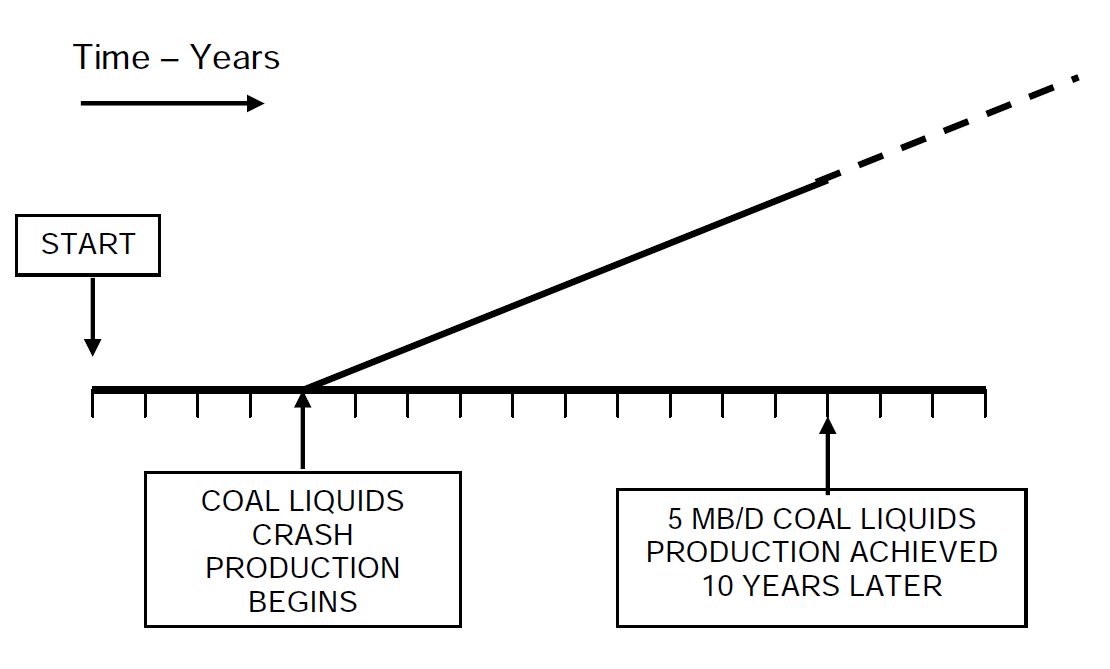
Making fuels from coal was contemplated during the first oil crisis of the 1970s, although it turned out that it was not needed. Then, in his 2005 report, Robert Hirsch suggested that peak oil could be staved off by a crash program involving – among other things – coal liquefaction. The technology is known, some plants are in operation right now; Wikipedia lists 6 plants in operation in the US and 6 more outside the US. Many more are planned. So, if a crash program on coal were to be started now, it could produce a major fraction of the US demand in 10 years, around 5 million barrels per day (image below, from Hirsch’s report), an impact similar to that obtained from shale oil over a similar period of time.
Is it really possible? Will we see a rush to coal similar to the rush to shale that we have seen in the past decade or so? It can’t be excluded. The world’s coal reserves are – theoretically – very large, even though whether they are all extractable is another matter. Before that is ascertained, however, it is not unlikely that the financial system can be convinced to sink great amounts of money into the new, potentially very profitable, coal adventure.
The real problem is, of course, that trying to replace oil with coal would mean wrecking the earth’s atmosphere and moving well over the “tipping point” of climate change. It would mean to forsake a whole planet in exchange for riding our SUVs for a few years more. Yet, the thirst for liquid fuels is so strong, and the denial of climate science so widespread and entrenched, that it is hard to think that the rush to coal could be stopped if – Heaven forbid – it were to turn out to be (or just perceived to be) economically profitable. So, before giving up with liquid fuels and admitting that the only way out is to go renewables, it is perfectly possible that some new monstrosity will be created in Sauron’s satanic mills.
25 Comments on "Fooling peak oil one more time: can we find new sources of liquid hydrocarbons?"
Plantagenet on Tue, 17th Feb 2015 6:18 pm
The peak in conventional oil production in 2005 turned out to not be peak oil sense stricto, as so much new production is now coming from tight shales that we are in an oil glut.
shortonoil on Tue, 17th Feb 2015 7:08 pm
A re-post
According to EIA, and Goldman released data, between 2008, and 2013 the shale industry produce 3.21 Gboe while accumulating $960 billion in debt. That is a debt formation of $299/boe produced, or more than 3 times what the producers received for their production. Obviously, shale is not even remotely economically viable, and yet in every article there is a reference to the incredible production gains it has experienced. To believe that this can continue one would literally have to be an idiot, and yet the industry continues its mantra!
If this miracle works as well as the shale miracle, we should be fine!
http://www.thehillsgroup.org/
farmlad on Tue, 17th Feb 2015 7:44 pm
to replace oil with coal would mean wrecking the earth’s atmosphere As if our Atmosphere isn’t wrecked already.
Davy on Tue, 17th Feb 2015 8:00 pm
With the BAU car sputtering, the guys wallet at home and the nearest gas station out of gas do you think the BAU car is going to make it far? The foundational elements of BAU are contracting. There is no substitution for this. There is no new human economic system and no new energy source. If that were not enough add to it a long list of other issues ready to converge and do the old positive feedback thing.
Folks you can prep and you can prepare mentally. You can relocate out of the worst locations. These are bottom activity. Do not expect any top activities except ones that make the situation worse. The Top is locked into negative activity because human nature at the top is a negative. The best of human values come out in the family, tribe and small community. The worst come out in the global and national. Our species never should have grown this large and complex. It is our evolutionary dead end. If we are lucky it may only be a near miss dead end. We may survive the coming bottleneck who knows.
Apneaman on Tue, 17th Feb 2015 8:07 pm
Plant, your stuttering again. Time to take your pill little buddy.
Plantagenet on Tue, 17th Feb 2015 8:17 pm
@shortonoil
Your math is wrong.
You claim that a debt load of 960 billion makes shale uneconomic. But shale output is currently about 5 million barrels per day in the US. At $50 bbl, the industry is generating gross income of 250 million PER DAY, or about 1.25 Billion per week, or roughly 60 billion per year.
At current interest rates the vig on 960 billion is about 40 billion (assuming a 4% interest rate. OF COURSE, If oil goes back up to $100 bbl, shale will generate about 120 BILLION gross income per year.
In other words, the debt load is actually not excessive at all. It can still be paid with current oil prices, and shale companies do very well at higher oil prices.
CHEERS!
Davy on Tue, 17th Feb 2015 8:27 pm
Problem solved. Please stand up and give Mr. Planter a round of applesause.
https://www.youtube.com/watch?v=y9kAB6GZ5AE
Apneaman on Tue, 17th Feb 2015 9:10 pm
4% on junk?
Dave Thompson on Tue, 17th Feb 2015 10:31 pm
The usable energy after all is said and done in production, refining,R&D, delivery ect. goes down as we speak. Oh sure the numbers all show year over year crude production continues to rise sort of. We are now deep into the age of limits. The US EROEI estimate is maybe 12 to 1 and the world combined is maybe 20 to 1. These ratios are only going to go down. Good luck with that.
Ralph on Wed, 18th Feb 2015 7:49 am
Plant’s number are fantasy at the moment.
Shale oils are getting a lot less than $50 at the well head. As Ape says, 4% on junk? And only a fraction of the well head cash makes it through operating costs and taxes to the payment of interest account, and that still leaves capital repayment untouched.
shortonoil on Wed, 18th Feb 2015 8:14 am
@shortonoil
Your math is wrong.
You forgot to factor in that a boe of NG is not worth the same amount as a barrel of oil. As of this morning WTI was $52.48, and a boe of NG was $16.26. In 2013 67% of total boe produced from shale was NG.
Adding apples, and oranges does not give you kumquats!
http://www.eia.gov/dnav/pet/hist/LeafHandler.ashx?n=PET&s=MCRFPUS2&f=A
http://www.eia.gov/dnav/ng/ng_prod_shalegas_s1_a.htm
http://www.thehillsgroup.org/
Davy on Wed, 18th Feb 2015 8:17 am
Maybe Planter should have said “guys will you check my math to see if I am right or wrong so I can say “Cheers”
rockman on Wed, 18th Feb 2015 8:43 am
4% interest??? Chesapeake along has $6.1 BILLION in bonds out at rates from 6% to 7.25%. And bonds have been a much better deal than those from the “mezzanine bankers”…actually investment companies. By requiring equity positions as part of the loan they avoid usury restrictions and can net between an effective rates of 12% to 25%. They can get that returns because they’ll take the risk to finance projects that traditional banks and bond markets won’t touch.
forbin on Wed, 18th Feb 2015 8:54 am
following Westexas position, the 2005 peak of API 45 oil I think has not been surpassed , if it has , not by much .
Peak BSO of course is a moving target but it too will peak .
( Peak Burnable $h!t we call Oil )
trust me , if we could figure out how to burn chalk ( extract energy as a fuel source), somebody would call it “oil”
Condensate for oil and gas wells is natural gasoline, drip oil and napthia ( plus other stuff – google it )
uses in lighter fluid , paint stripper and apparently Napalm
Hmmm, Napalm ……
Forbin
shortonoil on Wed, 18th Feb 2015 10:55 am
following Westexas position, the 2005 peak of API 45 oil I think has not been surpassed , if it has , not by much .
That is why we put up this graph:
http://www.thehillsgroup.org/depletion2_011.htm
To be used for the production of fuels a liquid hydrocarbon must have an API less than 50. It has to have an energy content (exergy) of at least 131,300 BTU/gal.
http://www.nrcan.gc.ca/sites/www.nrcan.gc.ca/files/energy/images/eneene/sources/petpet/images/refraf1-lrgr-eng.png
37% (1.2 mb/d) of LTO produced in 2013 had an API that was greater than 50. That portion of the production can only be used as a feedstock, and that market has become saturated. This is evident by the storage situation along the Gulf Coast. Production of crude that can produce fuels has probably not increased, and may have declined, since 2005. The declining value of the liquid hydrocarbons that have been produced has generated a price crisis as seen in this graph:
http://www.thehillsgroup.org/depletion2_022.htm
This situation will not be alleviated until a considerable portion of higher cost production products have been taken off line. We estimate that to be about 4mb/d.
In the mean time damage is being inflicted on the industry that will never be repaired. CapEx is being cut everywhere in the industry, and future development is likely to never fully recover. The Etp Model indicates that only about an additional 320 Gb will now ever be extracted. In 2012 petroleum contributed $6.22 trillion to the $16.16 trillion GDP of the US. That contribution will fall by more than half during the next decade.
http://www.thehillsgroup.org/
marmico on Wed, 18th Feb 2015 11:35 am
To be used for the production of fuels a liquid hydrocarbon must have an API less than 50
Really. Tell that to Kinder Morgan’s condensate processing splitter expected to start up next month. Liquid fuels produced include kerosene, diesel and gas oil.
U.S. refineries are pushing out light oil imports and using domestic condensate to blend with heavy oil. It is likely that refinery tolerances are now approaching limits for condensate and the split condensate products will be shipped to domestic petrochemical users and the balance exported.
Apneaman on Wed, 18th Feb 2015 12:52 pm
The Crash of 2015, Day 49: Hell to Pay
http://www.dailyimpact.net/2015/02/18/the-crash-of-2015-day-49-hell-to-pay/#more-2732
Davy on Wed, 18th Feb 2015 12:54 pm
Marm the modern day alchemist aren’t you a devil! Marm, are you are aware that your alchemy adds cost. I am sure Mr. Kinder does not do his splitting for free. That point to our point Marm, cost, of oil per economic value. There is no reason why everyone in the country can’t have a Mercedes in the driveway like you but can the economy afford that?
shortonoil on Wed, 18th Feb 2015 2:30 pm
Really. Tell that to Kinder Morgan’s condensate processing splitter expected to start up next month. Liquid fuels produced include kerosene, diesel and gas oil.
Really — Here is a post we made last year.
02/10/14 PO News
Gas Prices Set to Rise
In spite of the mythology that has arisen around shale oil, it will do very little to reduce finished product prices. Production out of the Bakken, Eagle Ford and the Permain Basin has flooded the Gulf Coast with field condensate (pentane, C5H12 ), Field condensate is a light hydrocarbon that must be further processed (with a very high energy input) to produce gasoline. EOG reports that 70% of Eagle Ford production is field condensate.
To capitalize on this flood of light (not particularly valuable hydrocarbons) companies like Marathon, and Velario are building condensate splitters (which are a type of mini refinery, only costing $200 million apiece). Condensate splitters reconfigure field condensate into other fractions:
Output…………%yield
LPG…………….3
Naphtha………..60
Jet fuel……….12
Gasoil…………20
Fuel Oil………..3
Even after reprocessing field condensate produces less that half the gasoline per barrel that conventional crude produces (20% vs 45-50). Don’t expect shale production to reduce the price at the pump, its not going to happen!
http://www.thehillsgroup.org/
Naphtha is essentially pentane. Splitters take pentane in, an output a few heavier fractions; at a huge energy cost. Since the industries problem is now low energy delivery per unit to the economy, splitters are not going to alleviate that problem. Actually they will make it worse!
rockman on Wed, 18th Feb 2015 2:36 pm
Hmm…didn’t post correctly: Chesapeake bonds $1.6 Billion from 6% to 7.25%.
Northwest Resident on Wed, 18th Feb 2015 3:57 pm
Marmico and facts are like babies with building blocks. He can thrown them around, chew on them, slobber on them, make a big pile of them and then gleefully smash the pile to pieces. But he lacks the intellectual development necessary to arrange said blocks (facts) into anything that resembles a logical, coherent structure.
Ralph on Thu, 19th Feb 2015 4:03 am
As far as I can see, a condensate splitter is simply a refinery for condensate, that separates out the hydrocarbons by number of carbon atoms per molecule – ie normal distillation.
It does no chemical modification at all,
so naptha in = naptha out. It is illegal to export ‘oil’ from the US, but it is legal to export partially refined products. Condensate may be 80% naptha to start with, so this refinery simply strips out the other fractions and exports the rest as chemical feedstock.
marmico on Thu, 19th Feb 2015 6:04 am
It’s simple, quart shy. Contrary to your initial assertion that “Production of crude that can produce fuels has probably not increased”, lease condensate can be split into liquid fuels.
Davy on Thu, 19th Feb 2015 7:29 am
Marm’s getting frustrated. Marm does not have a Freddy chart to go up against the Hill’s Groups well researched material. Being a corn in cognitive dissonance (why else would a corn be on a doom site) he is grasping for corn porn to counter a reality of foundational descent of the all-important oil complex to BAU. He fails to understand the profound issues of POD & ETP of oil and that is real energy delivered to the economy is likely in decline. BAU is extremely sensitive to any kinds of limits especially energy hence all the crazy financial games in progress i.e. the debt Ponzi scheme.
Marm, I would have more respect for you if you were not a simpleton agendist preaching a dated cornucopian message clearly being proven wrong on multiple fronts daily. Marm, if you would occasionally admit to bad news I would have more respect for you. Instead you come on here and selectively throw out your messaged Freddy charts links to paint a picture that there are no problems. In fact you try to show how we are doing better now than in the past. You are the quart shy Marm. You will go the way of the NOo (Noony) and disappear one day from this site because your message will be clearly falsified. You may also convert or partially convert. I like you Marm and consider you highly intelligent but with an inability to face reality. Your defense is a simpleton agendist technic of selective facts. Face reality Marm it is as simple as that.
GregT on Thu, 19th Feb 2015 7:40 am
“Fooling peak oil one more time: can we find new sources of liquid hydrocarbons?”
Maybe, maybe not. But even if we could, they would also eventually reach a peak and then go into terminal decline. It seems kind of stupid to keep running faster and faster to get to the same place, the end of modern industrial society, with no plan B in effect.
Hell, let’s just party like there’s no tomorrow, because if we keep burning fossil fuels there WILL be no tomorrow, for the human race and most other life forms on the planet Earth.