
Peak Oil is You

Donate Bitcoins ;-) or Paypal :-)


Page added on February 12, 2015

Japan Plans to Restart Some Nuclear Plants in 2015

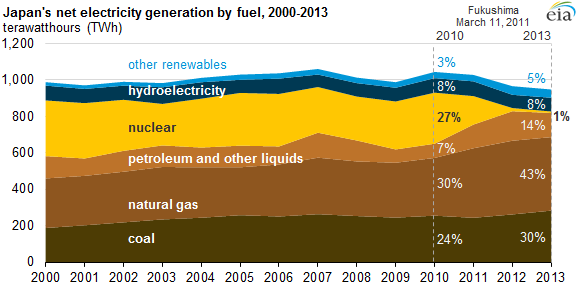
Previously one of the world’s largest producers of nuclear-generated electricity, Japan has relied heavily on fossil fuels following the meltdown at Fukushima Dai-ichi and subsequent shutdown of the country’s nuclear fleet. In 2013, when almost all of Japan’s nuclear fleet was shut down, more than 86% of Japan’s generation mix was composed of fossil fuels. In 2014, Japan’s nuclear generation was zero. The Japanese government anticipates bringing online a few nuclear facilities in 2015.
Nuclear reactor restarts could begin as soon as May 2015, as Kyushu Electric’s Sendai Units 1 and 2 in southwestern Japan received approval to restart from the Japan’s Nuclear Regulatory Agency (NRA) and local authorities in November 2014. The NRA also approved Kansai Electric’s Takahama Units 3 and 4 at the end of 2014, although these units are still awaiting authorization from the local government. The timelines for restarting these units and other reactors that currently have applications pending before the NRA are uncertain in the face of more stringent regulations and, in some provinces, political opposition.
Japan’s nuclear industry has been disrupted for nearly four years, ever since the 9.0-magnitude Tohoku earthquake and ensuing tsunami that occurred off the northeast coast of Japan in March 2011. That event led to the disaster at Fukushima Dai-ichi and the removal from service of the country’s entire nuclear capacity. Nuclear power plants that were not immediately damaged were gradually shut down as routine maintenance was scheduled to occur. Two nuclear reactors, Kansai Electric’s Ohi Units 3 and 4, were restarted in July 2012 and ran until September 2013, when they were shut down again.
Prior to the Fukushima accident and the gradual displacement of all of Japan’s nuclear generation, nuclear generation represented 27% of Japan’s net generation in 2010. At that time, Japan ranked as the third-largest nuclear power generator in the world behind the United States and France. Natural gas and coal were the primary fossil fuels used in Japan, making up about 30% and 24% of Japan’s electricity mix, respectively, in 2010. Oil, one of the most expensive and least-clean fuels to burn, accounted for just 7% of power generation in 2010. Renewable energy made up about 11%, mostly from hydroelectric generators.
Following the Fukushima accident, nuclear’s share of electricity generation declined, and energy conservation measures were enforced for larger businesses and highly encouraged for smaller consumers. Japan’s utilities initially substituted the lost nuclear generation with natural gas, heavy fuel oil, crude oil, and coal, but oil-fired generation began declining in 2013, as Japan relied more on natural gas and coal. Meanwhile, almost 4 gigawatts (GW) of additional coal capacity came online in 2013, increasing the share of coal-fired generation. Japanese utilities have proposed building several additional natural gas- and coal-fired power plants to replace aging generators and to serve the country’s high electricity demand.
Japan imports virtually all its fossil fuels. As a result of greater fossil fuel use and higher international oil prices during the past few years, Japan spent 60% more for fossil fuel imports in 2013 compared to 2010, an increase of $270 billion over three years. This reversed Japan’s trade surplus and created a widening trade deficit. Utilities have passed on some of the high cost for power production to consumers, and electricity prices have risen at least 20%.
The current Japanese government believes that the use of nuclear energy is necessary to help reduce current energy supply strains and alleviate high electricity prices. Japan’s new energy policy, issued in 2014, emphasizes energy security, economic efficiency, and greenhouse gas emissions reduction, although the plan has yet to provide details of the country’s future power generation fuel mix.
14 Comments on "Japan Plans to Restart Some Nuclear Plants in 2015"
Speculawyer on Thu, 12th Feb 2015 9:25 pm
Good! Pick some that are not in bad seismic zones and don’t have big tsunami risk and start them back up. It is good clean electricity. It will reduce your coal & natural gas costs and reduce your emissions.
Ted Wilson on Thu, 12th Feb 2015 9:45 pm
Good news. For no reason they shut down the functioning nuclear reactors and burnt billions of barrels of Oil and wasted lot of money.
Bring it on.
Also start building Gen-4 reactors which are totally meltdown proof. China is already building 1 such reactor.
Apneaman on Thu, 12th Feb 2015 10:12 pm
Meltdown proof and too cheap to meter. The bullshit promises were already made and broken a few generations ago. Oh and were going to Mars and getting, robot maids and flying cars again too.
Apneaman on Thu, 12th Feb 2015 10:19 pm
Too Hot to Touch
” Folks think that if we simply quit building new reactors, the nuclear boo-boo will go away, and we can forget about it — wrong! William and Rosemarie Alley have shed much light on the subject with their book, Too Hot to Touch. It reveals a deeply embarrassing chapter that has been omitted from the glorious epic of technology and progress.”
http://wildancestors.blogspot.ca/2015/02/too-hot-to-touch.html
Plantagenet on Thu, 12th Feb 2015 10:45 pm
The Japanese need power. Nukes produce electricity. The Japanese are going to fire up their nukes
Go Speed Racer. on Thu, 12th Feb 2015 11:32 pm
Why fire them up? Just set them on fire. 🙂
GregT on Thu, 12th Feb 2015 11:35 pm
“Also start building Gen-4 reactors which are totally meltdown proof.”
Whenever human beings have made such bold statements, the outcomes have always been very bad.
GregT on Fri, 13th Feb 2015 12:41 am
“Why fire them up? Just set them on fire. :)”
Probably more cost effective. I for one, would love to see someone do a real cost analysis per kilowatt hour generated, from plant construction to de-comissioning, to waste storage 1000 years into the future. I am sure that the reality of the matter is, we are simply compromising the lives of future generations, just so that we can have more needless consumer crap today.
forbin on Fri, 13th Feb 2015 3:49 am
Onagawa: The Japanese nuclear power plant that didn’t melt down on 3/11
Well apparently it comes down to people again
TEPCO was badly run
You can build reactor to shutdown – it has often been remarked the UK reactor fleet was a constant effort to stop them shutting down – fail safe
Still theres another nuclear source
Forbin
Makati1 on Fri, 13th Feb 2015 5:03 am
And the beat goes on…
http://www.fool.com/investing/general/2015/02/07/nuclear-energy-renaissance-takes-another-blow-and.aspx
http://ajw.asahi.com/article/0311disaster/fukushima/AJ201502080025
Go Speed Racer. on Fri, 13th Feb 2015 5:12 am
GregT, Shen they declared the Titanic was unsinkable, they were correct weren’t they ? This is why giu can be sure the reactor wont melt down. There actually could be safe, effective, fission power reactors. What there CAN NEVER be, is a politician who can stay out of the airport Men’s room long enough to understand it, and authorize its development.
Davy on Fri, 13th Feb 2015 5:32 am
Nuclear power is an example of a trap that is a dilemma of predicaments and catch 22’s. The trap is a predicament because BAU needs to function or at least a few BIL die in a decade. That’s just a guess but an educated guess by what we know here. If we don’t want a certainty of a few BIL deaths in maybe a decade then we need energy intensity and complexity. We here no BAU has the FF brick wall ahead in max 10 years. Yet, that is only a gamble because BAU may not make 6 months by virtue of BAU instabilities. FF will drive complexity and energy intensity but then we have the dangerous effects of AGW. This is a known with the unknown of when climate disaster will strike. BTW, catastrophic climate destabilization sounds baked in from everything I read BAU or no BAU.
NUk power is built out, functioning, and at least relatively clean on the front end of already built out infrastructure. The huge issue is the end product stream of highly hazardous waste we can barely manage with complexity and energy intensity now. What about that bumpy descent? I talk about the bumpy descent continuously and redundantly like a Planter glut because it is not mainstream. Reality points to the bumpy descent with nearly ever quantifiable human sector of energy, finance, population overshoot, ecological destruction, and AGW. If this is the case and we are in descent then energy intensity and complexity will soon follow with a serious drop. Energy intensity and complexity are foundational elements to the human system that do not degrowth well. They bifurcate from disequilibrium when their base is hollowed out by lack of energy intensity and complexity. When this happens the tail end of the NUK process will be problematic the front end may not work either.
We have to devote a huge effort to at least stabilizing NUK waste for the near term. A sort of temporary triage surgery if a descent is upon us. We need to make it safe for a generation in an affordable way considering a descent is now likely in progress and we can’t fix everything when we are getting poorer by the day. We need to maintain the existing NUK plants because of the fact we are getting poorer by the day and our foundational energy source oil is in POD & ETP. We need NUK power and all the other FF or we accelerate the poorer by the day dillemma. Every energy source will follow oil down. Oil is likely heading down because of POD & ETP and likely in demand and supply destruction as we speak. Most estimate give us tops a decade for a functional oil source for global BAU. Oil will be available but not enough to run BAU globally in a decade or less. Oil is a foundational commodity with no substitution.
The catch 22 is we can’t handle the waste we have now and we want to generate more. Not generating more will make us poor so we can’t handle the existing waste. There is no good answers to BAU and the end of BAU dilemma. Those who think we should do this or that often fail to see there is no time and no resources to do everything. Those who want the end of BAU now fail to see AGW will just be made worse by a plague species destroying what ecosystems we have left in a mad rush of survival. These NUK power and waste efforts now have to be triage field surgery in effect doing what we can with what we got. We need to be very careful with what we have the little time we got.
Yet, all this is really moot until the Top acknowledges to the masses the dilemma of predicaments and catch 22’s we are in. This is not likely to happen until a crisis forces them to show they have no clothes. The top is naked and unable to make sensible rational policy. There is little to no agreement on a way forward leaving the default option more of the same. We are digging our grave with more of the same. This is another catch 22 because we need BAU to transition out of BAU.
The only choice you have folks is prepare in your life, your family’s life, and try to shape a local in a stealth way. Until the masses acknowledge the realities of descent the shaping of the local will be very difficult hence stealth. Mention collapse to the sheeples and you get a blank stare. There is no comprehension in those hollow eyes. For the masses to acknowledge this the Top needs to show they are naked and we have grave predicaments ahead.
So as you see NUK is wrapped up in the same damned if you do damned if we don’t of everything human. We can just hang out in the amusement park of BAU until the lights go out. Imagine thousands of folks in Disney world trying to get out on a pitch black night. This is scary folks Prep now or face the consequences of the darkness soon. In the meantime enjoy the “Matterhorn Bobsleds” at the Disney world of BAU.
Kenz300 on Fri, 13th Feb 2015 7:53 am
Nuclear —- Too costly and too dangerous………
How much will it cost to clean up Fukishima and when will it be completed? When will the displaced people be able to move back home?
How much will it cost to store nuclear waste FOREVER?
There are safer, cleaner and cheaper ways to generate electricity.
Wind, solar, wave energy, geothermal and second generation biofuels made from algae, cellulose and waste are the future.
Utility-scale Solar Has Another Record Year in 2014
http://www.renewableenergyworld.com/rea/news/article/2014/12/utility-scale-solar-has-another-record-year-in-2014
TemplarMyst on Sat, 14th Feb 2015 9:31 am
I’ll make the usual chime in on the nuclear restart in Japan. I echo those who feel it will be the best of their available options, and reiterate the waste issue is tiny compared to the alternatives.
At some point there will be a need to reprocess the waste, both here in the US and in other locations which do not currently do so. The amount of energy available in the spent fuel rods is immense. I’d refer folks to EBR-II, located up in Idado, for the blueprint for the Integral Fast Reactor. One that actually worked. And that technology is thirty years old.
I think Davy summed up the Catch 22s pretty well. Yeah, we’re likely to crash bad, but if it can be avoided we ought to try. Of course the overwhelming majority of humanity is unaware of the problems they face, let alone having any meaningful discussion on them.